Realgar
What Is Realgar?
Realgar is a red to orange arsenic sulfide mineral with the formula As4S4.
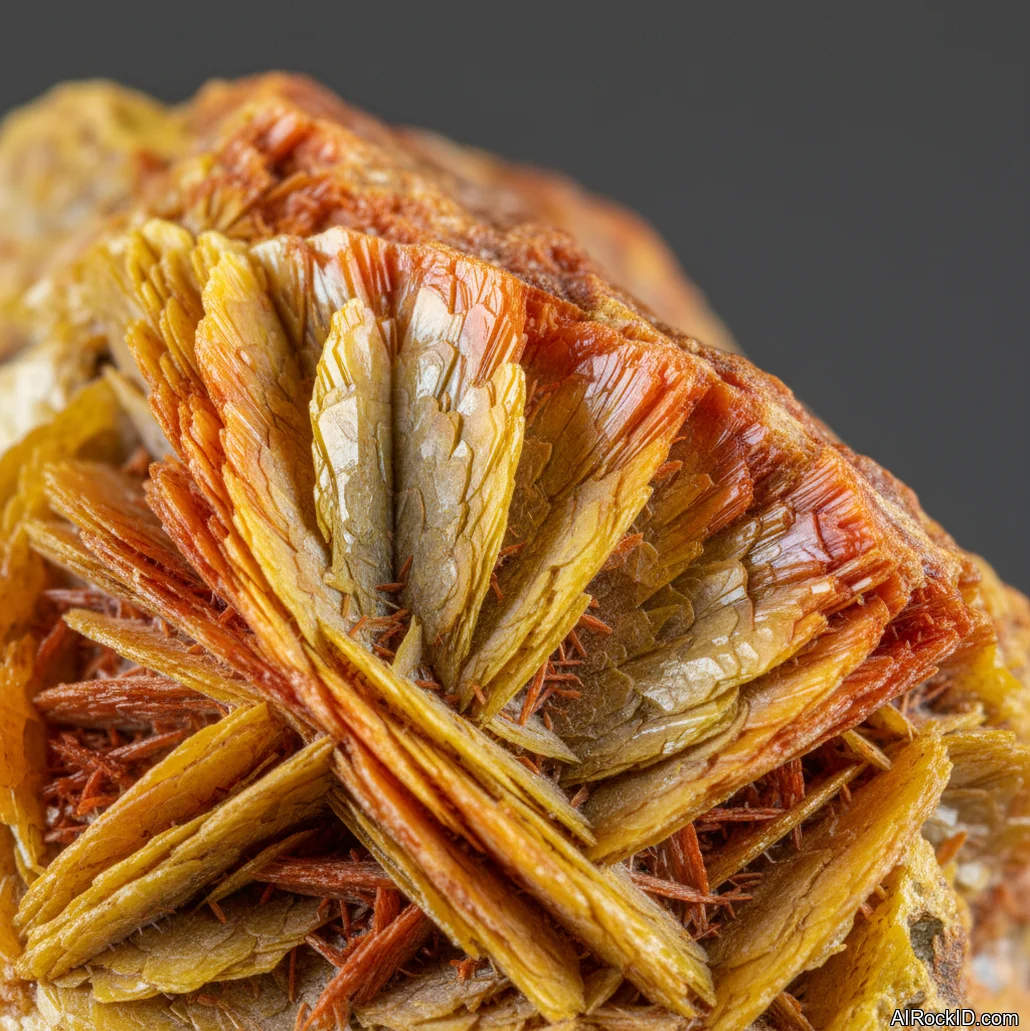
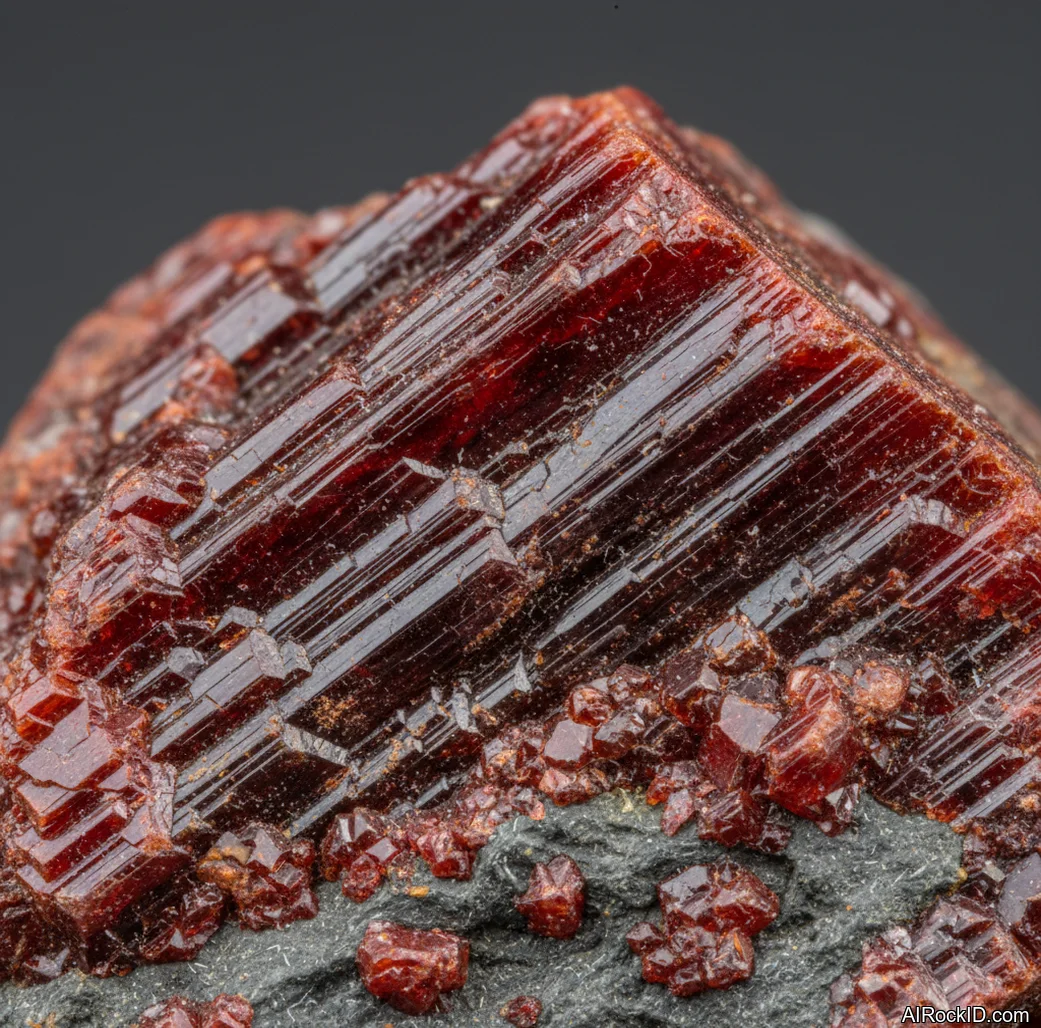
Grab a piece and you’ll notice it right away. It’s soft, and it has this slightly waxy feel under your fingers, even when the face looks glassy under a display light. The color can trick you too. Some pieces, especially the cherry-red ones, look like they’re lit from the inside, but you don’t treat it like quartz. I’ve set a specimen down on a paper towel, nudged it maybe an inch, and watched tiny grains leave a faint orange smear behind.
People confuse it with cinnabar at first because, sure, they sit in the same color range. But realgar usually leans more orange-red, and the luster is more resinous, not metallic. And it’s touchy. Leave it in sunlight or under strong shop lighting for long enough and it starts to alter, going yellow and kind of dusty. So the nicest realgar I’ve owned stayed in a box, not out on a bright shelf. Why risk it?
Origin & History
The word “realgar” comes in through Arabic (rahj al-ghār), usually glossed as “powder of the mine” or “mine dust.” And honestly, that tracks the second you handle a piece and notice how it sheds gritty little grains if you so much as rub an edge with your thumb.
Historically, people used realgar as a pigment and in early chemical work. But it had the same headache then that it has now: arsenic.
It got described as a mineral species back in the early days of modern mineralogy, and it turns up in the classic European locality literature right alongside orpiment. So collectors still call it a “classic old book” mineral. It’s flashy. It’s fragile. And it comes with a big warning label. Who could forget that?
Where Is Realgar Found?
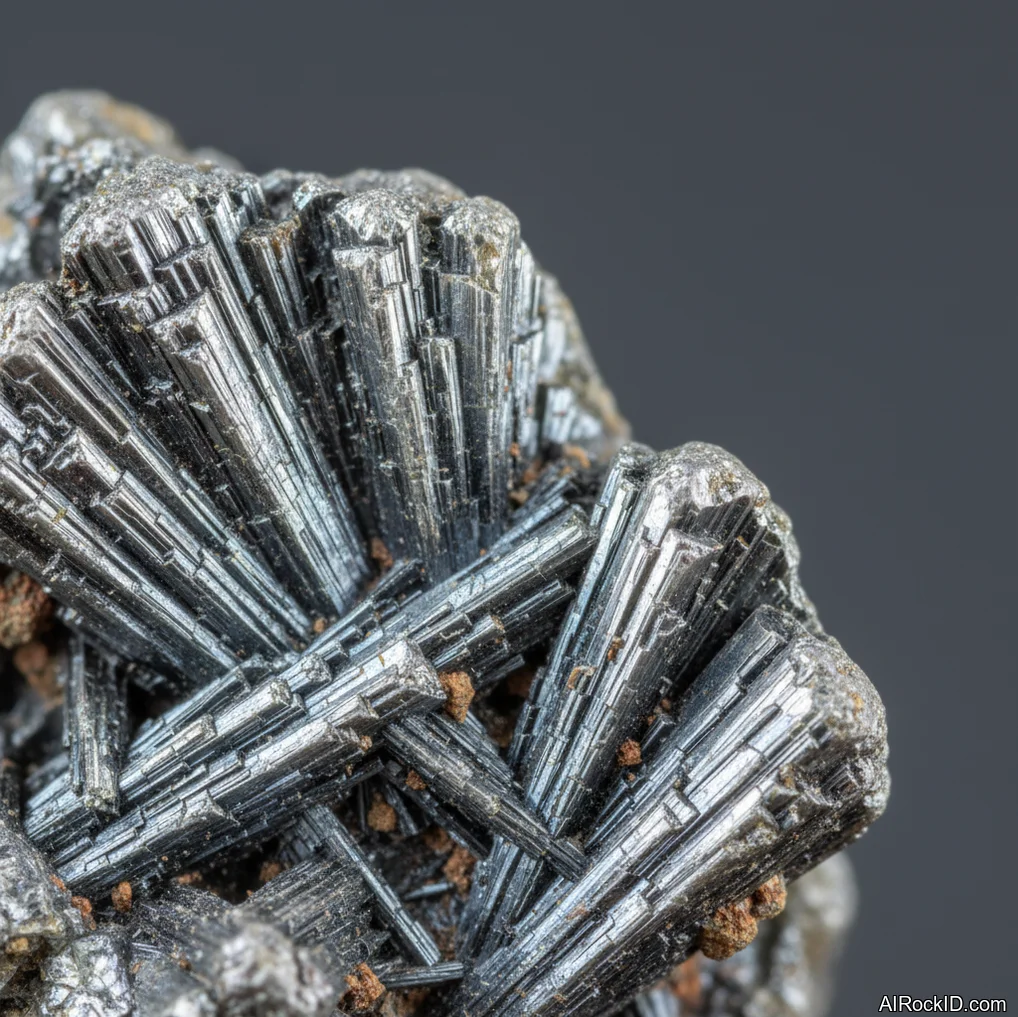
Realgar forms in low-temperature hydrothermal veins and around volcanic and hot-spring settings, often with orpiment and stibnite. China has produced a lot of the bright crystal material seen in modern dealer cases.
Formation
Most realgar shows up when hot fluids push through cracks in the rock at fairly low temperatures, hauling arsenic and sulfur along and then dumping them out as the fluids cool off. You’ll see it paired with orpiment (yellow arsenic sulfide) all the time. And depending on the district, it can also turn up with stibnite, barite, calcite, or quartz.
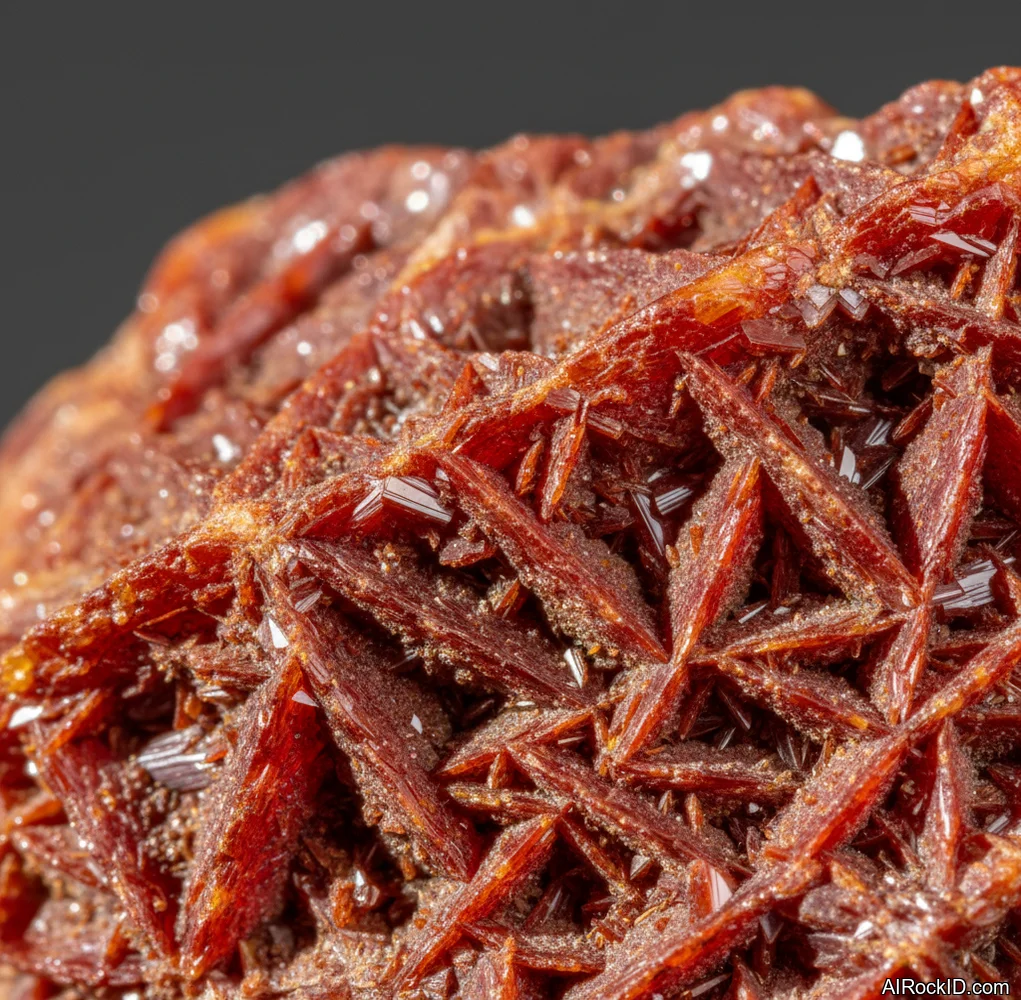
If you really stare at a good matrix piece, you can kind of read the paragenesis like a timeline. Realgar might be a later skin coating earlier sulfides, or it’ll pack into tiny vugs as sharp little crystals that look incredible until you remember what they are: a light-sensitive arsenic compound. And under light exposure it can alter to pararealgar (yellow), which is why older specimens sometimes look like somebody dusted them with mustard powder (that dull, powdery look is hard to unsee once you’ve handled one).
How to Identify Realgar
Color: Typical color ranges from orange-red to deep red; altered material can turn yellow (pararealgar) or look dull and powdery. Fresh surfaces often look brighter than weathered ones.
Luster: Resinous to vitreous luster on clean faces, turning dull as it powders or alters.
If you scratch it with a copper coin, it’ll usually mark pretty easily, which surprises people because it looks “hard” in a display case. The real test is streak and feel: it has an orange to red streak and a soft, slightly greasy touch compared to cinnabar’s heavier, more metallic vibe. But don’t do aggressive scratch tests on a nice piece, and don’t create dust.
Properties of Realgar
Physical Properties
| Crystal System | Monoclinic |
| Hardness (Mohs) | 1.5-2.0 (Very Soft (1-2)) |
| Density | 3.54-3.59 g/cm3 |
| Luster | Resinous |
| Diaphaneity | Transparent to translucent |
| Fracture | Uneven |
| Streak | orange to red |
| Magnetism | Non-magnetic |
| Colors | red, orange-red, orange, yellow (altered) |
Chemical Properties
| Classification | Sulfides and sulfosalts |
| Formula | As4S4 |
| Elements | As, S |
| Common Impurities | Sb, Hg |
Optical Properties
| Refractive Index | 2.40-2.55 |
| Birefringence | 0.020 |
| Pleochroism | Strong |
| Optical Character | Biaxial |
Realgar Health & Safety
Handle it gently. Keep it well away from anywhere food gets prepped or eaten. And if you see that orange-red dust, treat it like a hazard (it clings to your fingertips and shows up fast on a damp paper towel). The real risk is the dust and the hand-to-mouth stuff, not a quick touch.
Safety Tips
Keep it sealed up or tucked into a closed display case. Don’t sand it or grind it down. And after you’ve handled it, go wash your hands. If you’re sorting a bunch of specimens, nitrile gloves are a smart move (they keep that fine dust off your fingertips and out from under your nails). Keep it away from kids, pets, and any spot where it might get bumped, tip over, and crumble.
Realgar Value & Price
Price Range
Rough/Tumbled: $15 - $300 per specimen
Prices shoot up fast when the crystals are sharp and glassy, with hardly any alteration, and the matrix contrast really pops when you turn it in your hand under a lamp. But if it’s powdery, sun-faded, or it crumbles at the edges when you tap it, it’ll be cheaper, even when the color still looks pretty decent in photos.
Durability
Fragile — Scratch resistance: Poor, Toughness: Poor
Realgar is very soft and can alter under light exposure, so it’s best treated like a cabinet specimen, not a pocket stone.
How to Care for Realgar
Use & Storage
Keep realgar in a closed box or acrylic case, out of sunlight and strong display lighting. I separate it from soft calcites too, because crumbs and rubbing are how you ruin labels and specimens.
Cleaning
1) Do not use water, soap, or ultrasonic cleaners. 2) Use a soft, dry artist brush to flick off loose dust while keeping the specimen over a tray. 3) If it needs more, use a gentle air bulb, not canned air at close range.
Cleanse & Charge
Skip water and salt. If you do energy-style care, use indirect methods like sound, intention, or leaving it near (not on) a selenite slab in a dry spot.
Placement
Place it low, stable, and behind a barrier so it won’t get bumped. A closed cabinet with controlled light is the best real-world setup.
Caution
This mineral contains toxic arsenic, so treat it like a contamination source. Don’t make dust, don’t use water on it, don’t heat it, and don’t leave it somewhere people can casually pick it up and handle it. Keep it out of light too, because over time light can change it into yellow pararealgar.
Works Well With
Realgar Meaning & Healing Properties
Compared to a lot of the feel-good stones people like to keep around, realgar sits in the intense corner of a collection. I’ve mostly seen it treated like a symbol piece, the one you bring out when you’re dealing with boundaries, bad habits, or that stubborn part of your life you keep dodging. But look, I’ll say the quiet part out loud: it’s toxic, and it can shed dust, so I don’t recommend it for body contact. Not for sleep. Not for pockets. Just… don’t.
If you’re into the metaphysical side, keep it practical. Use it the way you’d use a written reminder, not like some tool you need to hold. Set it in a closed case near your desk when you’re trying to stay sharp and honest with yourself. Then put it away again. I’ve watched the color shift on a piece that sat under bright halogens in a shop for months, and you don’t forget that kind of thing once you’ve seen it with your own eyes (it’s a slow change, but it’s real). Realgar doesn’t reward careless routines.
Symbolically, the message with realgar is clarity with consequences. It’s bright. It’s direct. It makes you respect limits, whether you want to or not. And that’s useful, even if you treat it as straight psychology instead of anything mystical. And yeah, none of this is medical advice. Realgar is for looking at and thinking with, not for treating anything.
Identify Any Crystal Instantly
Snap a photo and get properties, value, care instructions, and healing meanings in seconds.