Sun Aura Quartz


Quick answer: Sun Aura Quartz is natural quartz that has been enhanced with a thin metallic coating, usually creating a golden to peachy iridescent surface. Its base hardness is 7, but the surface coating can be scratched or worn by abrasion, harsh chemicals, or ultrasonic cleaning.
AI Rock ID can help compare Sun Aura Quartz with similar coated quartz, natural citrine, and other yellow-gold crystals from a photo. RockIdentifier.io provides crystal identification support, but coated stones should also be checked for surface clues, seller disclosure, and handling wear.
Good fit
- Collectors who like bright metallic luster and rainbow-gold surface color
- Beginners who want a visually distinctive quartz variety
- Display pieces, jewelry worn with care, or decorative specimens
- People comparing treated quartz varieties such as aura quartz, angel aura quartz, and titanium-coated quartz
Not a good fit
- Buyers seeking an untreated or fully natural yellow crystal
- Rings or bracelets exposed to frequent impact, friction, or chemicals
- Collections that exclude lab-enhanced or coated minerals
- Situations where exact metal-coating composition must be verified without seller documentation
Most commonly confused with
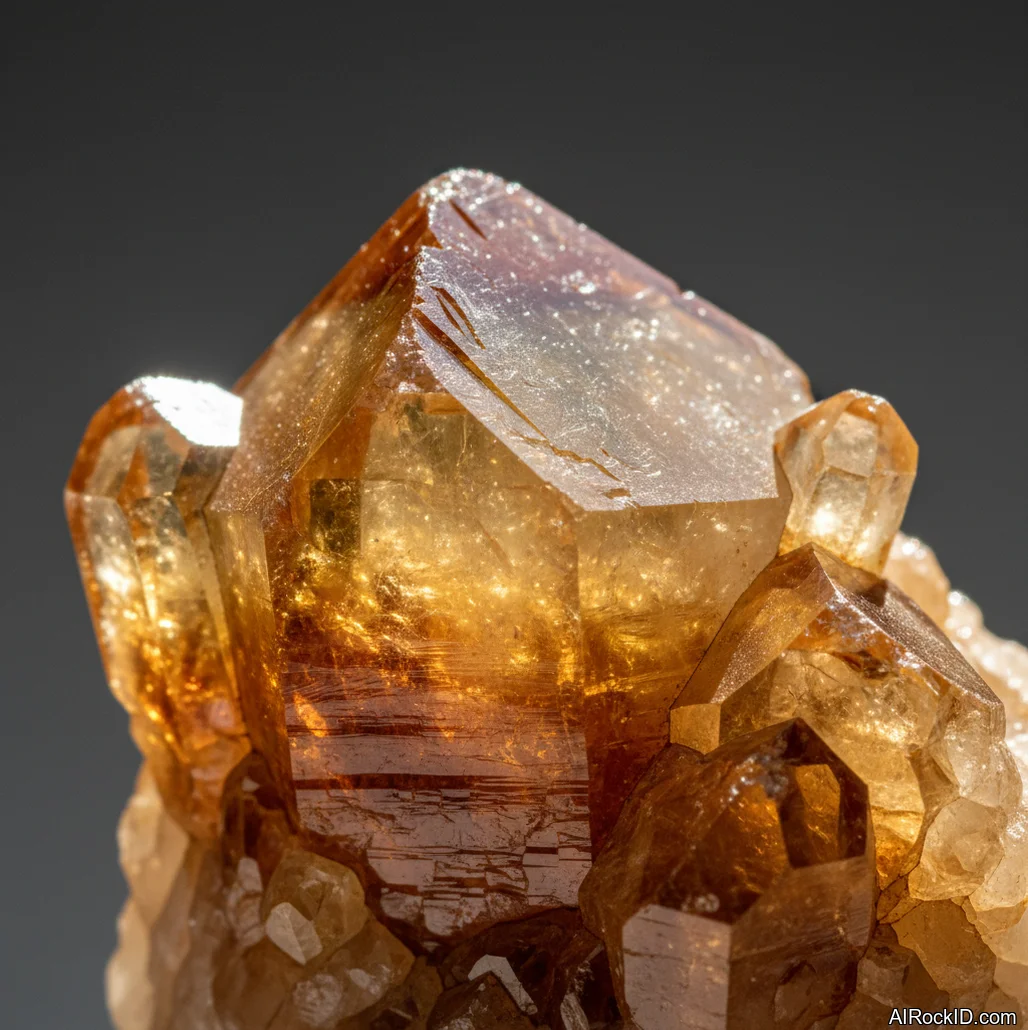
- Citrine: Citrine’s yellow to orange color is internal, while Sun Aura Quartz has an external metallic iridescent coating.
- Golden Healer Quartz: Golden Healer Quartz usually shows natural iron-oxide staining or inclusions rather than a uniform vapor-deposited sheen.
- Titanium Aura Quartz: Titanium Aura Quartz often appears more vivid rainbow, blue, purple, or green, while Sun Aura Quartz is typically gold to peach-gold.
- Angel Aura Quartz: Angel Aura Quartz is usually pale, pearly, and pastel, while Sun Aura Quartz has a warmer yellow-gold surface.
Sun Aura Quartz vs. Common Lookalikes
| Material | Color source | Key identification clue | Treatment status |
|---|---|---|---|
| Sun Aura Quartz | Metallic surface coating | Gold iridescence concentrated on the exterior | Treated quartz |
| Citrine | Natural or heat-related body color | Color continues through the crystal, not just on the surface | Natural or heated quartz |
| Golden Healer Quartz | Iron oxide staining or inclusions | Earthy yellow-orange zones, often uneven or internal | Often natural coating/inclusion |
| Titanium Aura Quartz | Metallic surface coating | Stronger rainbow colors, commonly blue, violet, or green flashes | Treated quartz |
| Yellow Glass | Manufactured glass color | Possible bubbles, molded shapes, and lower scratch resistance | Man-made |
AI identification confidence
AI identification can be moderately confident when photos show sharp quartz crystal form, golden iridescence, and surface reflectivity. Confidence drops when lighting is warm, the coating is worn, or the specimen is tumbled, because coated quartz, citrine, glass, and iron-stained quartz can appear similar in photos.
When AI gets it wrong
- Warm indoor lighting can make clear or smoky quartz look more yellow than it is.
- Close-up glare may exaggerate rainbow reflections and suggest an aura coating where none is present.
- Tumbled or polished pieces can hide crystal form and make quartz harder to separate from glass.
- Worn coating on edges or points may cause the piece to resemble citrine or Golden Healer Quartz.
Final recommendation
Choose Sun Aura Quartz when you want the appearance of golden iridescent quartz and are comfortable with an enhanced stone. If natural origin is the priority, compare it with citrine or iron-stained quartz and ask the seller to disclose any coating or treatment.
How to Check Sun Aura Quartz Authenticity
Authentic Sun Aura Quartz should be described as treated or coated quartz, not as naturally golden quartz. Look for a thin metallic sheen that follows the outer crystal surfaces, often with stronger color on points, edges, or raised areas. A reputable listing should disclose that the quartz was enhanced by vapor deposition or a similar coating process.
Buying Tips for Sun Aura Quartz
Ask whether the stone is natural quartz with an added coating, and avoid listings that imply the golden surface formed naturally. Check photos for chips, rubbed edges, or dull patches because coating wear can affect appearance. For jewelry, pendants and earrings are usually less exposed to abrasion than rings or daily-wear bracelets.
Photo Tips for Identifying Sun Aura Quartz
Photograph Sun Aura Quartz in indirect daylight on a neutral background to reduce yellow color cast. Include one close-up of the surface, one side view, and one image of any worn edge or broken area. A photo that shows both the crystal shape and the reflective coating gives better identification results than a single front-facing image.
What Is Sun Aura Quartz?
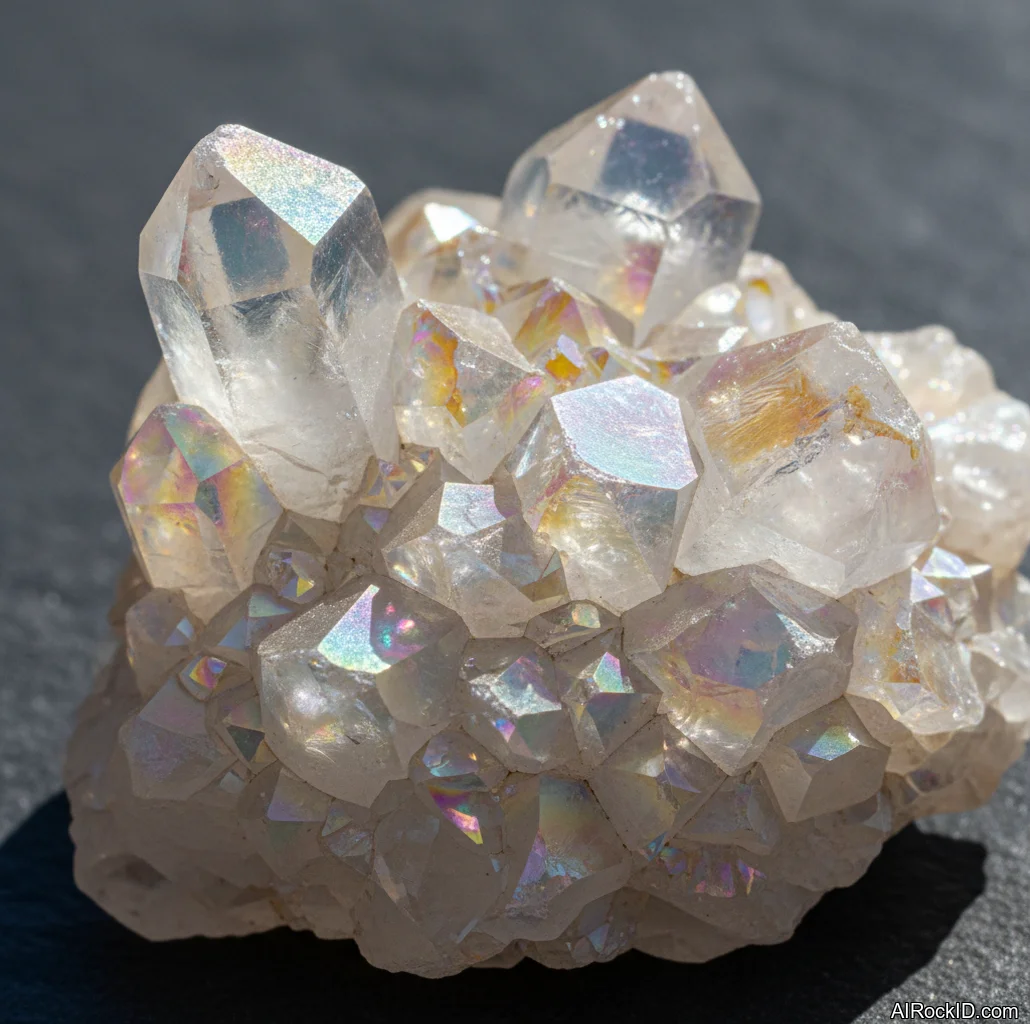
Sun Aura Quartz starts out as natural, clear quartz. Then it gets a lab coating: a super-thin metallic film that gives it that gold surface with a rainbow sheen sliding over the top.
Pick up a point and the first thing that hits you is how the look and the feel don’t quite match. It’s still plain quartz in your hand, that cool, glassy heft you notice right away. But tilt it under a lamp and the outside flashes like a soap bubble, only it’s sitting on a warm gold base that catches on the edges of the faces.
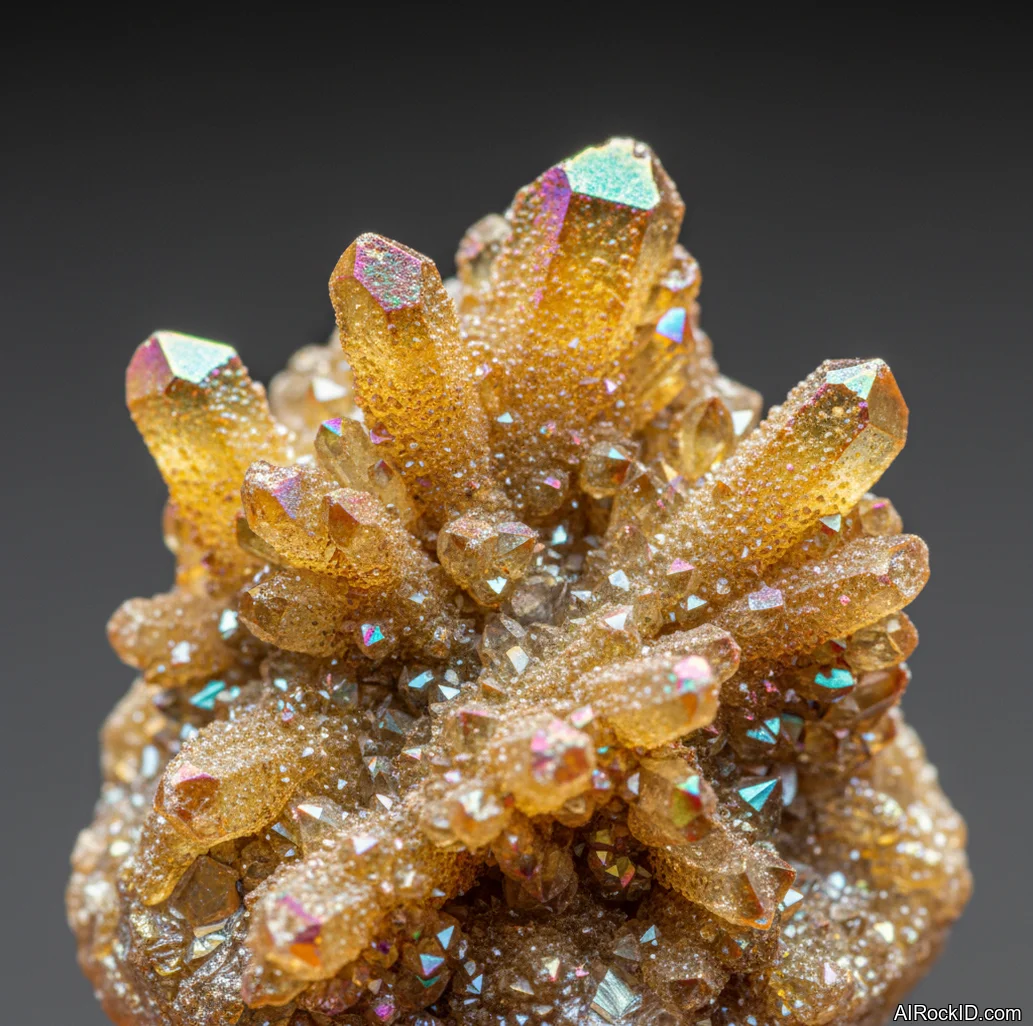
Most of what you’ll see for sale are coated points or clusters, usually with clean terminations because the coating looks sharper when the crystal faces are crisp. But you’ll run into tumbled stones too (they get that slick, flashy skin), and even carved shapes. The coating is real metal. Thing is, it’s only microns thin, so if you treat it like a metal object instead of a quartz crystal, yep, you can scratch it.
Origin & History
Aura quartz, as a product line, really only starts popping up in the late 20th century, once vacuum deposition and thin-film coatings were routine in commercial labs. It wasn’t “discovered” the way a new mineral gets described, because the base is just quartz and the surface is a manufactured coating (you can usually see that slick, metallic sheen sitting right on top).
The name “Sun Aura” is basically trade talk. Dealers use it to separate the warm gold coatings from the cooler blue (aqua aura) or purple (amethyst aura) looks. But here’s the annoying part: different sellers swap names around, so that same gold-coated quartz might get labeled Sun Aura, Titanium Aura, or Golden Aura depending on the booth. Why so messy? Because the naming isn’t standardized.
Where Is Sun Aura Quartz Found?
The quartz itself comes from the same places rock crystal is mined worldwide, then it’s coated in a lab. A lot of the clean points used for coating are sourced from Brazil, especially Minas Gerais.
Formation
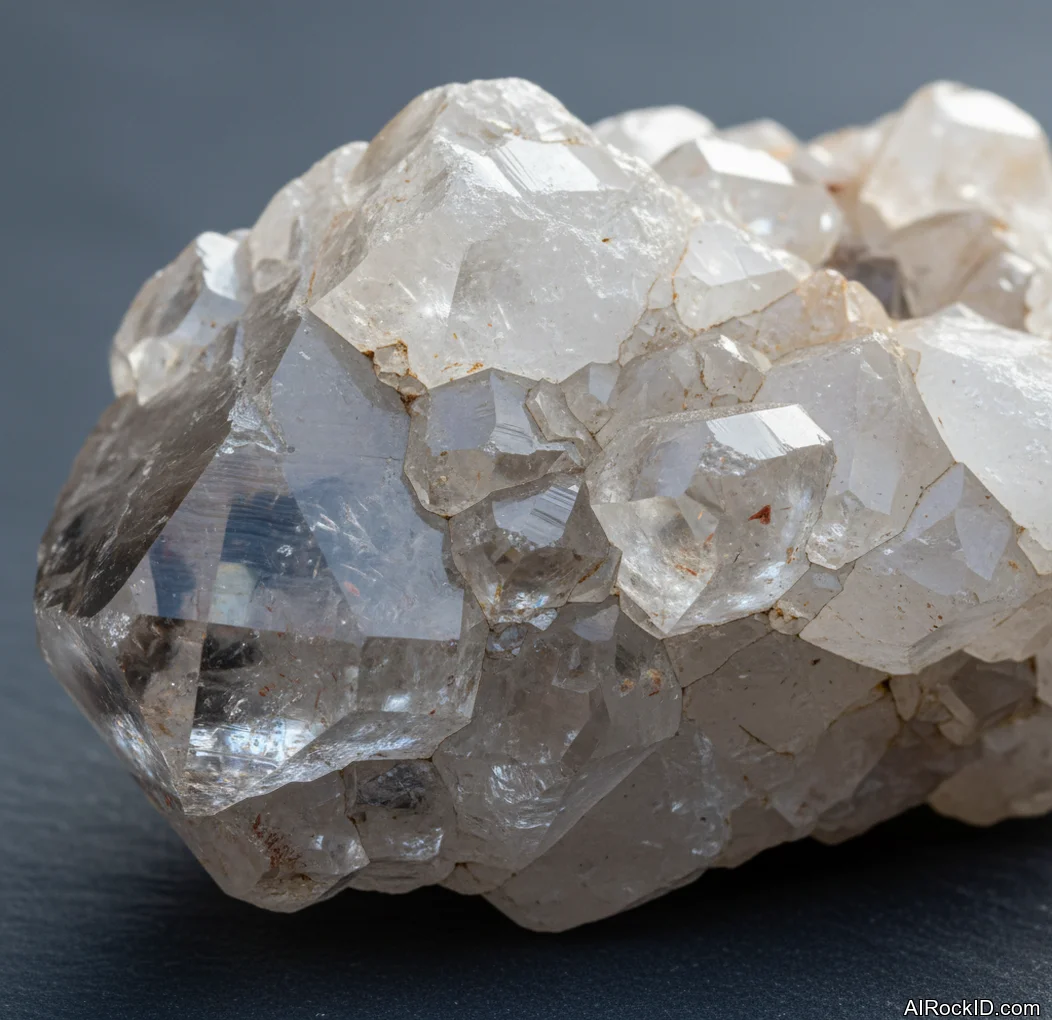
Start with regular quartz formation. Silica-rich fluids work their way through fractures and open pockets in igneous or metamorphic rocks, and quartz grows one layer at a time. Slow, steady. That’s why good points have those flat faces and crisp edges, and why clusters often pick up that drusy “sugar” zone around the bigger crystals (it looks like someone dusted them with tiny grains).
After that, the “aura” part is human-made. It’s done with physical vapor deposition in a vacuum chamber. The quartz gets cleaned, heated, and then a thin metal film, commonly titanium or a titanium-based mix, condenses onto the crystal faces. The color comes from thin-film interference. Look, you can spot it easiest when you rotate the crystal slowly and the rainbow slides across a face like oil on water. Hard to unsee once you’ve noticed it, right?
How to Identify Sun Aura Quartz
Color: Base color is clear to milky quartz under a gold or yellow metallic sheen, often with rainbow iridescence on edges and faces. The gold can look warmer on points and more “foil-like” on tumbled pieces.
Luster: Vitreous quartz luster under a metallic, iridescent surface film.
Look closely at the base near chips or the bottom of a point. If the coating’s worn, you’ll see plain clear quartz underneath with no gold color in the body. The real test is a bright flashlight and a slow tilt: the iridescence sits on the surface and slides across faces, instead of glowing from within like natural inclusions. And if you rub a coated face against a harder edge, you can sometimes feel a tiny bit more drag than raw quartz, like a super-thin “skin” on top.
Common Look-Alikes
Sun Aura Quartz is sometimes confused with these materials:
- Angel Aura Quartz
- Lemon Quartz (heated and dyed varieties)
- Gold Sandstone (glass with copper flakes)
- Citrine (heat-treated and natural)
- Glass points with metallic coating
- Titanium Aura Quartz
Market Cautions & Treatments
When AI Can Get This Wrong
AI photo tools mix up Sun Aura Quartz with Angel Aura and Titanium Aura all the time, especially if the lighting is harsh or the photo’s overexposed. The rainbow sheen is a big trap for image recognition. If you want to check it by hand, scratch a rough spot with steel—real quartz won’t mark, glass will scratch or flake. The cold, heavy feel in-hand is hard to fake in pictures.
Properties of Sun Aura Quartz
Physical Properties
| Crystal System | Trigonal |
| Hardness (Mohs) | 7 (Hard (6-7.5)) |
| Density | 2.65 g/cm3 |
| Luster | Vitreous |
| Diaphaneity | Transparent to translucent |
| Fracture | Conchoidal |
| Streak | White |
| Magnetism | Non-magnetic |
| Colors | Clear, White, Gold, Yellow, Iridescent rainbow |
Chemical Properties
| Classification | Silicates |
| Formula | SiO2 |
| Elements | Si, O |
| Common Impurities | Al, Fe, Ti |
Optical Properties
| Refractive Index | 1.544-1.553 |
| Birefringence | 0.009 |
| Pleochroism | None |
| Optical Character | Uniaxial |
Sun Aura Quartz Health & Safety
Handling it is pretty low risk. But don’t grind or sand coated quartz, because that can kick up super-fine silica dust that hangs in the air (and you’ll feel it in your throat if you’re not careful). And if you really scrape the coating hard, it can shed tiny little flakes.
Safety Tips
If you’re going to cut or polish quartz, keep a steady drip of water on it and wear a real respirator rated for silica dust, because that fine powder gets everywhere (and you don’t want it in your lungs). And if the piece has a coating, don’t treat it like lapidary rough. Put it on a shelf and call it a display piece.
Sun Aura Quartz Value & Price
Price Range
Rough/Tumbled: $10 - $80 per piece
Price mostly comes down to two things: the quartz point itself and how clean the coating work turned out. When the tip’s got a crisp termination, the edges don’t feel nicked when you run a fingernail over them (you can usually catch chips right there), and the gold tone looks even under normal room light, it moves fast. But if the quartz is cloudy and the film looks patchy up close, people notice, and it just doesn’t sell the same.
Durability
Durable — Scratch resistance: Excellent, Toughness: Good
Quartz itself is stable, but the surface coating can scratch, flake at sharp edges, or dull if it’s abraded a lot.
How to Care for Sun Aura Quartz
Use & Storage
Store it so the coated faces aren’t rubbing other stones. I keep mine in a small box or wrapped in a soft cloth because that thin film shows scuffs fast.
Cleaning
1) Rinse quickly in lukewarm water. 2) Use a drop of mild soap and your fingers, not a stiff brush. 3) Pat dry with a soft microfiber cloth and don’t tumble it around in a towel.
Cleanse & Charge
If you do energetic cleansing, stick to smoke, sound, or a quick rinse. Long salt soaks are overkill and can rough up the coating at tiny chips.
Placement
Put it where it can catch a single light source, like a desk lamp or a windowsill that doesn’t get harsh afternoon sun. At the right angle, the faces throw little gold flashes across the room.
Caution
Don’t run aura-coated pieces through an ultrasonic cleaner, and skip anything abrasive too. That buzzing ultrasonic bath and gritty cleaners can dull the shine or even start lifting the thin film. And don’t just toss it into a mixed bowl of tumbled stones to rattle around. You’ll hear that little clicking, and the coating will come out scratched.
Works Well With
Sun Aura Quartz Meaning & Healing Properties
In the metaphysical scene, Sun Aura Quartz gets talked about like it’s “quartz with a solar jacket.” People reach for it when they’re doing confidence work, trying to kick up motivation, or chasing that get-it-done feeling. And yeah, the look doesn’t hurt. When a stone is bouncing gold light right back into your face, it’s hard not to feel at least a little more switched on.
Pick up a coated point on a rough day and you’ll notice the difference between vibe talk and plain old sensory input. It’s slick. Cool. Almost glassy under your thumb (like it wants to slide out of your grip if your hands are dry). And the color shifts as you turn it in the light, that gold flashing to warmer yellow, then back again. So your eyes keep snapping back to it, which is why I’ve seen people park one on a desk as a focus thing. It kind of tugs at your attention.
But here’s what I tell customers at a show: the “aura” part is a finish, not some rare mineral event. If you want a stone for geology reasons, buy it for the quartz crystal shape and clarity first, then treat the coating like jewelry plating. If you want it for intention work, keep it simple, and don’t skip actual help when you need it. Crystals are support. Not a substitute for real care.
Common mistakes
- Calling Sun Aura Quartz a fully natural golden quartz rather than treated quartz.
- Using hardness 7 to assume the coating is equally durable as the quartz underneath.
- Cleaning the stone in an ultrasonic cleaner or with harsh chemicals that may damage the surface.
- Confusing surface iridescence with internal yellow color in citrine.
- Assuming all gold-colored quartz points are Sun Aura Quartz without checking for metallic sheen and seller disclosure.
Identify Sun Aura Quartz from a photo
Compare Sun Aura Quartz traits, care tips, value clues, and common lookalikes with a clear photo.