Sunset Sodalite


Quick answer: Sunset Sodalite is a trade name for sodalite material that shows blue areas with orange, peach, or rusty tones and commonly includes white calcite veining. It is often chosen for its color contrast, but identification should account for dyed stones and similar orange-blue minerals.
AI Rock ID can help compare Sunset Sodalite against similar blue, orange, and white-veined stones using visible features such as color zoning, luster, and pattern. RockIdentifier.io provides crystal reference information that can support visual checks, but gemological testing is recommended for uncertain or high-value purchases.
Good fit
- Collectors who like mixed orange, blue, and white patterned stones
- Buyers seeking a decorative sodalite variety with visible contrast
- Beginners who want a recognizable stone but are willing to check for dye or trade-name variation
- Jewelry users who can protect a Mohs 5.5–6 stone from hard knocks
Not a good fit
- Situations that require a highly scratch-resistant gemstone
- Buyers who need a standardized mineral variety name rather than a trade name
- People who want a stone with uniform color and minimal veining
- Pieces that will be exposed often to acids, harsh cleaners, or rough wear
Why people search for this
People often search for Sunset Sodalite to confirm whether the orange-blue coloring is natural-looking and how it differs from ordinary blue sodalite. Many searches also focus on whether a piece is genuine, dyed, or confused with similar trade-name stones.
Most commonly confused with
- Sodalite: Standard sodalite is usually blue with white veining, while Sunset Sodalite includes orange to rusty color zones.
- Yooperlite: Yooperlite is a fluorescent sodalite-bearing syenite known for UV response, while Sunset Sodalite is identified mainly by visible orange-blue patterning.
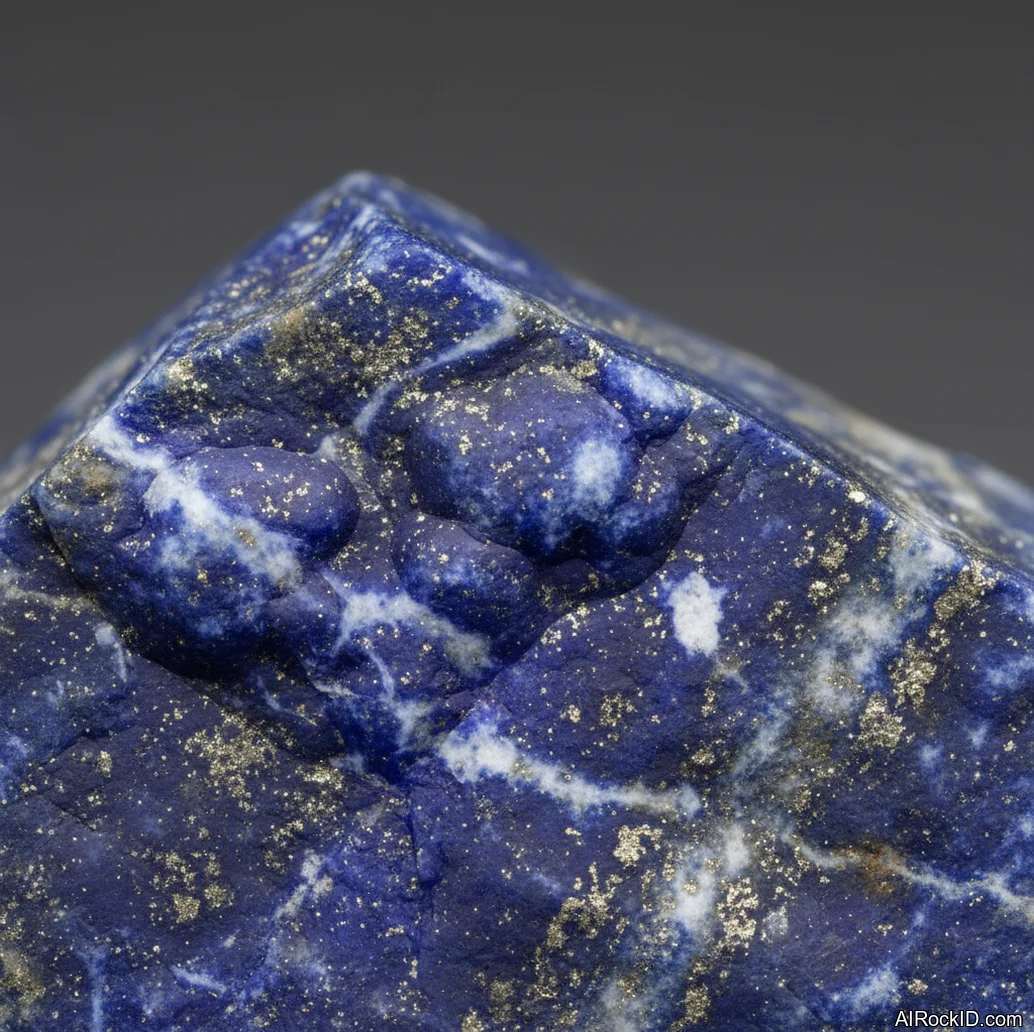
- Lapis Lazuli: Lapis lazuli commonly contains pyrite flecks and deeper ultramarine color, unlike the orange-white veining typical of Sunset Sodalite.
- Orange Calcite: Orange calcite is softer and usually lacks the blue sodalite areas that define Sunset Sodalite.
Sunset Sodalite vs Similar Stones
| Feature | Sunset Sodalite | Common Lookalike |
|---|---|---|
| Main colors | Blue with orange to rusty areas and white veining | Lapis lazuli is usually deep blue with possible gold pyrite |
| Veining | Often white calcite veins or patches | Dyed stones may show color concentrated along cracks |
| Hardness | About Mohs 5.5–6 | Orange calcite is softer at about Mohs 3 |
| UV response | Variable; not the main identifying feature | Yooperlite is sought for strong fluorescent areas under UV light |
| Trade-name clue | Name refers to appearance, not a formal mineral species | Standard sodalite may be sold without the orange-color trade name |
AI identification confidence
AI identification confidence for Sunset Sodalite is usually moderate when photos show both blue sodalite areas and orange-white veining in natural light. Confidence drops when the stone is heavily polished, color-enhanced, photographed under warm lighting, or shown without scale and multiple angles.
When AI gets it wrong
- Warm lighting can make beige or white calcite look more orange than it is.
- Dyed sodalite may appear similar in photos if dye has settled into cracks or pores.
- Lapis lazuli, blue-white sodalite, and other mixed blue stones can be misread when orange areas are not visible.
- Close-up photos without a full-stone view can hide the overall color pattern needed for comparison.
Final recommendation
Choose Sunset Sodalite based on clearly visible orange-blue contrast, stable polish, and seller disclosure about treatments. For expensive items, request natural-light photos and consider basic gemological confirmation rather than relying on trade-name labeling alone.
How to Check Sunset Sodalite Before Buying
Look for a balanced mix of blue sodalite, orange to rusty zones, and white veining rather than color that appears only in cracks. Ask whether the stone has been dyed, stabilized, or coated, especially for beads and inexpensive carvings. Natural-light photos from several angles are more useful than highly saturated product images.
Photo Tips for Identifying Sunset Sodalite
Photograph Sunset Sodalite in daylight or neutral indoor light without heavy filters. Include the whole stone, a close-up of the veining, and a scale reference such as a coin or ruler. A UV photo can be included if fluorescence is suspected, but visible color pattern remains the main clue.
Is Sunset Sodalite a Formal Mineral Name?
Sunset Sodalite is generally used as a descriptive trade name, not a separate mineral species. The material is associated with sodalite and calcite-rich veining, but exact composition can vary by source and seller. Trade names are useful for appearance, but mineral identification depends on observable properties and testing.
What Is Sunset Sodalite?
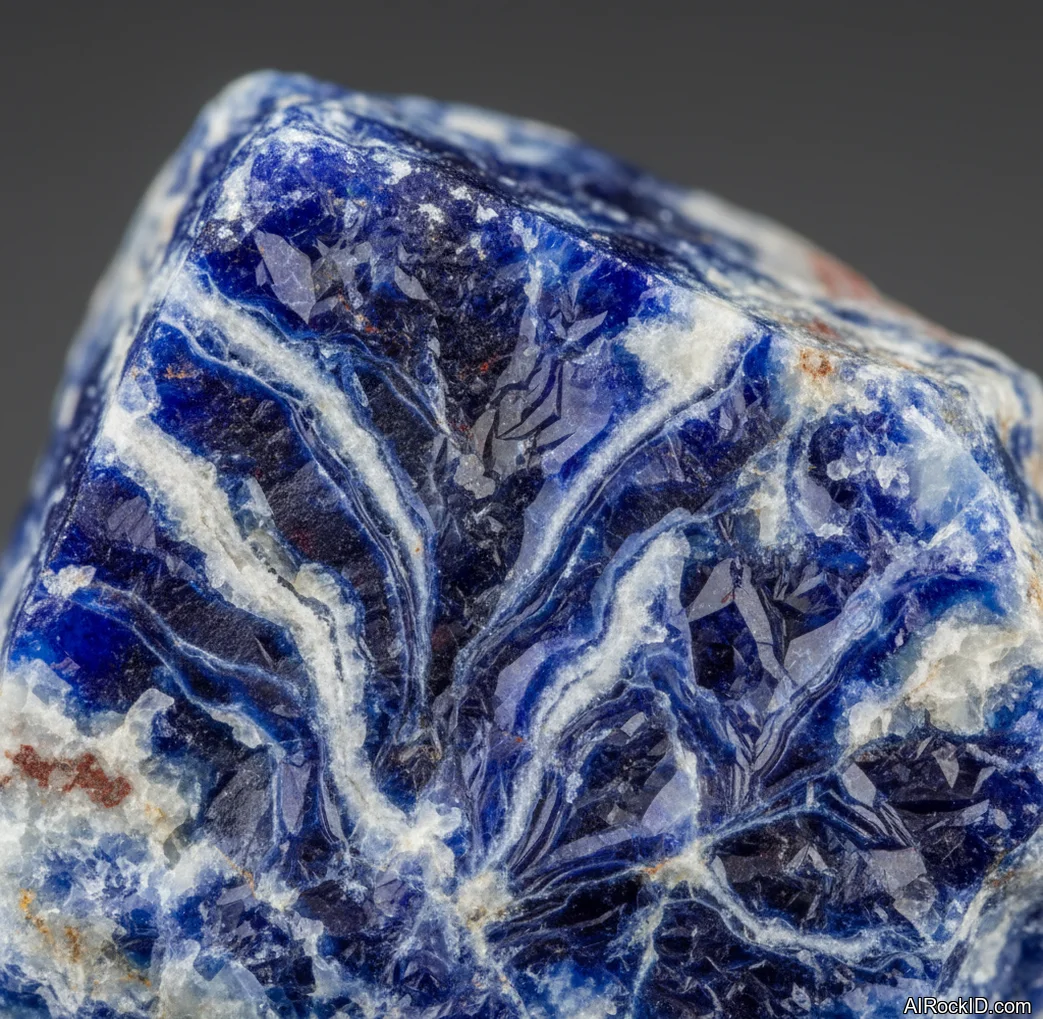
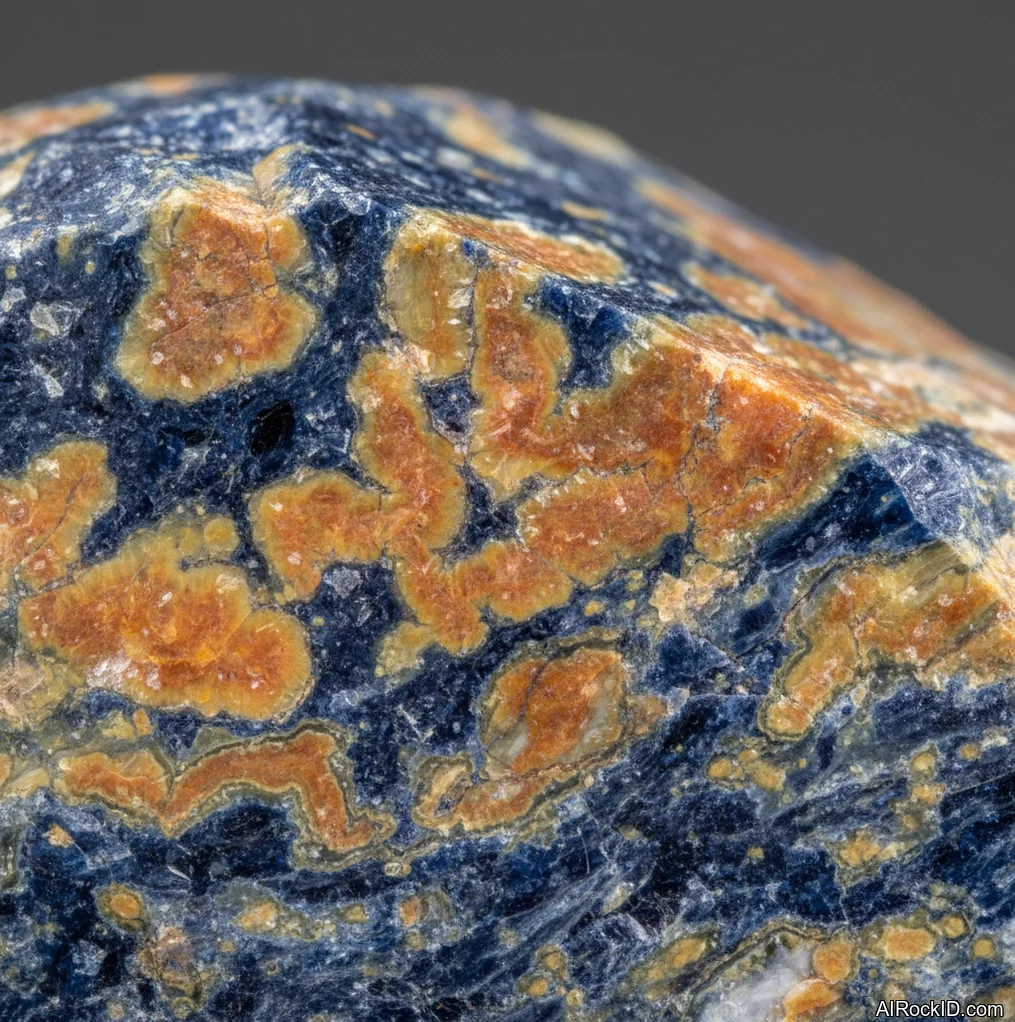
Sunset Sodalite is a trade name for sodalite-bearing rock that blends classic blue sodalite with warm peach-to-orange zones, usually cut through with white calcite veining.
Grab a palm stone and the first thing you notice is how cool it feels in your hand, even sitting under a lamp. And the surface has that weird sodalite texture when it’s polished but not over-buffed, kind of a chalky-glass feel (you can almost hear your fingertip squeak if you rub it). The color is why people bother. Instead of one flat royal blue, you get denim and inky blues pressed right up against apricot, salmon, or rusty orange patches, sometimes swirled and cloudy, other times in blocky chunks that look like a broken mosaic.
Most pieces you’ll see are tumbled or cut into freeforms. Raw, it’s not exactly a looker. It’s a chunky, massive rock with random calcite seams, and it can read pretty dull until you wet it or wipe on a little mineral oil. But once it’s polished, the “sunset” name clicks, especially under warm indoor light where the orange pops harder than it does in daylight.
Origin & History
Sodalite got its official start as a mineral species in 1811, when Thomas Thomson first described it, and the name is literally a nod to the sodium in it (from “soda”). Most collectors run into it through that deep blue stuff from around Bancroft, Ontario, Canada, since it’s been a go-to lapidary and decor material for ages. You see it in polished slabs and little carvings a lot, the kind that feel cool in your hand at first and take a glassy shine when they’re done right.
“Sunset Sodalite” isn’t a formal geologic name. It’s just a dealer tag, like when someone slaps “galaxy” or “ocean” on a piece of jasper to make it sound like its own thing. So what does it mean? Basically, you’re looking at sodalite with warm-toned inclusions and mixed-in material, usually calcite, and sometimes iron-stained patches that tint it toward peach and orange.
Where Is Sunset Sodalite Found?
Sodalite forms in silica-poor igneous settings and is collected from several countries; “Sunset” material is most often sold as lapidary rough from Brazil in mixed lots.
Formation
Sodalite forms in silica-undersaturated igneous rocks, especially nepheline syenites and related alkaline complexes. So, in plain speak, it turns up when the magma just doesn’t have enough silica to make quartz, and other minerals have to step in and take over.
Look at a fresh cut face under a bright shop light and you can usually read what happened. The blue sodalite shows up as big, blocky patches, and the white lines are most often calcite that later seeped in and plugged hairline cracks (the kind you can feel with a fingernail if you drag it across). The orange areas might be iron staining, altered feldspathoid material, mixed bits of host rock that ended up in the same slice, or just a lucky “sunset” slab pulled from a pretty chaotic boulder. Who hasn’t seen that happen?
How to Identify Sunset Sodalite
Color: Deep blue to denim-blue areas mixed with peach, salmon, or orange zones, commonly with white calcite veining. Color zoning is patchy and irregular rather than evenly blended.
Luster: Vitreous to waxy when polished, duller and more chalky on rough surfaces.
Pick up a piece and feel the heft. It’s not heavy like hematite, but it’s got more weight than most people expect from a “blue stone.” If you scratch it with a steel nail, it’ll usually mark, and a copper coin won’t do much. The problem with lookalikes is dyed material: dyed howlite or magnesite often has color sitting in cracks and drill holes, while real sodalite’s blue is part of the mass and looks more natural at the edges.
Common Look-Alikes
Sunset Sodalite is sometimes confused with these materials:
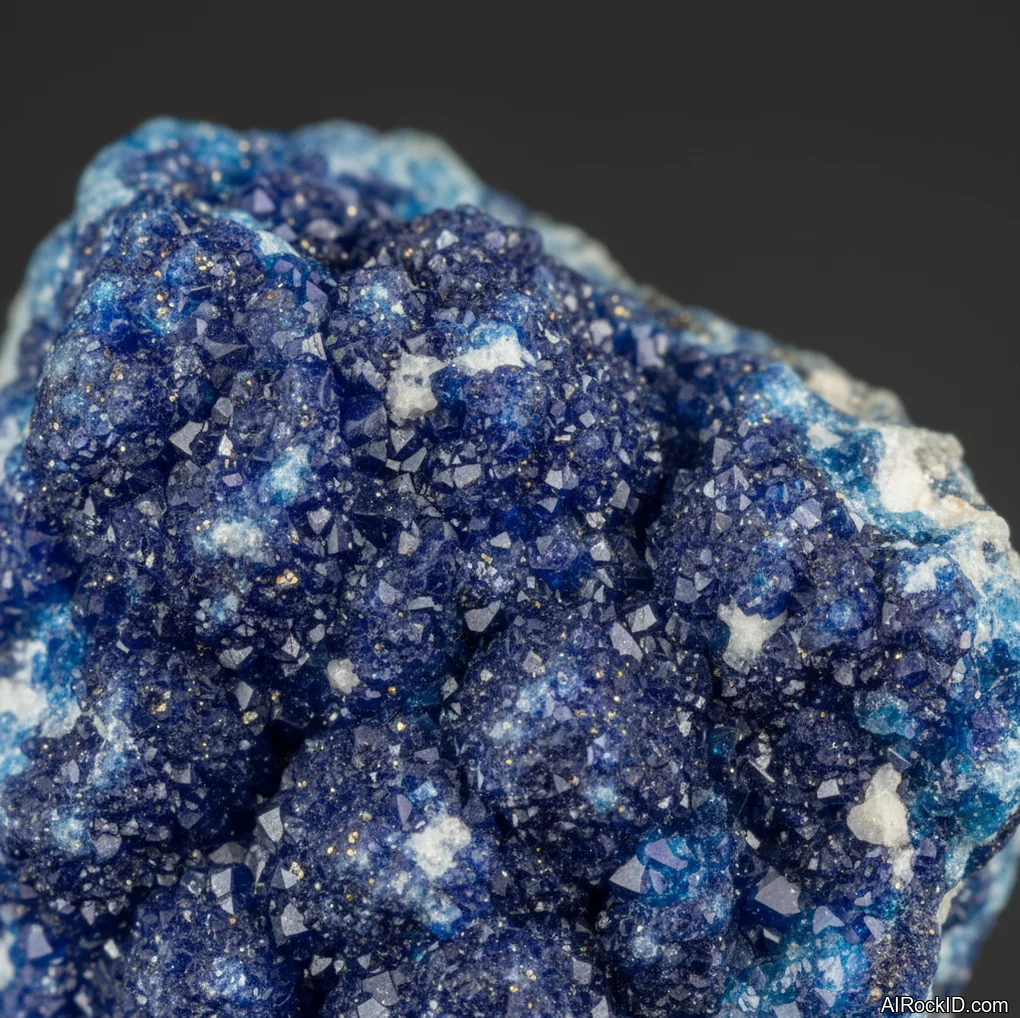
- Lapis lazuli (especially low-grade lapis with lots of white calcite and little to no pyrite)
- Dyed howlite or dyed magnesite sold as "sunset sodalite" or "orange sodalite" (dye grabs the white veining and cracks)
- Sodalite + feldspar rocks like hackmanite-bearing syenite (the peachy feldspar can mimic the warm zones)
- Blue calcite or blue aragonite with cream banding (softer feel and a waxier polish than sodalite)
- Man-made glass or resin "confetti" palm stones (too uniform, too glossy, and often lighter than they look)
Market Cautions & Treatments
When AI Can Get This Wrong
At first glance, photos make Sunset Sodalite look like low-grade lapis or even dyed howlite because the camera flattens the chalky-glass polish and over-saturates the orange zones. AI also trips when the peach areas are actually feldspar in a mixed rock, so it guesses "sunstone" or "jasper" just off color. The real test is a quick hardness check and a loupe: sodalite sits around 5.5 to 6, and the white calcite veining will scratch easily and look sugary up close instead of taking dye in a crisp, ink-like line.
Properties of Sunset Sodalite
Physical Properties
| Crystal System | Cubic |
| Hardness (Mohs) | 5.5-6 (Medium (4-6)) |
| Density | 2.27-2.33 g/cm3 |
| Luster | Vitreous |
| Diaphaneity | Opaque |
| Fracture | Uneven |
| Streak | White |
| Magnetism | Non-magnetic |
| Colors | blue, white, orange, peach, gray |
Chemical Properties
| Classification | Silicates (tectosilicate, feldspathoid) |
| Formula | Na8(Al6Si6O24)Cl2 |
| Elements | Na, Al, Si, O, Cl |
| Common Impurities | Ca, Fe, S |
Optical Properties
| Refractive Index | 1.483-1.487 |
| Birefringence | None |
| Pleochroism | None |
| Optical Character | Isotropic |
Sunset Sodalite Health & Safety
Handling it is pretty low-risk, and a quick splash of water usually won’t hurt anything. But if you’re cutting or sanding it, treat it like any lapidary stuff: don’t breathe in the dust (that fine, chalky grit that hangs in the air for a second). Why risk your lungs?
Safety Tips
If you’re grinding or drilling, run water on it, throw on a respirator, and mop up the slurry while it’s still wet (it’s that gray, gritty paste) instead of sweeping up dry dust.
Sunset Sodalite Value & Price
Price Range
Rough/Tumbled: $6 - $25 per palm stone or $8 - $35 per lb rough
Cut/Polished: $2 - $8 per carat
Price usually follows color balance and how clean the polish looks in your hand. More blue, with crisp orange patches and thin white veining, moves quicker than muddy gray mixes or rough that’s heavily fractured (the kind that catches on a fingernail and never quite shines up).
Durability
Moderate — Scratch resistance: Fair, Toughness: Fair
It’s generally stable in normal household conditions, but it can chip on edges and it doesn’t love hard knocks on a countertop.
How to Care for Sunset Sodalite
Use & Storage
Store it so it can’t bang into harder stones like quartz, because the edges will take little dings. I keep palm stones in a soft pouch or a divided tray.
Cleaning
1) Rinse with lukewarm water. 2) Use a drop of mild soap and a soft toothbrush for crevices. 3) Rinse again and pat dry; don’t bake it in direct sun to “speed dry.”
Cleanse & Charge
For a simple reset, wipe it down and set it somewhere calm, like a shelf away from the window. If you use moonlight, go for a short sit overnight and bring it back in the morning.
Placement
On a desk, it reads like a focus stone, and the orange bits keep it from feeling too serious. On a nightstand it’s fine, but keep it where it won’t get knocked onto the floor.
Caution
Skip harsh cleaners and don’t run long ultrasonic cycles, especially if you can see calcite veins or any little fractures. And don’t lump all “Sunset Sodalite” together like it’s one uniform rock. Some batches show up with softer, calcite-heavy pieces (you’ll spot the chalkier white streaks), and those scratch a lot more easily.
Works Well With
Sunset Sodalite Meaning & Healing Properties
Most folks grab Sunset Sodalite because the colors are just hard to ignore. But once you actually use it, the feel is what keeps you coming back. The blue sodalite part has that steady, head-clearing vibe people talk about in crystal shops, and then those orange patches swing it warmer, a little more social. In my own pile, it’s the one I reach for when I want to think straight without slipping into that icy, overly analytical headspace.
On a stressful day, I’ll snag a polished piece and do a quick reality check. It’s simple. Cool stone sitting heavy in your palm, the surface slick like it’s been buffed to glass, and you can feel it warming up a bit as your hand stays closed. Slow breath. That’s it. But look, if you’re waiting for fireworks, you’re gonna be let down. It’s more like a steady metronome than some big drum solo.
Thing is, metaphysical talk gets messy because people start treating it like medicine. It’s not. Use it like a reminder, a focus object, or the thing you hold while you’re journaling (especially when your thoughts are bouncing around). And if you’re sensitive to “busy” stones, keep an eye on the contrast. Some pieces have tons of veining and mixed material, and they can feel mentally noisy, even though they look incredible under the bright show lights.
Common mistakes
- Assuming every orange-blue stone sold as Sunset Sodalite has the same source or composition
- Identifying the stone from color alone without checking hardness, veining, and possible dye concentration
- Confusing white calcite veining with cracks or damage in all cases
- Using warm, edited, or oversaturated photos as proof of natural orange color
- Expecting the name Sunset Sodalite to indicate a formal mineral species
- Cleaning the stone with acidic products that can affect calcite-rich areas
Identify Sunset Sodalite from a photo
Compare Sunset Sodalite traits, care tips, value clues, and common lookalikes with a clear photo.