Timor Agate


Quick answer: Timor Agate is a banded chalcedony associated with Timor, Indonesia, and is usually recognized by translucent to opaque layers in beige, brown, gray, cream, or reddish earth tones. It can resemble other agates, so source claims and visual details should be checked rather than relying on color alone.
AI Rock ID can help compare a Timor Agate photo with visually similar banded chalcedony varieties, especially when the image shows the stone’s pattern and translucency clearly. RockIdentifier.io provides crystal and rock identification support, but geographic origin labels such as “Timor” may still require seller documentation or provenance.
Good fit
- Collectors who like subtle earth-tone banding and natural chalcedony patterns
- People comparing regional agate varieties from Indonesia or Southeast Asia
- Jewelry buyers looking for a durable quartz-family stone with a neutral color palette
- Beginners who want an agate variety that is usually recognizable by banding
Not a good fit
- Buyers who need verified mine-level origin without documentation
- Anyone expecting bright dyed colors or highly saturated banding
- People who want a crystal identified by color alone, since many agates overlap visually
Most commonly confused with
- Botswana Agate: Often has fine gray, pink, or brown banding and may look similar, but it is associated with Botswana rather than Timor.
- Crazy Lace Agate: Usually shows more tangled, lace-like patterns and stronger contrast than the calmer layered look typical of many Timor Agate pieces.
- Sardonyx: Has distinct sard and onyx-style bands, commonly with reddish brown, black, white, or orange layers.
- Banded Agate: A broad descriptive category; Timor Agate is a regional trade name within the wider banded chalcedony family.
Timor Agate vs Similar Agates
| Stone | Typical Look | Key Difference |
|---|---|---|
| Timor Agate | Earth-tone bands, often translucent to opaque | Regional trade name tied to Timor; origin can be hard to verify visually |
| Botswana Agate | Fine gray, pink, brown, or cream bands | Known locality is Botswana, not Indonesia |
| Crazy Lace Agate | Busy swirls, loops, and lace-like patterns | Pattern is usually more chaotic and high-contrast |
| Sardonyx | Straight to curved red-brown, white, black, or orange bands | More strongly associated with sard and onyx banding |
| Dyed Agate | Bright blue, pink, purple, green, or intense black tones | Color may collect in cracks or appear too uniform for natural agate |
AI identification confidence
AI identification confidence for Timor Agate is usually moderate when the photo clearly shows banding, translucency, and surface texture. Confidence is lower for confirming the Timor origin, because many regional agates share similar chalcedony patterns and require provenance information.
When AI gets it wrong
- The stone is photographed under warm or colored lighting that changes the natural earth tones.
- Only a polished cabochon face is shown, hiding the band structure or translucency.
- The piece is dyed, heat-treated, or resin-coated in a way that masks natural chalcedony features.
- The label refers to geographic origin, but the visual appearance matches many other banded agates.
Final recommendation
Choose Timor Agate by looking for natural-looking layered chalcedony, good polish, and a seller who can explain the source claim. If the origin matters, ask for provenance details rather than relying only on the trade name.
How to Check Timor Agate Authenticity
Authentic Timor Agate should show chalcedony-like banding, a waxy to vitreous polish, and color transitions that look integrated rather than painted on. Natural pieces may have small pits, fortification bands, cloudy zones, or uneven translucency. Bright artificial colors, dye collecting in cracks, or a plastic-like coating are signs to examine the stone more carefully.
Buying Timor Agate Online
Online listings should include clear photos in natural light, close-ups of the banding, size measurements, and disclosure of any dyeing, stabilization, or coating. The name “Timor Agate” can be used as a trade label, so buyers should ask whether the seller has source information for the material. For jewelry, check the polish quality, drill holes, fractures, and whether the setting hides chips or filler.
Natural Variation in Timor Agate
Timor Agate can vary from softly translucent to mostly opaque, with bands that may be straight, curved, cloudy, or fortification-like. Common colors include tan, brown, cream, gray, rust, and muted reddish tones. Variation is normal for agate, so two authentic pieces may look quite different even when sold under the same regional name.
What Is Timor Agate?
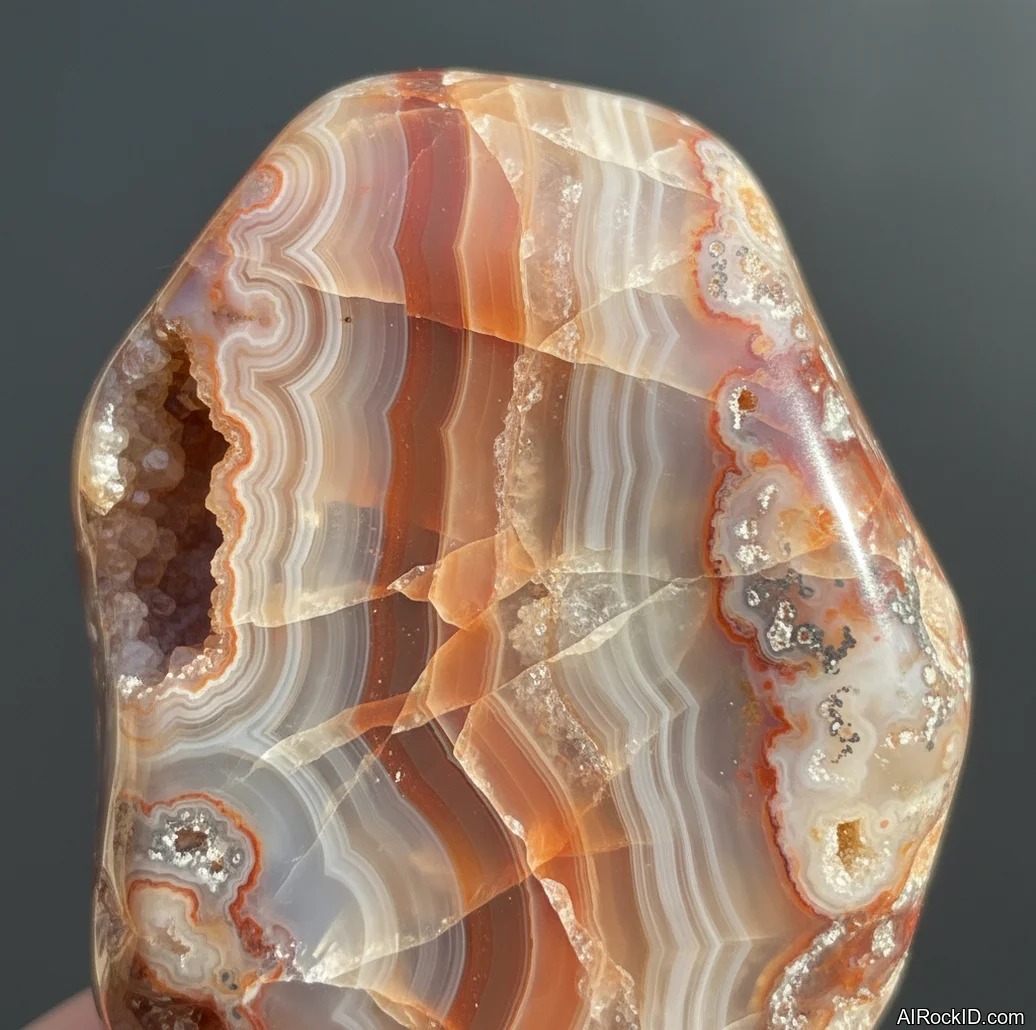
Timor Agate is a banded variety of chalcedony, which is microcrystalline quartz, and it comes off the island of Timor in Indonesia.
Grab a palm stone and you’ll feel it right away: it hangs onto that coolness for a bit, the way quartz does. Most of the Timor pieces I’ve had in my hands show tight, steady bands in tan, cream, gray, and rusty brown. And every so often you’ll see those cloudy “waterline” zones, like a little strip of fog got sealed inside. It’ll take a high polish, sure, but it doesn’t end up with that super glassy slick feel some agates from Brazil get. It’s smoother than you expect, with a slightly waxy slide under your thumb (kind of like warmed candle wax, but not sticky). Nice stuff.
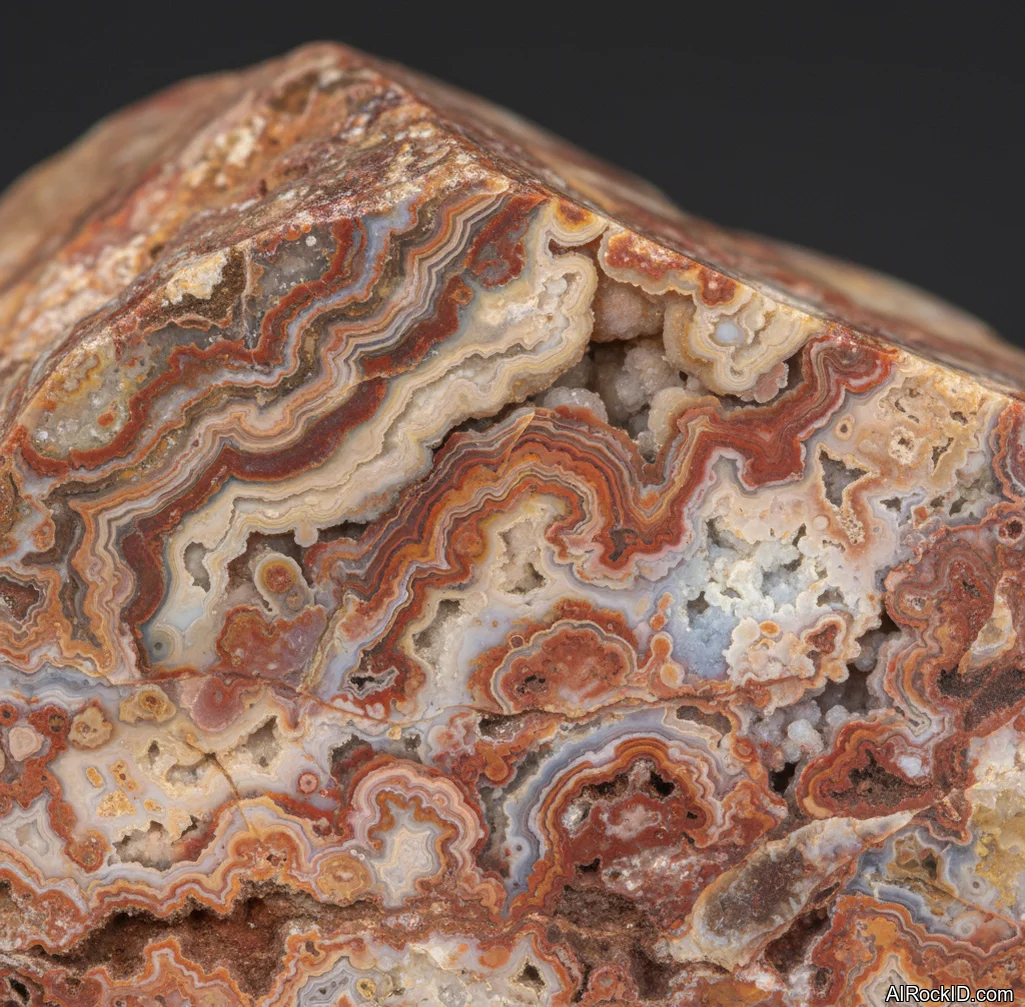
People mix it up with generic banded agate at first glance, and yeah, that’s understandable. But the appeal is the quieter look. Instead of those loud fortification zigzags, you more often get fine, parallel banding and soft transitions that read almost sedimentary, even though it’s silica all the way through.
Origin & History
Most dealers treat “Timor Agate” as a trade name, basically a location tag, not some formally defined mineral variety. You’ll see it sold the same way people sell “Madagascar agate” or “Botswana agate”, where the place name is doing the heavy lifting.
The name comes straight from Timor, which is part of Indonesia’s Lesser Sunda Islands. And in the gem trade, it started popping up more consistently once Indonesian lapidary material was easier to move through regional markets, but there isn’t one clean “first described by” moment like you get with a new mineral species.
Where Is Timor Agate Found?
Timor Agate is reported from Timor Island in Indonesia (and the Timor-Leste side of the island), typically as nodules and seam agate in volcanic host rocks.
Formation
Most agate origin stories go about like this: silica-heavy fluids slip into cracks and little pockets, and then the silica settles out in layers. Timor Agate follows that same script. It’s microcrystalline quartz plugging tiny voids in volcanic rock, usually in repeated pulses that stack up and leave the banding behind.
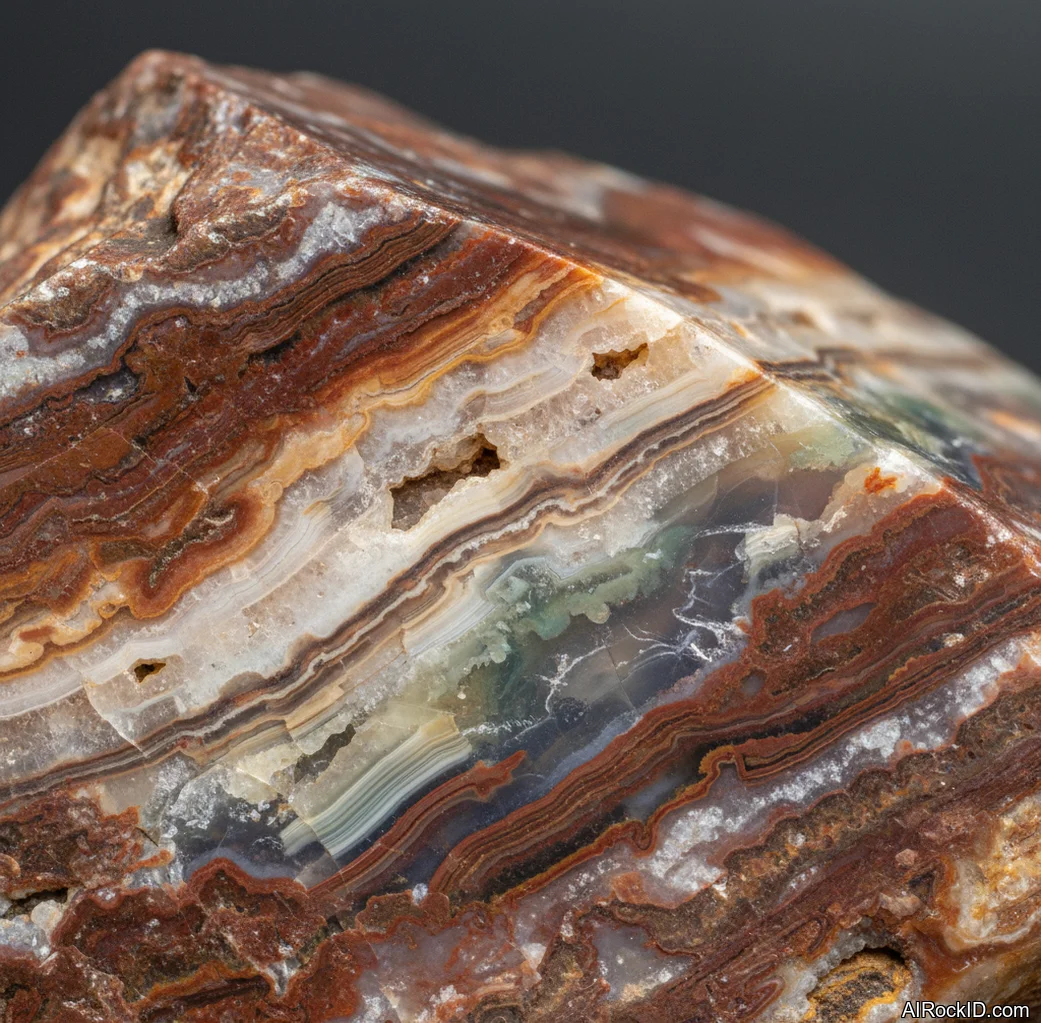
If you’ve got a cut face in front of you, you can kind of trace the sequence just by staring at the bands. Some layers let a bit more light through, others look more chalky, and the iron-stained zones skew brown or red. But don’t take the banding as a perfect timeline, because agate can dissolve again and then precipitate again (yeah, it’s annoying). So the crisp stripes are real, but the chemistry and the timing under them is a lot messier than a polished slice makes it seem.
How to Identify Timor Agate
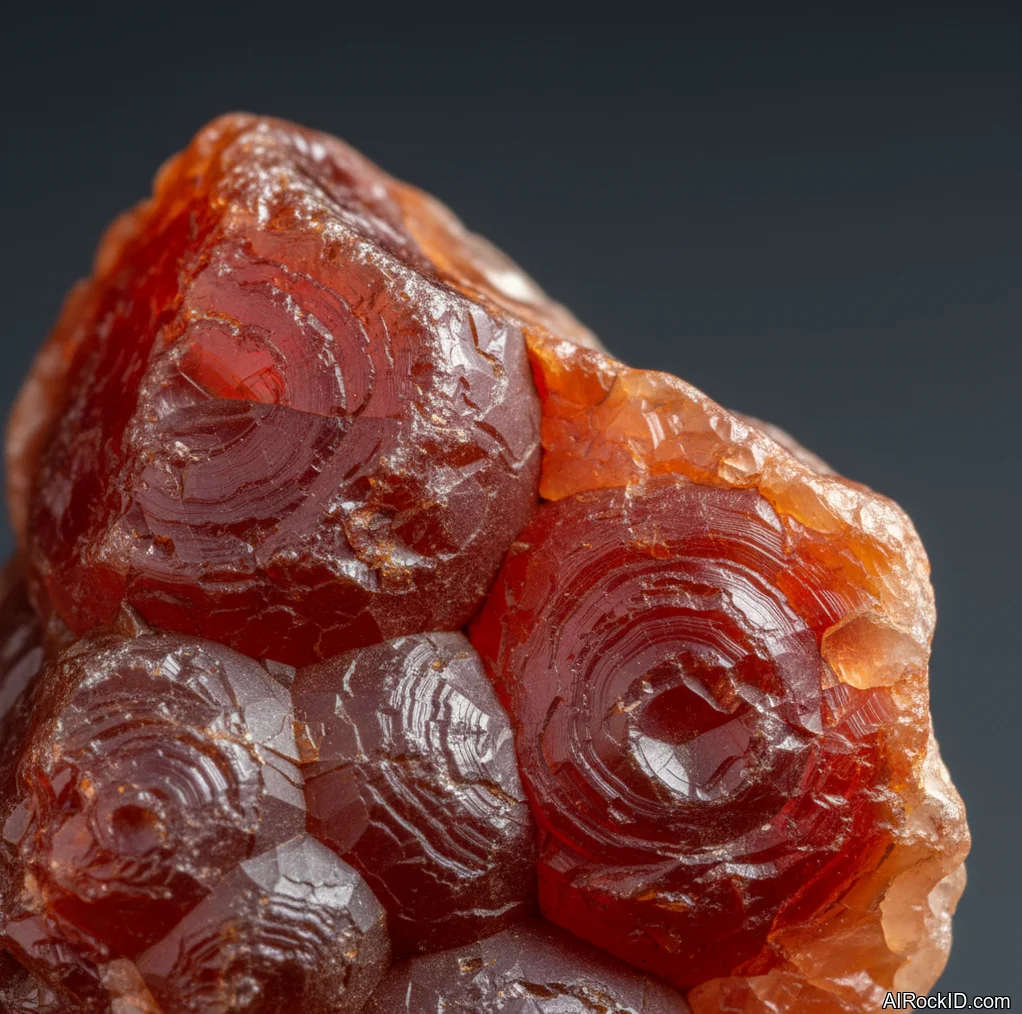
Color: Typical colors run cream, beige, gray, honey-brown, and reddish-brown, usually in fine parallel bands or soft band stacks. Some pieces show faint white plume or cloudy zones between bands.
Luster: Polished surfaces range from waxy to vitreous.
If you scratch it with a steel nail, it shouldn’t mark. Quartz hardness wins that fight. Hold it up to a strong light: a lot of Timor material is translucent at the edges, even when the center looks solid. And if the pattern looks printed or too perfectly repetitive, be skeptical, because dyed or reconstituted material can mimic banding when you only see it in photos.
Common Look-Alikes
Timor Agate is sometimes confused with these materials:
- Indonesian Banded Agate (from Java or Sumatra)
- Dyed Brazilian Agate (especially with artificial browns)
- Botswana Agate
- Glass fakes with printed banding
- Banded Jasper
- Onyx (banded varieties)
Market Cautions & Treatments
When AI Can Get This Wrong
AI photo apps often mix up Timor Agate with Botswana Agate or dyed Brazilian agate, especially when the bands look too crisp or the browns are extra bold. They miss the muted, foggy waterline zones you only spot in hand. The real test is the feel: real Timor Agate stays cool and weighs heavy, while glass and dyed pieces don’t.
Properties of Timor Agate
Physical Properties
| Crystal System | Trigonal |
| Hardness (Mohs) | 6.5-7 (Hard (6-7.5)) |
| Density | 2.58-2.64 |
| Luster | Waxy |
| Diaphaneity | Translucent to opaque |
| Fracture | Conchoidal |
| Streak | White |
| Magnetism | Non-magnetic |
| Colors | Cream, Beige, Gray, Brown, Reddish-brown, White |
Chemical Properties
| Classification | Silicates |
| Formula | SiO2 |
| Elements | Si, O |
| Common Impurities | Fe, Mn, Al |
Optical Properties
| Refractive Index | 1.530-1.543 |
| Birefringence | 0.009 |
| Pleochroism | None |
| Optical Character | Uniaxial |
Timor Agate Health & Safety
Timor Agate is non-toxic, so it’s safe to handle. For display pieces or jewelry, you don’t need anything fancy, just normal care.
Safety Tips
If you’re going to cut it or grind it, don’t breathe in the silica dust. Keep it wet with water (you’ll see the slurry), make sure you’ve got real ventilation, and wear a proper respirator.
Timor Agate Value & Price
Price Range
Rough/Tumbled: $5 - $40 per piece
Cut/Polished: $0.50 - $5 per carat
Price mostly comes down to how tight the pattern is, how translucent it looks when you hold it up to a window, and whether the polish comes out glassy or has that faint “orange peel” feel under your thumb. Big slabs with calm, even banding usually cost more than little mixed-color tumbles rattling around in a bag.
Durability
Very Durable — Scratch resistance: Excellent, Toughness: Good
It’s stable in normal household conditions, but a hard drop can still chip an edge because agate breaks with a conchoidal snap.
How to Care for Timor Agate
Use & Storage
Store it like you would any quartz: away from harder things that can bruise the polish and away from gritty pockets that can leave scratches. I keep my agates in individual pouches because slab corners love to kiss each other.
Cleaning
1) Rinse with lukewarm water to remove dust. 2) Use a drop of mild soap and your fingers or a soft toothbrush for crevices. 3) Rinse again and dry with a soft cloth so you don’t leave water spots on the polish.
Cleanse & Charge
For a simple reset, rinse and let it air dry, or leave it on a windowsill for indirect light for a few hours. Avoid long, harsh sun if your piece has any dyed treatment, since color stability depends on what was done to it.
Placement
On a desk or shelf, it looks best under a side lamp so the banding throws soft contrast instead of flattening out. If you’ve got a translucent edge, backlighting is the trick.
Caution
Don’t use bleach or any harsh acids. And if the piece has fractures or open seams, skip the ultrasonic cleaner entirely, the vibration can make those weak spots spread. If it’s set in jewelry, take a close look at the exposed edges, especially the spots that stick out, since that’s where you’ll usually spot little chips first.
Works Well With
Timor Agate Meaning & Healing Properties
Most folks who grab Timor Agate are after that steady, grounded vibe you get from banded chalcedony. It’s not a “lightning bolt” stone. It’s the kind you toss in your pocket because it’s got that reassuring heft, and the bands give your eyes something slow to track when your brain’s running too fast.
In my own routine, I use it like a focus anchor. If I’m sorting flats of specimens or stuck doing paperwork, I’ll park a smooth Timor palm stone right on the desk and, without even noticing, I’ll rub my thumb along the bands. You can feel the tiny changes where one stripe dips and the next one rises (and if the stone’s been handled a lot, there’s usually a slick spot where the polish is a little glassier). That repetitive texture is the whole point. But look, I’m not going to pretend it’s medicine. If you’re dealing with anxiety or sleep issues, treat the stone like a habit cue, and still do the real-world stuff that actually moves the needle.
People also connect agates with protection and boundaries. I get it. A good agate feels self-contained, like it’s holding itself together even when the pattern gets busy. So keep your expectations practical: it can be a reminder, a tool for attention, maybe a small reset in your hand, but it’s not a replacement for therapy, rest, or medical care.
Common mistakes
- Assuming every brown banded agate is Timor Agate without checking origin information.
- Confusing natural muted earth tones with faded dye or surface staining.
- Judging authenticity from a single front-facing photo instead of checking edges, fractures, and translucency.
- Treating the trade name as proof of exact locality when no provenance is provided.
- Overpaying for a common agate pattern because the listing uses a rare-sounding regional label.
Identify Timor Agate from a photo
Compare Timor Agate traits, care tips, value clues, and common lookalikes with a clear photo.