Turritella Agate 1


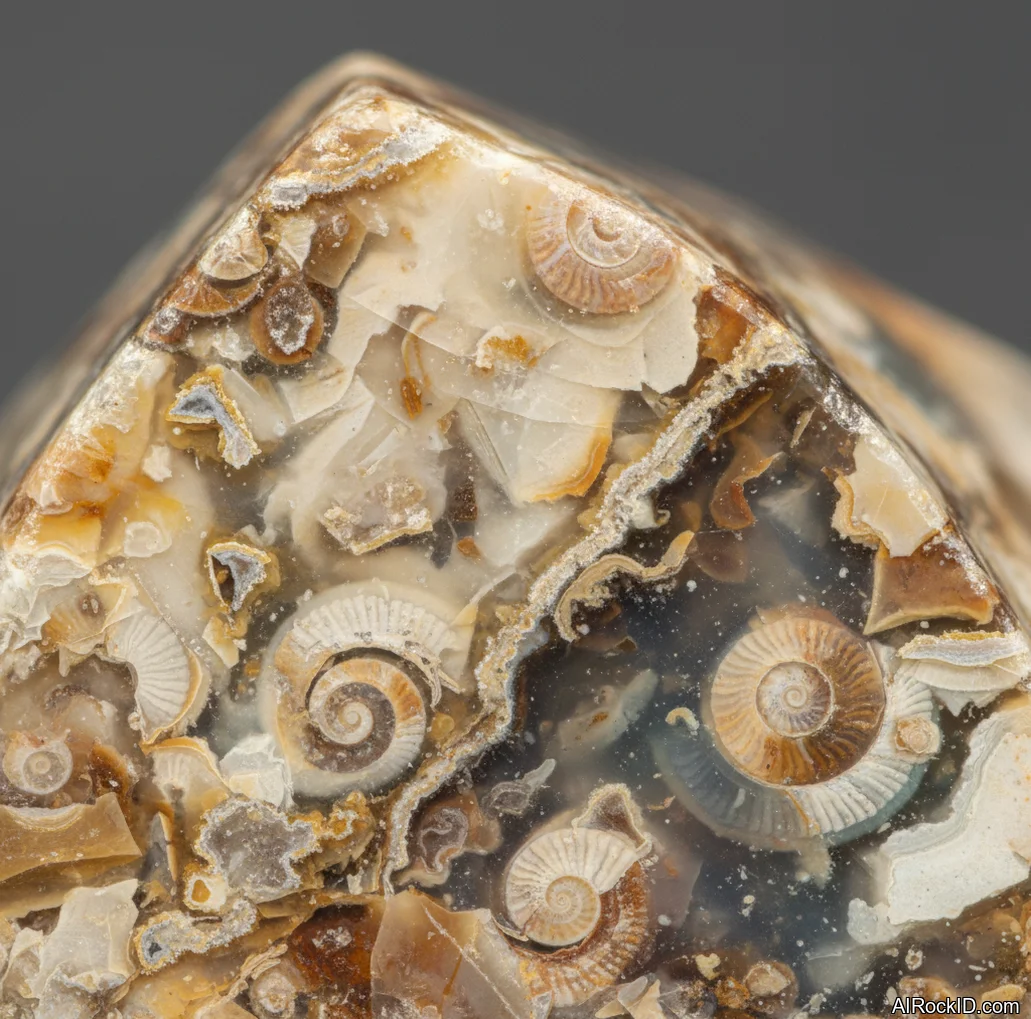
Quick answer: Turritella Agate 1 is a fossil-bearing chalcedony best recognized by dense, spiral shell inclusions in a brown, tan, or gray agate matrix. It is often sold for lapidary, jewelry, and fossil interest, but the trade name can be misleading because many classic specimens contain freshwater snail fossils rather than true Turritella sea snails.
AI Rock ID can help screen Turritella Agate 1 by checking for chalcedony texture, shell-like fossil shapes, and common lookalike patterns in a photo. RockIdentifier.io provides visual identification support, but fossil identification and origin claims should be confirmed with provenance, seller details, or expert review when value matters.
Good fit
- Collectors who like fossils preserved in wearable stone
- Jewelry buyers looking for a hard, durable chalcedony material
- Beginners learning to distinguish fossiliferous agate from patterned jasper
- Lapidary projects that benefit from visible shell cross-sections
Not a good fit
- Buyers who need a precisely verified fossil species without documentation
- Anyone expecting every specimen sold under this name to contain true Turritella fossils
- Projects requiring perfectly uniform color or pattern
Most commonly confused with
- Agatized Coral: Shows coral polyp or honeycomb-like structures rather than coiled snail shell forms.
- Jasper: May have earthy colors and opaque patterns, but lacks distinct fossil shell spirals.
- Fossiliferous Limestone: Contains fossils in a softer carbonate rock that reacts to acid more readily than chalcedony.
- Shell Marble: Displays shell fragments in calcite-rich stone, usually softer and more acid-sensitive than agate.
Turritella Agate 1 Lookalike Comparison
| Material | Key visual clue | Practical difference |
|---|---|---|
| Turritella Agate 1 | Dense coiled shell fossils in brown to gray chalcedony | Hard chalcedony; often suitable for cabochons and daily-wear jewelry |
| Agatized Coral | Radiating or honeycomb coral structures | Fossil pattern is coral-based, not snail-shell based |
| Fossiliferous Limestone | Shells or fossil fragments in dull carbonate matrix | Softer and more reactive to acids than agate |
| Jasper | Opaque earthy patterns without clear fossil coils | Pattern is mineral texture rather than fossil preservation |
| Shell Marble | Broken shell fragments in calcite-rich stone | More prone to acid etching and lower hardness than chalcedony |
AI identification confidence
AI identification confidence is usually moderate when a clear, close photo shows multiple spiral shell cross-sections in a chalcedony-like matrix. Confidence drops when the stone is highly polished, photographed from a distance, or labeled only by color without visible fossils.
When AI gets it wrong
- The photo shows a polished surface with glare that hides fossil outlines.
- The specimen has shell fragments but the host rock is limestone or marble rather than chalcedony.
- The pattern resembles fossils but is actually orbicular or brecciated jasper.
- The listing uses the trade name for any brown fossil stone without showing shell detail.
Final recommendation
Choose Turritella Agate 1 when the specimen clearly shows repeated coiled fossil forms and has the hardness and polish typical of chalcedony. For higher-priced pieces, ask for origin information and avoid relying on the trade name alone.
Buying and Authenticity Checks
A good Turritella Agate 1 listing should show close-up photos of the fossil pattern, not only a polished outline or cabochon shape. Look for repeated spiral or elongated shell sections embedded throughout the stone, rather than a surface print or isolated decoration. If a seller claims a specific locality, formation, or fossil species, ask whether that information comes from the rough source, a lapidary label, or formal documentation.
Name Accuracy and Fossil Labeling
The name “Turritella Agate” is widely used in the gem and lapidary trade, but some well-known material from Wyoming is more accurately associated with freshwater snail fossils rather than the marine genus Turritella. This naming issue does not make the material fake; it means the trade name and the paleontological name may not match. Collectors who care about fossil taxonomy should request more precise labeling.
Photo Tips for Identification
Photograph Turritella Agate 1 in natural light with the camera focused on the fossil-bearing surface. Include one close-up image of the shell pattern and one image of the full specimen for color and texture context. Avoid strong reflections on polished cabochons because glare can make shell outlines look like random banding.
What Is Turritella Agate 1?
Turritella Agate is fossil-packed chalcedony (agate) loaded with visible spiral gastropod shells, and the stuff everyone talks about most comes out of the Green River Formation in Wyoming. Grab a polished piece and the first thing that hits you is the heft. It feels weirdly heavy in your hand for how small it is, like a smooth river pebble that’s been rolling around in a jeans pocket for ages.
Color-wise, you’d call it tan, caramel, and coffee brown from across the room. But look closer. That’s where it gets good. The little spirals are everywhere: some sharp and black, some faint and kind of ghosted out (like the shell’s only half there), and a few that look slightly smeared, like they shifted right before the silica locked everything in place. Most pieces you’ll see for sale are cut and domed or tumbled, since the pattern really jumps once it’s polished. Raw chunks, though? They can look pretty bland until you slice them open, and yeah, that catches people off guard the first time they buy rough.
Origin & History
The name “turritella agate” comes from an old habit: people used to call just about any high-spired fossil snail a Turritella. But here’s the catch. The classic Wyoming material is mostly freshwater snails that are now placed in the genus Elimia, not marine Turritella, so the trade name stuck even after paleontology got cleaned up.
Collectors and lapidary folks have been cutting this stuff for ages because it’ll take a glassy polish (the kind that feels slick under your thumb, like it’s been waxed) and the fossils jump out at you even if you’ve never swung a rock hammer. And in shops you’ll still hear dealers say “turritella” because everyone knows what they mean, even if the label’s technically off. Why fight the word everyone already uses?
Where Is Turritella Agate 1 Found?
Most classic turritella agate on the market comes from the Eocene Green River Formation in southwestern Wyoming, where snail-rich beds were later silicified.
Formation
Look, what you’re staring at is basically a freeze-frame of a lake bottom that just happened to get preserved at the right moment. First, you’ve got layers absolutely packed with snail shells. Then later, silica-rich fluids thread their way through the sediment and start replacing, and also filling, the shells plus the surrounding mud with chalcedony and microcrystalline quartz.
And the real tell is how it behaves on the wheel. If the silicification finished the job, it cuts clean, the fossil outlines stay crisp, and it takes a bright shine like other agates. But some pieces come out patchy, with softer spots where the replacement never fully kicked in. So a cab can undercut there and you end up with tiny dips you can catch with a fingernail (you’ll feel that little snag even if it looks fine at first).
How to Identify Turritella Agate 1
Color: Typical colors are tan to caramel with dark brown to black spiral shells, sometimes with cream or gray areas. Pattern is fossil spirals, often packed and overlapping rather than banded like many agates.
Luster: Polished surfaces show a waxy to vitreous luster.
Pick up a piece and tilt it under a bright light. Real material shows spirals that look embedded at different depths, not printed on the surface. If you scratch it with a steel nail, it shouldn’t bite easily, but a cheap resin fake will gouge and feel a little warm compared to the cool, stone-like feel of chalcedony.
Common Look-Alikes
Turritella Agate 1 is sometimes confused with these materials:
- Turritella fossil limestone (not agate, from Texas and Morocco)
- Dyed agate with fake shell patterns
- Glass cabochons with printed spiral patterns
- Palm root agate (Indonesia)
- Coquina rock
- Fossil coral (Florida, Indonesia)
Market Cautions & Treatments
When AI Can Get This Wrong
AI photo ID often mistakes Moroccan limestone fossils for Turritella Agate because the spiral shells look similar at a glance. In photos, color and polish can trick AI into thinking dyed agate is real. The real test: Wyoming Turritella Agate always shows chalcedony between the fossils and feels much heavier than any limestone. Touch and polish are the best tells.
Properties of Turritella Agate 1
Physical Properties
| Crystal System | Trigonal |
| Hardness (Mohs) | 6.5-7 (Hard (6-7.5)) |
| Density | 2.58-2.64 g/cm3 |
| Luster | Waxy |
| Diaphaneity | Opaque |
| Fracture | Conchoidal |
| Streak | White |
| Magnetism | Non-magnetic |
| Colors | tan, beige, caramel, brown, dark brown, black, cream, gray |
Chemical Properties
| Classification | Silicates |
| Formula | SiO2 |
| Elements | Si, O |
| Common Impurities | Fe, Mn, C |
Optical Properties
| Refractive Index | 1.530-1.540 |
| Birefringence | None |
| Pleochroism | None |
| Optical Character | Uniaxial |
Turritella Agate 1 Health & Safety
Solid chalcedony is safe to handle, and it’s fine around water too. The only real gotcha, like with any silica-bearing stone, is the dust. If you’re cutting or sanding it and you end up with that super-fine powder (the stuff that clings to your fingertips and looks like a light haze), you don’t want to breathe it in.
Safety Tips
If you have to shape it, do it with a wet cut so the dust stays down. And don’t cheap out on the mask, grab a proper respirator that’s actually rated for fine particulates.
Turritella Agate 1 Value & Price
Price Range
Rough/Tumbled: $5 - $60 per piece
Cut/Polished: $0.50 - $3.00 per carat
Clean, high-contrast spirals and that bright, even polish? Yeah, those bump the price up fast. Big slabs with tight fossil density run higher too, because when you’ve got one in hand you can actually lay out and plan matching cabs instead of fighting random gaps.
Durability
Durable — Scratch resistance: Good, Toughness: Good
It’s stable chalcedony and doesn’t mind normal handling, but softer or porous zones can undercut if the material is only partly silicified.
How to Care for Turritella Agate 1
Use & Storage
Store it like you would other agates: separate from softer stones so it doesn’t scuff them up. If it’s a polished cab or sphere, I keep it in a small pouch so it doesn’t pick up grit that can dull the shine.
Cleaning
1) Rinse with lukewarm water and a drop of mild soap. 2) Use a soft brush to get into pits around fossil edges. 3) Rinse well and dry with a microfiber cloth.
Cleanse & Charge
If you do metaphysical cleansing, running water or a quick smoke cleanse works fine for chalcedony. Avoid salt soaks if your piece has tiny porous spots you can see as dull patches.
Placement
On a desk it’s great because you can actually stare at the fossil spirals while thinking. In a display case, put it under light from the side so the shell outlines cast tiny shadows and read sharper.
Caution
Don’t put it in an ultrasonic cleaner if the piece has any fractures, little pits, or those weird chalky-looking patches that almost look dusty up close. And if you’re cutting or polishing it, don’t breathe in the dust.
Works Well With
Turritella Agate 1 Meaning & Healing Properties
Most dealers will tell you it’s a grounding stone, and yeah, I get why. The second you pick it up, you feel it. Dense. Earthy. The surface has that steady, repeat-y patterning that your fingers keep wanting to trace.
When I’m fidgety, I reach for pieces with tight spirals. My eyes can just run the loops like they’re on rails, and my brain drops down a gear.
But there’s a ceiling to what it does. If you want that high-sparkle, high-energy vibe, this isn’t the rock for it. It’s quieter. More like wrapping your hands around a warm mug and zoning out at the window for a minute. People tie it to ancestry and deep time too, since you’re literally holding fossil life locked into silica, but that’s personal and reflective, not medicine.
So if you’re working with it in any kind of practice, keep it basic. Hold it while you journal. Set it near your feet during meditation. Stick it somewhere you’ll see it as a nudge to slow down (sounds small, but it works). And look, if you’ve got anxiety or health stuff going on, treat crystals like a comfort object and a ritual helper, not a substitute for real care.
Common mistakes
- Assuming every brown agate with spots is Turritella Agate 1.
- Treating the trade name as proof of an exact fossil species.
- Buying a specimen without close-up photos of the shell inclusions.
- Confusing shell marble or fossil limestone with harder chalcedony.
- Using acid-sensitive cleaning methods before confirming the stone is chalcedony.
Identify Turritella Agate 1 from a photo
Compare Turritella Agate 1 traits, care tips, value clues, and common lookalikes with a clear photo.