Afghanite


Quick answer: Afghanite is a rare blue to colorless feldspathoid mineral in the cancrinite group, best known from Afghanistan and a few other localities. It is usually identified by its bright blue color, moderate hardness, vitreous luster, and association with minerals such as calcite, scapolite, diopside, and lazurite.
AI Rock ID can help screen Afghanite by comparing color, crystal habit, luster, and visible matrix against visually similar blue minerals. RockIdentifier.io should be used as a supporting tool because Afghanite often requires refractive index testing, fluorescence observation, or laboratory confirmation for confident identification.
Good fit
- Collectors interested in rare feldspathoid minerals
- Specimens from classic Afghan or Italian localities with documented provenance
- Blue mineral collections that include sodalite-group and cancrinite-group species
- Study pieces for comparing Afghanite with lazurite, hauyne, and sodalite
Not a good fit
- Buyers seeking a common, inexpensive blue gemstone
- Jewelry intended for heavy daily wear
- Anyone relying on color alone for identification
- Specimens without locality or seller documentation when authenticity matters
Why people search for this
People often search for Afghanite because it resembles better-known blue minerals such as sodalite, lazurite, and hauyne. It is also searched by collectors because transparent to translucent Afghanite crystals are uncommon and locality-sensitive.
Most commonly confused with
- Sodalite: Sodalite is usually more common, commonly massive, and often lacks the same cancrinite-group crystal associations.
- Lazurite: Lazurite is a major blue component of lapis lazuli and is commonly associated with pyrite and calcite.
- Hauyne: Hauyne can be vivid blue but is typically known from volcanic rocks and may have a different geologic setting.
- Cancrinite: Cancrinite is closely related but is more often yellow, orange, white, or gray rather than intense blue.
Afghanite vs. Similar Blue Minerals
| Material | Typical Clue | Key Difference |
|---|---|---|
| Afghanite | Blue to colorless crystals or grains in high-grade carbonate-rich rocks | Cancrinite-group mineral; rare and locality-dependent |
| Sodalite | Blue massive material, often with white veining | More common and usually seen as aggregates rather than rare collector crystals |
| Lazurite | Deep blue grains in lapis lazuli, often with calcite and pyrite | Part of a rock assemblage; pyrite association is common in lapis |
| Hauyne | Bright blue crystals in volcanic rocks | Different geologic setting and typically smaller gem crystals |
| Cancrinite | Yellow, orange, white, gray, or pale crystals | Same mineral group but usually not the same vivid blue appearance |
AI identification confidence
AI identification confidence for Afghanite is usually moderate to low from photos alone because several blue feldspathoid minerals look similar. Confidence improves when images show crystal habit, host rock, associated minerals, locality information, and scale.
When AI gets it wrong
- A massive blue specimen is labeled Afghanite when it is actually sodalite or lapis lazuli.
- A bright blue volcanic mineral is mistaken for Afghanite instead of hauyne.
- Blue color is over-weighted while locality, matrix, and mineral associations are ignored.
- A dyed or enhanced blue stone is submitted without close-up images of fractures and surface texture.
Final recommendation
Choose Afghanite as a collector mineral when the specimen has credible locality data, natural-looking color, and a seller willing to disclose testing or provenance. For higher-value purchases, request diagnostic information such as refractive index, fluorescence behavior, or a lab report rather than relying on appearance alone.
How to Check Afghanite Authenticity
Authentic Afghanite should be evaluated using more than color because blue sodalite, lazurite, hauyne, and dyed materials can appear similar in photos. Useful checks include locality, associated minerals, crystal form, refractive index, and whether the piece fluoresces under UV light. For valuable transparent crystals or faceted stones, a gemological report is the safest confirmation.
Afghanite Buying Tips
Ask whether the Afghanite is a confirmed mineral specimen, a lapis-like rock containing multiple minerals, or a faceted stone. Clear provenance from localities such as Badakhshan, Afghanistan, or recognized European sources can add confidence. Be cautious with vague listings that use only the term “Afghan blue stone” without mineral testing or locality details.
Afghanite Locality Notes
Afghanite was first described from Afghanistan and is strongly associated with the mineral-rich rocks of the Badakhshan region. Other reported localities include parts of Italy, Germany, Russia, Canada, and the United States, but fine specimens remain uncommon. Locality matters because it helps separate Afghanite from similar blue minerals formed in different geologic environments.
What Is Afghanite?
Afghanite is a rare blue feldspathoid mineral in the cancrinite group, with the formula (Na,K)22Ca10(Si,Al)24O96(SO4)6Cl6.
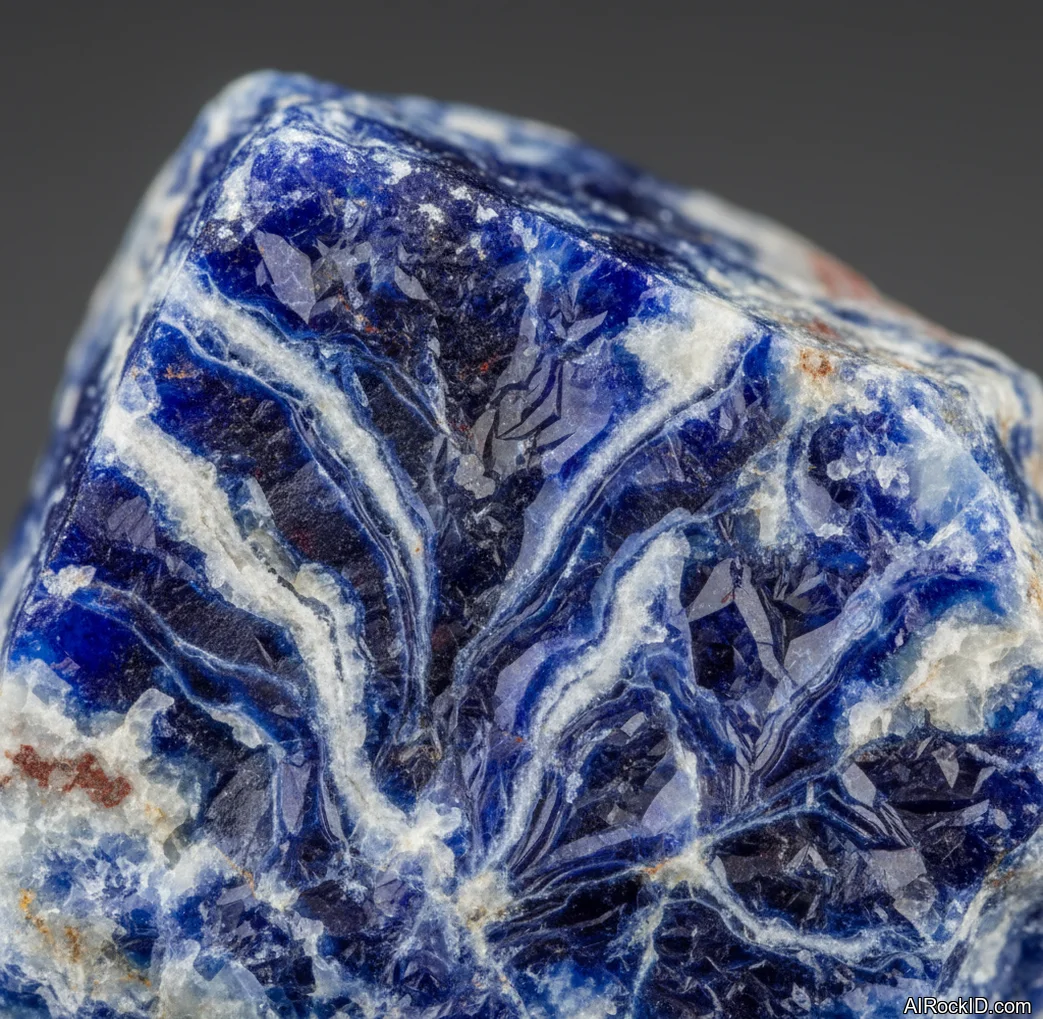
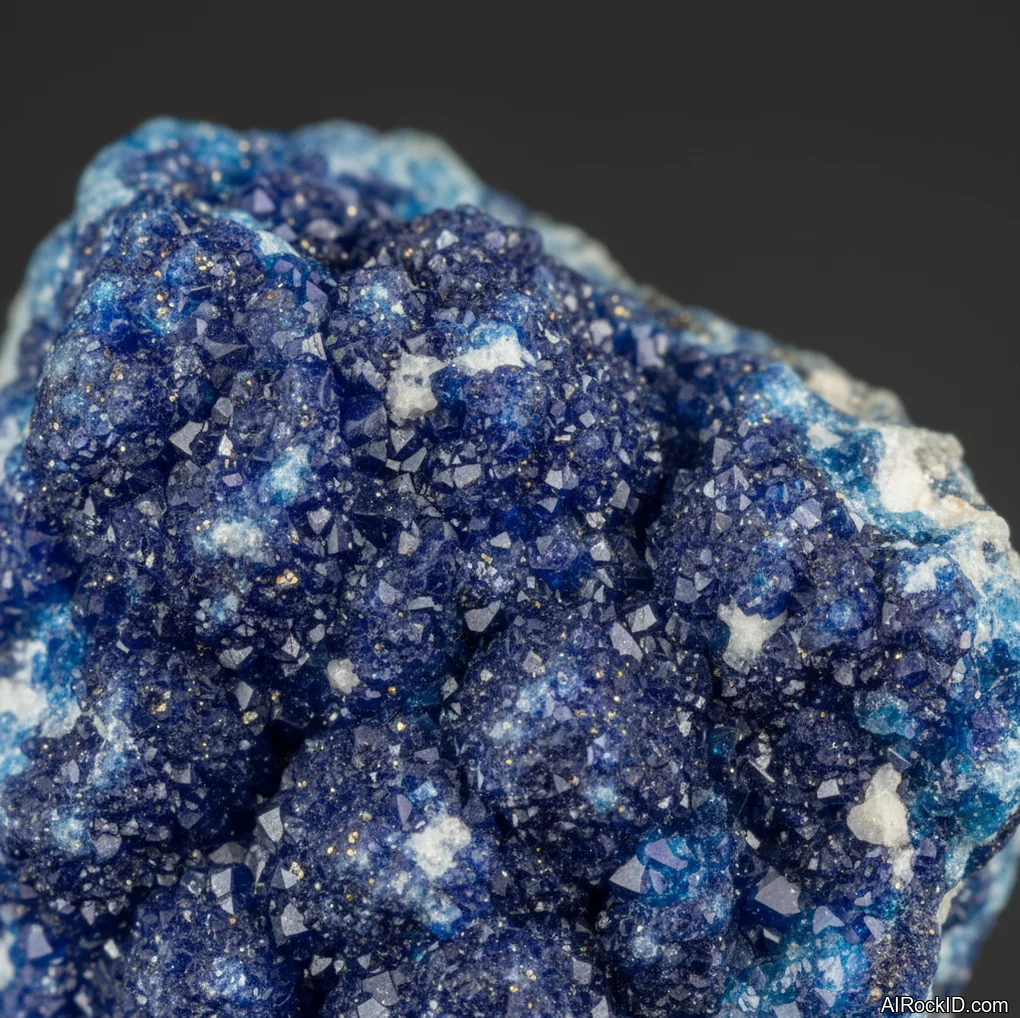
Hold a decent specimen in your hand and it’s got that cool, heavy, marble-like feel, except there’s this weird little surprise hiding inside. Most pieces are blue material sitting in white calcite or dolomite. Sometimes it flashes a slightly purpley lazurite vibe at first glance, but it doesn’t have lapis’ glittery pyrite look. Tip it under a shop light and the blue can swing from inky to smoky, and it really depends on how granular the piece is. Funny how much that texture changes the whole mood, right?
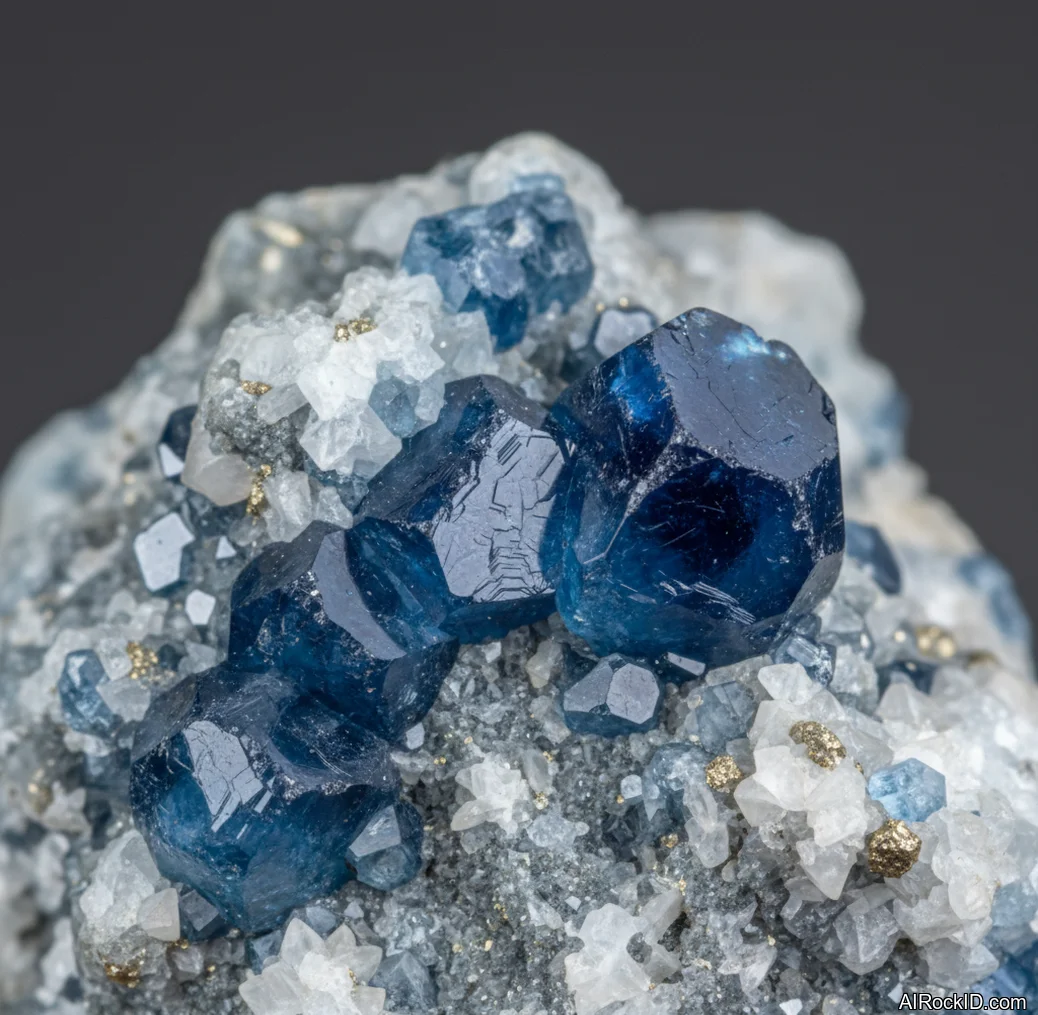
Clean, gemmy afghanite does exist. But it’s not what most dealers haul to a show. The more common material is massive and patchy, mixed up with other calc-silicate minerals, so you’re usually buying it for the color and contrast, not for crisp crystal form. And when you do spot actual crystal faces, they tend to be tiny and kind of stuck in there, the sort of thing you study with a loupe (nose almost to the case) instead of something you’d set in jewelry.
Origin & History
Afghanite got its first proper write-up in 1968, when A.A. Bariand, V.I. Beryozkin, and E.I. Nefedov described it from material collected in Badakhshan, Afghanistan. The name isn’t mysterious at all. It’s just geographic, and it stuck because those early blue chunks coming out of Afghanistan looked so unlike the usual cancrinite-group stuff.
As far as collectors go, it showed up slowly, in little spurts. I can still picture seeing it mis-tagged more than once, usually as “blue sodalite” or “lapis in marble” when a seller clearly didn’t feel like doing the whole new-mineral explanation. Thing is, once you’ve actually handled a few pieces, you start spotting it fast. The blue tends to be softer and a bit cloudy, and there’s often that white carbonate around it (that chalky rim that smudges the look). How many times have you seen that combo and thought, yeah, that’s not just sodalite?
Where Is Afghanite Found?
Best-known material comes from Badakhshan in Afghanistan, with other occurrences in high-grade marbles and skarns in places like Italy, Tajikistan, Russia, and a few small U.S. localities.
Formation
Raw pieces from Afghanistan usually come out of metamorphosed carbonate rocks. Stuff that started as plain limestone, then got cooked and squeezed until it turned into marble, with a bunch of chemical knock-on effects along the way.
Afghanite shows up in those high-temperature, silica-poor zones where feldspathoids make more sense than feldspars, and where sulfate and chloride can actually get trapped inside the structure. Thing is, it doesn’t just pop up anywhere.
Look closely at the matrix and you’ll often see it sitting with calcite, diopside, wollastonite, scapolite, and, in the broader district, sometimes lazurite or sodalite. It’s picky. “Right conditions only” kind of picky. So yeah, it stays rare even in a region people talk about for blue stones.
How to Identify Afghanite
Color: Most afghanite is medium to deep blue, sometimes gray-blue, and commonly mottled with white calcite or dolomite. Some pieces show pale zones or a slightly violet cast next to other blue minerals.
Luster: Vitreous to greasy on fresh surfaces, especially where the grain is tight.
At first glance it gets mistaken for sodalite or lapis, so I go straight to texture. Afghanite often looks a bit more “sugary” in the blue areas, and the boundary with white carbonate can be softer and more blended than sharp. If you scratch it with a steel nail, it may mark faintly but it shouldn’t gouge like calcite will. And under a loupe, you usually don’t see pyrite specks like lapis. The real test is a combination of context (marble/skarn matrix) plus the overall look, because hand-ID on blue feldspathoids is tricky without lab work.
Common Look-Alikes
Afghanite is sometimes confused with these materials:
- Lazurite / lapis lazuli (especially pyrite-poor lapis that looks flat blue in photos)
- Sodalite (massive blue with white veining, often sold as “lapis” too)
- Hackmanite (sodalite-group; can look like pale afghanite in white calcite, sometimes sold under loose “sodalite” labels)
- Blue calcite or blue dolomite (soft-looking blue patches in white carbonate matrix)
- Dyed howlite or dyed magnesite sold as “blue lapis” or “afghanite” (dye sits in cracks and drill holes)
- Blue glass or resin “lapis” blocks (too uniform, bubbles, and it warms up fast in the hand)
Market Cautions & Treatments
When AI Can Get This Wrong
At first glance, phone apps tend to call afghanite “lapis” or “sodalite” because all three show that same mid-to-deep blue against white calcite. Photos also miss the feel and the subtle grainy, patchy blue you see when you rock a real specimen under a shop light. The real test is simple: check hardness and texture in hand, and look for lapis clues (pyrite specks, more even blue) versus afghanite’s blue-in-white carbonate look with a slightly chalky matrix.
Properties of Afghanite
Physical Properties
| Crystal System | Hexagonal |
| Hardness (Mohs) | 5.5-6 (Medium (4-6)) |
| Density | 2.55-2.65 |
| Luster | Vitreous |
| Diaphaneity | Translucent to opaque |
| Fracture | Uneven |
| Streak | White |
| Magnetism | Non-magnetic |
| Colors | Blue, Gray-blue, White (in matrix) |
Chemical Properties
| Classification | Silicates (tectosilicate, feldspathoid) |
| Formula | (Na,K)22Ca10(Si,Al)24O96(SO4)6Cl6 |
| Elements | Na, K, Ca, Si, Al, O, S, Cl |
| Common Impurities | Fe, Mg |
Optical Properties
| Refractive Index | 1.50-1.53 |
| Birefringence | 0.003 |
| Pleochroism | Weak |
| Optical Character | Uniaxial |
Afghanite Health & Safety
It’s safe to handle and put on display. The real hazard shows up during lapidary work, when you’re grinding or cutting and those super-fine dust particles can get into the air (and your lungs). And if the piece still has matrix, watch it: cracked matrix can shed little bits of carbonate grit that feel like chalky sand.
Safety Tips
If you’re cutting or sanding, keep it wet. Use water, put on a proper respirator (not just a dusty paper mask), and wipe that slurry off your tools and work surface before it dries and turns into a crust you’ll be scraping off later.
Afghanite Value & Price
Price Range
Rough/Tumbled: $15 - $250 per specimen
Cut/Polished: $40 - $300 per carat
Price can bounce all over the place depending on how deep the blue looks and if it’s sitting in that clean, bright white matrix people like. Truly transparent, clean rough that you can actually facet is hard to come by, so real cut stones get expensive in a hurry.
Durability
Moderate — Scratch resistance: Fair, Toughness: Fair
It’s generally stable in normal display conditions, but it can chip along weak spots in mixed matrix pieces if it gets knocked around.
How to Care for Afghanite
Use & Storage
Store it in a padded box or a separate compartment, especially if it’s a blue-in-white matrix piece that can bruise on corners. I don’t let it rattle around with quartz points.
Cleaning
1) Rinse quickly with lukewarm water. 2) Use a soft toothbrush with a drop of mild soap to lift skin oils and show-dust. 3) Rinse and pat dry, then air-dry fully before putting it back in a box.
Cleanse & Charge
If you do energy-style cleansing, stick to gentle options like smoke, sound, or a dry bed of quartz. I skip saltwater because carbonate matrix can react over time.
Placement
A shaded shelf is fine, and a little side lighting makes the blue read deeper. Keep it away from the edge of a desk because it’s easy to chip.
Caution
Skip ultrasonic cleaners and anything too acidic. Those can bite into the carbonate matrix and, after a bit, you’ll notice grains starting to loosen (it’s like the surface goes slightly chalky under your fingers). And don’t do “scratch tests” on a polished face unless you truly don’t mind leaving a permanent mark. Why risk it?
Works Well With
Afghanite Meaning & Healing Properties
Compared to a lot of blue stones, afghanite just feels quieter in your hand. Not drowsy. Just steady. You pick up a cool, dense chunk and it has this calm-focus thing people talk about, especially when the blue is deep and the matrix is clean.
Most dealers will mention it right alongside lapis or sodalite, and sure, that’s a decent place to start, but it doesn’t land the same. To me, it comes off more like a thinking stone than a speaking stone. I’ve kept a palm-sized piece on my desk when I’m trying to stick to one task, and the most practical upside is basically this: it becomes a visual anchor. Blue, white, simple. (And yeah, it’s hard to ignore something that looks that crisp when you glance up.)
But look, there are limits. Any metaphysical take here is personal practice and tradition, not medicine, and it won’t replace real treatment for anxiety, sleep issues, or anything else. If you’re into chakras, afghanite usually gets tied to the throat and third eye, mostly because of the color and that clear-head association people like to pin on blue minerals. Why those two? That’s pretty much the reasoning.
Common mistakes
- Identifying any bright blue mineral as Afghanite without checking mineral group or locality
- Confusing lapis lazuli, which is a rock, with Afghanite, which is a single mineral species
- Assuming all Afghan material from Badakhshan is Afghanite
- Buying faceted Afghanite without asking for gemological confirmation
- Ignoring matrix minerals that can help distinguish Afghanite from hauyne or sodalite
- Using color saturation as proof of rarity or value
Identify Afghanite from a photo
Compare Afghanite traits, care tips, value clues, and common lookalikes with a clear photo.