Astrophyllite


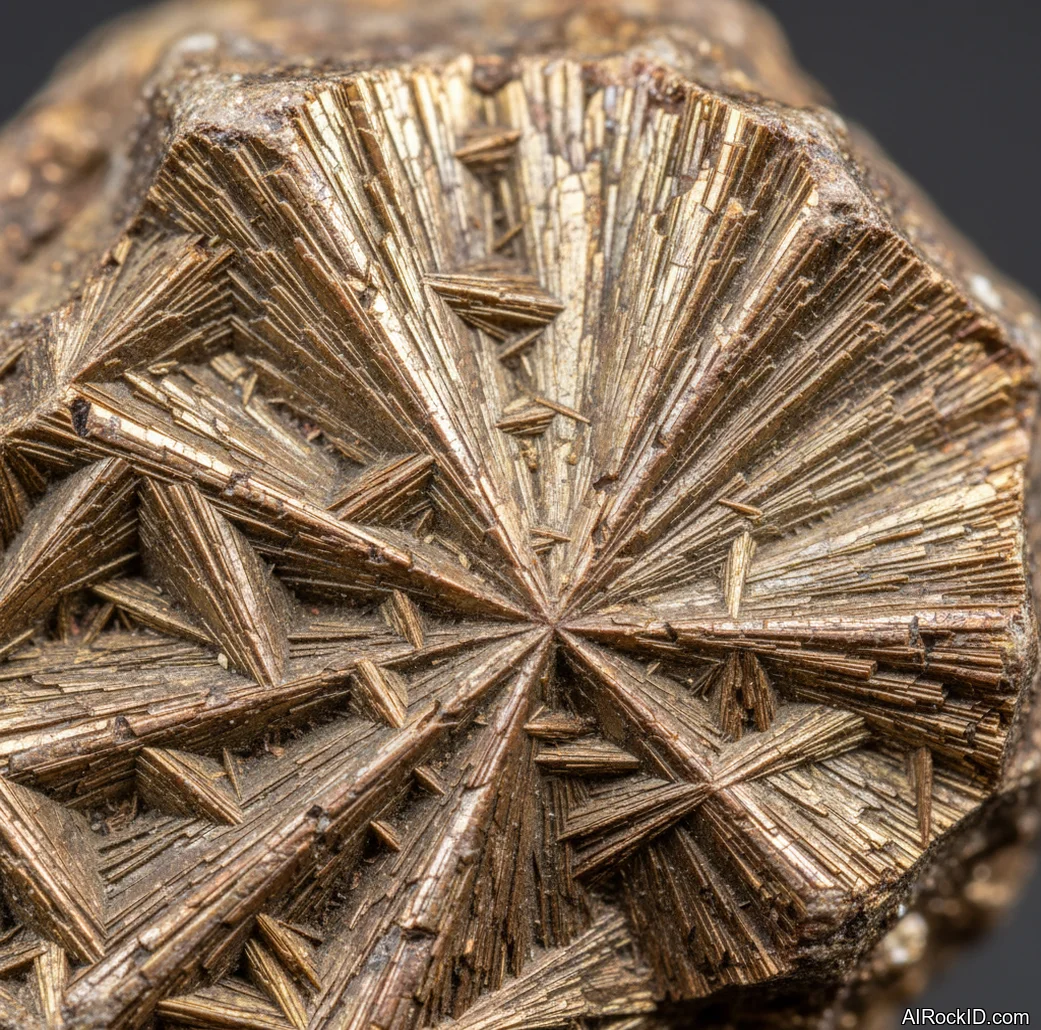
Quick answer: Astrophyllite is best recognized by thin bronze to golden-brown blades that form radiating, starburst-like sprays in a darker host rock. Because its appearance can overlap with arfvedsonite, mica, and altered amphibole minerals, identification is strongest when visual features are paired with locality, matrix, and basic mineral tests.
AI Rock ID can help compare an unknown specimen against astrophyllite lookalikes by checking color, crystal habit, luster, and host rock context. RockIdentifier.io provides visual identification support, but rare minerals such as astrophyllite may still require expert confirmation or lab testing for certainty.
Good fit
- Collectors who like rare minerals with metallic bronze flashes
- Specimens showing radiating sprays or starburst crystal habits
- Display pieces from alkaline igneous rocks such as nepheline syenite
- Buyers who can verify locality and avoid vague trade labels
Not a good fit
- Use in water, elixirs, or prolonged skin contact without mineral safety review
- Beginners seeking a very durable pocket stone
- Buyers who need a low-cost, widely available crystal
- Situations where a polished stone must be identified by appearance alone
Most commonly confused with
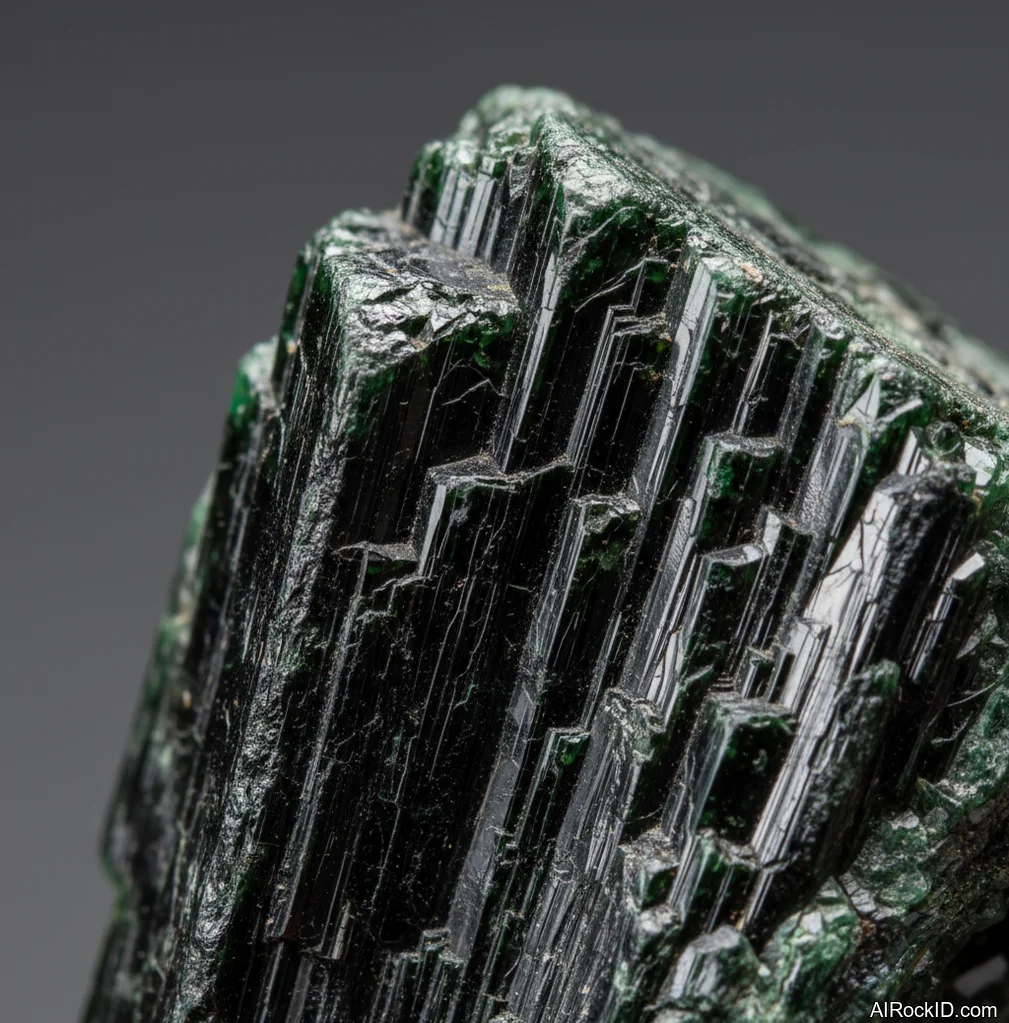
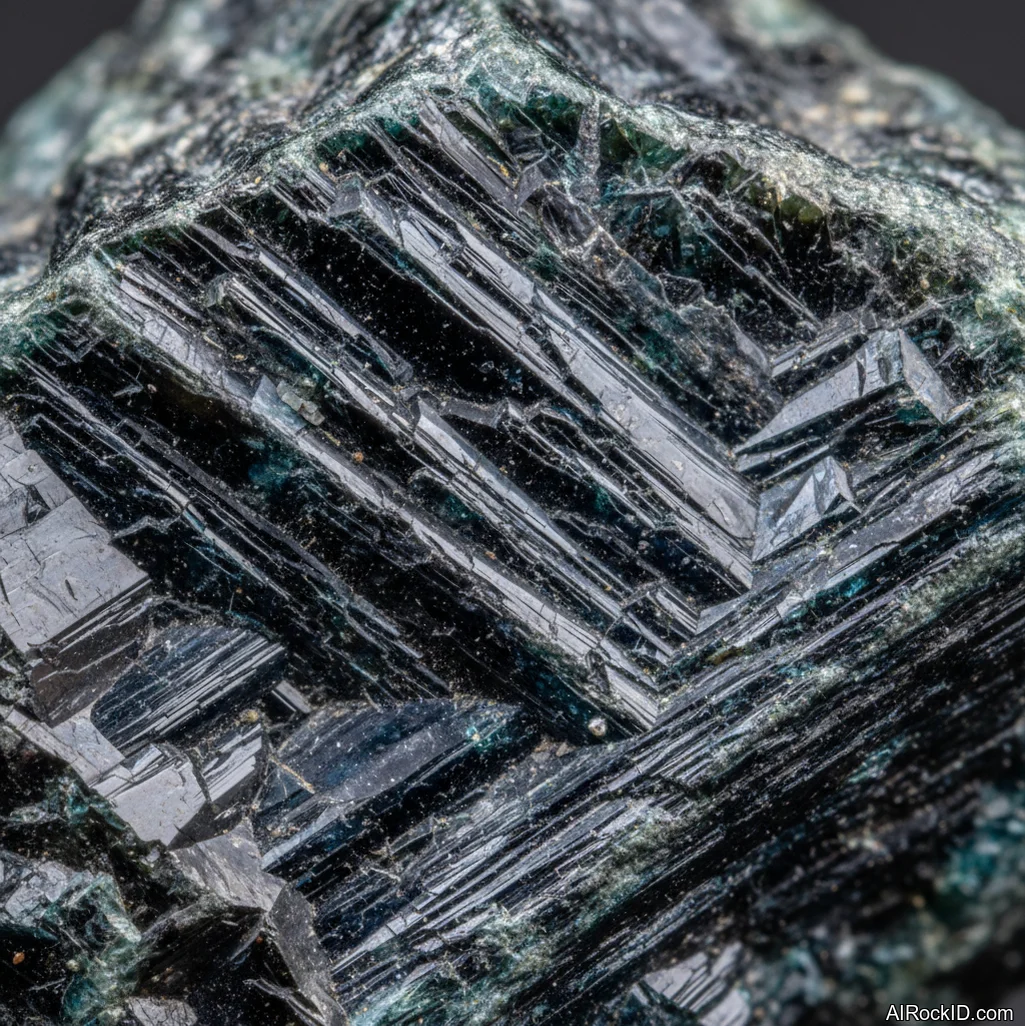
- Arfvedsonite: Usually dark blue-black to black with fibrous or prismatic crystals, lacking astrophyllite’s bronze starburst blades.
- Biotite: A dark mica that forms flexible sheets or flakes rather than stiff radiating bronze sprays.
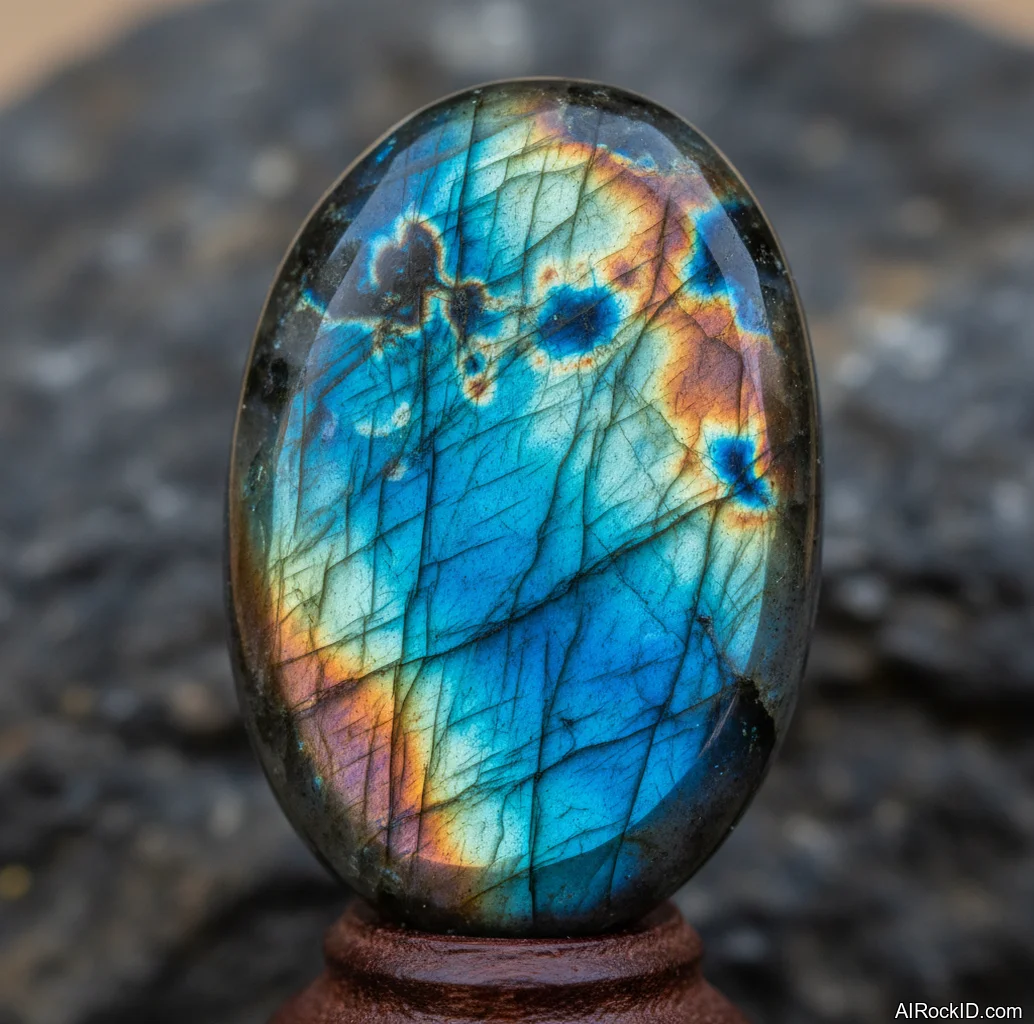
- Nuummite: Known for iridescent flashes in a dark metamorphic rock, not radiating titanium-silicate blades.
- Bronzite: Shows bronze schiller in massive or granular pyroxene, not thin star-like sprays in matrix.
Astrophyllite vs. Similar Dark Flashy Minerals
| Specimen | Typical visual clue | Main difference |
|---|---|---|
| Astrophyllite | Bronze-gold blades in radiating sprays | Starburst habit in alkaline igneous matrix |
| Arfvedsonite | Black to blue-black fibrous or prismatic crystals | Usually darker and less bronze-metallic |
| Biotite | Dark brown to black flaky sheets | Splits into flexible mica layers |
| Nuummite | Iridescent flashes in dark rock | Flash is internal schiller, not blade sprays |
| Bronzite | Bronze sheen in massive brown stone | Granular or massive texture rather than radial crystals |
AI identification confidence
AI identification is usually moderate when astrophyllite shows clear bronze radiating sprays in a contrasting matrix. Confidence drops for tumbled, polished, dark, or low-resolution specimens because several iron-rich and amphibole minerals can produce similar flashes.
When AI gets it wrong
- The photo shows only a polished surface without visible blade structure
- Lighting creates artificial gold or bronze reflections
- The specimen is labeled by trade name without locality information
- Dark amphiboles, mica, or schiller minerals are present in the same rock type
Final recommendation
For buying, prioritize specimens with visible radiating bronze blades, a reliable locality, and clear photos taken in natural light. For identification, treat visual results as preliminary when the stone is polished or sold only under a broad trade name.
How to Spot Real Astrophyllite When Buying
Real astrophyllite commonly appears as bronze to golden-brown, blade-like crystals arranged in sprays or starbursts within a darker host rock. Be cautious of listings that use only vague terms such as “gold flash stone” without close-up photos, locality, or mineral context. A credible listing should show the crystal habit clearly rather than relying only on bright lighting or polished reflections.
Typical Locality Clues
Astrophyllite is most associated with alkaline igneous environments, especially nepheline syenite and related pegmatitic rocks. Well-known sources include parts of Norway, Russia’s Kola Peninsula, Greenland, Canada, and the United States. Locality alone does not prove identity, but it can help separate astrophyllite from unrelated flashy decorative stones.
Simple Non-Destructive Checks
A hand lens can help confirm whether the metallic-looking areas are actual thin blades rather than random glitter or surface polish. Astrophyllite is not identified by color alone, so compare habit, luster, matrix, and seller documentation together. Avoid scratch or acid tests on collectible specimens, as they can permanently damage the surface.
What Is Astrophyllite?
Astrophyllite is a rare titanium-bearing silicate mineral that grows in bladed, radiating sprays, and it throws this bronze-to-gold flash against a dark matrix.
Pick up a decent hand specimen and two things hit you fast. First, it’s heavier than you expect for something that, at a glance, reads like a flaky mica. Second, the shine isn’t some flat, sheet-metal glare. It’s individual little blades grabbing the light one at a time as you roll the rock in your fingers. I’ve had pieces that look “meh, brown” on the table, then you tip them under a desk lamp and suddenly it’s a full-on golden starburst. Same stone. Different angle. Wild, right?
Most of what you’ll see for sale is astrophyllite sitting in black rock, usually nepheline syenite or related material, with those sprays that look like fireworks caught mid-burst. But thing is, it’s not a tough mineral. Those thin blades can chip and fray along the edges if you just toss it in a pocket with harder stones (you’ll see little ragged spots where it took a hit).
Origin & History
You can thank Norway for the name. Astrophyllite was first described in 1854 by the Norwegian mineralogist Paul Christian Weibye, working with material from the Låven (Løvøya) area near Brevik, in the Larvik region.
The name’s straight from Greek: astron (star) and phyllon (leaf). And yeah, that’s the whole vibe. When those bladed crystals fan out, they throw these starburst shapes that look like little leaves, especially when you tilt the piece and let a low, raking light skim across the surface (you’ll see it pop at the edges first).
Where Is Astrophyllite Found?
It shows up in alkaline igneous complexes and pegmatites. Collector-grade pieces most often come from Russia’s Kola Peninsula, Norway’s Larvik area, Mont Saint-Hilaire in Canada, and a few classic alkaline districts in the USA and Brazil.
Formation
Astrophyllite shows up pretty late, basically when an alkaline magma body is cooling down and the last bit of melt is packed with odd chemistry. Think sodium-rich, titanium-bearing fluids moving through nepheline syenite, pegmatites, plus the related veins that cut through them. It’s the same sort of setting that kicks out other “collector minerals” you just don’t see in regular granite.
Look, if you stare at the crystal habits for a minute, you can almost watch how it grew. Those bladed crystals usually come in sprays and fans, and they’ll pack into pockets and seams alongside feldspar, nepheline, aegirine, and sometimes translucent things like fluorite. But that blade shape is also the problem. Thin stuff. It’ll cleave and flake if the piece takes a knock (even a small one).
How to Identify Astrophyllite
Color: Most astrophyllite looks bronze, golden-brown, or coppery on a dark gray to black matrix. In some lighting it goes almost chocolate-brown, then snaps back to gold when you tilt it.
Luster: Pearly to submetallic on cleavage surfaces, with a flashy bronzy reflection on the blades.
Pick up the specimen and tilt it under a single strong light. Real astrophyllite “winks” blade by blade, like a bundle of tiny mirrors, instead of giving you an even glitter. The real test is the feel and the breakage: the sprays are slightly crumbly at the tips, and you can sometimes see perfect cleavage faces if a blade has popped off. And don’t confuse it with bronzite or tiger’s eye slabs, which have a smooth, silky banding and no radiating sprays in matrix.
Common Look-Alikes
Astrophyllite is sometimes confused with these materials:
- Bronzite (enstatite) with schiller, especially when astrophyllite blades are tight and look like a single bronze sheen
- Biotite mica books or “mica in matrix” specimens, since both can read as flaky bronze-brown in photos
- Golden mica (phlogopite) in dark rock, sold as “golden starburst mica” when the blades are small
- Arfvedsonite or aegirine in nepheline syenite, when the black matrix and needle-like textures get lumped together by sellers
- Goldstone glass (brown/gold glitter glass) sold as “astrophyllite palm stone” or “astrophyllite cab,” especially in polished shapes
Market Cautions & Treatments
When AI Can Get This Wrong
At first glance, phone pics turn astrophyllite into “bronze shimmer in black rock,” so AI regularly calls it bronzite, biotite mica, or even goldstone if the polish is high. The real test is motion and texture: tilt it under a single light and you should see separate blades flashing one-by-one in radiating sprays, not a uniform sheen or evenly spaced glitter. If you’ve got the piece in hand, a quick hardness reality check helps too, because astrophyllite is soft and will scuff and shed along cleavage far easier than bronzite.
Properties of Astrophyllite
Physical Properties
| Crystal System | Triclinic |
| Hardness (Mohs) | 3 - 4 (Soft (2-4)) |
| Density | 3.2 - 3.4 |
| Luster | Pearly |
| Diaphaneity | Opaque |
| Fracture | Uneven |
| Streak | yellowish brown |
| Magnetism | Non-magnetic |
| Colors | bronze, golden brown, coppery brown, brown, black |
Chemical Properties
| Classification | Silicates |
| Formula | K2NaFe7Ti2Si8O26(OH)4 |
| Elements | K, Na, Fe, Ti, Si, O, H |
| Common Impurities | Mn, Mg, Ca |
Optical Properties
| Refractive Index | 1.67 - 1.71 |
| Birefringence | 0.04 |
| Pleochroism | Strong |
| Optical Character | Biaxial |
Astrophyllite Health & Safety
It’s usually safe to handle. The real issue is when a blade chips or snaps and you get those sharp, flaky little splinters along the break (they’ll catch on your fingertip before you even see them).
Safety Tips
If you’re trimming matrix or snapping off pieces, put on eye protection and try not to breathe in any of that host-rock dust (it hangs in the air longer than you’d think).
Astrophyllite Value & Price
Price Range
Rough/Tumbled: $30 - $400 per specimen
Cut/Polished: $20 - $120 per carat
Prices can jump all over the place depending on how punchy the starburst looks, whether the blades are still intact (no chips along the edges), and how dark and clean the matrix is. And the big sprays, especially the ones that flash across the entire face when you tilt it in your hand, are the ones that pull the serious money.
Durability
Fragile — Scratch resistance: Poor, Toughness: Poor
It’s stable sitting on a shelf, but the bladed crystals chip and flake easily if it’s bumped or handled roughly.
How to Care for Astrophyllite
Use & Storage
Store it by itself or wrapped, because harder stones will chew up the blades fast. I keep mine in a small flat box so nothing presses on the sprays.
Cleaning
1) Use a soft, dry brush to lift dust out of the radiating blades. 2) If needed, rinse quickly with lukewarm water and a drop of mild soap. 3) Pat dry and let it air-dry fully before putting it away.
Cleanse & Charge
If you do energy-style care, keep it simple: smoke, sound, or a quick pass under running water works for most pieces. Don’t leave it soaking just because you can.
Placement
A low-traffic shelf is best. Angled light helps a lot, so try it near a lamp where you can tilt it and catch the gold flash.
Caution
Skip ultrasonic cleaners, steam cleaning, and definitely don’t toss it in a tumbler where it’ll rattle around and get knocked up. And don’t carry it loose in a pocket or bag with quartz, garnet, or anything else hard.
Works Well With
Astrophyllite Meaning & Healing Properties
A lot of metaphysical sellers talk about astrophyllite like it’s a “flip the switch” stone. Like you pick it up and, bam, you stop looping the same thoughts. I get why they say that. When you’ve actually got a piece in your hand, it’s got this solid, grounding heft, and the starry flash isn’t subtle. It yanks your attention back. Your eyes keep snapping to the same bright blades, especially when you tilt it a little and the light catches.
But look, I’m going to be straight about it: it’s not medicine. If crystals are part of your personal routine, I think astrophyllite works best as a focus tool. Grab a palm-sized piece. Feel that cool, slightly slick surface (the kind that warms up in your hand after a minute). And then use the sparkle as a visual “here” point while you journal or map out next steps. Short sessions tend to work better than leaving it on a shelf and forgetting it’s even there.
Thing is, there’s a practical shadow side to how it gets sold. Some listings slap the name “astrophyllite” on any bronze shimmer in black rock, and then people open the package expecting a huge golden burst and… nope. Just a dull brown patch. If you’re buying it for energy work, you still want the real optical punch. That flash is what your brain actually reacts to when you’re turning it under a light.
Common mistakes
- Identifying any dark stone with gold flash as astrophyllite
- Confusing polished nuummite or bronzite with blade-form astrophyllite
- Assuming a strong flash in photos is natural rather than lighting-related
- Ignoring the host rock and crystal habit during identification
- Buying without checking locality, close-up photos, or return policy
Identify Astrophyllite from a photo
Compare Astrophyllite traits, care tips, value clues, and common lookalikes with a clear photo.