Black Banded Onyx
What Is Black Banded Onyx?
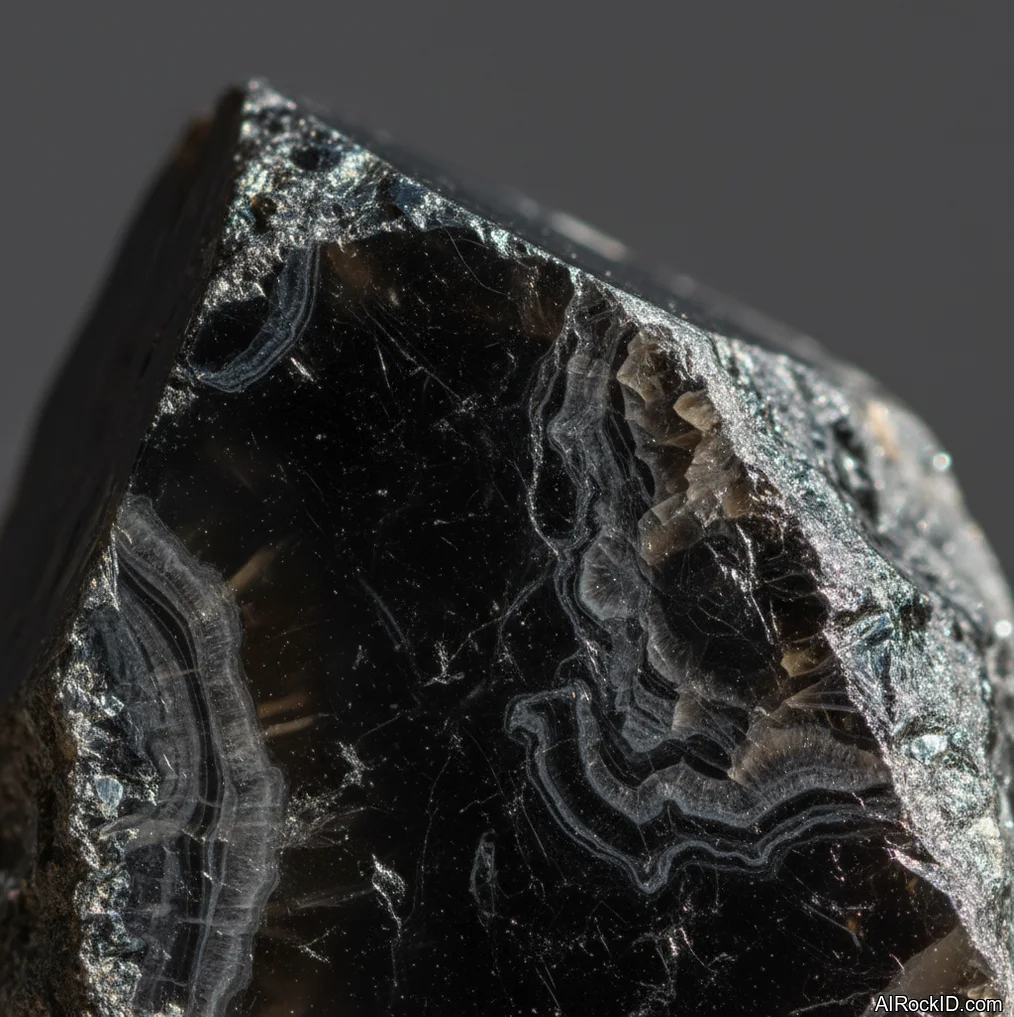
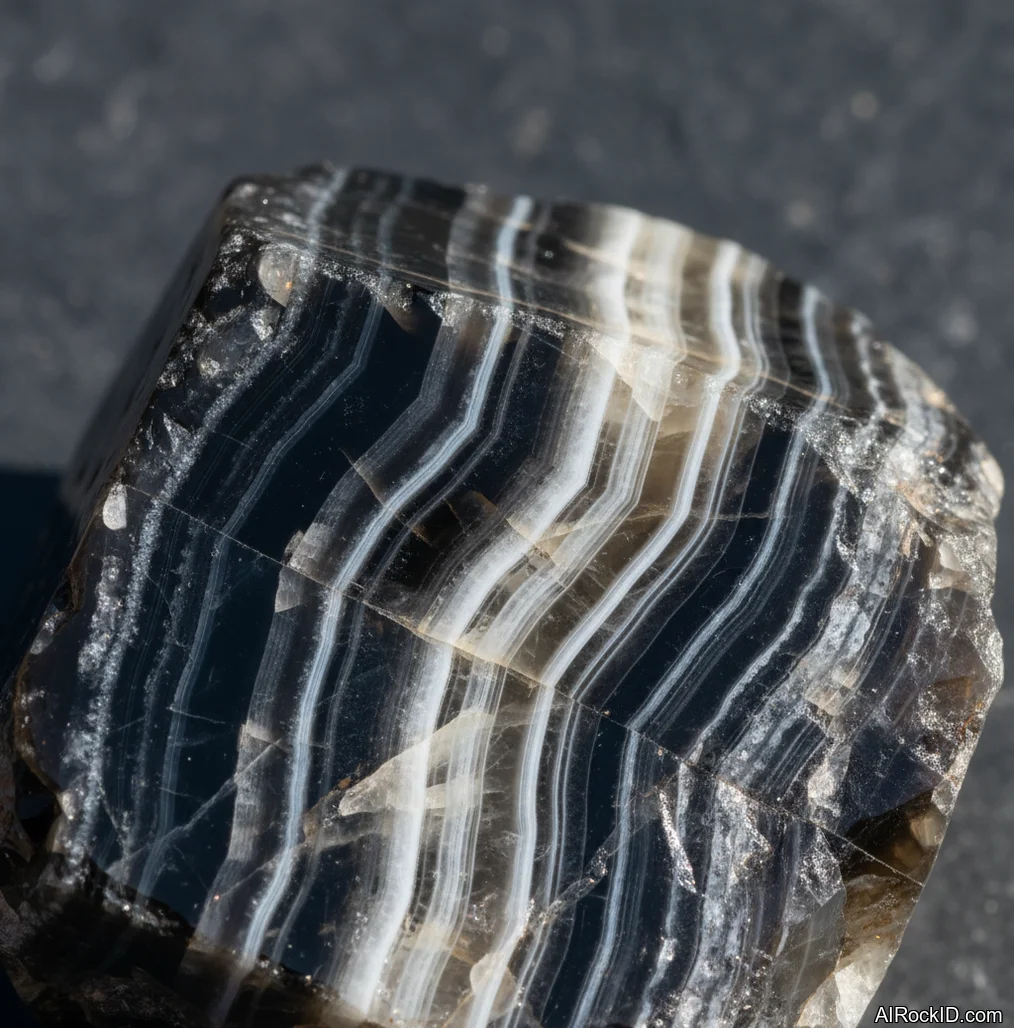
Black Banded Onyx is a banded variety of chalcedony (microcrystalline quartz), laid down in parallel layers that run black and white to gray. It feels like quartz in your hand because it is quartz, but there’s also that smoother, slightly waxy glide you get from really fine-grained silica. Grab a tumbled piece and it stays cool longer than glass or plastic, and it has this solid, honest weight for its size.
People usually expect jet-black with crisp white stripes at first, kind of like a cartoon drawing of a banded stone. But real material’s more restrained. The “white” bands tend to read milky or smoky gray, and the black can look more charcoal once you’re in bright light. And if you actually stare at it up close, the band edges aren’t always razor sharp. Sometimes you’ll catch tiny clouds, little wisps, or a faint translucence in the thinnest layers, especially when you hold it up to a phone flashlight (you can see the glow sneak through).
Most of what’s for sale is polished, since raw chunks of banded chalcedony don’t exactly shout from a table. But cut into a cab, those straight bands do something weirdly satisfying. Clean lines. No sparkle. Just pattern.
Origin & History
“Onyx” comes from the Greek *onyx*, which means “claw” or “fingernail.” It was originally used for banded stones where a pale layer sits on top of a darker one (kind of like a nail with that lighter tip over the pinkish bed). And for a long time, the names got sloppy: onyx and banded agate were basically lumped together, way before modern mineral ID tools made it easy to tell one from the other.
In today’s trade, “black onyx” is a lot messier than most people think. A ton of the plain black chalcedony you see for sale has been dyed, and it still gets labeled as onyx anyway. Black Banded Onyx, the way collectors usually mean it, is the naturally banded chalcedony that already has those light and dark layers without needing a dye bath. But you’ll still run into sellers stretching the name.
Where Is Black Banded Onyx Found?
Banded chalcedony used as black banded onyx comes from volcanic and sedimentary silica deposits worldwide, with big commercial output from Brazil, India, and Madagascar.
Formation
Picture silica gel, but left alone long enough to get its act together. Chalcedony forms when silica-rich fluids slip through little cavities and hairline cracks in rock, then lay down microcrystalline quartz in thin layers. It stacks up the way a tide line creeps up a cave wall, just painfully slow, and it happens a lot in volcanic rocks because gas bubbles used to sit there and leave behind empty pockets.
The banding shows up because the chemistry and the conditions keep changing while the material’s being deposited. Tiny shifts. A touch more iron in one layer, a slightly different oxidation state in the next, maybe the fluid sped up or slowed down as it moved through the space. So, over time you end up with those parallel stripes that look weirdly engineered. But it’s not perfect, and that’s the point. The bands can pinch, widen, or curve around older features, and if you’ve ever looked closely at a piece in your hand (tilting it in the light helps), that unevenness is one of the giveaways you’re seeing a natural process, not a printed pattern.
How to Identify Black Banded Onyx
Color: Typically black to dark gray bands alternating with white, light gray, or milky bands in fairly parallel layers. Some pieces show brownish-gray transitions rather than pure black and white.
Luster: Waxy to vitreous luster when polished; duller and more matte on rough surfaces.
Pick up a strand of beads and rub two together. Chalcedony has a slick, glassy-waxy feel, not the plasticky drag you get from resin. If you scratch it with a steel nail, it won’t bite easily, but a quartz point will mark it. The problem with dyed black “onyx” is the color can look too uniform and too inky, and dye can concentrate in fractures or drill holes, so check the bead holes with a loupe.
Properties of Black Banded Onyx
Physical Properties
| Crystal System | Trigonal |
| Hardness (Mohs) | 6.5-7 (Hard (6-7.5)) |
| Density | 2.58-2.64 |
| Luster | Waxy |
| Diaphaneity | Translucent to opaque |
| Fracture | Conchoidal |
| Streak | White |
| Magnetism | Non-magnetic |
| Colors | Black, Dark gray, White, Light gray, Smoky gray |
Chemical Properties
| Classification | Silicates |
| Formula | SiO2 |
| Elements | Si, O |
| Common Impurities | Fe, Mn, C |
Optical Properties
| Refractive Index | 1.530-1.543 |
| Birefringence | 0.004 |
| Pleochroism | None |
| Optical Character | Uniaxial |
Black Banded Onyx Health & Safety
Black Banded Onyx is non-toxic, so it’s fine to handle. But the second you start cutting or grinding it, you can kick up respirable silica dust (that super-fine stuff that hangs in the air and gets in your nose). So, treat it the same way you’d treat any quartz when you’re doing lapidary work.
Safety Tips
Use wet grinding, and if you’re sanding or cutting, put on a real respirator, not just a dust mask. Don’t dry-grind chalcedony on a wheel. The fine dust gets everywhere (you can feel it stick to your lips and the inside of your nose), and it’s not worth the risk.
Black Banded Onyx Value & Price
Price Range
Rough/Tumbled: $2 - $20 per palm stone or small rough piece
Cut/Polished: $1 - $8 per carat
Price mostly comes down to how crisp and straight the banding is, plus how the polish actually looks in your hand under a light. If the bands are thick and high-contrast, and you’ve got a bigger chunk of carving rough, you’re going to pay more. But if the banding turns muddy gray (that kind of smeary look you see when you tilt it), it usually sells cheap.
Durability
Durable — Scratch resistance: Good, Toughness: Good
It holds up well in daily handling, but a hard knock can still chip edges because chalcedony breaks with a conchoidal fracture.
How to Care for Black Banded Onyx
Use & Storage
Keep it in a soft pouch if it’s polished, because it’ll scuff softer stones and can get scuffed by harder stuff like corundum. And don’t toss it loose with metal jewelry if you care about the shine.
Cleaning
1) Rinse with lukewarm water and a drop of mild soap. 2) Use a soft toothbrush around grooves or bead holes. 3) Rinse well and dry with a microfiber cloth to keep water spots off the polish.
Cleanse & Charge
If you do ritual cleansing, running water or smoke cleansing works fine for chalcedony. I avoid salt baths for polished pieces only because salt can leave a crust in tiny pits and drive me nuts.
Placement
On a desk it’s great as a worry stone because the surface stays cool and the bands give your eyes something to settle on. If you display it in sun, keep in mind some dyed material can fade, so store questionable pieces out of a bright windowsill.
Caution
Don’t use an ultrasonic cleaner on anything carved or already cracked. It’ll rattle those weak spots and can make a small fracture creep. And skip harsh acids or bleach too, because they’ll slowly take the shine down and leave the surface looking kind of tired. If you’re cutting or grinding, treat the dust like the problem it is. Silica dust gets everywhere, hangs in the air longer than you expect, and it’s not something you want in your lungs. So set up dust control and wear proper respiratory protection.
Works Well With
Black Banded Onyx Meaning & Healing Properties
A lot of dealers pitch Black Banded Onyx like it’s mood armor. I don’t buy it like that. To me, it’s just a steady stone with a clear pattern, and that visual order is exactly why people grab it when their brain feels loud. Hold a banded piece and your thumb starts tracing the stripes without you even thinking about it. Back and forth. Repetitive. That’s the whole trick.
And compared to flashier stones like labradorite, it doesn’t try to steal the show. It just sits there and behaves. When I’m sorting flats at a show, lights buzzing overhead, hands dusty from handling trays all day, a banded onyx palm stone is what I’ll shove in my pocket because it’s smooth, cool at first touch, and predictable every single time. But if you’re hoping for some big emotional “release” stone… yeah, this usually isn’t that. It’s more like tape on a moving box. Practical. Not poetic.
Thing is, metaphysical folks tie it to grounding, boundaries, keeping your attention from leaking all over the place. I can live with that wording if we keep it in the right lane. It’s not medical care. It doesn’t replace therapy, sleep, or any of that real-life stuff. What it can do, though, is give you a physical cue. A small reminder sitting in your hand (or rubbing against your pocket seam) that you can slow down and pick the next step on purpose. Who couldn’t use that sometimes?
Identify Any Crystal Instantly
Snap a photo and get properties, value, care instructions, and healing meanings in seconds.