Sardonyx
What Is Sardonyx?
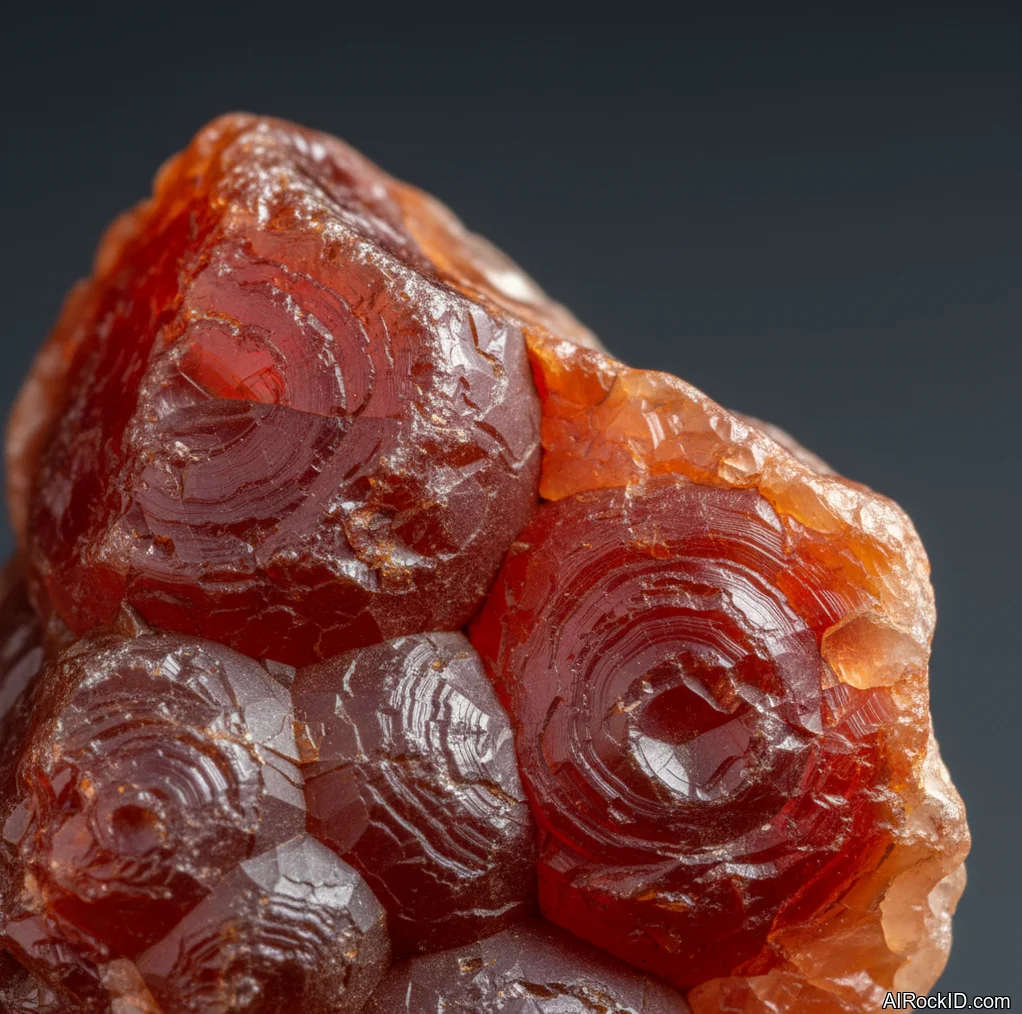
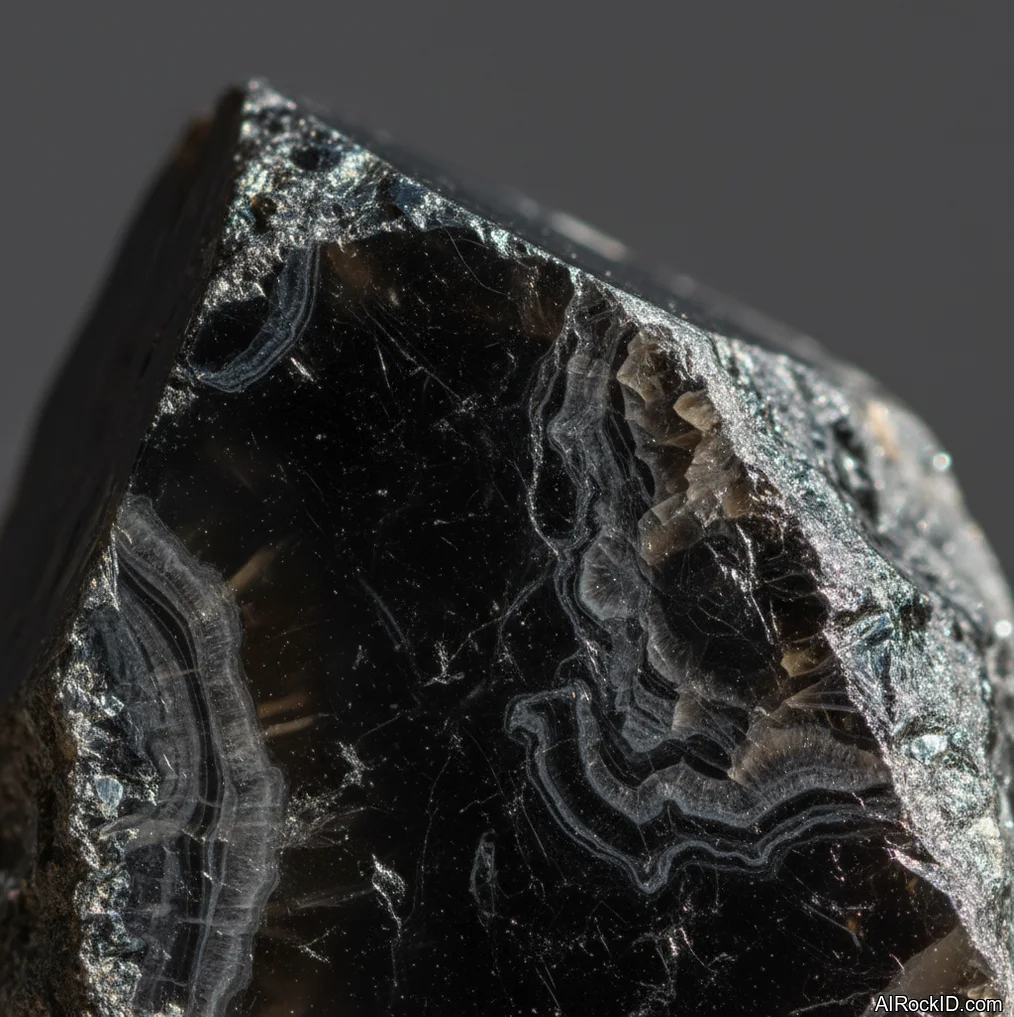
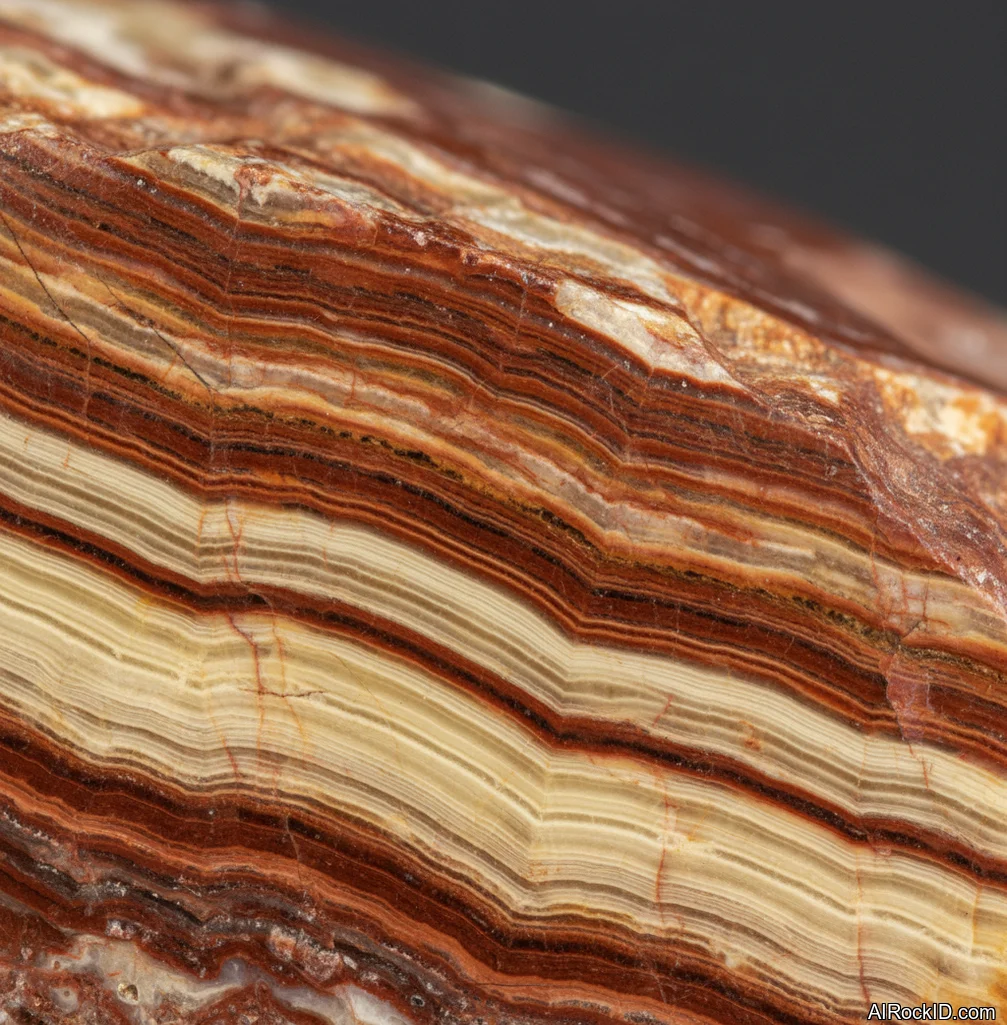
Sardonyx is a banded variety of chalcedony (microcrystalline quartz) made up of sard layers (reddish-brown) stacked with onyx layers (usually white, gray, or black).
Look, when you pick up a decent piece, the first thing you clock is the feel. It has that classic chalcedony heft, not heavy like hematite, but somehow denser than your eyes expect, and it stays a little cool against your skin even after you’ve been holding it for a minute. The bands can be razor-straight, like somebody took a ruler to it. But they can also wobble, taper, then disappear, especially on tumbled stones where the cutter clearly chased the best color and let the stripes do whatever they were gonna do.
Most of what you’ll see for sale is polished. And that’s totally fine, because sardonyx shows best with a smooth face, where you can literally trace the stripes around it like a contour map. Just don’t mix it up with “just onyx.” Real sardonyx has that warm brick-red to chestnut layer somewhere in the stack (you can usually spot it when the light hits right), not only black and white.
Origin & History
Thing is, the name’s basically a mash-up. “Sard” points to that red-brown chalcedony (the stuff long tied to the old term sardius), and “onyx” is there for the straight, parallel banding.
And people have been carving it forever, because those layers act like a built-in backdrop for cameos and seals. You can actually feel it when you’re working it too, the cut hits a layer and the color shift is instant. It’s like the stone’s already telling you where the design is supposed to sit.
So you’ll run into “sardonyx” a lot more in older lapidary books and in classical jewelry talk than you will in modern mineralogy texts, since it’s a trade and gem term, not a separate species. In gem markets, dealers still call it “sardonyx” when the red-brown and lighter bands are crisp enough to read from across the table. Clean bands. No muddy fade. That’s the whole point, right?
Where Is Sardonyx Found?
Sardonyx turns up anywhere chalcedony forms in volcanic rocks, with major cutting-grade material historically coming from India and Brazil and plenty of banded agate/chalcedony sources worldwide.
Formation
Most sardonyx kicks off the same way a lot of agates do: silica-rich fluids sneaking through cavities and fractures in volcanic rock. Think of old basalt that’s full of little gas bubbles and hairline cracks, the kind you can feel with a fingernail if you’ve got a rough chunk in your hand. Over time, those open pockets get coated, then slowly stuffed, with layer after layer of microcrystalline quartz.
The banding is really a chemistry plus timing thing. Tiny changes in impurities and iron content can swing the color from milky white to gray to that sard red-brown. The layers stack up like tree rings, only these “rings” come from pulses of fluid and shifting conditions, not seasons. And yeah, some of what you see for sale is dyed to boost the contrast, because chalcedony soaks up dye way too easily (almost annoyingly well, honestly).
How to Identify Sardonyx
Color: Look for straight to gently curved bands that alternate white/gray/black with reddish-brown sard layers. The red is usually earthy, like brick or cinnamon, not neon.
Luster: Waxy to vitreous luster on polished surfaces.
Pick up the stone and check the band edges under a strong light. Natural banding usually has tiny soft transitions or micro-waves, while dyed stuff can look too flat and inky in the dark layers. If you scratch it with a steel nail, it shouldn’t take a scratch easily, but the nail will leave a faint metal streak you can rub off. The real test is a loupe: you won’t see grains, just a tight, almost “sugary-smooth” chalcedony texture and crisp layers.
Properties of Sardonyx
Physical Properties
| Crystal System | Trigonal |
| Hardness (Mohs) | 6.5-7 (Hard (6-7.5)) |
| Density | 2.58-2.64 |
| Luster | Waxy |
| Diaphaneity | Translucent to opaque |
| Fracture | Conchoidal |
| Streak | White |
| Magnetism | Non-magnetic |
| Colors | red-brown, white, gray, black, cream, orange-brown |
Chemical Properties
| Classification | Silicates (tectosilicate, quartz group) |
| Formula | SiO2 |
| Elements | Si, O |
| Common Impurities | Fe, Mn, Ni, C |
Optical Properties
| Refractive Index | 1.530-1.540 |
| Birefringence | 0.004 |
| Pleochroism | None |
| Optical Character | Uniaxial |
Sardonyx Health & Safety
Sardonyx is a non-toxic quartz chalcedony, so it’s fine to handle, and you can rinse it off under the tap without worrying about it. But it’s still silica, so if you’re cutting or grinding it, don’t breathe in the dust. (That fine, gritty powder gets everywhere, too.)
Safety Tips
If you’re going to lapidary it, keep it wet the whole time and don’t skip the respirator. You want one that’s actually rated for fine silica dust, not just a flimsy mask.
Sardonyx Value & Price
Price Range
Rough/Tumbled: $5 - $60 per tumbled stone or cabochon
Cut/Polished: $2 - $15 per carat
Price shoots up when the banding is crisp and runs nice and parallel, and when the sard layer is strong and not all muddy-looking. Big slabs with clean, even stripes cost more because cutters can lay out the pattern on purpose (instead of guessing) and pull matched pairs that actually line up.
Durability
Durable — Scratch resistance: Good, Toughness: Good
It holds up well in daily handling, but polished surfaces can dull if they’re tossed loose with harder stones or gritty quartz points.
How to Care for Sardonyx
Use & Storage
Store it in a pouch or a divided box if you care about the polish. It’ll survive a pocket, but keys and sand will haze it over time.
Cleaning
1) Rinse with lukewarm water. 2) Use a drop of mild soap and a soft brush for skin oils. 3) Rinse again and dry with a microfiber cloth.
Cleanse & Charge
A quick rinse and a wipe-down is usually all it needs for day-to-day. If you do energetic cleansing, stick to gentle methods like moonlight or a dry bed of rice and avoid harsh salt scrubs on polished pieces.
Placement
On a desk, sardonyx looks best where side light can skim the bands and make them pop. I keep a flat slice near a window but not in direct sun all day, since some dyed material can fade.
Caution
Don’t put glued settings or doublets in an ultrasonic cleaner. Just don’t. The vibration and heat can mess with the glue fast, and you’ll sometimes see the stone shift a hair right after. And if the color looks almost too perfect, treat it like it might be dyed. Keep it away from long sun sessions, and don’t let it soak around chemicals either. Why risk it?
Works Well With
Sardonyx Meaning & Healing Properties
Next to the flashier stones, sardonyx just feels… practical. In my own stash, it’s the one I reach for when I want something that sits heavy and steady in my hand through a long day, like a worry stone that won’t chip if you fumble it. The bands are a big part of that. Your thumb kind of locks onto the stripes and keeps moving along them, and the whole piece looks “lined up” and orderly, which is probably why people connect it with discipline and actually finishing what you start.
On the metaphysical side, most dealers lean hard on protection and grounding with sardonyx, and yeah, I see the logic. The darker layers give it a guarded, keep-your-feet-planted feel, and the warmer sard layer keeps it from coming off icy or too harsh. But look, I’m going to be blunt: it’s still quartz. If you’re expecting fireworks, you’re going to be let down. What it’s good at is the quiet, steady kind of support you notice after you’ve carried it for a week, not ten minutes.
Anything health-related? Treat the stories as stories. Use it as a focus object, a little nudge to stay consistent, or something tactile to hold during meditation (especially when your mind won’t sit still). Keep actual medical stuff with actual medical professionals. Still, I’ve watched customers at shows pick up sardonyx and their shoulders drop right away because it feels smooth, cool, and solid in the palm. That part is real, even if it isn’t medicine.
Identify Any Crystal Instantly
Snap a photo and get properties, value, care instructions, and healing meanings in seconds.