Faden Quartz
What Is Faden Quartz?
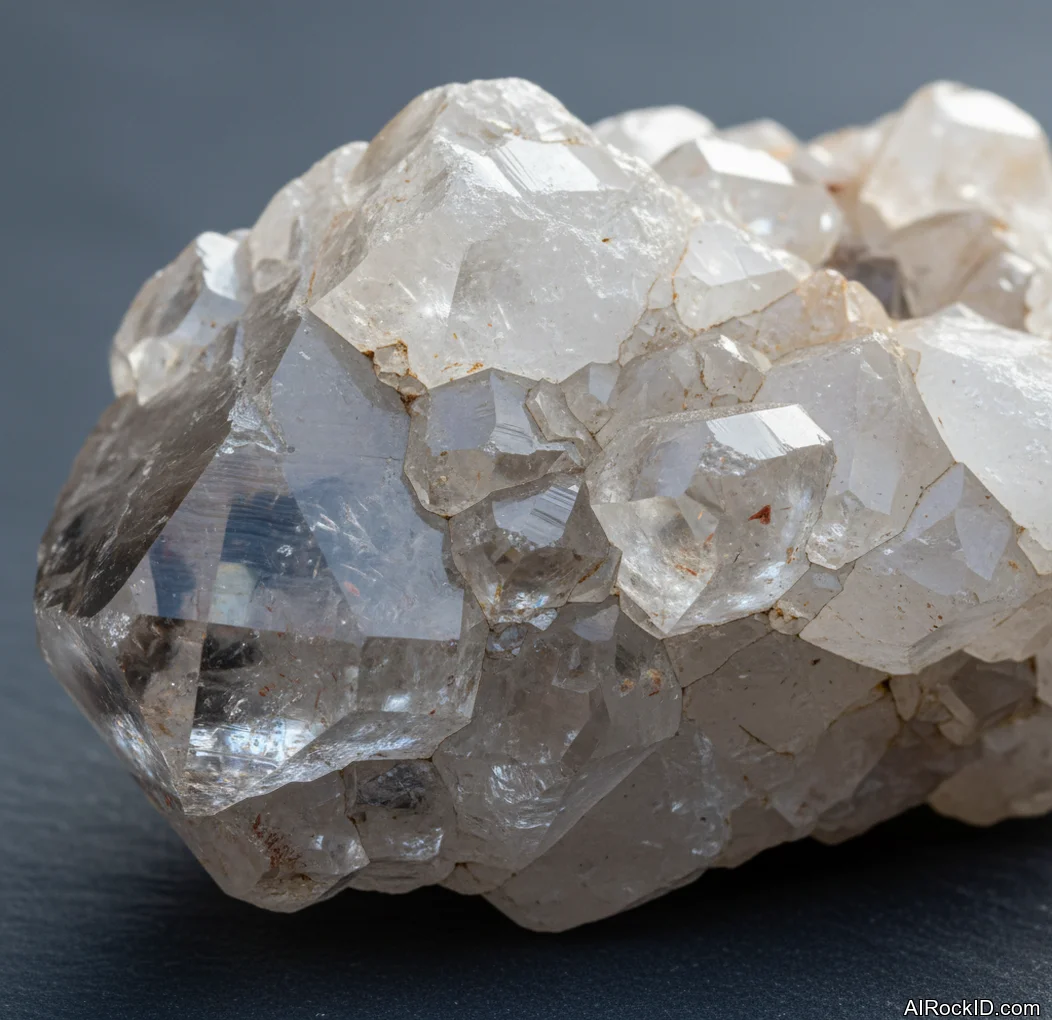
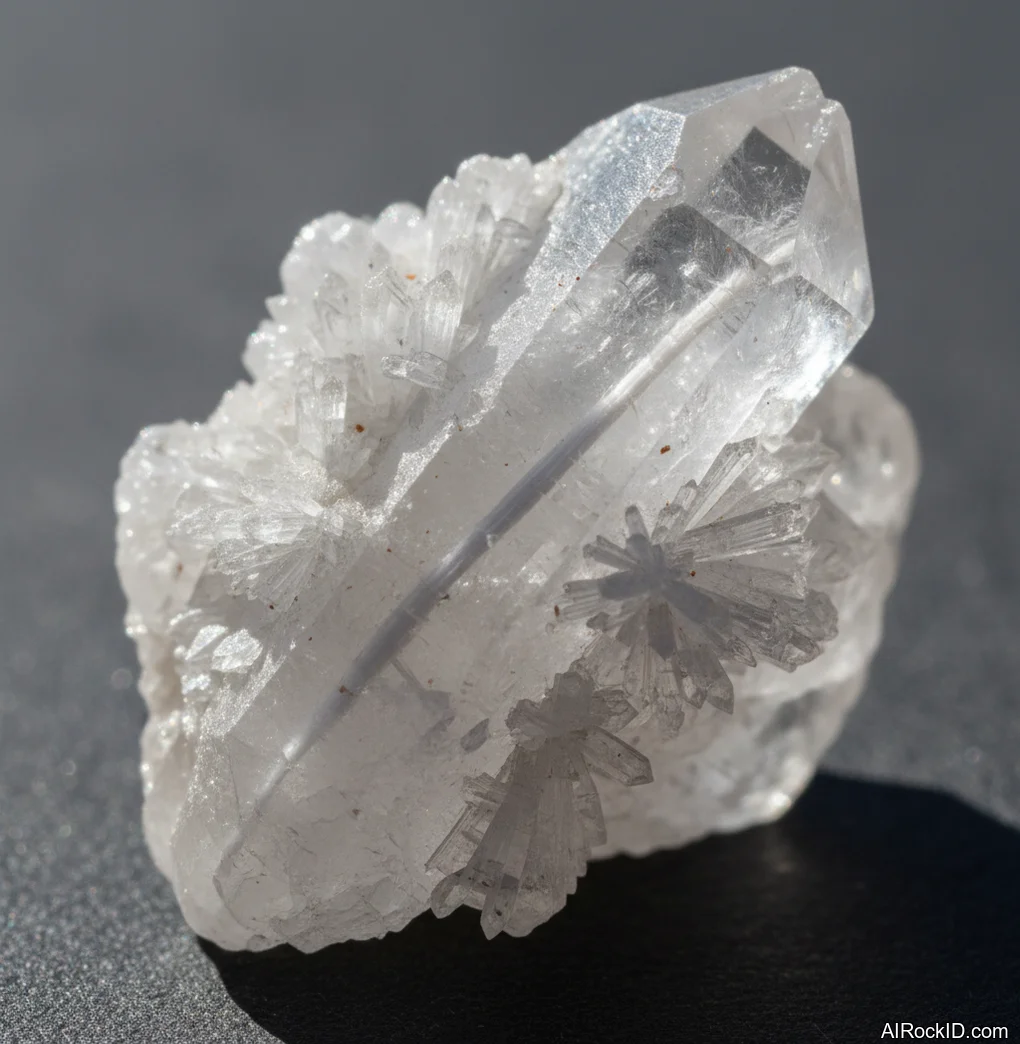
Faden Quartz is a natural quartz crystal with a visible white “thread” inside (the faden). That line forms when the crystal breaks, then heals over and over again along the same fracture plane.
Hold a good piece and you notice it fast. It’s still quartz, so it has that cool, slick, glassy feel against your fingertips, but inside there’s this milky stripe that honestly looks like somebody tugged a string right through the middle. Tip it under a desk lamp and the line winks in and out, especially when the crystal’s clean and the faden sits dead center. And some specimens come out flatter, almost blade-like, because the growth keeps reopening on that same plane.
At first glance, a lot of people assume the thread is a fiber or just a crack that’s about to finish splitting. But it isn’t that. The faden is basically a scar that healed, then healed again, and you can often spot tiny “stitch marks” or little offsets where the crystal shifted and reattached (it’s pretty obvious once you know what you’re looking at). In a tray at a show, faden pieces jump out because your eye grabs that internal stripe even when the outer faces are beat up.
Origin & History
“Faden” is just the German word for “thread.” That name stuck because collectors in the Swiss Alps kept finding quartz that looked clear except for one stubborn, bright white line running right through it, like a strand trapped inside the crystal.
Alpine miners and early collectors already knew quartz can grow in some weird ways, but “faden quartz” as an actual collector label didn’t really catch fire until European mineral trading picked up in the 19th and early 20th centuries. And yeah, most sources still point to the Swiss Alps as the classic home for it, since all that stress from mountain building plus repeated movement along fractures makes that growth habit easier to form.
Today, the term gets thrown around pretty loosely in the trade (too loosely, honestly). So that’s where the confusion starts.
Where Is Faden Quartz Found?
Classic specimens come from Alpine-type fissures in Switzerland, and a lot of the clean, larger crystals on the market are from Pakistan and nearby Himalayan regions.
Formation
Look closely at a faden and you’re basically watching geology happen in slow motion. Quartz starts growing inside a pocket or a fracture. Then the host rock shifts, the crystal snaps, and the two halves pull apart just a hair. Silica-rich fluids keep sneaking through that tiny opening, and the broken faces knit themselves back together while fresh quartz keeps growing (kind of like a scar that won’t stop forming).
Thing is, it doesn’t happen only once. It happens over and over along the same plane. Each time it opens and seals again, it leaves behind that white, threadlike inclusion zone, usually from tiny fluid inclusions plus microfractures that get trapped while the crystal is healing. And because that crack plane can steer the later growth, you often end up with that flattened, tabular look instead of the usual prismatic quartz point.
How to Identify Faden Quartz
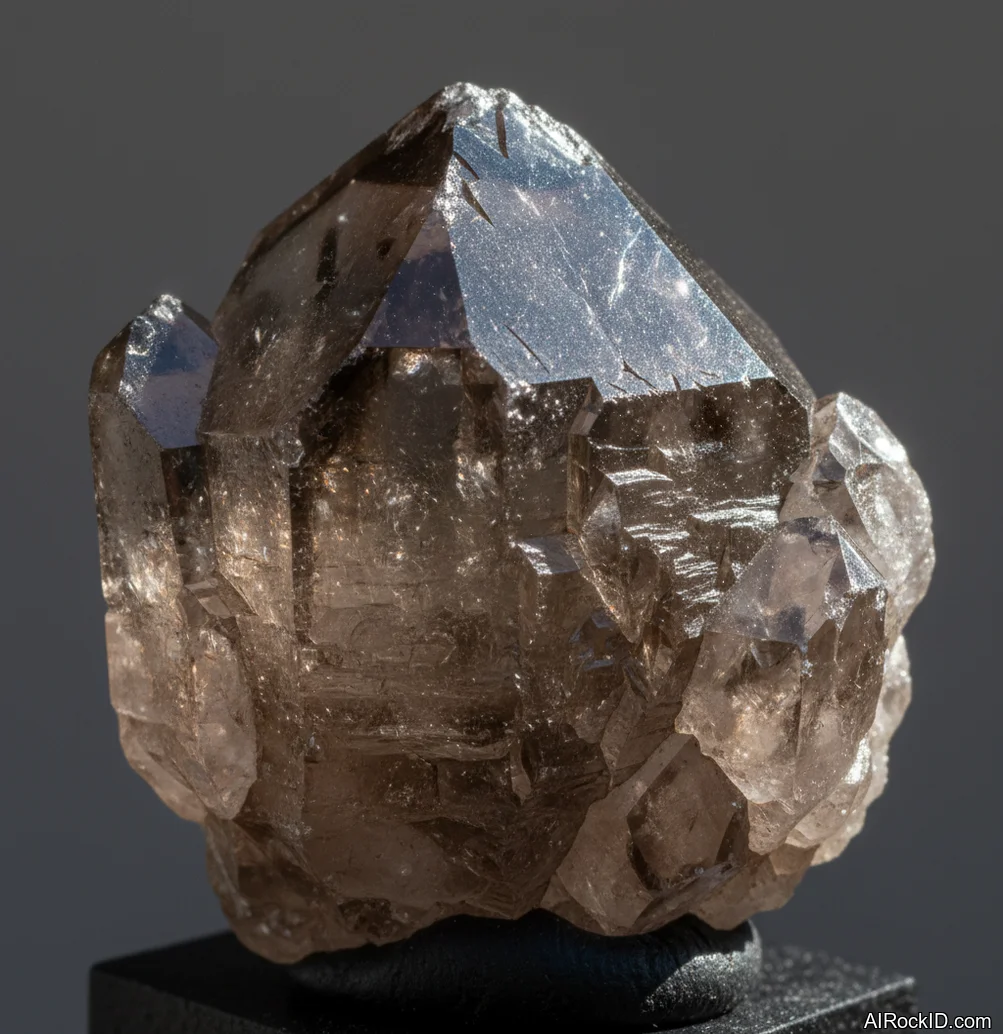
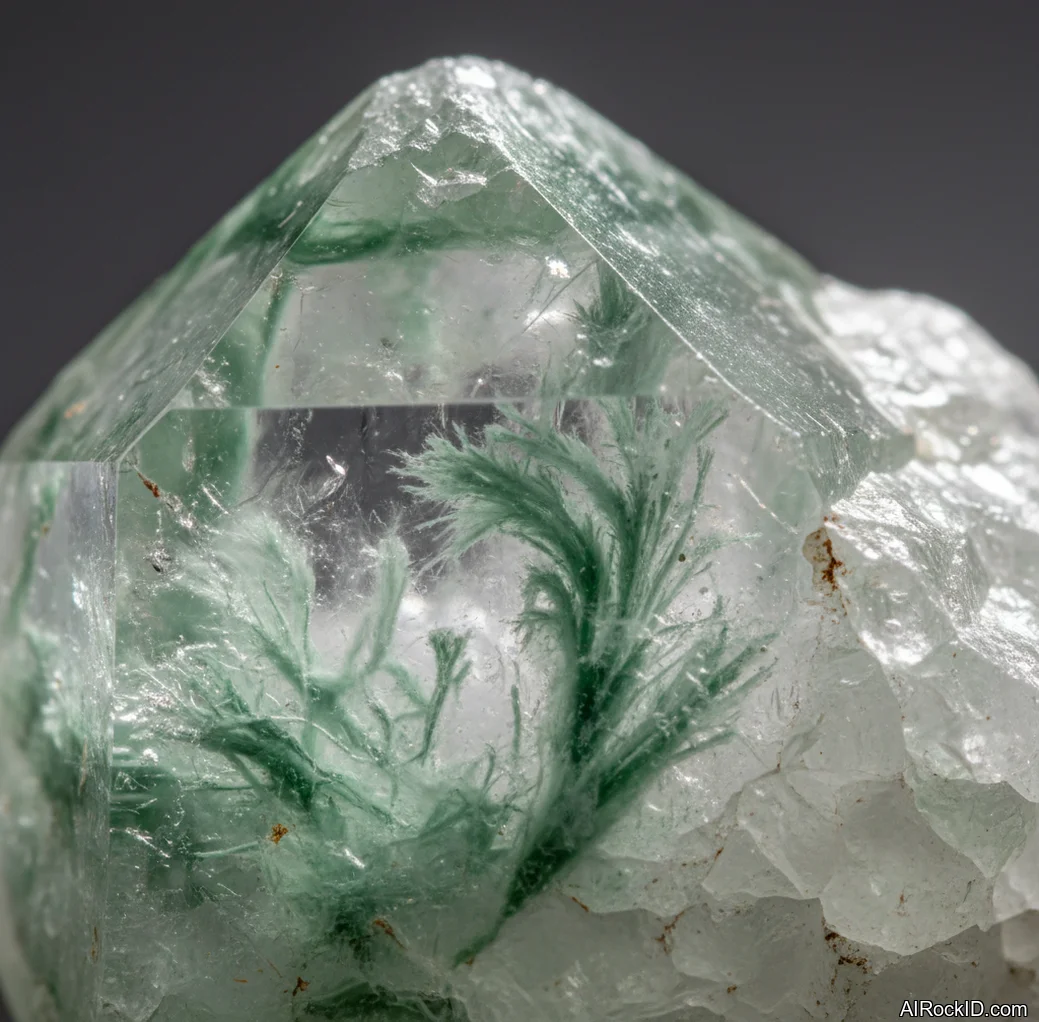
Color: Usually colorless to milky white, with a bright white internal “thread” or band; it can also be smoky, chlorite-dusted, or slightly iron-stained on the surface.
Luster: Vitreous on clean crystal faces.
Pick up the crystal and rotate it slowly under a single light source. A real faden shows a continuous internal line or band that stays inside the crystal, not a surface scratch that moves with the glare. The real test is the thread running through growth zones, sometimes with little step-offs where the crystal rejoined after shifting. And don’t let a seller talk you into “faden” just because there’s one random internal fracture; you want that repeated-heal look, not a one-time crack.
Properties of Faden Quartz
Physical Properties
| Crystal System | Trigonal |
| Hardness (Mohs) | 7 (Hard (6-7.5)) |
| Density | 2.65 g/cm3 |
| Luster | Vitreous |
| Diaphaneity | Transparent to translucent |
| Fracture | Conchoidal |
| Streak | White |
| Magnetism | Non-magnetic |
| Colors | Colorless, White, Smoky gray, Light brown |
Chemical Properties
| Classification | Silicates |
| Formula | SiO2 |
| Elements | Si, O |
| Common Impurities | Al, Fe, Ti, Li |
Optical Properties
| Refractive Index | 1.544–1.553 |
| Birefringence | 0.009 |
| Pleochroism | None |
| Optical Character | Uniaxial |
Faden Quartz Health & Safety
Faden Quartz is non-toxic, so you can handle it safely. But if you’re cutting or grinding it, treat it like any other quartz. That fine, chalky silica dust (the stuff that hangs in the air and ends up on your fingers) is a respiratory hazard, so normal quartz precautions still apply.
Safety Tips
If you’re lapping, carving, or sawing quartz, don’t do it dry. Keep it wet and wear proper respiratory protection, because that fine dust gets everywhere (you can feel it on your lips). But if you’re just displaying it or picking it up now and then, basic care is plenty.
Faden Quartz Value & Price
Price Range
Rough/Tumbled: $10 - $200 per specimen
Price shoots up when the clarity’s there, the faden runs straight down the middle without breaking, and the terminations look crisp instead of chipped. Big, sharp Swiss or Himalayan pieces on a solid thread can cost way more than those smaller, beat-up blades with scuffed ends.
Durability
Durable — Scratch resistance: Excellent, Toughness: Good
Quartz is stable in normal household conditions, but faden pieces can have internal fracture zones that chip if you knock them around.
How to Care for Faden Quartz
Use & Storage
Store it where it won’t rattle against harder points or metal stands. I keep faden blades in a small box with foam because those thin edges love to chip.
Cleaning
1) Rinse under lukewarm water to remove dust and grit. 2) Use a soft toothbrush with a drop of mild dish soap to get into crevices. 3) Rinse well and air dry; avoid sudden temperature changes.
Cleanse & Charge
If you do energetic cleaning, simple options are running water, smoke, or leaving it on a windowsill for indirect light. Don’t bake it in harsh sun if it’s got smoky color you care about.
Placement
Set it where side light can catch the internal thread, like near a lamp or on a shelf with a spotlight. Dark backgrounds make the faden line look sharper.
Caution
Quartz is tough, sure, but it’s not invincible. Drop a pointy piece onto a tile floor and you’ll often see the tip or termination chip right off (that little fresh-looking nick is hard to miss). So skip strong acids when you clean it. And if your specimen has a bunch of internal fractures, don’t put it in an ultrasonic cleaner. Why risk turning those tiny cracks into bigger ones?
Works Well With
Faden Quartz Meaning & Healing Properties
Most dealers will tell you faden quartz is about “repair” or “reconnection,” and yeah, I get it. You can actually see the healed break running right through the crystal, like a little seam that held and didn’t let go. In my own stash, it’s the one I grab when I’m trying to get back on track after a messy week, mostly because the visual is almost too perfect. A literal line through the middle. Hard to ignore.
But here’s the honest part: it’s still quartz. If you already use clear quartz for focus and clean intention setting, faden quartz just gives you a louder symbol to hang that same practice on. I’ve also noticed people see the “thread” and assume it’s fragile or somehow “broken.” Thing is, in your hand, a solid faden crystal feels as sturdy as any other quartz point, with that same cold, glassy weight and the slick faces that catch the light when you tilt it. Unless it’s one of those thin blade-like pieces with a lot of open fractures (then yeah, you handle it a little more carefully).
Keep it grounded, though. None of this is medical. If you use crystals for meditation, faden quartz pairs well with journaling or any routine where you’re trying to stitch scattered thoughts back together. The thread gives your eyes something to lock onto, and honestly, that’s half the battle when your mind won’t sit still, right?
Identify Any Crystal Instantly
Snap a photo and get properties, value, care instructions, and healing meanings in seconds.