Gyrolite
What Is Gyrolite?
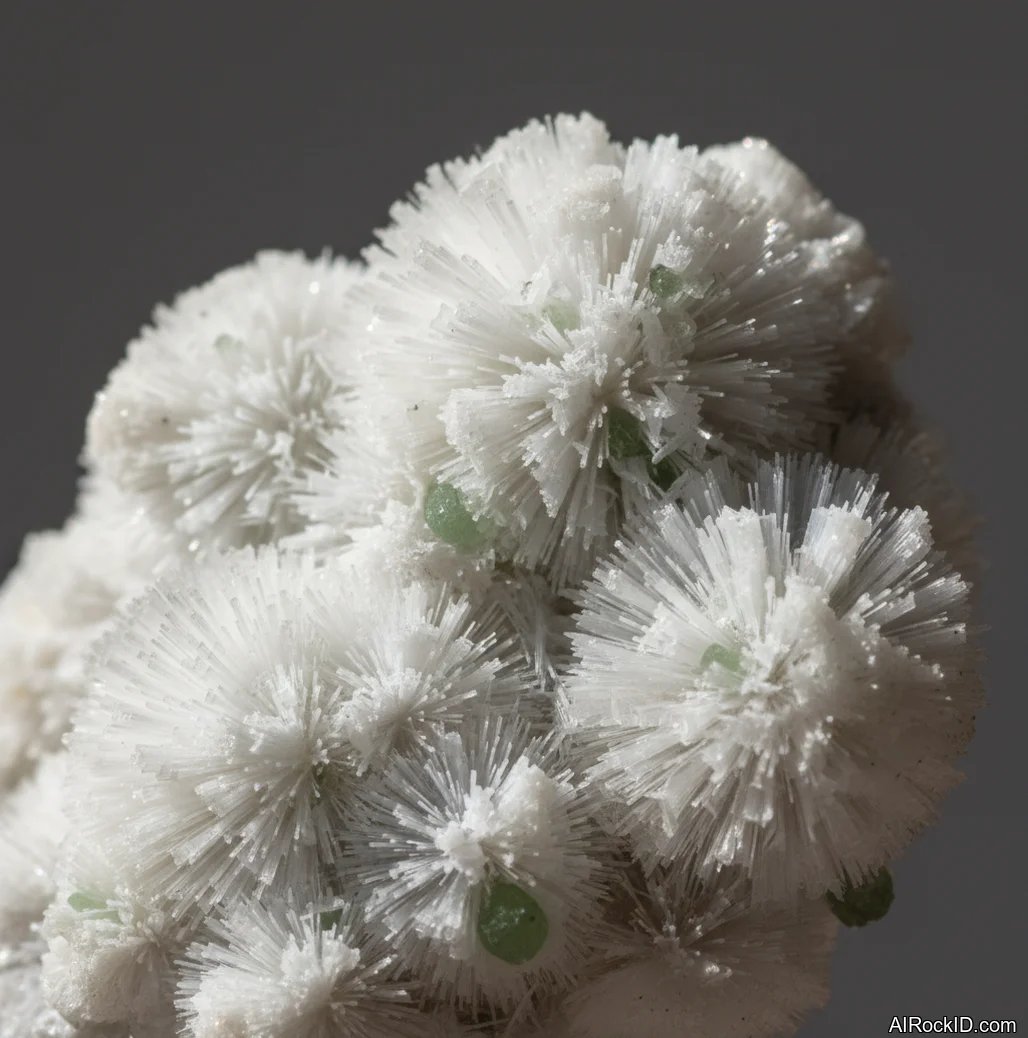
Gyrolite is a hydrated calcium silicate mineral, and it usually shows up as radiating, spherical aggregates tucked into basalt cavities.
Look, the first time you see it you might swear it’s a tiny white sea-urchin puff. Or a tight little rosette. When the spheres are clean and sitting there away from the matrix, that resemblance is hard to unsee.
Most specimens I’ve handled are white to creamy, sometimes with this faint minty green cast that only shows up when you tilt it under a lamp. They tend to sit in vugs with other zeolite-zone material, like apophyllite or stilbite, kind of crowded together in the same pocket. It’s not a “crystal points” mineral the way quartz is. Not even close. It’s all about the texture, and those concentric, layered fans.
Pick one up and you’ll notice it feels light for its size. And the clusters can feel slightly chalky along the edges if they’ve been knocked around in a flat (you can almost feel the tiny scuffs with a fingertip). Fresh material can have a gentle pearly sheen, but it marks up fast.
But that’s the catch. Gyrolite photographs better than it wears. So if you want those spheres to stay crisp and pristine, the best move is to leave it alone once it’s sitting in the case.
Origin & History
The name’s straight out of Greek, meaning “circle” and “stone,” which makes sense the first time you see one in hand: the crystals curl into little rolled fans that radiate out like a tight pinwheel. And yeah, that shape is the whole point of the name.
It got formally described in the 19th century, right in the middle of that European rush to document zeolites and all the weird minerals hiding in basalt cavities. The old papers from that era have that familiar “let’s name everything in this pocket” feel to them.
Most collectors bump into the term because it shows up at those classic basalt localities where cavity minerals have been picked over, labeled, argued about, then studied some more. It’s not sitting on centuries of lapidary lore like quartz or garnet, but in zeolite circles it’s absolutely a real, accepted species, and you’ll see it in the literature and on plenty of dusty old cabinet labels (the kind with browned glue at the corners).
Where Is Gyrolite Found?
Gyrolite turns up in basalt cavities and related low-temperature veins, especially in classic zeolite districts like western India and parts of Scotland.
Formation
Look at where gyrolite shows up and it kind of clicks. It prefers that late-stage, low-temperature part of basalt alteration, after the hot fluids have already chewed through a bunch of chemistry and the cavity walls are slicked over with secondary minerals.
Most of the time you’ll find it tucked into vesicles or sitting in fractures in basalt. It grows outward as layered, radiating sheets, then those sheets curl and round up into spheres. It also tends to hang out with other calcium-rich secondary minerals. And yeah, it’s pretty common to see gyrolite sitting on top of earlier crusts, like a little white firework that popped off after the cavity was already lined.
Apophyllite can come in looking sharp and crystally, but gyrolite feels more like a slow build. If a sphere breaks open, you can almost read it like rings. Like a tiny silicate onion, stacked in layers (and kind of satisfying to stare at, honestly).
How to Identify Gyrolite
Color: Usually white to cream, sometimes pale greenish or grayish depending on inclusions and the host rock staining.
Luster: Pearly to vitreous on fresh surfaces, often turning more dull if the surface is scuffed or dusty.
Pick up the piece and tilt it under a single overhead light. The better gyrolite clusters flash a soft pearly sheen across the radiating layers, not a glassy mirror like calcite can. If you scratch it with a copper penny, it’ll mark, and a steel nail will bite fast. And when sellers call every white rosette in basalt “gyrolite,” check for that tight, spherical radiating habit, because okenite and some zeolites can look similar in photos.
Properties of Gyrolite
Physical Properties
| Crystal System | Monoclinic |
| Hardness (Mohs) | 2.5 (Soft (2-4)) |
| Density | 2.23-2.27 g/cm3 |
| Luster | Pearly |
| Diaphaneity | Translucent |
| Fracture | Uneven |
| Streak | White |
| Magnetism | Non-magnetic |
| Colors | White, Cream, Pale green, Grayish white |
Chemical Properties
| Classification | Silicates |
| Formula | Ca16Si24O60(OH)8·14H2O |
| Elements | Ca, Si, O, H |
| Common Impurities | Fe, Mn, Al |
Optical Properties
| Refractive Index | 1.535-1.548 |
| Birefringence | 0.013 |
| Pleochroism | None |
| Optical Character | Biaxial |
Gyrolite Health & Safety
Gyrolite isn’t considered toxic, so for normal collecting it’s safe to handle. Thing is, the bigger risk isn’t chemistry at all. It’s you accidentally chipping it, scratching it, or knocking a corner off while you’re moving it around.
Safety Tips
If you’re trimming matrix or doing any cleaning, put on eye protection and try not to kick up dust from any silicate mineral. That stuff gets everywhere, and you’ll feel it gritty on your fingers if you’re not careful. For display pieces, the easiest prevention is just to handle them as little as possible. Why risk it?
Gyrolite Value & Price
Price Range
Rough/Tumbled: $15 - $250 per specimen
Price usually comes down to how clean those spheres look in hand and how good the matrix is. Crisp, unchipped clusters with strong contrast and a clear locality tag tend to move quicker and bring more money.
Durability
Fragile — Scratch resistance: Poor, Toughness: Poor
Gyrolite is soft and can scuff or crumble at the edges if it’s handled a lot or rattled around in storage.
How to Care for Gyrolite
Use & Storage
Store it in a padded box or a display case where it won’t get bumped. I keep gyrolite away from harder pieces because one little clink can chew up the spheres.
Cleaning
1) Use a soft makeup brush to lift dust off the spheres. 2) If you need water, do a quick rinse with lukewarm water and pat dry, don’t soak. 3) Let it air-dry fully before putting it back in a closed box.
Cleanse & Charge
For metaphysical-style care, stick to smoke, sound, or setting it near a dry selenite slab. I’d skip salt bowls and long water soaks, mostly because the piece is fragile.
Placement
Best spot is a stable shelf where it won’t vibrate, like away from doors that slam. A dark matrix behind it makes the white clusters read better from across the room.
Caution
Don’t use ultrasonic or steam cleaners on it. Skip acids and any heavy-duty household cleaners, too. And please don’t just toss it loose in your pocket or let it rattle around in a tote bag.
Works Well With
Gyrolite Meaning & Healing Properties
Most dealers selling gyrolite on the metaphysical side pitch it as a “quiet mind” stone. I get it. Those tight concentric circles look almost too neat, like somebody drew them on purpose, and the pattern kind of nudges your brain toward order.
And honestly, I do the same thing sometimes. After a show, when I’m sorting flats and everything’s a mess of labels and bubble wrap, I’ll leave a small piece of gyrolite on the desk so my eyes have somewhere simple to land. It helps. Just a little.
But here’s the practical reality. Gyrolite is soft. Soft enough that if you try to carry it around every day, you’re probably going to end up with tiny crumbs in your pocket or a slightly scuffed, sad-looking stone. I treat it like a shelf stone. If you’re using it for meditation, set it down and leave it there. Don’t fuss with it.
Thing is, the feel matters. In the hand it’s delicate, and the high points can feel a little powdery, like they want to flake if you rub them too much (because they do). That physical fragility changes how you handle it, and honestly it changes the whole vibe of the practice. You naturally get gentler. More careful. Slower.
So, same as any spiritual or wellness use: keep it in the “supportive tool” category, not medical treatment. If you’re stressed, the real value is the pause. You look closely at the radiating pattern, slow your breathing down, and let your attention clamp onto one small thing that’s actually right in front of you. Isn’t that the point sometimes?
Identify Any Crystal Instantly
Snap a photo and get properties, value, care instructions, and healing meanings in seconds.