Hazu Tonalite
What Is Hazu Tonalite?
Hazu Tonalite is just a trade name for tonalite, which is a coarse-grained intrusive igneous rock made mostly of plagioclase feldspar and quartz, with dark mica or amphibole mixed in.
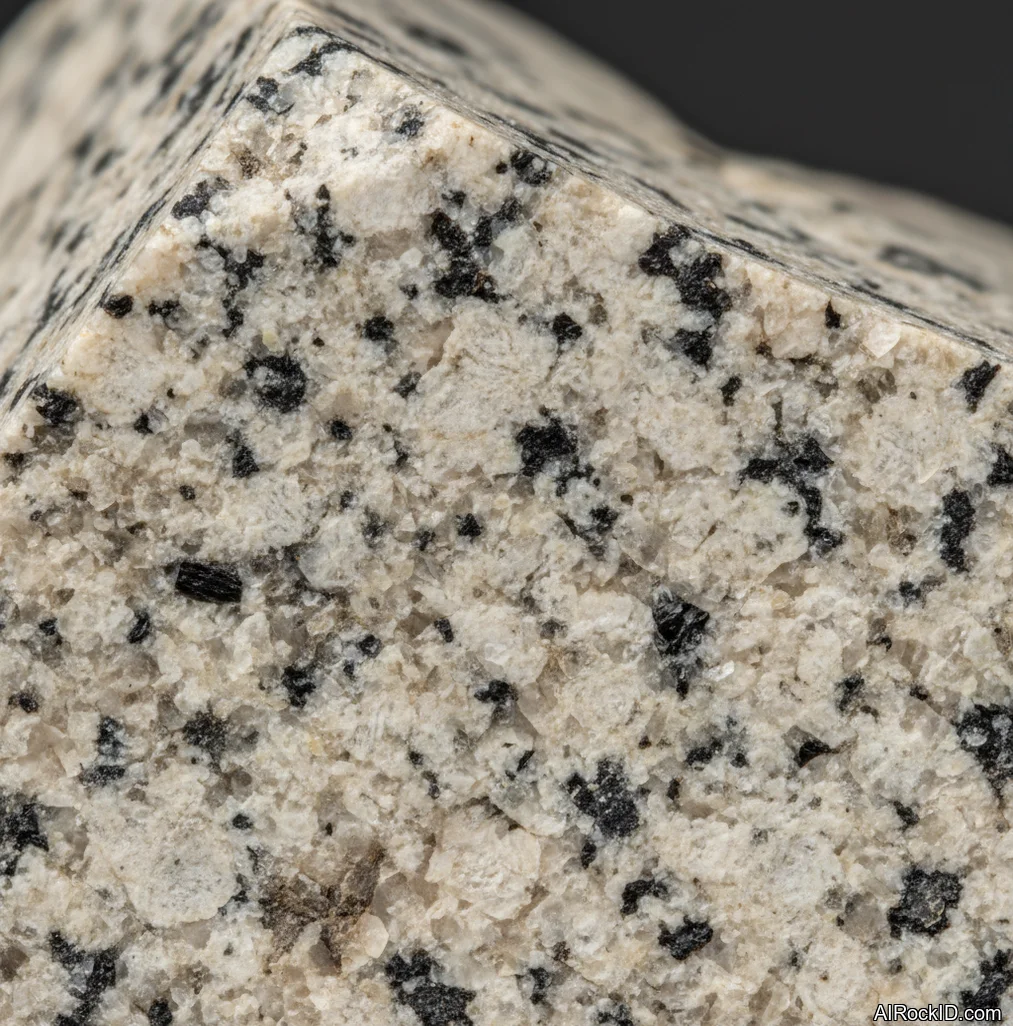
Look, at first glance most folks clock it as plain gray “granite.” Fair enough. But once you’ve actually got a piece in your hand, it doesn’t quite read the same. You get that classic salt-and-pepper balance: chunky white feldspar blocks, little glassy quartz blebs, and black flecks that flash when you tilt it under a lamp (the kind of thing you notice while you’re standing at a table, bored, turning a stone over and over).
Thing is, I’ve handled a lot of tonalite at shows that was labeled as granite because that word sells. But when you start hunting for pink potassium feldspar and it just isn’t there, tonalite is usually where you end up. So yeah, “granite” on the tag, tonalite in your hand.
Most of what you’ll run into is cut slabs, palm stones, or freeform decor. Raw material can look kind of dull in a flat photo. In person, it’s got more depth. And if the feldspar crystals run a little bigger, you can literally feel the grain boundaries with your thumb, like tiny steps where one mineral ends and the next one starts.
Origin & History
“Tonalite” got its name back in the 18th century, after rocks described from around the Tonale Pass in the Alps. And it stuck because petrologists needed a tidy way to sort granitic rocks by mineral percentages.
But “Hazu Tonalite” isn’t a formal geology term. It’s basically a dealer label, the kind you’ll see printed on a slab tag with a bit of clear tape stuck over the corner, used so one name can cover a consistent look.
The word origin part is simple: tonalite refers to the Tonale region in northern Italy. The “Hazu” bit? No standard scientific source. So you’ll find different sellers using it in different ways, which is your first clue you’re looking at a trade tag, not a newly defined mineral species.
Where Is Hazu Tonalite Found?
Tonalite occurs in big intrusive bodies worldwide, especially in mountain belts and continental arc settings. On the market, a lot of “Hazu Tonalite” style material is sold without a tight locality beyond country-level sourcing.
Formation
Look at the grain size for a second. Big, easy-to-see crystals usually mean it cooled slowly. Tonalite shows up when silica-rich magma gets stuck underground and has time to crystallize as an intrusive rock, so plagioclase and quartz can grow into grains you can actually pick out with your naked eye (especially in good light). That’s why it ends up with that speckled, interlocking texture instead of the tight, fine-grained look you see in volcanic rocks.
But it’s not the same as true granite. Tonalite runs lower in potassium feldspar and leans harder into plagioclase plus quartz, with biotite or hornblende giving you those dark flecks. The real test is the mineral percentages, sure, but honestly your eyes get you pretty far. If the rock reads gray-white overall with peppery black specks, you’re seeing plenty of quartz, and there’s basically no pink K-feldspar anywhere, tonalite is a solid call.
How to Identify Hazu Tonalite
Color: Usually medium gray to light gray with a salt-and-pepper pattern: white plagioclase, clear to smoky-gray quartz, and black biotite or hornblende. Some pieces show subtle bluish-gray cast depending on lighting and grain size.
Luster: Overall dull to vitreous, with quartz grains flashing glassy and mica giving tiny sparkles on fresh faces.
Pick up a piece and tilt it slowly under overhead light. Quartz will wink back at you like broken glass, while feldspar looks more waxy and blocky. If you scratch it with a steel nail, the feldspar parts may mark faintly but the quartz won’t, and it’ll still scratch window glass because of the quartz content. The problem with “Hazu Tonalite” labels is that gabbro and diorite get mixed in, so check for obvious quartz before you buy.
Properties of Hazu Tonalite
Physical Properties
| Crystal System | Triclinic |
| Hardness (Mohs) | 6-7 (Hard (6-7.5)) |
| Density | 2.65-2.80 g/cm3 |
| Luster | Vitreous |
| Diaphaneity | Opaque |
| Fracture | Uneven |
| Streak | white |
| Magnetism | Non-magnetic |
| Colors | gray, light gray, white, black |
Chemical Properties
| Classification | Silicates |
| Formula | Composite rock (primarily plagioclase feldspar + quartz; common biotite/hornblende) |
| Elements | Si, O, Al, Na, Ca, K, Fe, Mg |
| Common Impurities | Ti, Mn |
Optical Properties
| Refractive Index | 1.53-1.55 |
| Birefringence | None |
| Pleochroism | None |
| Optical Character | Uniaxial |
Hazu Tonalite Health & Safety
It’s a solid, low-risk rock for normal handling and display. But like any stone with silica in it, don’t create dust if you’re cutting or grinding it (that fine powder that sticks to your fingers and gets in your nose).
Safety Tips
If you’re going to saw or shape it, keep it wet and wear a proper respirator that’s actually rated for silica dust (not just a flimsy paper mask). Silica dust is nasty stuff.
Hazu Tonalite Value & Price
Price Range
Rough/Tumbled: $8 - $60 per piece
Price mostly comes down to how well it’s polished and what the pattern looks like, not some “rare” factor. Big slabs that really pop, bright white feldspar against inky black mica, move quickly. The dull stuff? The muddy, flat gray that stays kind of lifeless even after a decent buff. That tends to sit.
Durability
Durable — Scratch resistance: Good, Toughness: Good
It’s stable in normal indoor conditions, but the feldspar can dull if it’s repeatedly abraded or cleaned harshly.
How to Care for Hazu Tonalite
Use & Storage
Store it like you would most polished stones: separate from softer stuff so it doesn’t scuff them, and keep it where it won’t get knocked off a shelf. Raw chunks are fine in a tray, but they’ll chip other pieces if you let them rattle around.
Cleaning
1) Rinse with lukewarm water to remove grit. 2) Use a drop of mild soap and a soft brush to get into the grain texture. 3) Rinse again and dry with a towel so water spots don’t sit on the quartz patches.
Cleanse & Charge
If you do energetic cleansing, a quick rinse and a few hours on a windowsill with indirect light is plenty. Don’t bake it in full sun all day if it’s highly polished, since heat cycling is what eventually makes tiny fractures look worse.
Placement
It looks best under a directional lamp where the quartz flashes a bit and the mica specks sparkle. On a desk, it’s a good “thinking stone” just because it feels steady and substantial in the hand.
Caution
Skip ultrasonic cleaners and harsh acids. They can etch feldspar and leave tiny micro-pits right along the grain boundaries (the kind that catch grime later and never really rinse clean). And if you’re cutting it, don’t shrug off the dust. Treat it like a silica hazard.
Works Well With
Hazu Tonalite Meaning & Healing Properties
Most dealers slot Hazu Tonalite in the grounding section, and yeah, that lines up with how it actually feels in your hand. It isn’t flashy. Grab a little palm stone and you get that cool, steady heft, like a river rock that’s been rolling around in a jacket pocket forever. The surface on the ones I’ve handled is usually smooth but not glassy, with those tiny gray-and-black speckles you can feel more than you can see if you run your thumb over it.
When I’m sorting inventory or labeling flats at a show, I’ll keep a chunk next to me sometimes. Not because it’s doing anything dramatic, but because it gives my fingers something to do without yanking my attention the way a sparkly crystal does. It just sits there. Quiet.
If you use stones during meditation, tonalite tends to slide into routines that are about focus, planning, and staying level. I don’t treat it like a “big energy” stone. It’s more like background support. The kind you park on your desk during paperwork, forget about for an hour, then brush it with your knuckles and notice it’s still calm and cold. Like it didn’t budge an inch.
But let’s keep the line bright: none of this replaces medical care. People love to overpromise what a gray, speckled rock can do, and that’s where I start rolling my eyes. The honest upside is pretty simple, honestly. It’s steady. It’s tactile. And it’s easy to live with (no fuss, no sparkle, no weird drama).
Identify Any Crystal Instantly
Snap a photo and get properties, value, care instructions, and healing meanings in seconds.