Lakelandite


Quick answer: Lakelandite is a trade name rather than an officially recognized mineral species. The label is usually applied to decorative, gray-green or mottled stones that can resemble several different rock types, so identification depends on the actual material being sold.
AI Rock ID can help compare a Lakelandite-labeled stone with visually similar rocks by analyzing color, pattern, luster, and texture from a clear photo. RockIdentifier.io is useful for narrowing possibilities, but trade-name stones may still require seller documentation or lab testing for confirmation.
Good fit
- Collectors who enjoy trade-name stones and unusual lapidary materials
- Buyers comparing a labeled specimen with similar gray, green, or mottled rocks
- People who want a decorative stone but do not need an official mineral species name
- Beginners learning the difference between mineral names and commercial labels
Not a good fit
- Collectors who require an officially recognized mineral species
- Buyers who need a guaranteed composition without testing or documentation
- Anyone expecting one consistent appearance or source for every stone sold as Lakelandite
Why people search for this
People often search for Lakelandite to verify whether it is a real mineral name or a commercial label. Many searches also come from buyers trying to compare a Lakelandite-labeled stone with jasper, serpentine, slate, or other look-alike materials.
Most commonly confused with
- Jasper: Jasper is a microcrystalline quartz variety and is usually harder than many soft green-gray rock materials sold under trade names.
- Serpentine: Serpentine commonly has waxy luster and green tones, while Lakelandite is a label that may be applied to more than one actual material.
- Slate: Slate may split into flat layers and has a fine-grained metamorphic texture, unlike many polished trade-name stones.
- Rhyolite: Rhyolite often shows volcanic flow patterns or speckling and may be sold under decorative names when polished.
Lakelandite vs. Common Look-Alikes
| Material | Typical Clue | Main Difference |
|---|---|---|
| Lakelandite | Trade-name label; variable appearance | Not an official mineral species |
| Jasper | Hard, opaque, often takes a high polish | Quartz-based material |
| Serpentine | Green, waxy to greasy look | Softer and may feel smoother than jasper |
| Slate | Fine layers or flat cleavage | Rock texture may split along planes |
| Rhyolite | Speckled or flow-banded volcanic texture | Igneous rock rather than a single mineral |
AI identification confidence
AI identification confidence for Lakelandite should be treated as tentative because the name is a trade label, not a single mineral with fixed diagnostic traits. A clear photo can support a likely match to a rock group, but hardness, streak, density, and provenance are important for stronger identification.
When AI gets it wrong
- The stone is polished, dyed, or photographed under strong color-shifting light
- The label describes a commercial name rather than a mineral species
- The specimen lacks visible texture, grain, banding, or fracture details
- Several rocks share the same gray-green or mottled appearance
Final recommendation
Treat Lakelandite as a descriptive sales label unless the seller provides the actual rock or mineral composition. For buying, prioritize clear photos, disclosure of treatments, origin information, and a return policy over the name alone.
How to Check a Lakelandite Listing
A reliable listing should state that Lakelandite is a trade name and should identify the probable material when known. Useful details include origin, whether the stone is natural or treated, and whether it has been stabilized, dyed, or waxed. Vague claims such as “rare mineral” or “newly discovered crystal” should be treated cautiously unless supported by documentation.
Authenticity and Label Accuracy
Authenticity for Lakelandite usually means the stone matches the seller’s description, not that it belongs to an officially recognized mineral species. If mineral identity matters, ask for the underlying composition or request testing from a gemological or mineralogical lab. For casual collecting, accurate trade-name labeling and honest disclosure may be sufficient.
Photo Tips for Identification
Photograph the stone in natural, indirect light on a neutral background. Include close-up images of any grain, banding, fractures, or unpolished areas, plus one photo beside a scale such as a coin or ruler. Avoid heavy filters because small color shifts can make gray-green rocks look like different materials.
What Is Lakelandite?
“Lakelandite” isn’t an officially recognized mineral species in the standard mineral references. Most of the time, it’s just a trade name sellers slap on other stones.
Look, the stuff that gets sold under that label usually sits in the same gray-green lane as a lot of other materials: kind of a soft, muted color, a cloudy translucence, and a polish that can feel a little too slick, almost plasticky under bright lights. And the second you pick one up, you notice it. Temperature. Weight. The pieces I’ve handled at shows felt pretty light for their size, and they warmed up in my hand quicker than I’d expect from most quartz-based material (which usually stays cool a bit longer).
But here’s the problem. Different sellers use the same name for totally different materials. I’ve seen “Lakelandite” tags on serpentine, on low-grade aventurine, and on what looked like dyed chalcedony. So you can’t really talk about one consistent set of mineral properties until you figure out what the specific piece actually is.
Origin & History
Most dealers talk about “Lakelandite” like it’s a place-name mineral, but it doesn’t line up with a formally published mineral description, complete with a type locality, author, and year, the way an actual species does. You won’t see it sitting neatly in mindat-style listings as an approved species.
Thing is, the name gets tossed around like a marketing tag. I’ve seen it at gem shows on little handwritten cards (the kind with smudged Sharpie ink and bent corners), usually stuck in the same glass case as other modern trade names. And when you ask what it actually is? You’ll hear three different answers in five minutes. That’s the tell. It’s a label, not a species.
Where Is Lakelandite Found?
Because “Lakelandite” is a trade name, locality claims vary by seller and should be treated as unverified unless the material is tested and documented.
Formation
Lakelandite isn’t a defined mineral species, so there’s no single “this is how it forms” story you can slap on it. It all comes down to what the stone actually is once you pin it down.
If it turns out to be serpentine, you’re generally dealing with ultramafic rock that’s been altered, hydrated, and transformed, often tied to old ocean crust or metamorphic belts. But if it’s quartz or aventurine, that points to silica-rich material that formed from fluids, and later picked up that sparkly look from mica or other inclusions (you can usually spot the tiny glittery flecks when you tilt it under a light). Thing is, the name “Lakelandite” sort of steamrolls over those differences and tucks a whole lot of geology behind one catchy label.
How to Identify Lakelandite
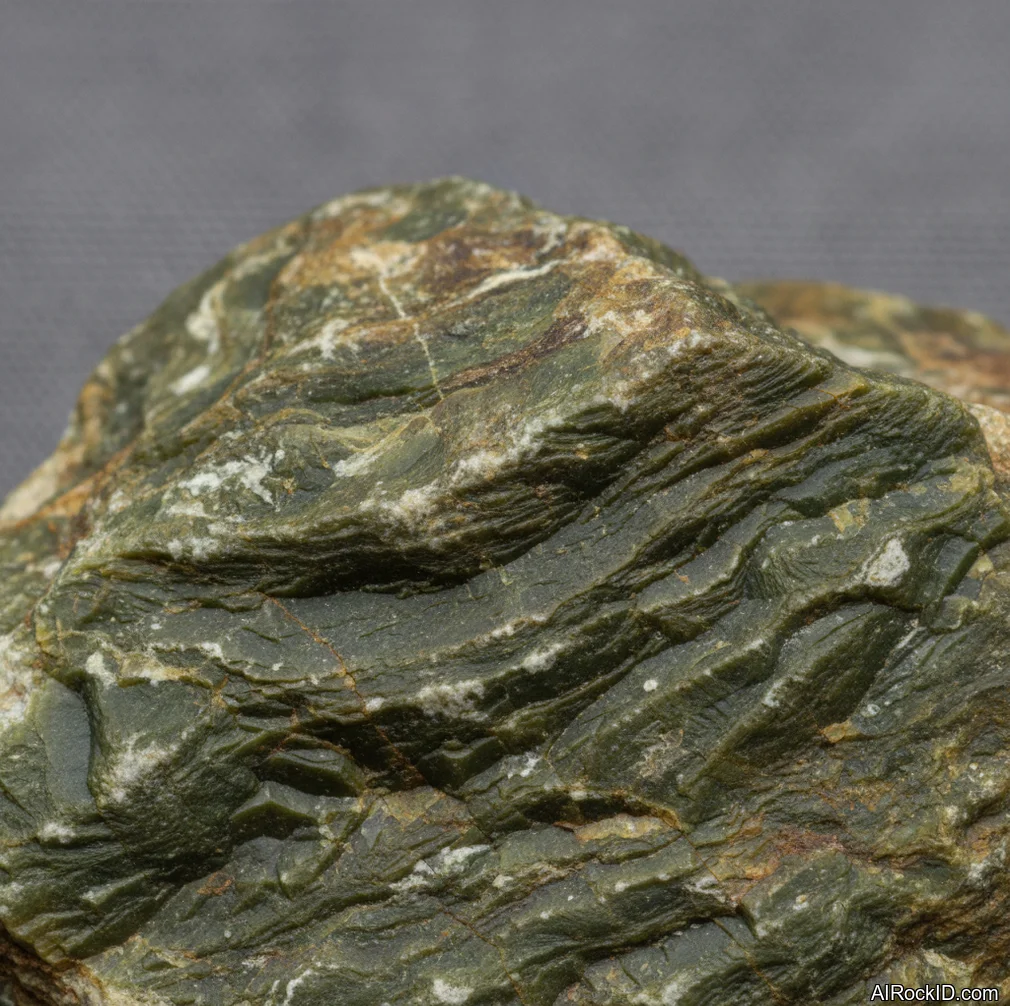
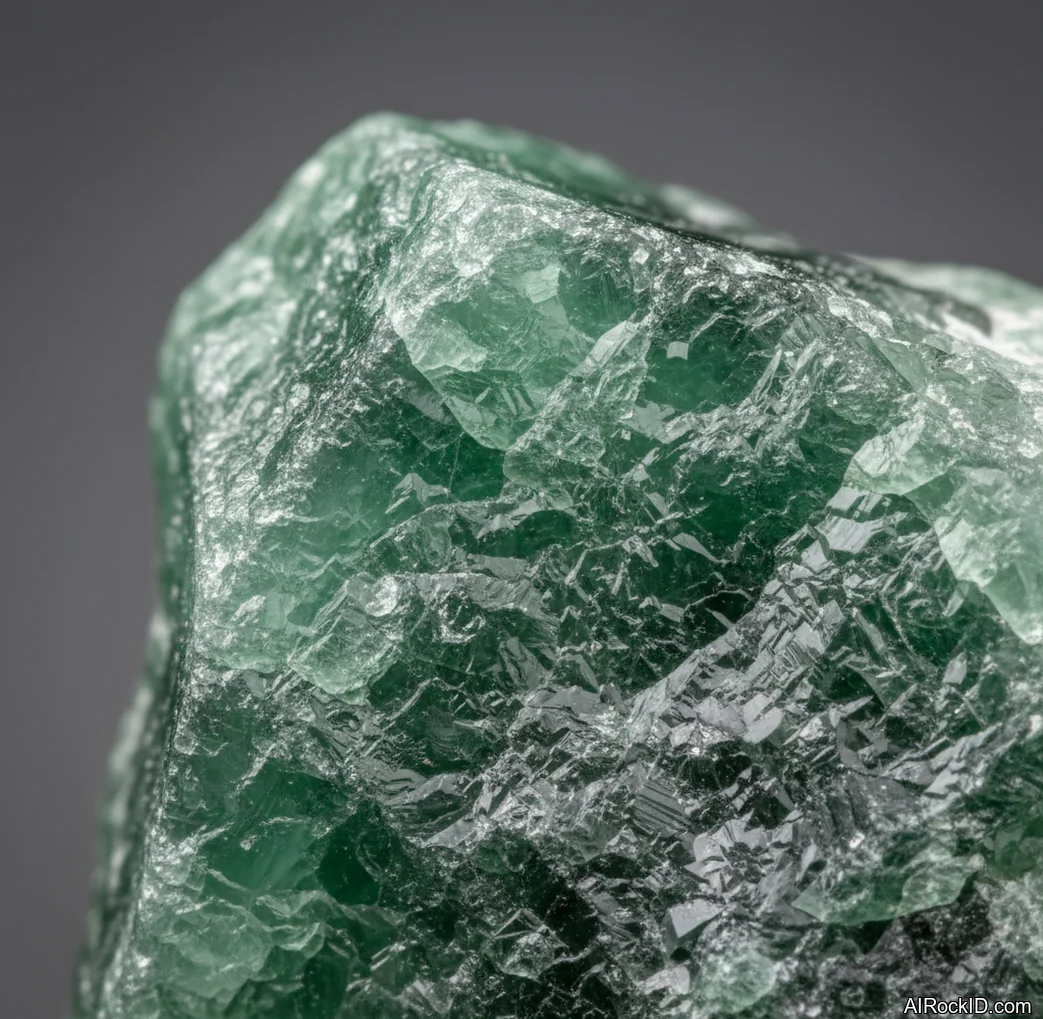
Color: Most “Lakelandite” on the market shows pale gray-green to olive tones, often with cloudy patches or soft banding. Some pieces lean more bluish-gray under cool LEDs and more yellow-green in warm light.
Luster: Polished pieces usually show a waxy to vitreous shine, depending on what the underlying stone is.
Pick up the piece and do the simple stuff first: does it feel glassy-cool like quartz, or does it warm up and feel a bit “soapy” like serpentine? If you scratch it with a steel nail in an inconspicuous spot, quartz-type material won’t care, but serpentine will mark. The real test is a proper ID: ask for the actual species name, or get a refractive index and hardness check before you pay collector money for a mystery label.
Common Look-Alikes
Lakelandite is sometimes confused with these materials:
- Serpentine (often sold as "new jade"), including waxed or resin-impregnated pieces
- Nephrite jade and low-grade jade mixes (gray-green, greasy polish, tough feel)
- Chlorite-in-quartz / "green quartz" (cloudy pale green with peppery inclusions)
- Amazonite (especially pale or gray-blue pieces that lose the obvious grid pattern in photos)
- Dyed howlite or dyed magnesite marketed as muted "sage green" stones
- Green glass or slag glass sold as tumbled "Lakelandite" (too uniform, roundy wear, bubbles)
Market Cautions & Treatments
When AI Can Get This Wrong
At first glance in photos, AI tends to lump "Lakelandite" in with serpentine, nephrite jade, and dyed howlite because they all hit that same muted gray-green and the polish hides texture. The real test is physical: heft and temperature in the hand (glass often feels warmer and lighter for its size), plus a loupe check for dye pooling in cracks and drilled holes. If you can, do a quick scratch test on an unpolished spot and look for bubbles or flow lines under strong backlight, since pictures won’t show those reliably.
Properties of Lakelandite
Physical Properties
| Crystal System | Amorphous |
| Hardness (Mohs) | Unknown (Soft (2-4)) |
| Density | Unknown |
| Luster | Waxy |
| Diaphaneity | Translucent |
| Fracture | Uneven |
| Streak | Unknown |
| Magnetism | Non-magnetic |
| Colors | gray-green, olive, pale green, bluish-gray |
Chemical Properties
| Classification | Unknown |
| Formula | Unknown |
| Elements | |
| Common Impurities |
Optical Properties
| Refractive Index | Unknown |
| Birefringence | None |
| Pleochroism | None |
| Optical Character | Isotropic |
Lakelandite Health & Safety
Handling it is usually pretty low-risk. But the real safety question comes down to what’s actually in the stuff behind the trade name. If you’re cutting or sanding it and you see that fine powdery dust hanging in the air (or settling on your sleeves), don’t breathe it in.
Safety Tips
If you’re grinding or drilling, keep things wet with water, crack some ventilation (a window and a fan helps), and wear a proper respirator that actually seals on your face. Then wash your hands afterward, especially before you eat or touch your phone.
Lakelandite Value & Price
Price Range
Rough/Tumbled: $5 - $40 per piece
Price mostly comes down to how clean the polish looks, how big the piece is, and how sure the seller sounds when they say it’s a real ID. And yeah, if it’s being sold under some mystery trade name, the price can jump. But unless someone’s actually tested it, that extra cost usually isn’t worth it.
Durability
Moderate — Scratch resistance: Fair, Toughness: Fair
Durability depends on the actual stone being sold as Lakelandite, so treat it as scratch-prone until proven otherwise.
How to Care for Lakelandite
Use & Storage
Store it in a soft pouch or a divided box slot so harder stones don’t scuff it. If it’s a softer material like serpentine, it’ll pick up scratches from quartz in no time.
Cleaning
1) Rinse with lukewarm water and a drop of mild soap. 2) Use a soft toothbrush for crevices, then rinse again. 3) Pat dry and let it fully air-dry before storing.
Cleanse & Charge
A quick rinse and a wipe-down works fine for most pieces sold under this name. If you’re unsure what it is, skip salt and harsh methods and keep it gentle.
Placement
On a desk or shelf is safest, where it won’t bang into harder crystals. If you keep it in sunlight, watch for fading if the color looks dyed or treated.
Caution
Look, don’t assume it’s one specific mineral just because the tag says “Lakelandite.” Treat it like it’ll scratch if you so much as look at it wrong until you’ve actually confirmed the hardness. And skip acids or any strong cleaners (the kind that sting your nose when you open the bottle). Why risk it?
Works Well With
Lakelandite Meaning & Healing Properties
Look hard at how “Lakelandite” gets talked about in the metaphysical scene and you’ll run into the same headache collectors do. The name’s slippery. So whatever “meaning” gets pinned on it is really just meaning people are pinning on the vibe of whatever material they were sold, not on any clearly defined mineral species.
In my own stash, the pieces I’ve seen sold under that label feel quiet, steady, kind of earthy. Not flashy. When I’m at my bench sorting stones, these are the ones I grab when I want my hands doing something and my brain to calm down a notch. Simple stuff. And if the piece has that faintly soapy, slick feel you get with serpentine, it almost begs to be handled slowly, like you’re rubbing a worry stone, instead of being stared at for sparkle.
But look, I’m going to be blunt. If you want to use it in any consistent way, you’re better off figuring out what it actually is first. Serpentine, aventurine, chalcedony, plus dyed material don’t act the same in the real world, and they come with different traditional associations for anyone who’s into that side of things. This isn’t medical advice. It won’t replace actual treatment either. But it can still be a useful personal anchor, as long as your expectations stay realistic and your ID stays honest.
Common mistakes
- Assuming Lakelandite is an officially approved mineral name
- Buying based only on the trade name without asking what the material actually is
- Comparing only color instead of checking texture, hardness, luster, and fracture
- Treating every Lakelandite-labeled stone as coming from the same source
- Assuming a polished piece has the same appearance as the rough material
Identify Lakelandite from a photo
Compare Lakelandite traits, care tips, value clues, and common lookalikes with a clear photo.