Lattice Lace Agate


Quick answer: Lattice Lace Agate is a patterned variety of chalcedony, the microcrystalline form of quartz, recognized by intersecting or lace-like bands. It is usually cut as cabochons, beads, palm stones, and small decorative pieces because its pattern is the main visual feature.
AI Rock ID can help compare a photo of Lattice Lace Agate with visually similar banded chalcedony, jasper, and dyed agate. RockIdentifier.io provides crystal identification references that pair visual clues with mineral properties such as hardness, luster, translucency, and banding style.
Good fit
- Collectors who like detailed banding and lace-like chalcedony patterns
- Jewelry buyers looking for a durable quartz-family cabochon or bead
- Beginners who want a stone that is usually easy to care for
- People comparing natural banded agates with dyed or treated agates
Not a good fit
- Anyone needing a precisely defined mineral species rather than a trade or variety name
- Buyers who require fully transparent gemstones
- People expecting every specimen to show strong lattice-like patterning
- Use in high-impact rings without protective settings
Most commonly confused with
- Crazy Lace Agate: Often has chaotic, swirling bands rather than a more grid-like or lattice impression.
- Mexican Lace Agate: A locality and trade-name agate that may overlap visually with lace-patterned chalcedony.
- Botswana Agate: Typically shows fine parallel gray, pink, or brown bands rather than open lace-like patterning.
- Jasper: Usually more opaque and may lack the waxy translucency seen at thin edges of many agates.
Lattice Lace Agate Lookalike Comparison
| Stone | Typical pattern | Key ID clue | Common caution |
|---|---|---|---|
| Lattice Lace Agate | Intersecting lace-like bands | Waxy luster, chalcedony hardness, translucent edges possible | Trade name may vary by seller |
| Crazy Lace Agate | Swirls, loops, and irregular bands | More chaotic band movement | Names may be used loosely online |
| Botswana Agate | Fine parallel bands | Subtle gray, pink, brown, or white banding | May be mislisted as general lace agate |
| Jasper | Mottled or scenic opaque patterns | Usually opaque with less edge translucency | Some jasper-agate mixes blur categories |
| Dyed Agate | Bright or highly even color | Dye may collect in cracks or drilled holes | Color treatment may be undisclosed |
AI identification confidence
AI identification confidence is usually moderate for Lattice Lace Agate because agate varieties are often named by pattern, locality, or trade usage rather than by a strict mineral species. Clear, well-lit photos of the banding, edge translucency, and any drilled holes or fractures improve the reliability of an AI-assisted match.
When AI gets it wrong
- The photo is taken under colored lighting that changes the apparent band colors.
- Only a polished face is visible, with no edge translucency or side view.
- The specimen is dyed, coated, or resin-stabilized without visible treatment clues.
- The seller uses a broad trade name that overlaps with Crazy Lace Agate, Mexican Lace Agate, or general banded agate.
How to Identify Lattice Lace Agate in Photos
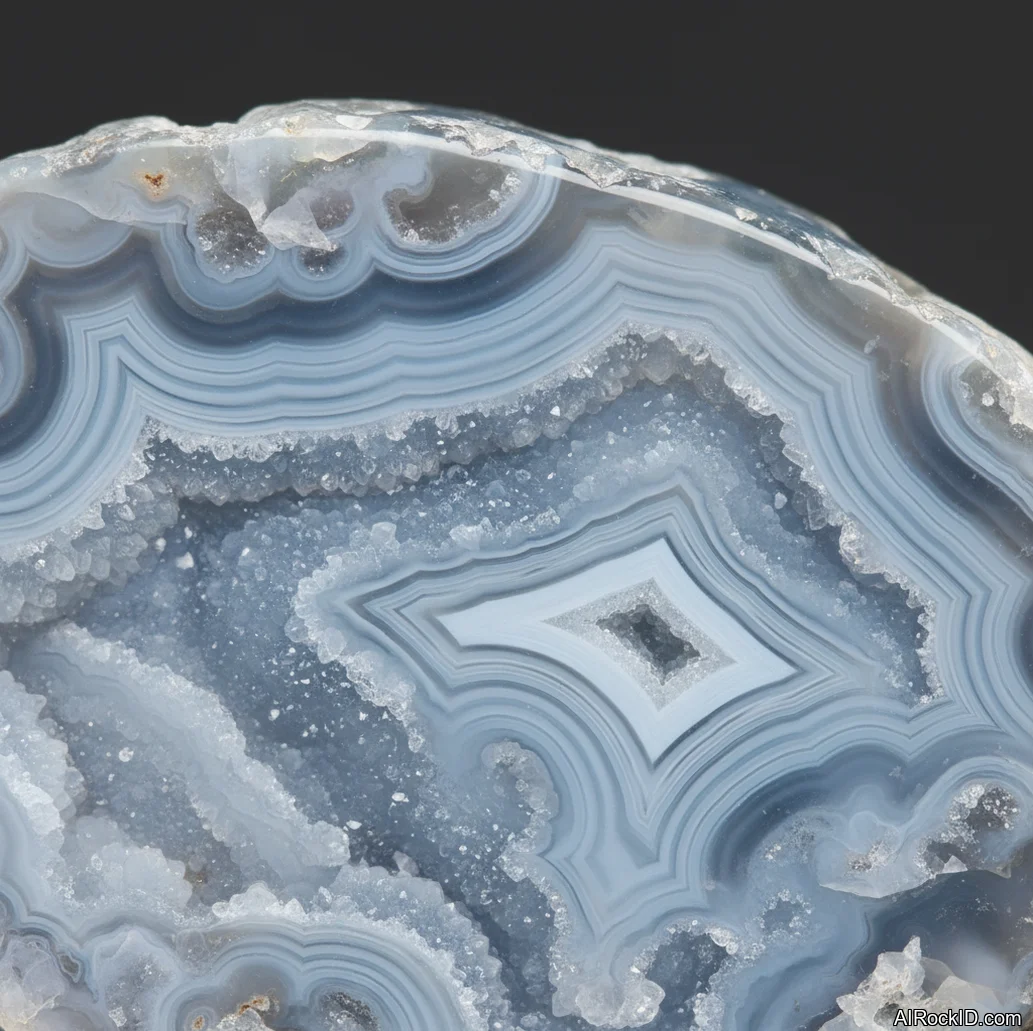
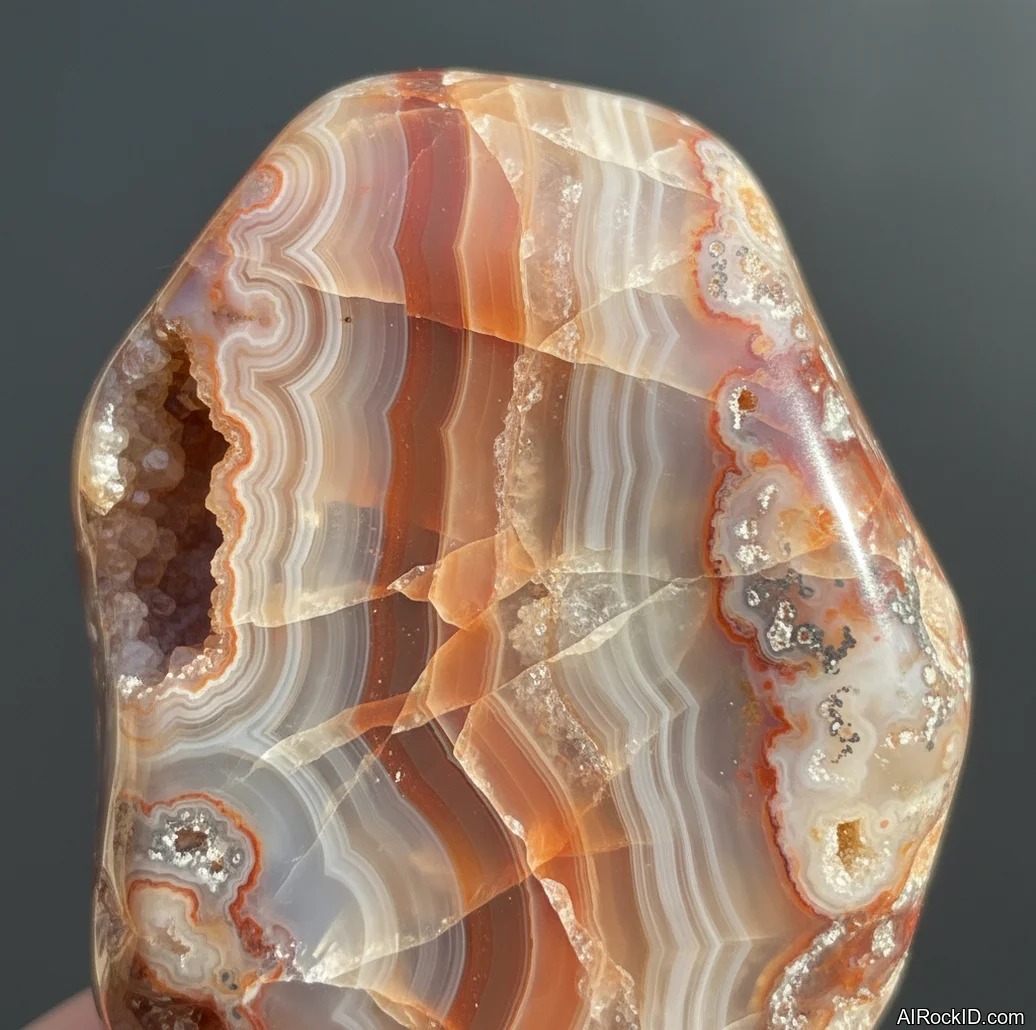
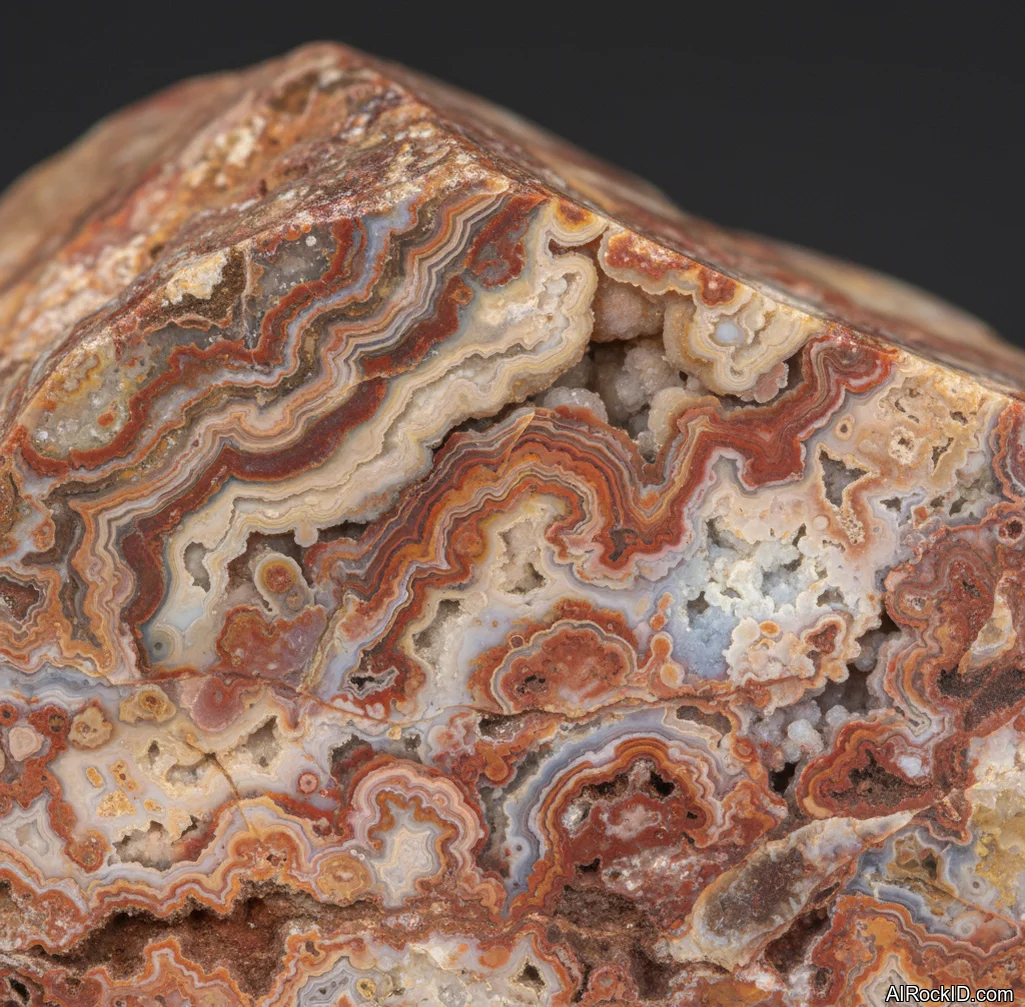
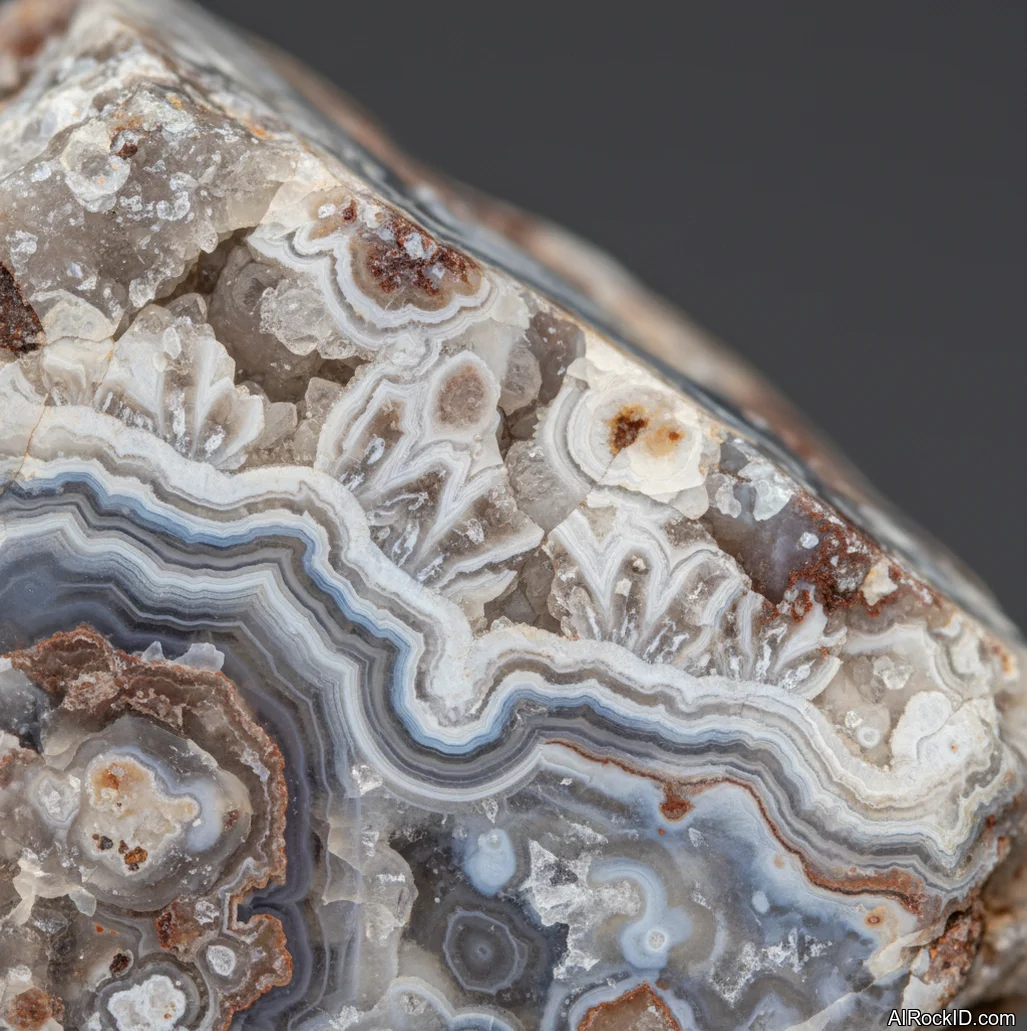
Look for fine, lace-like bands that cross, loop, or form an open network rather than simple straight stripes. Natural chalcedony usually has a waxy to vitreous luster and may appear slightly translucent at thin edges. A photo showing both the polished surface and the side of the stone is more useful than a single front-facing image.
Buying and Authenticity Checks
Ask whether the stone is natural, dyed, stabilized, or otherwise treated, especially when the color is very bright or unusually uniform. Check drilled beads and fractures for concentrated color, which can suggest dye. Because Lattice Lace Agate is often a pattern-based trade name, request clear photos rather than relying only on the label.
Best Uses for Lattice Lace Agate Jewelry
Lattice Lace Agate is suitable for pendants, earrings, beads, brooches, and protected rings because chalcedony is relatively durable. Cabochon cuts are common because they display the lace pattern without needing transparency or faceting. For rings, bezels or other protective settings help reduce the risk of chipping during daily wear.
What Is Lattice Lace Agate?
Lattice Lace Agate is a banded variety of chalcedony (microcrystalline quartz) with a lace or net-like lattice pattern.
At first glance, you’d probably file it under regular lace agate. But look a second longer and the pattern’s usually tighter, more grid-ish, like somebody ran a fine-tooth comb through the bands and turned them into tiny little “windows.” Grab a palm stone and the first thing you notice is the temp. It stays cool longer than glass, and once it’s polished it has that smooth-but-not-slippery agate feel under your thumb.
Most of what you’ll see for sale ends up as cabs, hearts, worry stones, or palm stones, because that’s where the lattice really shows off. Raw chunks are out there, sure, but a lot of the time they just look like brownish nodules until you slice them open. And that’s the fun part, honestly. I’ve watched dealers at shows crack a nodule and suddenly there it is, that cream-and-caramel lace inside, like a surprise layer cake. Who doesn’t like that?
Origin & History
“Lattice lace agate” is a trade name, not a formally described mineral species. You’re not going to find it listed like an official entry the way you would crocoite or benitoite. Most dealers use the label for lace agate that shows a netted, crosshatched pattern instead of those simple, parallel fortification bands you see in a lot of other pieces.
The name is basically as straightforward as it sounds. “Agate” traces back to the Achates River in Sicily. And “lace” plus “lattice” are just pattern words sellers and cutters use so you can picture the look once it’s cut and polished (that little glassy shine makes the crisscross really pop, honestly). In the lapidary world, names like this show up, fade out, then pop back in under a slightly different spin, but this one’s hung on because people actually remember it. Why? It’s easy to say, and it tells you what you’re getting.
Where Is Lattice Lace Agate Found?
It’s sold from multiple agate-producing regions, with a lot of market material coming out of Brazil and the western USA, plus some Russian agates that get labeled for their tight patterning.
Formation
Most agate begins when silica-rich fluids seep through little cavities in volcanic or sedimentary host rock. Think of the old gas bubbles you see in basalt, or those weird open pockets left behind after something dissolved out. Given enough time, that silica turns into a gel that coats the inside of the space, then it firms up into chalcedony. One skin-thin layer, then another. And another. Slow stuff. Kind of like tree rings, except you feel it under your thumb as a waxy, glassy band in stone.
That lattice look usually shows up when the banding gets cut off and then kicks back in, or when the chemistry and the flow routes change mid-deposit. Tiny shifts matter. A touch more iron in one pulse, a slightly different surge of fluid in the next (you can almost imagine the stop-start rhythm), and instead of neat stripes you end up with broken bands, feathery plumes, plus that netted pattern cutters go hunting for. But it’s still quartz at its core, just packed into a microcrystalline mesh.
How to Identify Lattice Lace Agate
Color: Common colors are cream, white, tan, honey-brown, gray, and sometimes a rusty red from iron staining. The pattern tends to look like lacework or a fine grid rather than broad, simple bands.
Luster: Polished pieces have a waxy to vitreous shine; rough surfaces look duller and chalkier.
Look closely at the edges of a cabochon under a phone flashlight. Real chalcedony usually shows that soft, even translucency at thin spots, not a plasticky glow. If you scratch it with a steel nail, it shouldn’t take a mark, but a cheap glass imitation will pick up tiny scratches fast. And in the hand, agate has a steady heft for its size, plus it stays cool on your cheek longer than resin or acrylic.
Common Look-Alikes
Lattice Lace Agate is sometimes confused with these materials:
- Crazy Lace Agate (including the common dyed pink/purple “crazy lace” tumbles)
- Botswana Agate (tight grey-white banding that can read as a lattice in photos)
- Picture Jasper (tan and brown “scene” patterns that get mislabeled as lace agate)
- Banded Calcite / “Mexican onyx” (softer, takes a high polish but scratches easier than agate)
- Dyed white agate sold as “lattice” (dye sitting in the net-like lines and pits)
- Pressed glass or resin “agate” cabochons (too light, too warm, pattern looks printed)
Market Cautions & Treatments
When AI Can Get This Wrong
In photos, AI tends to lump Lattice Lace Agate in with Crazy Lace Agate, Botswana agate, or even picture jasper because all three throw similar tan-and-cream swirls when the lighting’s flat. The real test is in-hand: a quick scratch test (agate should scratch glass), plus checking for dye pooling in the tiny lattice pits and cracks, clears up most of the bad calls.
Properties of Lattice Lace Agate
Physical Properties
| Crystal System | Trigonal |
| Hardness (Mohs) | 6.5-7 (Hard (6-7.5)) |
| Density | 2.58-2.64 g/cm3 |
| Luster | Waxy |
| Diaphaneity | Translucent to opaque |
| Fracture | Conchoidal |
| Streak | White |
| Magnetism | Non-magnetic |
| Colors | Cream, White, Tan, Brown, Gray, Red, Rust |
Chemical Properties
| Classification | Silicates |
| Formula | SiO2 |
| Elements | Si, O |
| Common Impurities | Fe, Mn, Al, Ca |
Optical Properties
| Refractive Index | 1.530-1.540 |
| Birefringence | None |
| Pleochroism | None |
| Optical Character | Uniaxial |
Lattice Lace Agate Health & Safety
Solid agate is safe to handle, and it’s fine if it gets a quick rinse or a short dip in water. Thing is, the real concern isn’t touching it at all. It’s inhaling the super-fine silica dust that kicks up when you cut or grind it (you know, that chalky, gritty powder that ends up on your fingers and clings to the tool and bench).
Safety Tips
If you’re going to do any lapidary work, do it wet. Keep water running, make sure you’ve got real airflow in the room (you should actually feel it moving past you), and wear a proper respirator that’s rated for silica. Dry grinding kicks up that super-fine dust that hangs in the air and gets everywhere, so don’t mess around. But if you’re just dealing with finished stones, it’s pretty simple. Wash your hands like you normally would, especially if you’ve been sorting through a bunch of dusty rough and your fingertips still feel gritty.
Lattice Lace Agate Value & Price
Price Range
Rough/Tumbled: $5 - $60 per palm stone or small slab
Cut/Polished: $1 - $8 per carat
Tight, high-contrast lattice patterns with a clean polish will jack the price up fast. But if the material goes muddy brown or the pattern looks kind of weak and washed out, it stays cheap. And size matters too. Bigger, well-matched pairs for earrings and cabochons with the pattern centered right in the dome (you can spot it as soon as you tilt it under a light) usually cost more.
Durability
Durable — Scratch resistance: Good, Toughness: Good
It’s stable in normal household conditions, but sharp blows can chip edges, especially on thin cabochons or carved points.
How to Care for Lattice Lace Agate
Use & Storage
Store it in a pouch or a divided box if it’s polished, since agate can still scratch softer stones and get scuffed by harder stuff. Keep thin cabochons away from heavy chunks that can smack them.
Cleaning
1) Rinse with lukewarm water. 2) Use a drop of mild soap and a soft toothbrush to clean crevices. 3) Rinse again and dry with a microfiber cloth.
Cleanse & Charge
If you’re into energetic cleansing, running water, smoke, or a night on a dry windowsill all work fine for agate. Skip salt soaks if the piece has fractures that might trap residue.
Placement
On a desk it reads calm and tidy because the pattern doesn’t scream for attention. In a display case, put it under angled light so the lace lines don’t wash out.
Caution
Don’t hit stones that have cracks or dyed areas with harsh cleaners, and skip the ultrasonic cleaner too. And if the color looks a little “pumped up” (you know the type), don’t park it in direct sun for hours, because some dyed agates fade.
Works Well With
Lattice Lace Agate Meaning & Healing Properties
Grab lattice lace agate when your head feels like a junk drawer. That’s what it does for me. The pattern’s busy, sure, but it’s the kind of busy that still makes sense, and a lot of people take that as grounding, “sort it out” energy.
I’ve literally kept a palm stone in my pocket at gem shows while I’m zigzagging booth to booth, fingers rubbing that smooth, cold surface through the fabric so I don’t impulse-buy the first shiny thing that catches the overhead lights. It helps. Simple as that.
In crystal-healing circles, agates usually get linked with steadiness, patience, and taking the edge off emotional spikes. Lattice lace agate gets grouped right in there, but with this extra “pattern recognition” twist because it actually looks like interlocking lines. But look, it’s not medicine. If you’re dealing with anxiety or panic stuff, think of the stone as a tactile anchor, something solid and cool to hold onto, not a stand-in for real support.
And here’s the straight collector note. Some sellers will hype “rare lattice lace” like it’s a separate species, when it’s really just a pattern grade of chalcedony. If it helps you focus while you meditate or journal, awesome. Just don’t hand over museum-mineral money for a trade name and a pretty polish (seriously, why would you?).
Common mistakes
- Assuming every lace-patterned agate is the same variety or locality.
- Treating vivid color as proof of rarity without checking for dye.
- Identifying a stone from pattern alone without considering hardness, luster, and translucency.
- Confusing opaque jasper with agate when no translucent edges are visible.
- Expecting two Lattice Lace Agate pieces to match exactly, even though natural banding varies widely.
Identify Lattice Lace Agate from a photo
Compare Lattice Lace Agate traits, care tips, value clues, and common lookalikes with a clear photo.