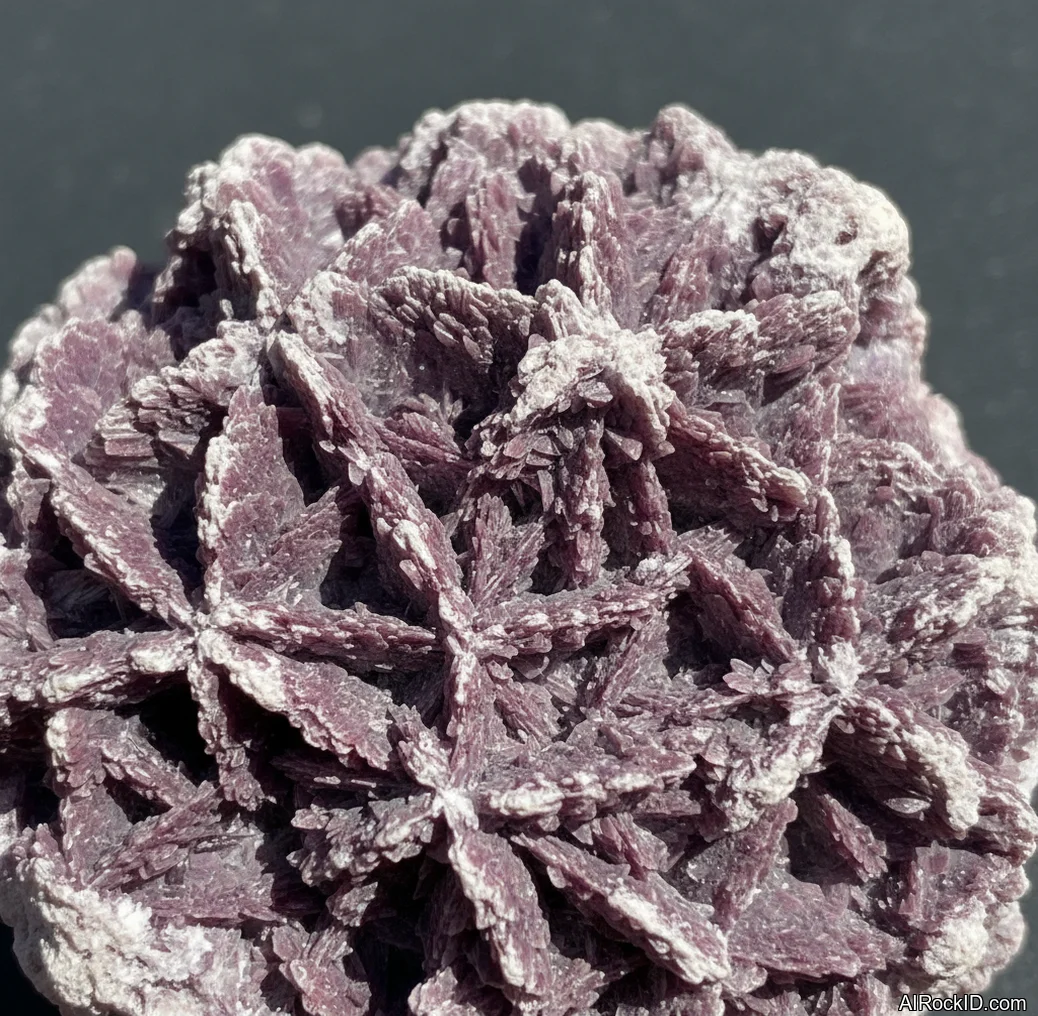
Nevada Rose Purple Dumortierite


Quick answer: Nevada Rose Purple Dumortierite is a purple to violet dumortierite material associated with Nevada sources, usually seen as opaque to translucent lapidary rough, cabochons, or polished pieces. Its hardness can be relatively high, but visual identification should be checked against similar purple stones and dyed materials.
AI Rock ID can help compare Nevada Rose Purple Dumortierite against visually similar purple minerals using color, texture, luster, and photo context. RockIdentifier.io provides crystal reference details that can support, but not replace, hands-on gemological testing when origin or authenticity matters.
Good fit
- Collectors who want a purple lapidary material with a less common locality association
- People comparing opaque to translucent purple stones by hardness, luster, and texture
- Buyers who prefer stones sold with locality details and clear seller documentation
- Lapidary users looking for material that may take a polish when properly cut
Not a good fit
- Anyone needing a transparent faceted gemstone with high brilliance
- Buyers who require guaranteed Nevada origin without seller documentation
- Identification based only on color, because several purple stones can look similar
- Use in harsh ultrasonic or chemical cleaning without prior testing
Most commonly confused with
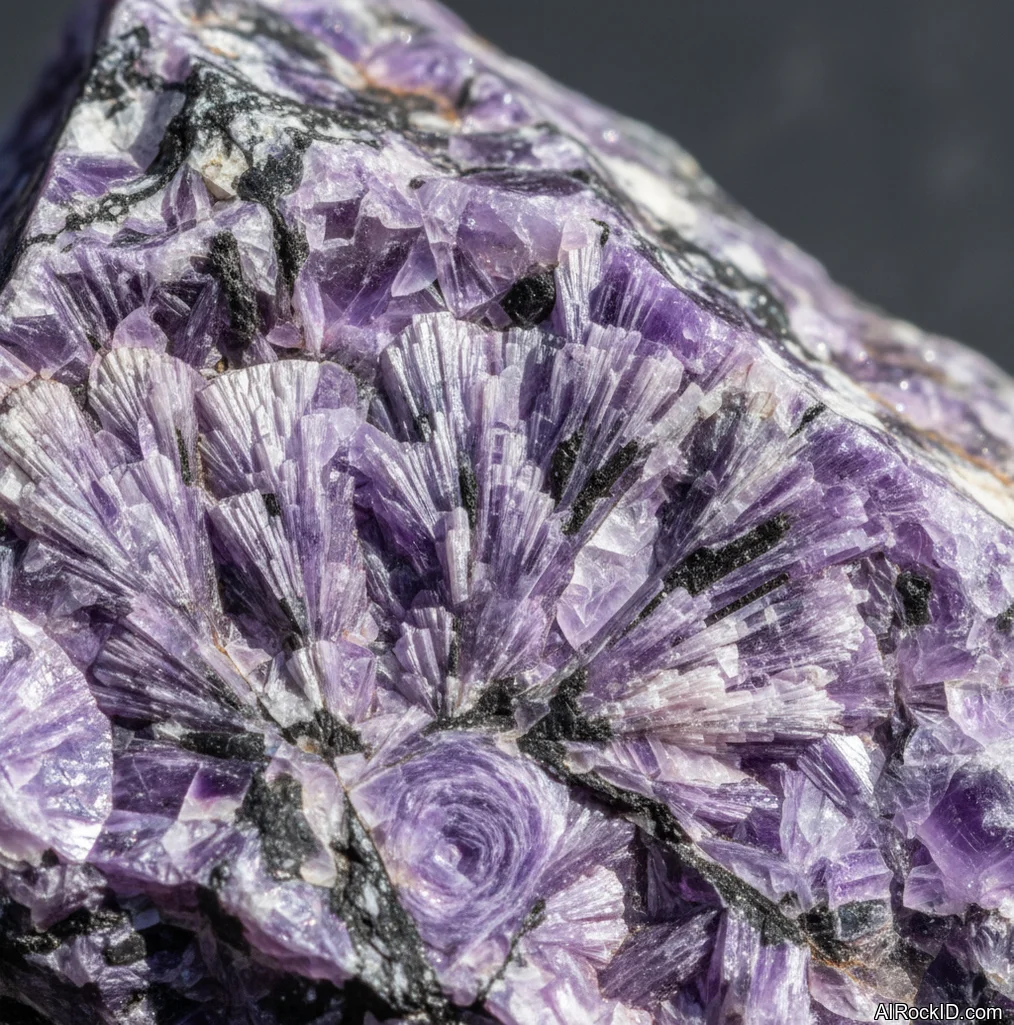
- Charoite: Charoite often shows swirling fibrous lavender patterns and is generally softer than dumortierite.
- Sugilite: Sugilite can be rich purple with a more massive waxy look, and confirmed pieces often require gemological testing.
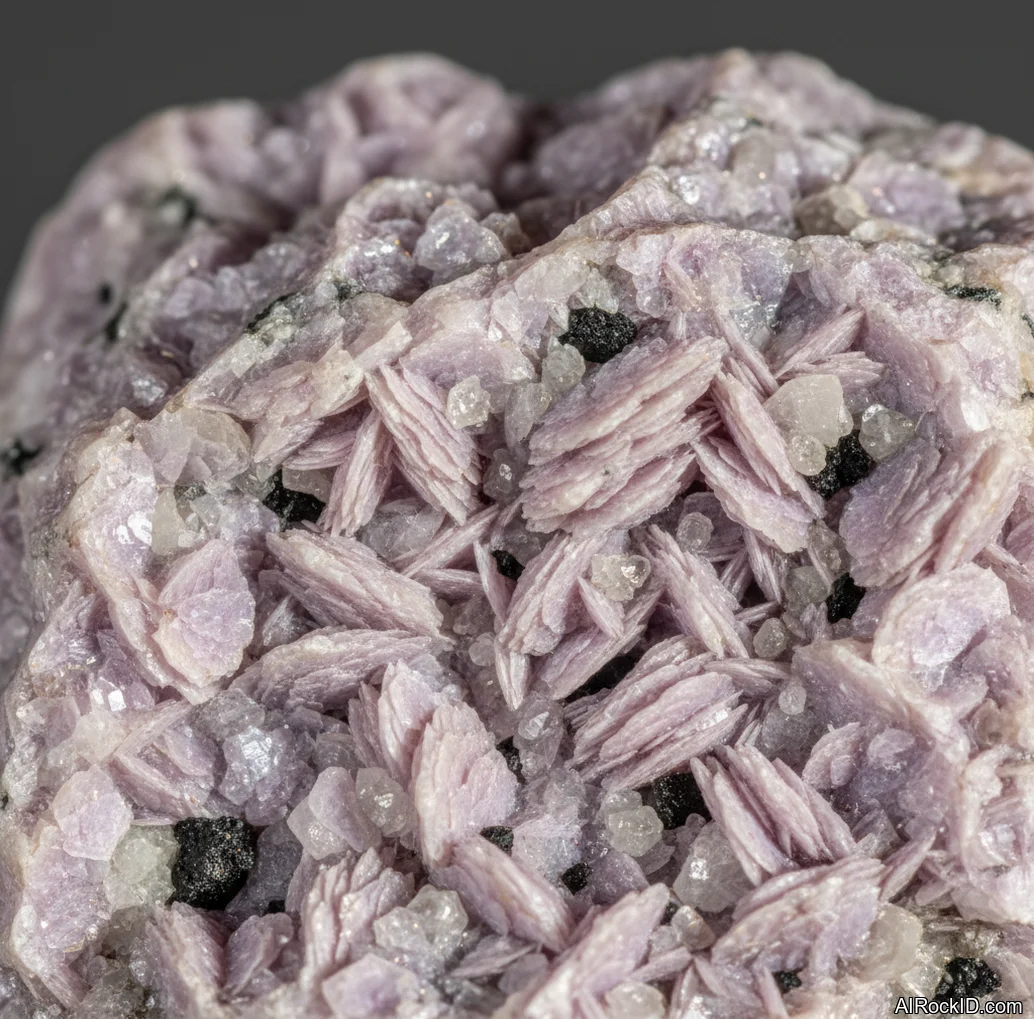
- Lepidolite: Lepidolite is a mica, usually softer, lighter, and may show sparkly or flaky cleavage surfaces.
- Amethyst: Amethyst is quartz and is commonly transparent to translucent with a glassy luster rather than a dense fibrous or massive texture.
Nevada Rose Purple Dumortierite vs Similar Purple Stones
| Material | Typical look | Practical ID clue | Common concern |
|---|---|---|---|
| Nevada Rose Purple Dumortierite | Purple to violet, opaque to translucent | High hardness and massive to fibrous texture | Locality claims need documentation |
| Charoite | Lavender to purple with swirling patterns | Often has distinctive silky, chatoyant-looking swirls | Can be confused in polished cabochons |
| Sugilite | Strong purple, often massive | Waxy to vitreous luster; testing may be needed | Imitations and lookalikes occur |
| Lepidolite | Lilac to purple, sometimes sparkly | Soft mica with flaky cleavage | May be mislabeled as harder purple stones |
| Dyed Quartzite | Bright or uneven purple | Color may collect in fractures or pores | Dye disclosure may be missing |
AI identification confidence
AI photo identification for Nevada Rose Purple Dumortierite is usually moderate at best because many opaque purple stones share similar color and polish. Confidence improves with sharp close-ups, unfiltered lighting, scale, locality information, and photos of both rough and polished surfaces.
When AI gets it wrong
- Photos are taken under purple, blue, or warm lighting that shifts the true body color
- The specimen is a polished cabochon with few visible texture or mineral features
- Dyed quartzite, dyed agate, or composite material is shown without close-up fracture detail
- The listing depends on a Nevada locality claim but provides no provenance or testing
Final recommendation
Choose Nevada Rose Purple Dumortierite when the seller provides clear photos, dimensions, treatment disclosure, and any available locality information. For higher-value purchases, ask for gemological observations or independent verification rather than relying on color alone.
How to Check Authenticity Before Buying
A credible listing for Nevada Rose Purple Dumortierite should show the stone in natural light, include close-up surface detail, and state whether the piece is rough, stabilized, dyed, or untreated. Be cautious with unusually vivid purple color, identical-looking beads, or listings that use multiple premium names without documentation. Locality-specific claims are strongest when supported by mine, dealer, or collection provenance.
Photo Tips for Identification
Use daylight or a neutral white light source and photograph the specimen against a plain background. Include one close-up of the surface texture, one image showing translucency at an edge if present, and one photo beside a ruler or coin for scale. Avoid heavy filters, wet surfaces, and colored backgrounds because they can make common purple materials look more distinctive than they are.
Testing Clues That Help Separate Lookalikes
Hardness, specific gravity, refractive index, and microscopic texture are more useful than color alone for separating dumortierite from other purple stones. A simple scratch test should be avoided on finished pieces because it can damage the polish. For valuable items, a gemologist can check refractive index, density, magnification features, and evidence of dye or treatment.
What Is Nevada Rose Purple Dumortierite?
Nevada Rose Purple Dumortierite is dumortierite with rose to purple color, and it’s a trade name used for material sourced from Nevada, USA.
Pick up a chunk and you’ll notice something right away: it doesn’t have that slick, glassy feel quartz has. It feels tighter. More like a fibrous ceramic (almost like the surface has a fine, grippy drag to it). And the purple usually shows up as streaks and cloudy patches, not a clean, even wash. Some pieces honestly look like someone rubbed a lavender pastel across the stone and didn’t bother to blend it.
Look, at first glance people mix it up with lepidolite or even purple chalcedony. But dumortierite feels tougher and more stubborn when you do a scratch test. And when it’s sitting in host rock, the purple often shows as little brushy bundles instead of flat mica flakes.
Origin & History
Dumortierite got its first proper write-up in 1881, thanks to the French mineralogist Ferdinand Gonnard. And the name? That was picked to honor Eugène Dumortier, a French paleontologist and industrialist.
Thing is, “Nevada Rose Purple” isn’t some separate species name. It’s dealer shorthand, the kind you see scribbled on a little card in a display case, meant to hint at the color and the supposed locality. So you’ll run into the same habit at shows with tags like “Arizona blue dumortierite” or “denim dumortierite,” even when the rough in the tray (dusty chips, mixed sizes) is obviously coming from mixed sources.
Where Is Nevada Rose Purple Dumortierite Found?
Dumortierite forms in high-grade metamorphic rocks and boron-rich environments worldwide; “Nevada Rose Purple” refers to material sold as coming from Nevada in the western United States.
Formation
Most dumortierite you’ll ever run across forms during metamorphism. Boron gets mixed into the party, and you end up with fibrous borosilicates threading their way through the rock. Think gneiss and schist country. And then, sometimes, pegmatites or quartz veins that happened to have the right chemistry at the right moment.
If you pick up a raw purple chunk and actually stare at it for a second, the growth habit usually gives itself away even without a loupe. It’s not blocky like feldspar. It shows up as tiny fibers, little bundles, almost like a faint grain running through it. That fibrous texture is also why a fresh break can have a slightly silky look when you tilt it under a light. But that same thing is exactly why clean, transparent, gemmy dumortierite is on a whole other level of rare compared to the chunkier material.
How to Identify Nevada Rose Purple Dumortierite
Color: Color ranges from dusty rose-violet to deeper grape purple, often in streaks, patches, or fibrous “paintbrush” areas rather than uniform color.
Luster: Luster is usually vitreous to dull, and can look slightly silky on fibrous surfaces.
If you scratch it with a steel nail, it usually won’t bite like softer purple minerals will. The real test is glass: dumortierite can scratch glass, though the fibrous texture can make the scratch feel uneven. Pick up a polished piece and run your thumb over it, the purple areas often look cloudy and threadlike instead of sparkly like mica or waxy like chalcedony.
Common Look-Alikes
Nevada Rose Purple Dumortierite is sometimes confused with these materials:
- Purple quartz (amethyst), especially pale lavender amethyst chunks sold as "Nevada purple"
- Lepidolite (lavender mica), both massive and sparkly micaceous pieces
- Charoite (purple swirly massive), often cut into palm stones and mislabeled as dumortierite
- Sugilite (purple massive), usually in small pricey pieces but it gets name-dropped on listings
- Dyed quartzite or dyed chalcedony sold as "purple dumortierite" (look for dye in fractures and drill holes)
- Purple slag glass or colored glass chunks marketed as "raw crystal"
Market Cautions & Treatments
When AI Can Get This Wrong
At first glance in photos, AI mixes Nevada Rose Purple Dumortierite up with pale amethyst, lepidolite, and even charoite because all three can read as "lavender with mottling" once the seller bumps saturation. The real test is tactile and simple: dumortierite rough feels tighter and slightly draggy, not slick like quartz, and it won’t show mica glitter like lepidolite when you tilt it under a single overhead light. If you can, do a quick hardness reality check on an inconspicuous edge: it should scratch glass cleanly, while a lot of dyed soft stuff won’t.
Properties of Nevada Rose Purple Dumortierite
Physical Properties
| Crystal System | Orthorhombic |
| Hardness (Mohs) | 7-8.5 (Hard (6-7.5)) |
| Density | 3.26-3.35 g/cm3 |
| Luster | Vitreous |
| Diaphaneity | Opaque to translucent |
| Fracture | Splintery |
| Streak | White |
| Magnetism | Non-magnetic |
| Colors | Purple, Violet, Rose, Lavender, Blue, Grayish purple |
Chemical Properties
| Classification | Silicates |
| Formula | Al7BO3(SiO4)3O3 |
| Elements | Al, B, Si, O |
| Common Impurities | Fe, Mn, Ti |
Optical Properties
| Refractive Index | 1.678-1.689 |
| Birefringence | 0.010 |
| Pleochroism | Strong |
| Optical Character | Biaxial |
Nevada Rose Purple Dumortierite Health & Safety
Handling it is safe. But if you cut it or sand it, you can kick up that super-fine mineral dust, the kind that hangs in the air and gets in your nose, and you really shouldn’t be breathing that stuff. And water contact is generally fine as long as the piece is intact (no crumbling edges).
Safety Tips
If you’re going to work it lapidary-style, keep the wheel wet and put on a real respirator. Don’t dry-sand anything fibrous, because that dusty fuzz gets everywhere (and you’ll taste it in the back of your throat if you’re not careful).
Nevada Rose Purple Dumortierite Value & Price
Price Range
Rough/Tumbled: $8 - $60 per piece
Cut/Polished: $12 - $65 per carat
Price jumps around depending on how deep that purple looks in person and whether the piece is solid dumortierite or just a bit of dumortierite sitting in host rock. Clean cabbing rough costs more, mostly because it doesn’t crumble or undercut when you put it on the wheel (and yeah, it feels different under your fingers too). And if it’s verified Nevada provenance with actual paperwork, that can bump the tag up.
Durability
Durable — Scratch resistance: Excellent, Toughness: Fair
It’s stable in normal room conditions, but the fibrous habit means sharp knocks can chip edges even though it resists scratches.
How to Care for Nevada Rose Purple Dumortierite
Use & Storage
Store it like you would most harder silicates: separate from softer stones so it doesn’t scratch them, and pad it if it has thin edges. I keep my purple dumortierite in little perky boxes because the splintery breaks can snag cloth pouches.
Cleaning
1) Rinse with lukewarm water. 2) Use a drop of mild soap and a soft toothbrush to get dust out of pits and seams. 3) Rinse again and pat dry; don’t blast it with steam.
Cleanse & Charge
A quick rinse and a dry cloth wipe is plenty for most people. If you use smoke or sound, keep it simple and avoid long direct sun if the color looks surface-sensitive on your piece.
Placement
It reads best under neutral light, like a shelf that doesn’t get harsh afternoon sun. On a desk, it’s the kind of stone you’ll keep picking up because it feels dense and cool.
Caution
Don’t breathe in the dust if you’re cutting or drilling it. When it fractures in that fibrous way, it can kick up much finer particles than you’d expect. And don’t just drop it loose in your pocket with softer stones either, unless you want to pull them out later covered in little scuffs.
Works Well With
Nevada Rose Purple Dumortierite Meaning & Healing Properties
Next to the flashier purple stones, dumortierite comes off like the “get it done” rock in a spiritual kit. It’s the one people reach for when they’re trying to build some mental structure, lock in study habits, or keep their brain from pinballing around when there are way too many tabs open. And honestly, the rough material matches that vibe. The purple isn’t syrupy or smooth. It’s fibrous, kind of gritty, the sort of texture you notice right away when you rub your thumb over it.
But here’s the straight answer: a lot of the lore out there mashes dumortierite together with “dumortierite in quartz,” and collectors will tell you those don’t feel the same in hand. Quartz-hosted pieces tend to feel colder and glassier, and people sometimes (maybe without realizing it) drag quartz meanings onto the mix. So if you’re buying it for metaphysical use, ask what you’re actually getting. Is it solid dumortierite, or is it inclusions in quartz?
I’ll say this plainly. None of this is medical. If someone’s trying to sell “Nevada Rose Purple Dumortierite” like it’s a cure, don’t buy it. Walk away. What it can do, in a normal human way, is work as a tactile focus object. Pick it up, feel the weight, stare at those purple threads, and you might actually finish the thing you told yourself you’d finish. (We’ve all been there, right?)
Common mistakes
- Assuming every opaque purple stone from the western United States is dumortierite
- Accepting a Nevada locality claim without provenance, invoice history, or seller explanation
- Confusing lepidolite’s soft, flaky mica texture with harder purple dumortierite
- Judging authenticity from saturation alone, since lighting and dye can change appearance
- Using scratch tests on polished cabochons or beads and damaging the surface
- Overlooking treatment disclosure for dyed, stabilized, or composite purple material
Identify Nevada Rose Purple Dumortierite from a photo
Compare Nevada Rose Purple Dumortierite traits, care tips, value clues, and common lookalikes with a clear photo.
Nevada Rose Purple Dumortierite FAQ
Related Crystals
See also: Dumortierite.