Purple Opal Morado Opal


Quick answer: Purple Opal, often sold as Morado Opal, is a lavender-to-violet common opal made of hydrated silica rather than crystalline quartz. It is best identified by its waxy to vitreous luster, opaque to translucent body, lack of strong cleavage, and moderate hardness around Mohs 5.5–6.5.
AI Rock ID can help compare a photo of Purple Opal Morado Opal against visually similar purple stones by checking color, luster, opacity, and surface texture. RockIdentifier.io should be used as a screening tool rather than a final laboratory identification, especially for dyed, stabilized, or composite material.
Good fit
- Collectors who want an opaque to translucent purple stone with a soft, natural-looking color
- Jewelry buyers choosing pendants, earrings, or low-impact rings with protective settings
- People comparing purple opal against charoite, sugilite, amethyst, and dyed chalcedony
- Beginners learning to identify common opal without play-of-color
Not a good fit
- Daily-wear rings exposed to frequent knocks, water, or chemicals
- Buyers who require strong spectral fire, which is typical of precious opal rather than common purple opal
- Anyone needing a laboratory-grade identification from a photo alone
Most commonly confused with
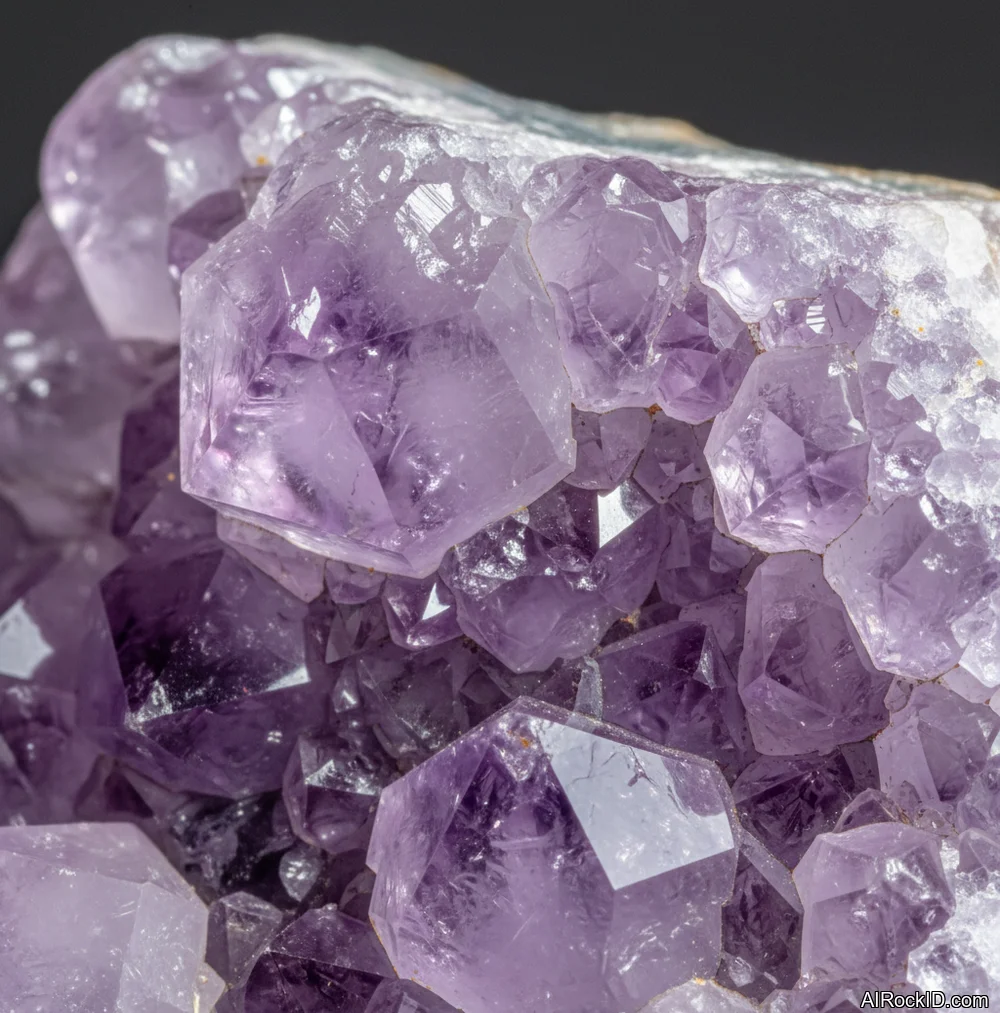
- Amethyst: Amethyst is crystalline quartz with higher hardness around Mohs 7 and usually shows clearer crystal structure or faceted transparency.
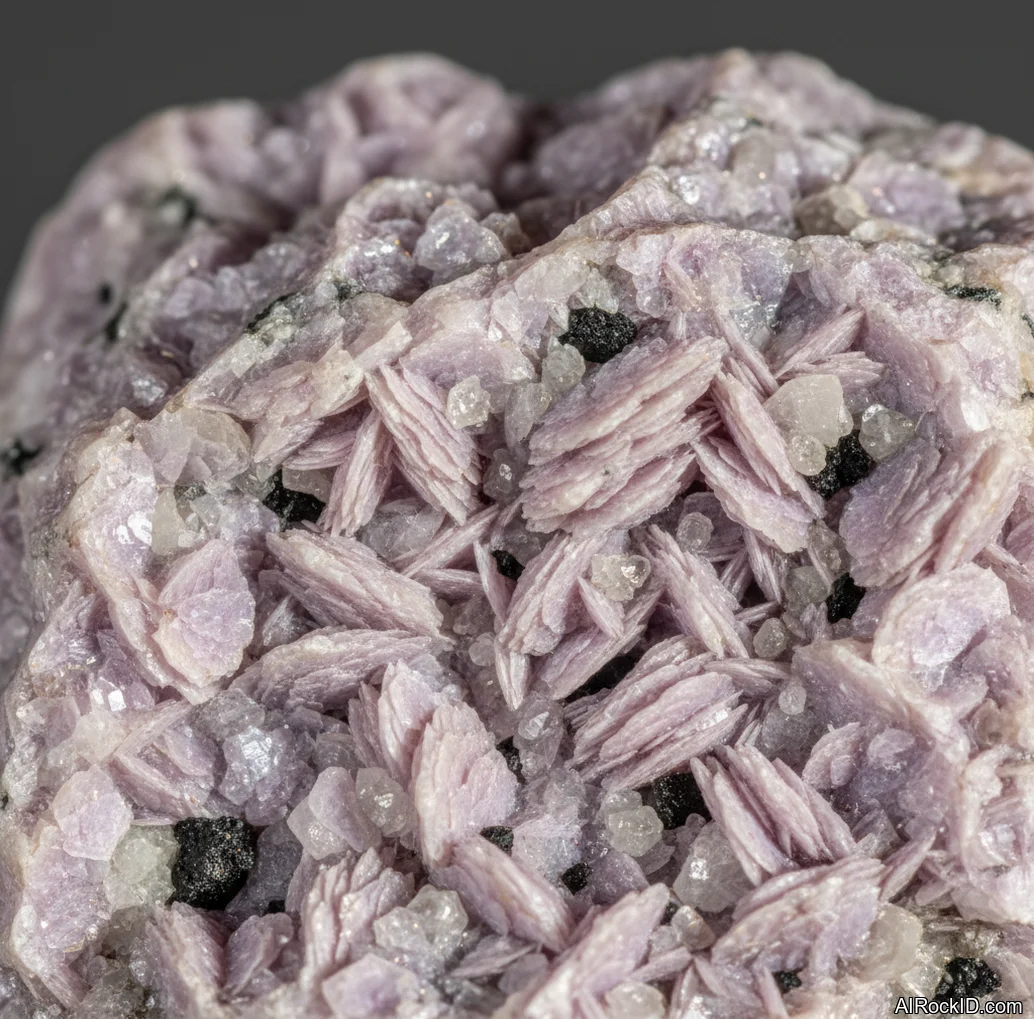
- Sugilite: Sugilite can be richer purple and may show manganese-associated veining, while Purple Opal is hydrated silica with a lower specific gravity range.
- Charoite: Charoite commonly has swirling fibrous patterns and chatoyant-looking bands, unlike the more even or patchy texture of many Morado Opal specimens.
- Dyed Chalcedony: Dyed chalcedony may show concentrated color in cracks or pores, while natural Purple Opal usually has more irregular but integrated coloration.
Purple Opal vs. Similar Purple Stones
| Stone | Typical Look | Key ID Difference | Mohs Hardness |
|---|---|---|---|
| Purple Opal Morado Opal | Lavender to violet, opaque to translucent, waxy or vitreous | Common opal; usually no play-of-color | 5.5–6.5 |
| Amethyst | Transparent to translucent purple quartz | Crystalline quartz, often faceted or crystal-pointed | 7 |
| Charoite | Purple with swirling fibrous bands | Distinctive flowing, silky pattern | 5–6 |
| Sugilite | Purple to magenta, often massive | May show darker veining and denser color zones | 5.5–6.5 |
| Dyed Chalcedony | Even bright purple or color concentrated in pores | Dye may collect in fractures or around drilled holes | 6.5–7 |
AI identification confidence
AI identification confidence is usually moderate for Purple Opal Morado Opal when photos show natural texture, translucency at edges, and multiple lighting angles. Confidence drops when the specimen is polished, uniformly dyed, heavily filtered, or shown without scale.
When AI gets it wrong
- A polished cabochon has no visible matrix, edge translucency, or diagnostic texture
- Purple color is enhanced by lighting, saturation filters, or a colored background
- Dyed chalcedony, dyed quartzite, or resin-filled material has a similar smooth surface
- The image does not show hardness clues, fracture style, or close-up surface detail
Final recommendation
For buying Purple Opal Morado Opal, prioritize clear seller photos, disclosed treatments, and a return policy if the material is sold as natural. For higher-value pieces, ask whether the stone is natural, dyed, stabilized, or assembled, because appearance alone may not separate all lookalikes.
How to Check Authenticity When Buying
Authentic Purple Opal Morado Opal should be described as common opal or hydrated silica, not as purple precious opal unless it shows genuine play-of-color. Check for dye concentration in cracks, around drill holes, or along surface pits. Ask sellers for untreated daylight photos and treatment disclosure, especially for beads, cabochons, and unusually uniform bright-purple pieces.
Photo Tips for Better AI Identification
Photograph Purple Opal Morado Opal in indirect daylight on a neutral background. Include one close-up, one image showing the whole specimen, and one edge-lit photo if the stone is translucent. Avoid purple-tinted lighting, heavy filters, and wet surfaces because they can make chalcedony, fluorite, or dyed material appear closer to opal.
Treatment and Stabilization Notes
Some opal and porous silica materials may be stabilized, waxed, oiled, or dyed to improve color and durability. These treatments are not always visible without magnification or testing. Treatment disclosure matters because it can affect care, resale value, and confidence in identification.
What Is Purple Opal Morado Opal?
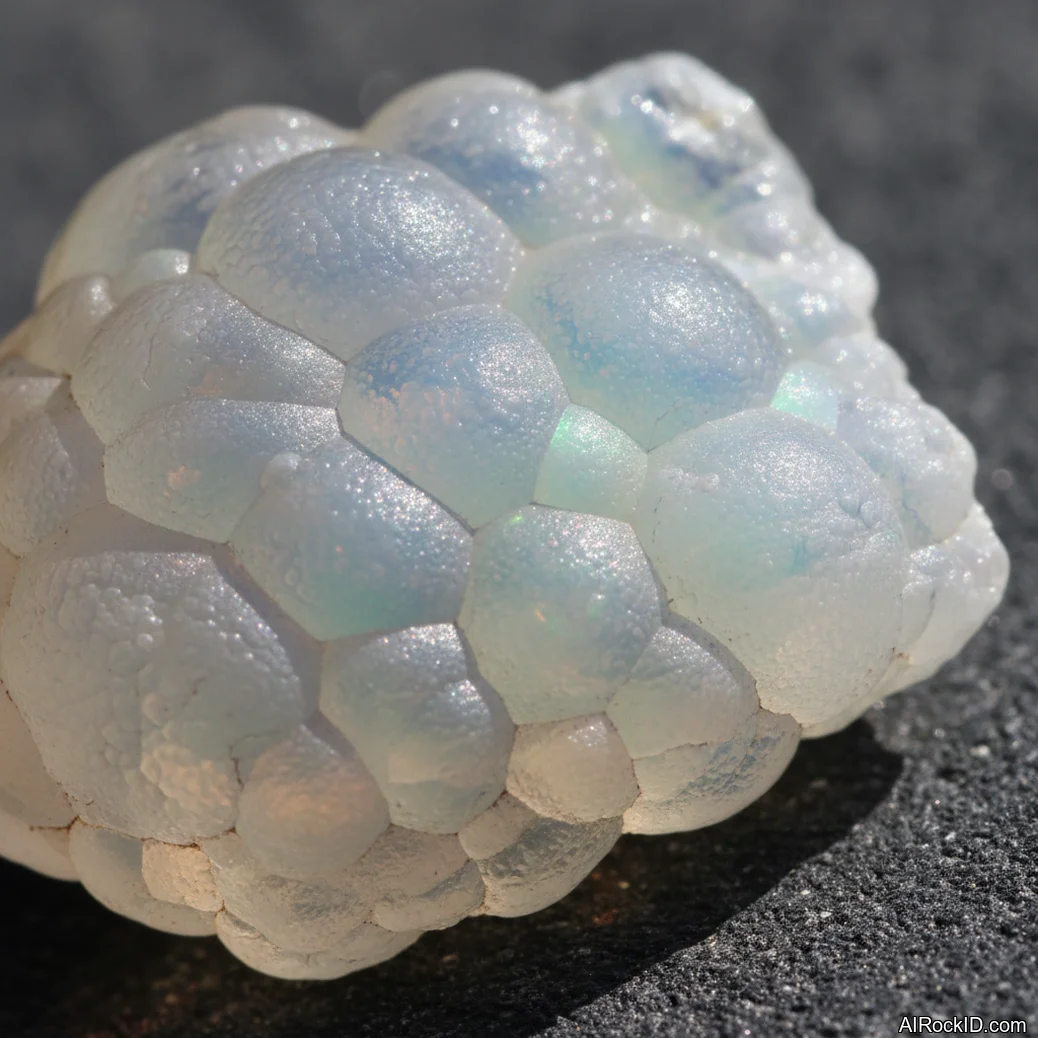
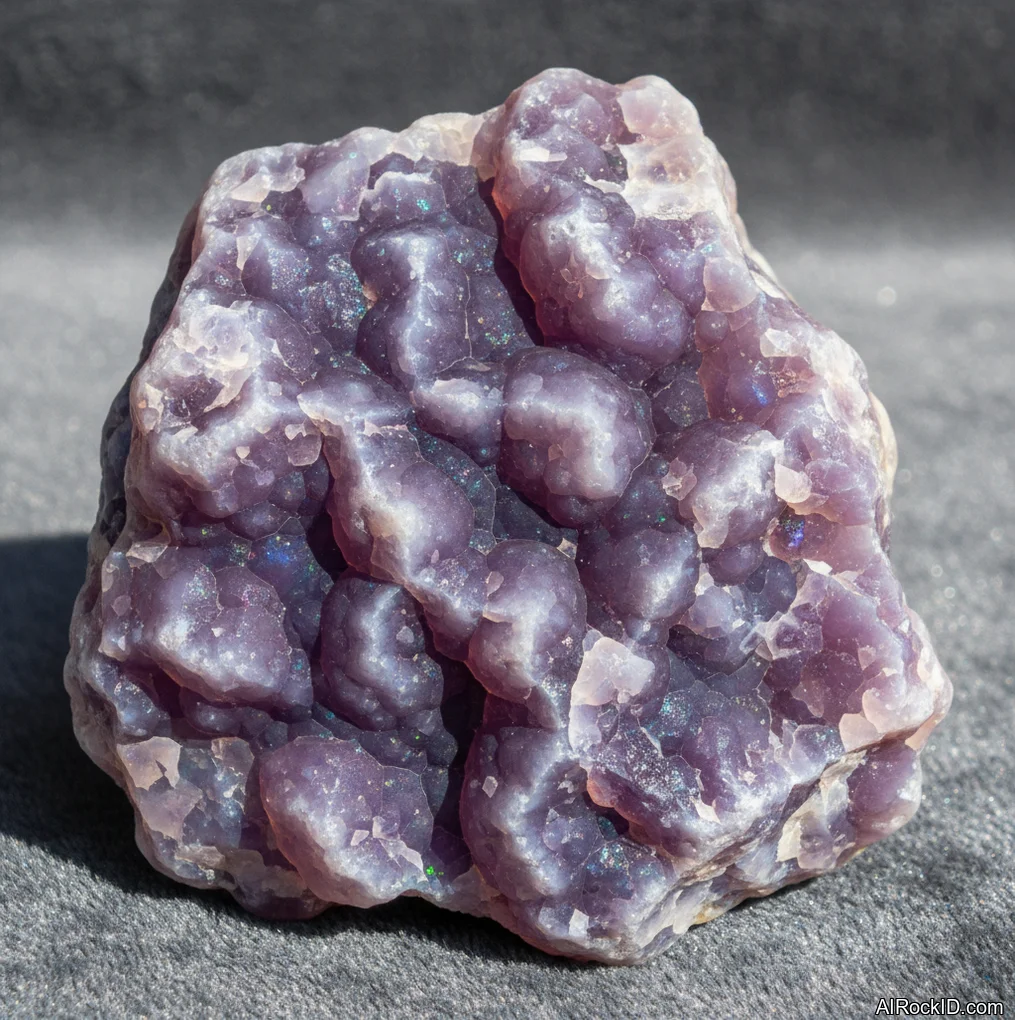
Purple Opal, also called Morado Opal, is basically common opal that happens to be purple. It’s an amorphous hydrated silica (SiO2·nH2O), and most pieces have that waxy shine, with little to no play-of-color.
Grab a tumbled chunk and you’ll know immediately. It’s got that unmistakable opal feel. Light in the palm, almost weirdly so, and it warms up faster than quartz does once you’ve been holding it for a minute. The purple can be a soft lilac or it can lean into a darker grape tone, and a lot of stones have milky clouds, pale banding, or tiny freckles, like somebody swirled cream into grape juice and didn’t fully mix it.
People see the color and think “amethyst,” which is fair. But it doesn’t have that crisp, glassy snap. Purple opal looks more velvety, like there’s a low glow sitting under the surface. And if you’ve carried opal around much, you’ve probably noticed this already: the edges ding up easier than quartz points tossed in the same pocket. So yeah, it’s a carry-it stone, just don’t beat it up.
Origin & History
Morado literally just means “purple” in Spanish. In the gem trade, you’ll run into “Morado Opal” all the time as a label for purple common opal coming out of Mexico. Opal itself has been recognized as a mineral species for centuries, but this purple stuff didn’t really get its own name in the mainstream market until dealers started pulling it out of the catch-all “common opal” bins and giving it a separate tag.
Thing is, most dealers I know treat it as a color variety, not some formally defined mineral variety. So you’ll see it written up by color and origin, like “Morado opal, Mexico,” and not phrased like it’s an official new species. Basically, it’s old opal with newer marketing. And honestly, who cares, as long as nobody’s trying to sell it as rare precious opal.
Where Is Purple Opal Morado Opal Found?
Most Morado opal on the market is sold as Mexican material, with other purple common opals also coming from Peru and smaller occurrences elsewhere. Dealers often list it by state (like Jalisco) rather than a specific mine name.
Formation
Opal starts out pretty simply: silica-rich water seeps through rock, then leaves behind a silica gel in cracks, little pockets, and those spongy, porous layers. Give it enough time and that gel firms up into opal, but it hangs onto some water inside the structure. And that leftover water is why opal feels a little different in your hand, kind of cool and slightly waxy, and it’s also why it can get finicky if you bake it with heat or dry it out too fast.
As for the purple you see in common opal, that usually comes down to trace impurities, tiny inclusions, plus how light scatters as it passes through the stone. You’ll sometimes spot banding where the purple washes out into white or gray, like the gel’s chemistry shifted halfway through a flow. Raw pieces can look honestly kind of boring at first, just dull lumps with a dusty skin (sometimes you even get that chalky rind), but once you cut or polish them the color opens up and that waxy sheen suddenly pops. Why does it change so much? Because the fresh surface lets the light do its thing.
How to Identify Purple Opal Morado Opal
Color: Lavender to violet-purple, often with milky white clouds, pale bands, or mottled patches; typically no strong play-of-color. Color is usually softer and more “foggy” than purple quartz.
Luster: Waxy to dull, sometimes slightly vitreous on a fresh polished surface.
Look closely at the surface and you’ll usually see a creamy, waxy glow instead of the crisp glassy look amethyst has. If you scratch it with a steel needle in an inconspicuous spot, it can mark easier than quartz, since opal sits around Mohs 5.5–6.5. The real test is feel: a lot of purple opal has a slightly “soapy” smoothness when polished, and the edges nick more easily than you’d expect from a purple stone.
Common Look-Alikes
Purple Opal Morado Opal is sometimes confused with these materials:
- Sugilite (especially low-grade, opaque pieces)
- Chalcedony dyed purple
- Purple fluorite
- Purple glass (especially tumbled)
- Purple agate (dyed or natural)
- Amethyst (polished, lower quality)
Market Cautions & Treatments
When AI Can Get This Wrong
AI photo ID mixes Morado Opal up with dyed chalcedony and purple glass all the time, especially if it's tumbled or cabbed. Sugilite pops up as a false match too, since both can go lavender to deep purple. The real test is weight and feel—Morado Opal is light for its size, warms up fast in your hand, and doesn't have the sugary sparkle of fluorite or the perfect transparency of glass.
Properties of Purple Opal Morado Opal
Physical Properties
| Crystal System | Amorphous |
| Hardness (Mohs) | 5.5-6.5 (Medium (4-6)) |
| Density | 2.0-2.2 g/cm3 |
| Luster | Waxy |
| Diaphaneity | Translucent to opaque |
| Fracture | Conchoidal |
| Streak | White |
| Magnetism | Non-magnetic |
| Colors | Purple, Lavender, Violet, White, Gray |
Chemical Properties
| Classification | Silicates |
| Formula | SiO2·nH2O |
| Elements | Si, O, H |
| Common Impurities | Fe, Mn, Al, Ca, Mg |
Optical Properties
| Refractive Index | 1.44-1.46 |
| Birefringence | None |
| Pleochroism | None |
| Optical Character | Isotropic |
Purple Opal Morado Opal Health & Safety
Purple opal is generally safe to handle, and it isn’t considered toxic. Just use normal stone-handling hygiene, like washing your hands after you’ve been holding it (especially if you’ve got that fine, chalky dust on your fingertips). That’s it.
Safety Tips
If you need to cut or sand it, keep it wet with water and put on a respirator. Silica dust gets airborne fast (you can almost taste that gritty chalky stuff), and you really don’t want to be breathing it in, right?
Purple Opal Morado Opal Value & Price
Price Range
Rough/Tumbled: $5 - $60 per piece
Cut/Polished: $5 - $30 per carat
Price jumps around depending on how saturated the color is, how clean that purple looks in plain daylight, and whether the stone will actually take a high polish without showing pits (those tiny little pinholes you sometimes only notice once it’s glossy). Bigger chunks with even color are pricier, sure. But purple opal, in general, still sits in that “affordable pretty” lane, not the high-end gem bracket.
Durability
Moderate — Scratch resistance: Fair, Toughness: Fair
Opal can craze or crack if it’s exposed to rapid drying, heat, or big temperature swings.
How to Care for Purple Opal Morado Opal
Use & Storage
Store it away from harder stones like quartz and topaz, because it’ll pick up scratches and edge chips. I keep mine in a little pouch or a divided box so it’s not clacking around in a drawer.
Cleaning
1) Rinse quickly with lukewarm water and a drop of mild soap. 2) Wipe with a soft cloth or a very soft brush, then rinse again. 3) Pat dry and let it air dry away from direct sun or heaters.
Cleanse & Charge
A quick smoke cleanse, sound, or a short sit on selenite works without stressing the stone. Skip long sunbaths, since opal and heat don’t get along.
Placement
On a desk or nightstand is fine, but don’t park it in a sunny window. If you’re wearing it, pick settings that protect edges, like a bezel.
Caution
Skip ultrasonic cleaners and steam cleaning, and don’t hit it with sudden temperature swings. And seriously, don’t leave it baking in a hot car. If you’re trying to be gentle (especially if there might be crazing), don’t let it sit soaking for hours either.
Works Well With
Purple Opal Morado Opal Meaning & Healing Properties
Compared to the flashier precious opal, purple common opal is way quieter to live with. When I’m sorting new stock at the shop, I’ll sometimes shove a palm stone in my pocket just because it’s smooth. Not slippery, not sticky, just that satiny, slightly cool feel that warms up in your hand after a minute. And it keeps my fingers busy without making me feel too wired. Practical, honestly. It’s a solid worry stone.
In metaphysical circles, purple opal gets linked to calming the mind and helping with emotional processing, especially the kind that hits in waves and then backs off. But it’s not a miracle fix. It’s not medical care. Think of it like a sensory cue. You touch it, you slow down, you remember to breathe, you stop doom-scrolling for a minute. That little reset.
But here’s the straight collector take. People buy it expecting amethyst energy or expecting play-of-color, then they get bummed when it looks cloudy and acts like opal. If you’re into soft purples, a gentle sheen, and stones that feel kind, you’ll probably love it. If you want crisp sparkle and durability, grab purple sapphire or spinel and call it a day.
Common mistakes
- Assuming every purple opal has play-of-color; Morado Opal is usually common opal without spectral flashes
- Identifying a stone as Purple Opal from color alone without checking hardness, luster, and translucency
- Confusing dyed chalcedony or dyed quartzite with natural purple opal because both can be opaque and polished
- Using water soaking as a routine test, which can damage some porous or treated opal materials
- Overlooking seller treatment disclosures for beads, cabochons, and unusually saturated purple stones
Identify Purple Opal Morado Opal from a photo
Compare Purple Opal Morado Opal traits, care tips, value clues, and common lookalikes with a clear photo.