Rudraksha
What Is Rudraksha?
Rudraksha is a dried seed bead from the Elaeocarpus tree, usually Elaeocarpus ganitrus, and people use it for malas and devotional jewelry. It’s not a mineral. So if you’re picturing crystal sparkle, nope, you’ll be disappointed fast.
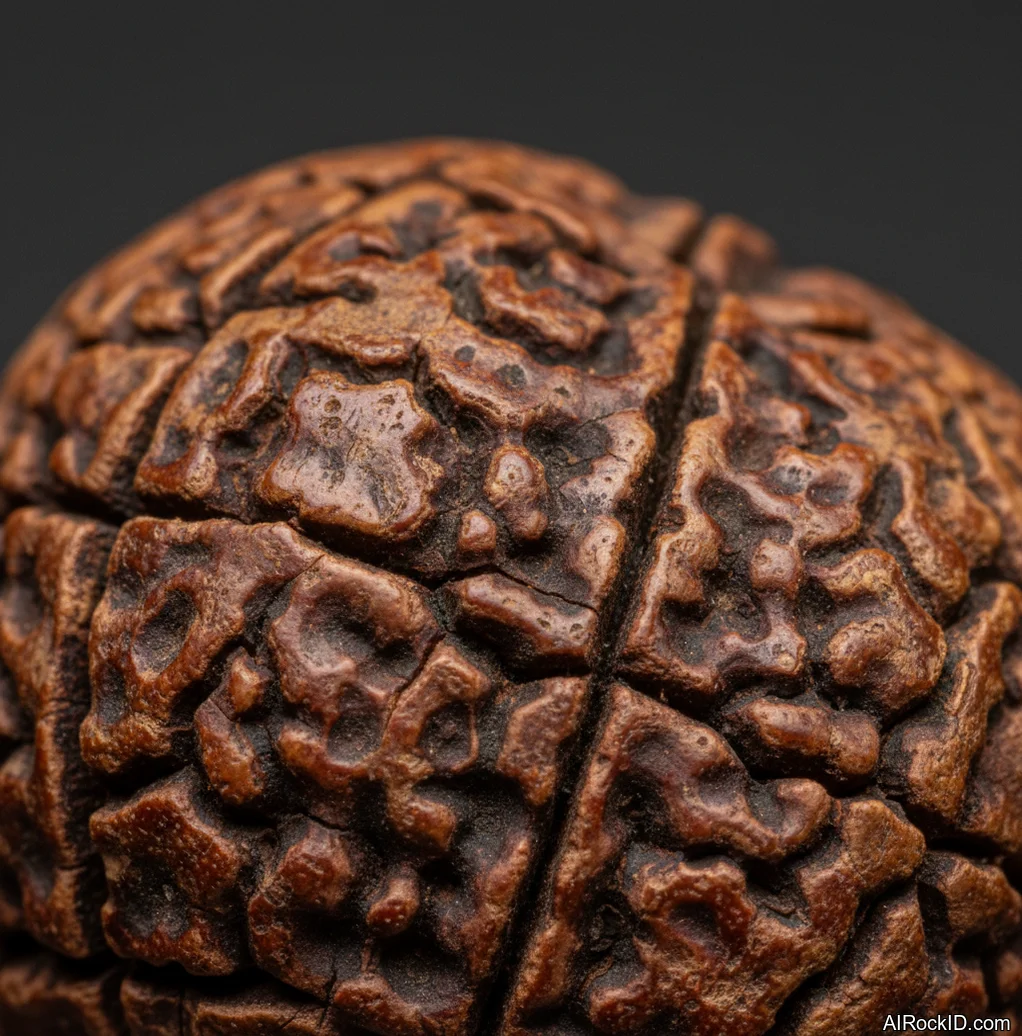
What you do get is texture. Real Rudraksha has this grippy, slightly toothy feel, and those deep grooves actually snag your fingertip a bit when you roll a bead between your fingers (you can feel the ridges “click” past).
Pick up a strand and the first thing you notice is the weight. Or, honestly, the lack of it. Next to stone beads, Rudraksha feels light in your palm, and the surface is naturally matte, kind of like a tiny dried walnut with carved channels.
The hole drilling matters a lot, too. Look, if the holes are clean and there’s hardly any chipping around the edge, that usually means the bead was drilled slowly and the seller didn’t rush it. If it’s blown out and flaky around the hole, that’s a different story.
And here’s what collectors learn pretty quickly: the market’s messy. Sellers toss around “mukhi” counts like they’re lab measurements, but grooves can be faint, beads vary, and some pieces are stabilized or oiled to look darker and more uniform than they really are. Sounds simple on paper. In your hand? Not always.
Origin & History
“Rudraksha” is a Sanskrit name people usually break into “Rudra” (a form of Shiva) and “aksha” (eye). And in real life, it’s tied to Hindu and Shaiva practice as a prayer bead, the kind you actually feel clicking between your fingers on a mala, and you see it all over South Asia in religious art and in everyday wear.
Most of the “first described by” history you find online doesn’t really fit Rudraksha the way it fits minerals, because this is a seed, not a species stamped into the record by some mineralogist. But what you can actually track is the long use of these beads as malas, plus the way trade routes carried them past Nepal and India and into the wider metaphysical and jewelry markets.
Where Is Rudraksha Found?
Rudraksha beads come from Elaeocarpus trees grown across parts of South and Southeast Asia, with major commercial supply from India, Nepal, and Indonesia.
Formation
Rudraksha starts out on a tree. The Elaeocarpus fruit grows around a hard inner seed that has those natural segmented lines. Once it’s harvested, people peel off the fleshy outer fruit, then the seed gets cleaned, dried, and sorted.
Look, the grooves are where the whole drying and handling thing really shows up. Dry a bead too hard and you can end up with tiny hairline cracks that stay invisible until you actually string it, pull it snug, and it suddenly snaps under tension. I’ve had beads show up that looked totally fine in the listing photos, but when I held one under a desk lamp (the kind with that harsh white bulb), there it was: a thin crack cutting straight through a groove like a little fault line. How is that not frustrating?
How to Identify Rudraksha
Color: Most Rudraksha ranges from tan to medium or dark brown, sometimes with a gray-brown cast when it’s very dry. Freshly oiled beads can look almost chocolatey, but that color can fade or blotch with wear.
Luster: Natural luster is dull to waxy-matte, not glassy.
Pick up the bead and rub it between your fingers. Real Rudraksha feels porous and slightly rough, not slick like plastic or glass. The real test is a loupe: the grooves should look like natural channels with tiny pits and irregularities, not perfectly machined lines. And if it smells strongly of perfume or solvent, someone probably treated it to fake age or color.
Properties of Rudraksha
Physical Properties
| Crystal System | Amorphous |
| Hardness (Mohs) | 2-3 (Soft (2-4)) |
| Density | 1.10-1.30 g/cm3 |
| Luster | Dull |
| Diaphaneity | Opaque |
| Fracture | Uneven |
| Streak | brownish white |
| Magnetism | Non-magnetic |
| Colors | tan, brown, dark brown, gray-brown |
Chemical Properties
| Classification | Organic (biogenic polymer; lignocellulosic material) |
| Formula | No fixed chemical formula (primarily cellulose, hemicellulose, lignin) |
| Elements | C, H, O, N |
| Common Impurities | Ca, K, Mg, Fe |
Optical Properties
| Refractive Index | 1.53-1.56 |
| Birefringence | None |
| Pleochroism | None |
| Optical Character | Isotropic |
Rudraksha Health & Safety
Rudraksha is usually safe to touch and wear against your skin. The real “risk” isn’t toxicity, it’s just ruining the bead with sloppy care (cracking it, drying it out, that kind of thing).
Safety Tips
Skip strong detergents, and don’t leave it sitting in hot water for a long soak. And if you end up drilling or sanding it (not usually a thing), throw on a dust mask, because that organic dust can really irritate your nose and throat.
Rudraksha Value & Price
Price Range
Rough/Tumbled: $1 - $30 per bead (common grades); $50 - $500+ per bead (high mukhi/collector grades)
Prices jump around depending on bead size, how clean and sharp the groove looks, the bead’s condition (cracks really do matter), any origin claims, and how it’s graded and certified. A full strand usually works out cheaper per bead than buying a single, but the low-priced malas tend to be a grab bag, quality-wise.
Durability
Moderate — Scratch resistance: Fair, Toughness: Fair
Rudraksha can dry out, crack, or discolor if it’s over-soaked, baked in sun, or exposed to harsh cleaners.
How to Care for Rudraksha
Use & Storage
Store it dry and out of direct sun, ideally in a cloth pouch so it doesn’t get crushed by harder stones. If it’s on a mala, don’t leave it stretched tight on a hook for months.
Cleaning
1) Wipe with a slightly damp, soft cloth to remove skin oils and dust. 2) If needed, use a tiny drop of mild soap in cool water, then rinse quickly. 3) Pat dry and let it air-dry fully before storing or wearing again.
Cleanse & Charge
For non-water methods, smoke cleansing or a simple rest on a clean cloth overnight keeps it low-drama. If you oil the bead lightly, do it sparingly and wipe off excess so it doesn’t turn sticky.
Placement
Wear it against skin if you like the feel, but keep it away from perfumes and hair products. On a shelf, set it where it won’t get cooked by a sunny windowsill.
Caution
Don’t use ultrasonic cleaners or steam cleaners. Skip bleach too, and don’t hit it with alcohol wipes. And don’t leave it soaking for a long time, because the bead can puff up a bit and that puts extra strain on older drill holes.
Works Well With
Rudraksha Meaning & Healing Properties
Rudraksha doesn’t really look like a “crystal” when you first see it, and honestly, that’s the whole deal. It’s not something you set on a shelf and admire. People actually use it. You roll the beads between your fingers while you count breaths, you repeat a mantra, you keep your hands from fidgeting during meditation. In my own little pile of stuff, it’s what I grab when I’m not in the mood for sparkle. I want texture. I want the comfort of doing the same thing again and again. Grounding, but in a very practical, almost boring way (in a good sense).
Dealers love talking about mukhi counts and what each one is tied to. I’m not going to pretend that’s physics. But I will say this: different beads feel wildly different in your hand. Some are smooth because they’ve been worn for ages, kind of polished in the spots your thumb naturally hits. Others are sharp with deep grooves that catch on your skin. And that tactile feedback changes how steady your counting stays. That part’s real. If a bead is too spiky, or it’s cracked, you notice it every time. It turns into a little annoyance, and then you just stop reaching for it. Happens fast.
But let’s keep this line bright and obvious: none of this is medical care. If you’re using Rudraksha for stress or focus, think of it as a ritual object that props up your habits, the same way a notebook props up journaling. When it’s good quality and it sits comfortably, you end up touching it a lot without thinking. And that alone can nudge you into calmer breathing and slower, less impulsive choices. That’s the benefit. Isn’t it?
Identify Any Crystal Instantly
Snap a photo and get properties, value, care instructions, and healing meanings in seconds.