Bumblebee Jasper


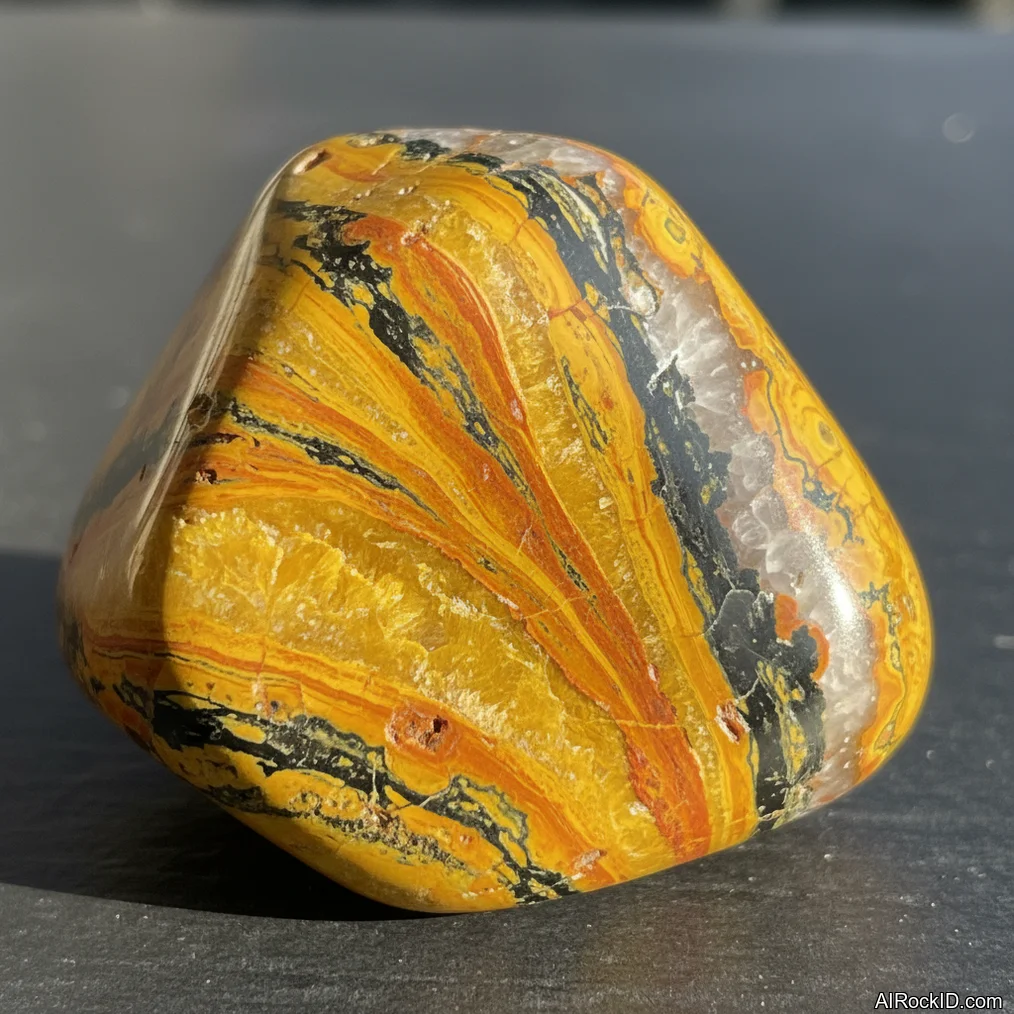
Quick answer: Bumblebee Jasper is a trade name for a colorful Indonesian carbonate rock, not a true jasper. Its yellow, orange, gray, and black patterns usually come from calcite or aragonite mixed with sulfur-bearing minerals and iron oxides.
AI Rock ID can help screen Bumblebee Jasper by comparing its color zoning, banding, and surface texture with known visual patterns. RockIdentifier.io should be used as a visual identification aid, not as a substitute for lab testing when toxicity, treatment, or exact mineral composition matters.
Good fit
- Collectors who like bold yellow, orange, and black natural-looking patterns
- People buying display stones, cabochons, or wrapped pendants from reputable sellers
- Beginners comparing carbonate rocks, jaspers, and sulfur-rich decorative stones
- Users who want a stone where authenticity depends heavily on pattern, source, and seller disclosure
Not a good fit
- Children’s handling collections or stones likely to be mouthed or scratched
- Water elixirs, soaking, or any use involving ingestion
- Rings or high-wear jewelry, because the material can be relatively soft and porous
- Buyers who need a mineral with a single simple composition
Most commonly confused with
- Mookaite Jasper: Mookaite usually shows earthy red, cream, mustard, and purple tones rather than high-contrast black-and-yellow banding.
- Ocean Jasper: Ocean Jasper is typically orbicular or spotted chalcedony, while Bumblebee Jasper is a carbonate rock with layered or flame-like color zones.
- Septarian: Septarian often has brown, gray, and yellow crack-filled patterns, but it lacks the vivid sulfur-yellow and orange banding common in Bumblebee Jasper.
- Dyed Jasper: Dyed jasper may show unnaturally uniform or saturated color in cracks, while genuine Bumblebee Jasper usually has irregular natural banding.
Bumblebee Jasper Lookalike Comparison
| Material | Typical appearance | Key difference |
|---|---|---|
| Bumblebee Jasper | Yellow, orange, gray, and black bands or swirls | Carbonate-rich Indonesian decorative rock, not true jasper |
| Mookaite Jasper | Cream, mustard, red, brown, or purple patches | Usually lacks bold black sulfur-like banding |
| Septarian | Gray or brown nodules with yellow calcite-filled cracks | Pattern is crack-like rather than flame-banded |
| Ocean Jasper | Orbicular spots, circles, or mossy chalcedony patterns | Silica-rich chalcedony instead of a carbonate rock |
| Dyed Jasper | Bright color concentrated in pores or fractures | Color may look artificial or bleed during testing |
AI identification confidence
AI identification confidence for Bumblebee Jasper is often moderate when the stone shows strong yellow, orange, gray, and black banding. Confidence drops for polished pieces, close-up photos without scale, dyed lookalikes, or stones with muted colors.
When AI gets it wrong
- The photo is taken under warm lighting that makes cream or tan stone look yellow-orange.
- Only a small polished area is visible, hiding the full banding pattern.
- A dyed jasper or resin-treated stone has exaggerated colors similar to Bumblebee Jasper.
- A septarian or mookaite specimen is photographed without enough context to show its structure.
Final recommendation
Choose Bumblebee Jasper from sellers who clearly disclose the trade name, Indonesian origin when known, and any stabilization or coating. For safety-sensitive uses, display pieces and sealed jewelry are more appropriate than raw handling, soaking, or powder-producing activities.
How to Identify Real Bumblebee Jasper When Buying
Authentic Bumblebee Jasper usually has irregular yellow, orange, gray, and black zoning rather than perfectly repeated stripes. Ask sellers whether the piece is natural, stabilized, coated, or dyed, and be cautious with listings that describe it simply as “yellow jasper” without origin or treatment details. A lower price is not automatically a problem, but very uniform color or glossy coatings can indicate enhancement.
Bumblebee Jasper Treatments and Stabilization
Some Bumblebee Jasper pieces may be stabilized with resin or sealed to improve durability and reduce surface shedding. Stabilization is common for softer or porous lapidary materials, but it should be disclosed by sellers. A sealed or stabilized piece may be more practical for jewelry, while untreated rough material should be handled more carefully.
Best Uses for Bumblebee Jasper Specimens
Bumblebee Jasper is well suited for display specimens, cabochons, pendants, and collector pieces where its pattern can be viewed without heavy wear. It is less suitable for daily-wear rings, carving dust exposure, or any application involving water immersion. In metaphysical traditions, it is often associated with confidence and vitality, but those associations are cultural beliefs rather than medical effects.
What Is Bumblebee Jasper?
Bumblebee Jasper is a banded carbonate rock from Indonesia. It’s mostly calcite and aragonite, with sulfur and iron oxides mixed in, and yeah, it isn’t a true jasper.
Look, the first time you see it, it honestly looks like someone splashed yellow paint over black ink. But once you’ve actually got a piece in your hand, it usually feels softer. A little chalky, too. Tap it with a fingernail and it just doesn’t have that hard, glassy snap you get from real jasper or agate.
Grab a polished palm stone and two things jump out right away: the pattern is loud, and the surface can pick up tiny scuffs if it’s been bouncing around in a bin. I’ve handled pieces that look bulletproof in photos, then you tilt them under bright shop lights and there they are, faint drag marks from a quick polish. Why? Because the material has softer zones (you can feel it when you rub a thumb across the bands).
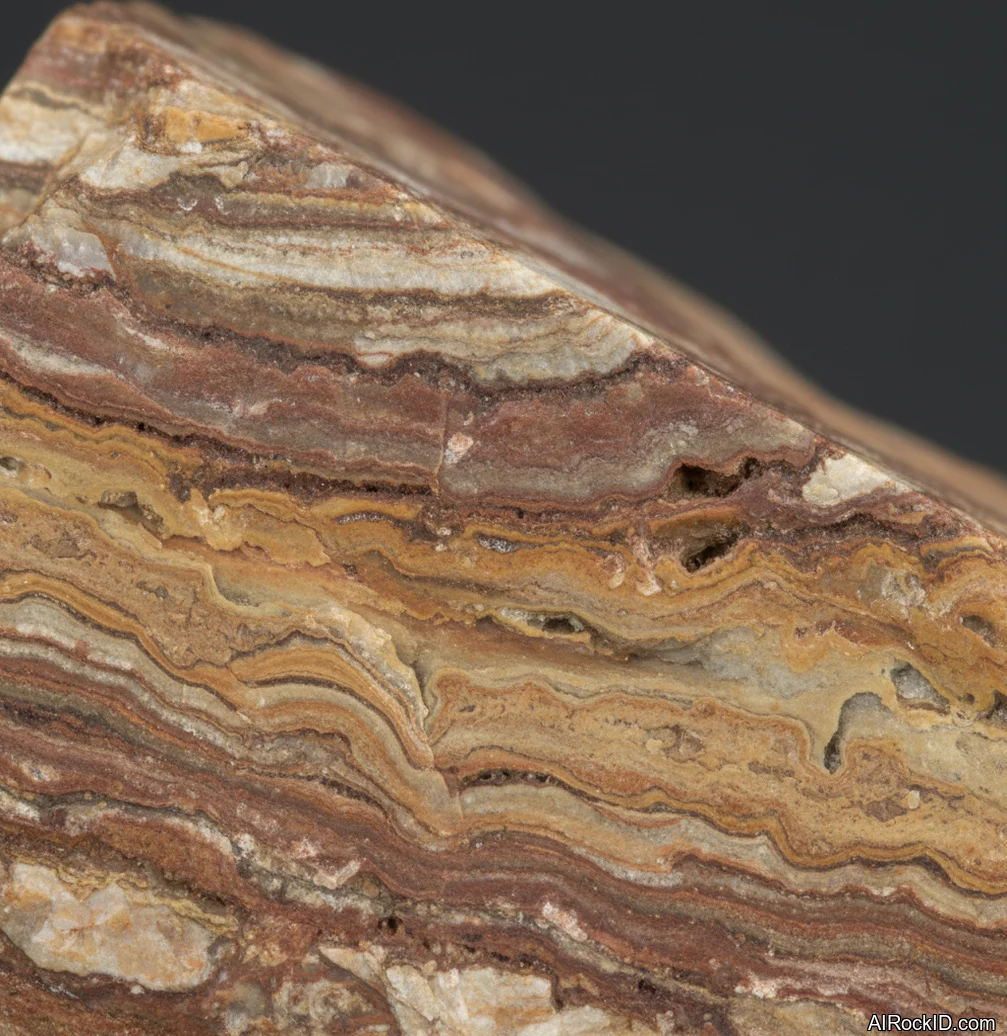
Most of what you’ll see for sale is cut from compact, layered material, not any kind of crystal. And the best pieces have clean, high-contrast banding, with mustard yellow and orange running straight into deep charcoal black, with a bit of gray or cream calcite breaking things up.
Origin & History
“Bumblebee Jasper” is just a trade name, and it really took off in the late 1990s and early 2000s when material from West Java started popping up in the gem and mineral market. It was never “jasper” in the strict sense. Dealers leaned on the name because those yellow and black bands genuinely look like a bumblebee, and calling it jasper made it easier to move right next to other pattern stones.
Thing is, if you talk to the old-timers at shows, a bunch of them will swear they first ran into it as slabs and cabs, not as rough still sitting on matrix like you’d expect with classic jaspers from the US. And that tracks with how it showed up on tables: already cut, already polished, warm yellow flashing under the lights and the black banding standing out fast. Over time, people started using more accurate descriptions: it’s a carbonate-rich rock with calcite and aragonite, colored by sulfur and iron minerals, and sometimes you’ll see a bit of volcanic ash and other material mixed in.
Where Is Bumblebee Jasper Found?
Commercial Bumblebee Jasper comes from West Java, Indonesia, tied to volcanic and hydrothermal activity around the Mount Papandayan area.
Formation
Look at the colors for a second and it kind of gives itself away. Those yellow bands are usually sulfur-rich. The orange-to-brown bits tend to be iron oxides. And the pale cream zones? Most often calcite or aragonite.
This material forms in a volcanic setting, the kind where hot fluids push through carbonate rock and ash layers. You can almost picture it: warm, mineral-loaded water moving along cracks, then cooling off and dropping minerals out, staining whatever it touches as it goes.
Next to true jasper, which is microcrystalline quartz, Bumblebee isn’t really in the same lane. It’s more like a chemically messy layer cake. You’ll sometimes spot tiny vugs (little pinhole pockets) and weird, jagged seams where the mix changed mid-flow. And since it’s carbonate-based, it can react to acids. It also doesn’t take kindly to rough handling, even though it can still polish up and take a shine.
How to Identify Bumblebee Jasper
Color: Usually banded mustard yellow, orange, and black, often with cream, gray, or white calcite patches. Patterns can be swirly, layered, or broken into blotches rather than crisp agate-like lines.
Luster: Polished pieces show a waxy to vitreous luster, with softer areas that can look slightly matte under strong light.
If you scratch it with a steel needle in an inconspicuous spot, it may mark more easily than real jasper because it’s carbonate-based. The real test is a tiny drop of weak acid on an unpolished edge: calcite/aragonite can fizz, while true jasper won’t. In hand, a lot of Bumblebee feels a touch warmer and less glassy than quartz jaspers, and the black bands can look more like mineral staining than solid silica.
Common Look-Alikes
Bumblebee Jasper is sometimes confused with these materials:
- Dyed howlite or dyed magnesite sold as “bumblebee jasper” (dye can wick into pits and fractures)
- Yellow-and-black banded calcite/aragonite sold as “onyx marble” or “Mexican onyx” (same carbonate vibe, similar softness)
- Banded travertine or other decorative carbonate rock (often cut into tiles and slabs, then rebranded as jasper)
- Yellow/black resin composite or reconstituted stone (looks too clean, feels warmer than real carbonate)
- Painted or dyed glass “bumblebee” cabochons (too glossy, edges look syrupy, weight can feel off)
Market Cautions & Treatments
When AI Can Get This Wrong
In photos, AI mixes Bumblebee Jasper up with banded calcite (onyx marble) and dyed howlite because the yellow-black striping reads the same on a screen. The real test is hardness: a steel needle will bite into Bumblebee pretty easily, and it won’t give that glassy “ring” when you tap it like true jasper. If the pattern looks airbrushed-perfect with no soft spots, AI may call it Bumblebee even when it’s resin or dyed material.
Properties of Bumblebee Jasper
Physical Properties
| Crystal System | Trigonal |
| Hardness (Mohs) | 3 (Soft (2-4)) |
| Density | 2.7-2.9 g/cm3 |
| Luster | Waxy |
| Diaphaneity | Opaque |
| Fracture | Uneven |
| Streak | white |
| Magnetism | Non-magnetic |
| Colors | yellow, orange, black, gray, white, brown |
Chemical Properties
| Classification | Carbonates (rock composed mainly of calcite and aragonite, with sulfur and iron oxides) |
| Formula | CaCO3 |
| Elements | Ca, C, O |
| Common Impurities | Fe, S, Mn |
Optical Properties
| Refractive Index | 1.49-1.66 |
| Birefringence | 0.172 |
| Pleochroism | None |
| Optical Character | Uniaxial |
Bumblebee Jasper Health & Safety
Handling finished stones is usually fine in your hands, like the smooth, cool feel you get when you roll one between your fingers. But don’t breathe in the dust if you’re cutting, sanding, or drilling it. And don’t put it in elixirs or soaking water either. Thing is, the yellow and black zones can be an unknown mix, and that’s the part that can bite you. So I treat it as a “no dust, no water” stone. Why risk it?
Safety Tips
If you’re going to lap it or drill it, do it wet, crank up the ventilation, and wear a real respirator that’s rated for fine particulates (not just a flimsy dust mask). Dust gets everywhere. Wash your hands after you’ve handled the rough stuff, and don’t let it anywhere near food prep areas.
Bumblebee Jasper Value & Price
Price Range
Rough/Tumbled: $10 - $80 per piece
Cut/Polished: $2 - $12 per carat
Prices jump when the material has crisp, high-contrast bands and a clean polish with hardly any pits (you know, that smooth, glassy feel instead of a bunch of little pinholes). Big display chunks and nicely cut cabs cost more, mostly because solid, stable rough in those larger sizes just isn’t as common as the small, palm-stone grade.
Durability
Nondurable — Scratch resistance: Poor, Toughness: Fair
It can take a nice shine, but it scratches and bruises more easily than quartz jaspers and doesn’t like acids or harsh cleaners.
How to Care for Bumblebee Jasper
Use & Storage
Store it in a soft pouch or separate compartment so harder stones like quartz don’t haze it up. If it’s a polished piece, I wouldn’t let it clack around in a bowl with other tumbles.
Cleaning
1) Wipe with a dry or slightly damp microfiber cloth. 2) If needed, use a tiny bit of mild soap on the cloth and wipe again. 3) Rinse the cloth, wipe off residue, and dry the stone right away.
Cleanse & Charge
Skip water soaks and salt. I stick to smoke cleansing, sound, or leaving it on a shelf away from direct sun for a reset.
Placement
Looks great on a desk or display shelf where it won’t get scratched. Keep it out of humid spots like a bathroom if you’ve got rough with soft, porous areas.
Caution
Don’t use this in crystal water or elixirs. And skip anything acidic, like vinegar-based cleaners. Stay away from ultrasonic or steam cleaners too. Grinding is a no-go unless you’ve got proper dust control in place (seriously, that dust gets everywhere).
Works Well With
Bumblebee Jasper Meaning & Healing Properties
Most dealers and collectors file Bumblebee Jasper under the “get moving” vibe, and honestly, you can see why the second it’s in your hand. The stuff is loud. High contrast, almost shouty. And when you’re holding a palm stone, those yellow bands keep yanking your eyes back to them even if your brain’s wandering.
In my own stash, I grab it when I need a nudge to take action, not when I’m trying to chill out. But look, it’s not exactly gentle to live with, visually. If you’re already overstimulated, that striping can feel like way too much, especially under bright overhead light where the yellow looks almost electric.
Thing is, keep the metaphysical talk in its lane. It’s not medical care. It’s not a stand-in for dealing with real anxiety or burnout. I use it more like a focus cue: leave it somewhere you’ll actually notice it, pick it up for a minute (it’s got that smooth, cool-in-the-palm feel), and then go do the thing you’ve been dodging. Simple as that.
Common mistakes
- Assuming Bumblebee Jasper is true jasper; it is usually a carbonate-rich rock sold under a trade name.
- Buying based only on bright yellow color without checking for natural-looking zoning and seller disclosure.
- Using the stone in water, elixirs, or soaking practices despite possible sulfur-bearing and other reactive components.
- Cutting, sanding, or drilling the material without proper lapidary dust control.
- Expecting every piece to have identical yellow-and-black stripes; natural material varies widely.
- Confusing sealed or stabilized material with fake material; treatment is not always deceptive if it is disclosed.
Identify Bumblebee Jasper from a photo
Compare Bumblebee Jasper traits, care tips, value clues, and common lookalikes with a clear photo.