Erythrite
What Is Erythrite?
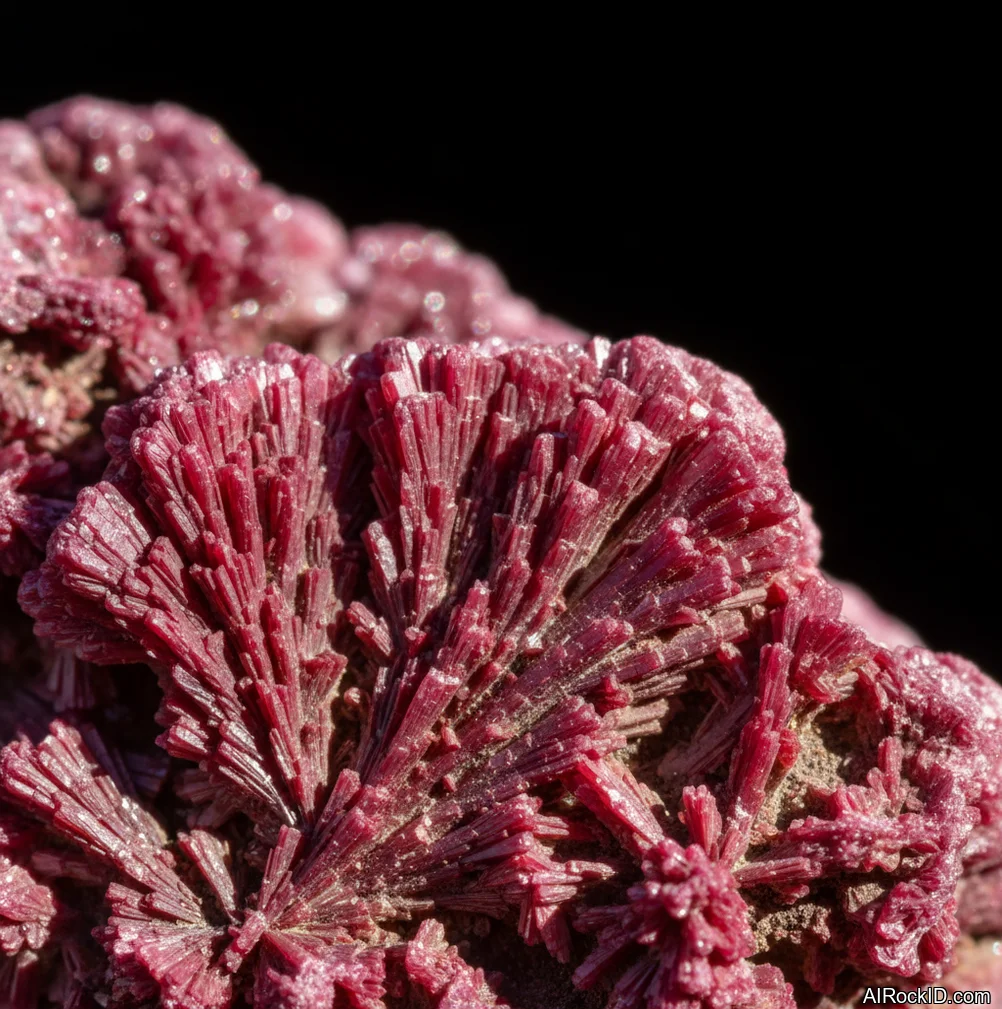
Erythrite is a hydrated cobalt arsenate mineral, Co3(AsO4)2·8H2O. It forms pink to raspberry-red crystals and crusts in the oxidized zones of cobalt-bearing ore deposits.
Grab a decent cabinet specimen and a couple things jump out right away. It’s weirdly light for how intense that color is. And the crystals? They’re brittle, the kind that don’t forgive clumsy handling. I’ve had little sprays where one lazy thumb swipe took a crisp, sharp starburst and left nothing but pink dust smeared into the foam (so, yeah, I don’t handle those bare-handed anymore).
People sometimes swear it’s dyed because under bright show lights the color can look almost fake. But move it a little and you catch that soft, pearly sheen and it starts to make sense. And most of the time it’s sitting on a darker matrix, or hiding in cracks with other oxidized-zone signs like limonite staining and bits of calcite.
Origin & History
Erythrite got its first proper write-up in 1832, thanks to François Sulpice Beudant. He pulled the name from the Greek “erythros” for red, and yeah, that clicks the moment you spot that hot pink crust dusting an otherwise dull brown gossan (it really does look like someone smeared lipstick on rusty rock).
Old mining reports call it “cobalt bloom,” and as a field clue for cobalt ores, that’s pretty much just erythrite showing up and doing what it does. Miners weren’t chasing it for the specimen shelf back then. They treated it like a neon arrow that basically said, “Cobalt is here.”
Where Is Erythrite Found?
You’ll see erythrite wherever cobalt-bearing arsenides and sulfides weather near the surface, especially in classic cobalt districts. Morocco’s Bou Azzer is a steady source of sharp sprays and drusy crusts.
Formation
Look at where it’s perched on the specimen and you can pretty much read the whole backstory. Erythrite is a secondary mineral, so it forms during weathering, not by crystallizing out of a deep magma chamber. When cobalt minerals like skutterudite (cobalt arsenide) start breaking down in oxygen-rich, near-surface conditions, cobalt and arsenate ions can end up meeting in groundwater, then re-precipitating as erythrite.
Most of the pieces I’ve handled show up as crusts, powdery coatings that’ll dust your fingertips, or those tiny radial sprays tucked along fractures. Big, isolated crystals do happen, but they’re rare. And it usually hangs out with other oxidation-zone minerals like limonite, goethite, malachite in coppery areas, plus sometimes annabergite when nickel is in the mix.
How to Identify Erythrite
Color: Color runs from pale pink to deep raspberry red, sometimes with a slightly purplish cast in thicker crystal clusters. Thin crusts can look almost cotton-candy pink, especially on dark matrix.
Luster: Luster is pearly to vitreous on crystal faces, and more dull or earthy when it’s a fine crust.
Pick up a specimen and check your fingertips afterward. If you see a faint pink rub-off, that’s a clue you’re dealing with a soft, delicate secondary like erythrite and not a hard pink silicate. If you scratch it with a fingernail, many pieces will mark or crumble, since it sits around Mohs 1.5–2.5. The real test is a hand lens: look for tiny prismatic crystals in sprays with a silky-pearly flash when you tilt the piece under one overhead light.
Properties of Erythrite
Physical Properties
| Crystal System | Monoclinic |
| Hardness (Mohs) | 1.5-2.5 (Very Soft (1-2)) |
| Density | 2.95-3.10 |
| Luster | Pearly |
| Diaphaneity | Transparent to translucent |
| Fracture | Uneven |
| Streak | pink |
| Magnetism | Non-magnetic |
| Colors | pink, raspberry red, red, purplish pink |
Chemical Properties
| Classification | Arsenates |
| Formula | Co3(AsO4)2·8H2O |
| Elements | Co, As, O, H |
| Common Impurities | Ni, Fe, Mg, Ca |
Optical Properties
| Refractive Index | 1.625-1.730 |
| Birefringence | 0.105 |
| Pleochroism | Strong |
| Optical Character | Biaxial |
Erythrite Health & Safety
Handle it gently. Don’t rub it or scratch at it, because it can leave this fine pink powder on your fingertips (you’ll see it right away under bright light). Keep it away from food prep spots, and don’t let kids mess with it like a worry stone.
Safety Tips
Keep it in a closed box or a display case. If you absolutely have to clean it, go gentle: a tiny puff of dry air or a super soft brush (think the kind with floppy bristles that barely bend). Wear a mask while you do it, and then wash up afterward.
Erythrite Value & Price
Price Range
Rough/Tumbled: $15 - $300 per specimen
Prices jump when the sprays are sharp, unbroken, and the color’s strong, especially when they’re sitting on a contrasting matrix that really makes them pop. But if the surface has that dusty, powdery crust (the kind that rubs off on your fingers), it’s usually cheaper. And big pieces often run more money, mostly because they’re a pain to ship without something snapping or getting bruised on the way.
Durability
Fragile — Scratch resistance: Poor, Toughness: Poor
It bruises and powders easily, and the best crystals don’t like being handled or bounced around in a display case.
How to Care for Erythrite
Use & Storage
Keep erythrite in a perky box or a closed display case so it doesn’t get bumped and so any loose dust stays contained. I separate it from harder specimens because calcite or quartz points will chew it up in a shared tray.
Cleaning
1) Skip water, soaking, and ultrasonic cleaners. 2) Use a soft makeup brush or a gentle puff of air to remove dust, keeping the nozzle back so you don’t sandblast the crystals. 3) If you have to pick off grit, use tweezers on the matrix only, not on the pink crystals.
Cleanse & Charge
If you do energy-style cleansing, use smoke, sound, or a short sit on a dry selenite plate, not running water or salt. Keep it simple and keep it dry.
Placement
Best spot is a stable shelf away from sunlight, pets, and the edge where it can get knocked. I like it at eye level so you can catch that pearly flash without picking it up.
Caution
Don’t ingest this. And try not to breathe in the dust either (it gets airborne fast if you tap the container). Don’t mix it into elixirs or add it to drinking water. Wash your hands after you handle it, especially if you get any powder on your fingers. Keep it away from kids and pets.
Works Well With
Erythrite Meaning & Healing Properties
In crystal shops, people talk about erythrite like it’s this heart-centered stone just because it’s pink. But it doesn’t land “soft and fluffy” for me at all. It hits like a wake-up call. Fast, bright, a little intense. I’ve seen folks reach for it, then pause halfway through because they realize it’s not the kind of palm stone you tuck in your pocket and forget about.
If you’re using crystals for reflection, I’d keep erythrite to short sessions. Set it on a table, stare at it for a couple minutes, and let the color do its thing, it can yank your attention out of a mental spiral. But look, it’s not a medical tool. It won’t fix anxiety or depression, and it doesn’t replace real care. Not even close.
And the practical side matters here, even if you’re coming at it from a spiritual angle. Because it’s an arsenate and it can powder (that dusty little residue you sometimes see on the base or on your fingertips if you’ve handled a crumbly piece), I wouldn’t rub it on your skin, sleep with it under your pillow, or do any water ritual with it. You can still work with it. Just keep it as a visual anchor. That’s how I handle fragile toxics, same deal as realgar or orpiment: respect the chemistry, enjoy the specimen.
Identify Any Crystal Instantly
Snap a photo and get properties, value, care instructions, and healing meanings in seconds.