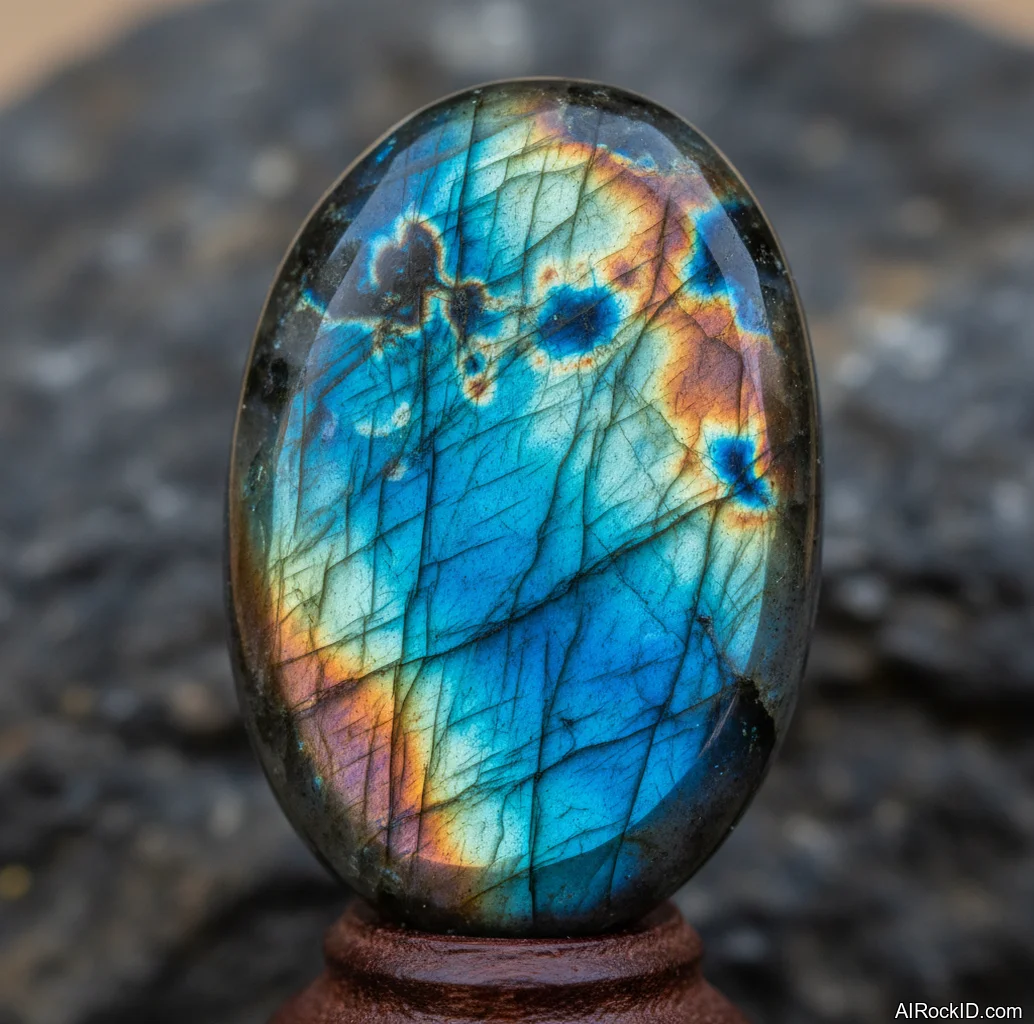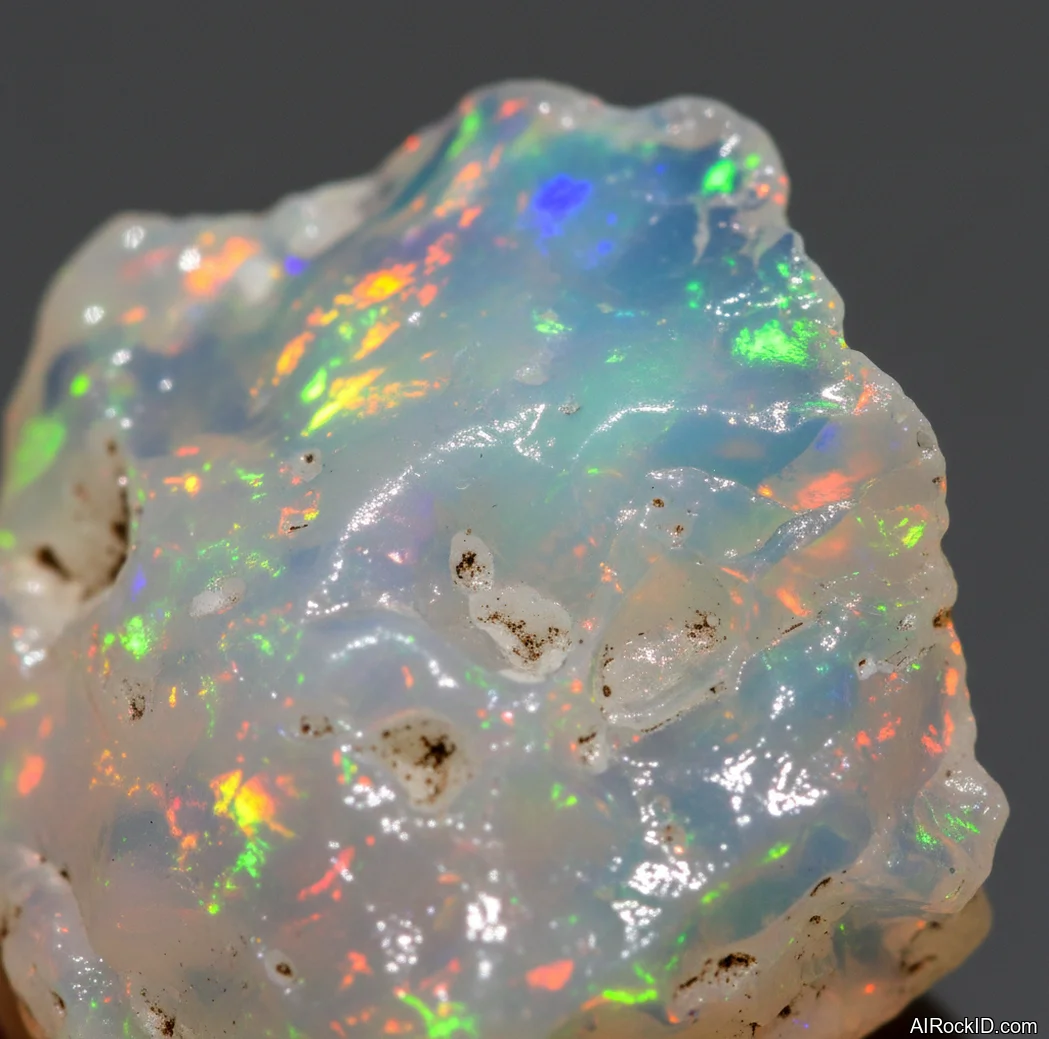
Ethiopian Welo Opal


Quick answer: Ethiopian Welo opal is a hydrophane precious opal known for absorbing water and showing vivid play-of-color. It can be attractive in jewelry, but it needs more careful handling than many harder or less porous gemstones.
AI Rock ID can help screen an Ethiopian Welo opal candidate by checking visual traits such as play-of-color, body tone, transparency, and possible lookalikes. RockIdentifier.io provides crystal and mineral references that can support identification, but laboratory testing is the most reliable option for valuable opal purchases.
Good fit
- Collectors who want precious opal with visible play-of-color
- Buyers comparing hydrophane opal against Australian opal or synthetic opal
- Jewelry wearers who can avoid prolonged water, oil, and chemical exposure
- People who prefer lightweight cabochons, beads, or specimen pieces with shifting color
Not a good fit
- Rings or bracelets intended for heavy daily wear without protective settings
- Anyone who wants a gemstone that can be soaked, oiled, or cleaned ultrasonically
- Buyers who need a stone that is easy to authenticate from photos alone
Most commonly confused with
- Australian Opal: Australian opal is often less hydrophane and may come from different deposit types, including solid opal, boulder opal, and doublets.
- Synthetic Opal: Synthetic opal may show overly regular color patterns or columnar structure under magnification.
- Opalite: Opalite is usually man-made glass with a milky blue glow and lacks natural precious opal play-of-color.
- Fire Opal: Fire opal is commonly orange to red and may or may not show play-of-color; Welo opal more often appears white, crystal, honey, or gray with color flash.
Ethiopian Welo Opal vs Common Lookalikes
| Material | Typical Visual Clue | Key Identification Note | Care Difference |
|---|---|---|---|
| Ethiopian Welo Opal | Strong play-of-color in white, crystal, honey, or gray body | Hydrophane; may temporarily change appearance after water exposure | Avoid soaking, oils, and harsh chemicals |
| Australian Opal | Play-of-color in solid, boulder, or assembled forms | Often less water-absorbent than Welo hydrophane opal | Still sensitive to heat and impact |
| Synthetic Opal | Bright color patches that may look repeated or uniform | Magnification may reveal ordered growth pattern | Care varies by product and resin content |
| Opalite | Milky blue-white glow without true play-of-color | Man-made glass, not natural precious opal | Less porous but still scratch-prone |
| Glass Imitation | Bubbles, swirls, or flat color effects | No natural opal structure or hydrophane behavior | Usually less affected by water but easily scratched |
AI identification confidence
AI identification confidence for Ethiopian Welo opal is moderate when photos show clear play-of-color, body color, translucency, and multiple angles. Confidence drops when the stone is wet, heavily edited, set in jewelry, or photographed under lighting that exaggerates color flash.
When AI gets it wrong
- A synthetic opal has a natural-looking color pattern in a single photo.
- A glass imitation or opalite is photographed under strong directional light.
- The opal is wet or recently soaked, changing its transparency and body tone.
- An assembled stone such as a doublet or triplet is shown only from the front.
Final recommendation
For buying Ethiopian Welo opal, prioritize clear seller disclosures about origin, treatment, hydrophane behavior, and whether the stone is solid or assembled. For high-value stones, request a reputable gemological report rather than relying only on photos or informal descriptions.
How to Check Ethiopian Welo Opal Authenticity
A basic authenticity check should include viewing the stone from multiple angles, checking for natural-looking play-of-color, and examining the side and back for assembled layers. Magnification can help reveal bubbles, repeated synthetic patterns, glue lines, or a cap layer. Valuable pieces should be tested by a gemologist, especially if the seller claims untreated natural origin.
Solid Opal, Doublet, or Triplet
Solid Ethiopian Welo opal is one piece of opal rather than a layered construction. A doublet has a thin opal layer attached to a backing, while a triplet adds a clear protective cap over the opal layer. Side views, seam lines, and unusually even thickness can help separate assembled opals from solid stones.
Photo Tips for Better Identification
Photograph Ethiopian Welo opal dry, under neutral lighting, and from the front, side, and back. Include one close-up that shows play-of-color and one image that shows the full outline and setting, if present. Avoid filters, wetting the stone, or using only flash photos because these can distort body color and transparency.
What Is Ethiopian Welo Opal?
Ethiopian Welo Opal is a hydrophane type of precious opal from Ethiopia’s Welo (Wollo) region, and it can show bright play-of-color while also soaking up water.
Hold a solid Welo cab in your fingers and the first thing you notice is the weight. Or really, the lack of it. It feels almost too light for the footprint. Then tip it under a lamp and the color patches skate around like they’re sitting just under the polish. Some stones toss big, sheet-like flashes, and some are pure pinfire, like someone sprinkled confetti sparks across the face. The body color’s all over the map too: clear, milky white, honey, and sometimes that warm “orange bread” look you see in the Mezezo material.
But it’s not a set-it-and-forget-it stone. Welo’s known for behaving like a sponge. I’ve literally seen one go from crisp and lively to kind of sleepy after it picked up a little moisture, then snap back after it dried for a day or two. That hydrophane behavior is part of what makes Welo Welo (and yeah, it can be a hassle).
Origin & History
Most dealers trace the whole modern Welo boom back to the mid to late 2000s, when new finds and mining really ramped up. All of a sudden, parcels were showing up in real volume at gem shows, and you couldn’t walk past a row of cases without seeing those little trays labeled “Ethiopian opal” under the glass.
The rough and the finished stones are coming out of Ethiopia’s Welo area, which you’ll also see spelled Wollo. And yeah, it literally depends on who scribbled the tag or printed the label which spelling you get.
Opal as a gem has been described and named for centuries, so none of this is “new” in that sense. But in the trade, Welo opal honestly did feel like the new kid. I remember old-timers at shows kind of shrugging it off at first because it wasn’t the classic Australian material, then a few seasons later people were staring at the bright play-of-color and those bigger sizes and going, wait, why are we ignoring this?
Thing is, the historical significance here isn’t some romantic backstory. It’s mostly economic and trade related: Welo shifted what buyers expect to pay when they want flashy opal in larger pieces.
Where Is Ethiopian Welo Opal Found?
Ethiopian Welo opal is mined in Ethiopia, mainly in the Welo (Wollo) region, with important material also associated with the Mezezo area.
Formation
Look at opal for a minute and you can tell it didn’t grow the way quartz does. It’s amorphous silica gel that set up underground, holding water inside its structure, and then it hardened slowly over time. In Ethiopia, a lot of Welo opal turns up in volcanic settings, where silica-rich fluids moved through porous rock and filled cavities, seams, plus little pockets.
And compared to a lot of Australian seam opals, Welo often shows up as nodules or chunky pieces you can cut into bigger clean areas. That hydrophane behavior really matches the whole porous-host-rock idea. But those tiny pathways that let water in are also the reason oils and dirt can be a headache if you handle it rough.
How to Identify Ethiopian Welo Opal
Color: Body color ranges from transparent to milky white, yellow, honey, and orange-brown, with play-of-color that can show green, blue, red, and everything between. Some pieces have a “crystal opal” look where the color seems suspended inside.
Luster: Welo opal usually has a waxy to vitreous luster when polished.
Pick up the stone and check the weight. Real opal feels surprisingly light compared to glass or many simulants. The real test is water behavior: many Welo opals temporarily change appearance when they absorb moisture, then return as they dry, but don’t do this on purpose with a finished ring. And if the color looks like a perfect printed pattern sitting on the surface, be suspicious of assembled or synthetic material.
Common Look-Alikes
Ethiopian Welo Opal is sometimes confused with these materials:
- Australian white opal (non-hydrophane precious opal, often sold as "Welo" online)
- Mexican fire opal / light opal from Querétaro (especially pale body color with scattered pinfire)
- Synthetic opal (Gilson or other lab-grown opal with very regular pattern and too-even color)
- Opalite glass (man-made glass sold as "opal" or "moonstone")
- Dyed hydrophane opal (Welo that’s been soaked in dye or smoke-treated to fake darker body color)
Market Cautions & Treatments
When AI Can Get This Wrong
At first glance, phone pics of Welo can get tagged as moonstone, opalite glass, or “white opal” because the body color is pale and the play-of-color blows out under flash. AI also trips on synthetic opal when the pattern is tight and regular in a photo. The real test is physical: Welo often turns more transparent when it gets wet (even a damp fingertip), and it’s usually lighter in the hand than glass with the same footprint.
Properties of Ethiopian Welo Opal
Physical Properties
| Crystal System | Amorphous |
| Hardness (Mohs) | 5.5-6.5 (Medium (4-6)) |
| Density | 1.98-2.25 |
| Luster | Waxy |
| Diaphaneity | Transparent to translucent |
| Fracture | Conchoidal |
| Streak | White |
| Magnetism | Non-magnetic |
| Colors | Colorless, White, Cream, Yellow, Honey, Orange, Brown, Green, Blue, Red, Multicolor |
Chemical Properties
| Classification | Silicates |
| Formula | SiO2·nH2O |
| Elements | Si, O, H |
| Common Impurities | Fe, Al, Ca, Na, K |
Optical Properties
| Refractive Index | 1.37-1.47 |
| Birefringence | None |
| Pleochroism | None |
| Optical Character | Isotropic |
Ethiopian Welo Opal Health & Safety
Ethiopian Welo opal is generally safe to handle, and it isn’t toxic. Thing is, the real issue isn’t chemical at all, it’s durability. I’ve seen these stones pick up tiny scratches fast, and if you bump one on a hard countertop you can end up with a little chip before you even notice. The main risk is toughness, not chemistry.
Safety Tips
If you’re going to cut or sand it, put on safety glasses and keep the dust under control, same as you’d do with any material that has silica in it.
Ethiopian Welo Opal Value & Price
Price Range
Rough/Tumbled: $10 - $300 per piece
Cut/Polished: $20 - $500 per carat
Price mostly comes down to brightness, the pattern (pinfire vs broadflash vs those harlequin-like patches), how clear the body looks, and how stable the stone is over time. A clean stone that throws a strong red and doesn’t show any visible crazing will run way higher than stuff that looks watery in the hand or seems like it’ll crack if you so much as breathe on it.
Durability
Nondurable — Scratch resistance: Fair, Toughness: Fair
Hydrophane Welo opal can absorb liquids and may craze or change appearance with rapid drying, heat, or chemicals.
How to Care for Ethiopian Welo Opal
Use & Storage
Store it separate from harder stones. I keep my opals in a little padded box because one rub against quartz in a pocket will leave a mark.
Cleaning
1) Wipe with a soft, dry or slightly damp cloth. 2) If needed, use mild soap with cool water and rinse quickly. 3) Pat dry and let it air-dry away from heat and sun before putting it back in a case.
Cleanse & Charge
If you do the metaphysical “reset,” stick to smoke, sound, or a dry moonlight sit. I skip salt and I don’t soak Welo on purpose.
Placement
A shaded shelf is better than a sunny windowsill. If it’s in jewelry, treat it like a delicate gem and take it off for chores.
Caution
Skip ultrasonic or steam cleaners, and stay away from harsh detergents or anything perfumed. And don’t soak it, either, or let it sit in oils for long. Hydrophane opal will actually drink in liquids, and then it can temporarily shift its color, transparency, or brightness (sometimes it looks a bit “cloudy” until it dries back out). Also, don’t leave it in a hot car or parked under a lamp that warms it up.
Works Well With
Ethiopian Welo Opal Meaning & Healing Properties
At first glance, a lot of people want Welo opal to be a “high energy” stone, mostly because the colors look electric under a counter light. Thing is, in my own collecting and those shop-counter chats, it usually lands more in the emotional and creative lane. You stare into the play-of-color and your brain does that soft-focus thing, like you’re daydreaming with your eyes open. That’s the hook for plenty of folks.
Pick up a few different pieces and you’ll feel how mood-based it can be. A clear crystal opal with tight pinfire reads quick and sparkly. But a milky white one with a broad green flash feels calmer, even if that sounds oddly specific (it’s real, though). And I’ve watched people get frustrated because the look can shift when it drinks in moisture, and they think something “happened” to the stone. Most of the time it’s just being hydrophane.
And just to keep it honest, none of this is medical. If you like using stones as a focus tool, Welo is great for journaling, art nights, meditation, setting intentions around change. If you want a rock that can take a beating and look the same every single day, opal isn’t that rock. Why pretend it is?
Common mistakes
- Assuming all vivid play-of-color means the stone is natural Ethiopian Welo opal
- Buying a cabochon without checking whether it is solid, doublet, or triplet
- Soaking hydrophane opal to make it look clearer before judging quality
- Using oil, lotion, or perfume near the stone and expecting the appearance to remain unchanged
- Evaluating price from face-up color only while ignoring cracks, crazing, thickness, and treatment disclosure
- Relying on a single online photo instead of requesting side views and magnified images
Identify Ethiopian Welo Opal from a photo
Compare Ethiopian Welo Opal traits, care tips, value clues, and common lookalikes with a clear photo.