Golden Mica


Quick answer: Golden Mica is the golden-brown variety commonly associated with phlogopite, a mica mineral known for thin, flexible sheets and pearly to glassy flashes. It is easy to recognize by its perfect basal cleavage, soft feel, and reflective plate-like surfaces, but it can be confused with biotite, muscovite, and metallic-looking minerals.
AI Rock ID can help screen a Golden Mica specimen by checking color, sheet cleavage, luster, and visible flake structure from a clear photo. RockIdentifier.io provides visual identification support, but softness, flexibility, and cleavage tests are still useful for confirming mica minerals.
Good fit
- Collectors who want a lightweight, reflective sheet mineral
- Beginners learning perfect cleavage and mica-family traits
- Educational kits showing mineral structure and flexible flakes
- Specimens kept for display rather than frequent handling
Not a good fit
- Jewelry that needs strong wear resistance
- Pocket stones or high-contact pieces
- Cleaning methods involving soaking, scrubbing, or ultrasonic tools
- Anyone needing a mineral that will not shed flakes
Most commonly confused with
- Biotite: Usually darker brown to black, while Golden Mica is more bronze, honey, or golden brown.
- Muscovite: Typically silvery, pale, or colorless rather than warm golden-brown.
- Pyrite: Metallic, harder, and cubic or granular; Golden Mica splits into thin flexible sheets.
- Chalcopyrite: Brassy metallic with tarnish colors; Golden Mica has pearly sheet surfaces and much lower hardness.
Golden Mica vs. Common Lookalikes
| Mineral | Key visual clue | Simple difference |
|---|---|---|
| Golden Mica | Golden-brown pearly sheets | Thin flakes split easily and may flex |
| Biotite | Dark brown to black sheets | Darker color and less golden flash |
| Muscovite | Silvery or clear pale sheets | Lacks the warm bronze-gold tone |
| Pyrite | Brassy metallic cubes or grains | Hard, brittle, and not sheet-like |
| Chalcopyrite | Brassy metallic masses, often tarnished | Denser metallic look without flexible cleavage sheets |
AI identification confidence
AI identification confidence is usually moderate to high when Golden Mica is photographed as clear sheets or flakes with strong reflective surfaces. Confidence drops when the sample is crushed, mixed in matrix, poorly lit, or photographed at an angle that hides cleavage.
When AI gets it wrong
- A bright flash makes mica look metallic like pyrite or chalcopyrite
- A very dark specimen is labeled as Golden Mica instead of biotite
- A pale sheet is identified as Golden Mica instead of muscovite
- Loose flakes on a rock surface are mistaken for the main rock type
Final recommendation
Choose Golden Mica if you want a recognizable sheet mineral with warm color and strong reflective cleavage. For handling, jewelry, or daily carry, a harder and less flaky mineral is usually more practical.
How to Photograph Golden Mica for Identification
Use indirect light so the reflective sheets do not turn into a white glare. Take one photo straight on, one at a low angle to show flash, and one close-up of an edge where thin layers are visible. A coin, ruler, or fingertip can help show scale without covering the cleavage surfaces.
Buying and Authenticity Tips
Authentic Golden Mica should show layered, flaky cleavage rather than a solid metallic surface. Be cautious with listings that describe mica as a durable jewelry stone, because it is soft and separates into sheets. A natural specimen may shed small flakes during shipping, which is normal for mica but should be disclosed by careful sellers.
Field Clues for Golden Mica
Golden Mica often appears as shiny flakes in metamorphic rocks, pegmatites, and mica-rich schists. A useful field clue is the ability to split or peel along flat planes with very little force. Do not rely on color alone, because several mica minerals can appear brown, bronze, or gold depending on lighting.
What Is Golden Mica?
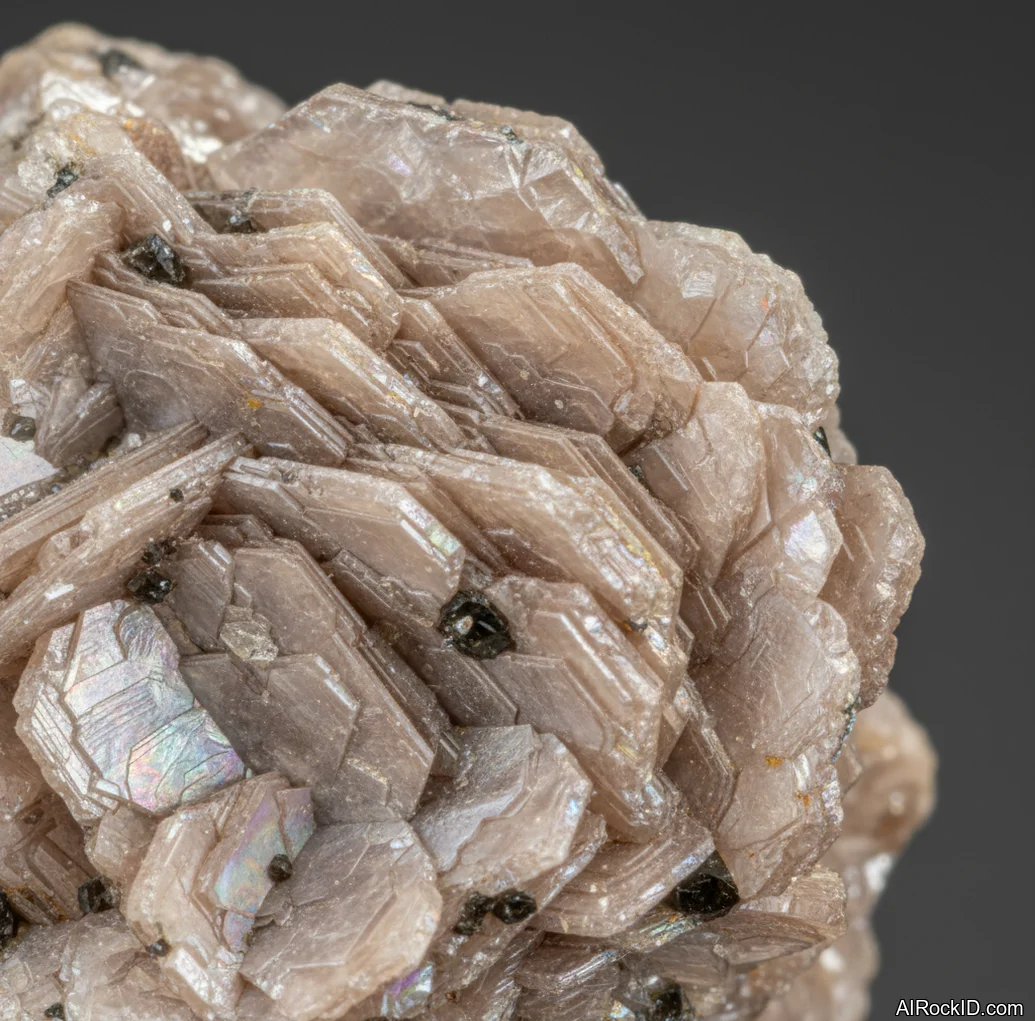
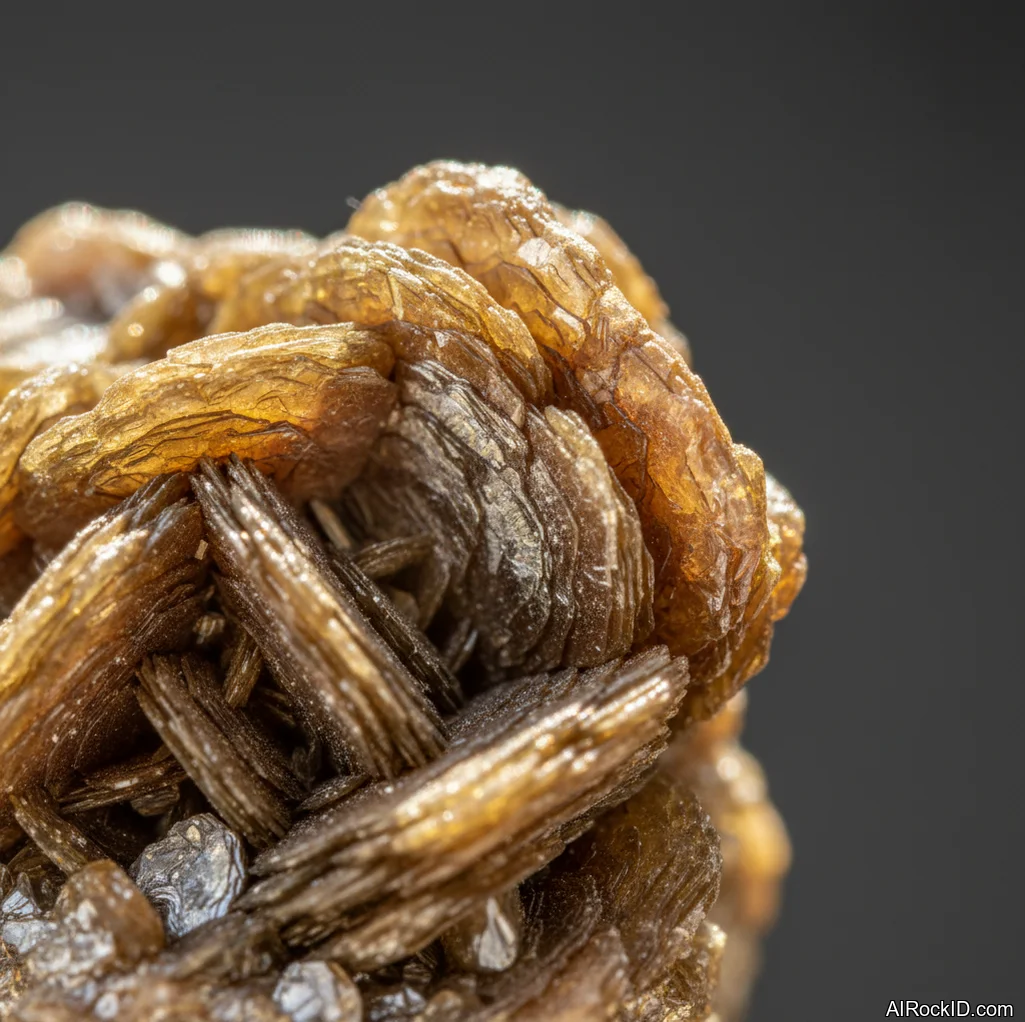
Golden mica is that golden to bronze-brown kind of phlogopite, a mica mineral that’s a sheet silicate. It splits cleanly into thin, flexible flakes. Grab a chunk and you notice it instantly: it feels weirdly light for its size, and it almost begs to peel apart in your fingers along those paper-thin layers.
People see it once and go, “gold,” because the flashes can be loud under a lamp. Tilt it and the shine snaps on and off like a switch. I’ve had pieces that looked kind of dull sitting flat on a table, then I turned them maybe 10 degrees and the whole face suddenly lit up with that warm, buttery glare (it’s hard to capture in a photo, honestly).
But it’s not tough. Not even close. Toss it in a pocket with keys and it’ll scuff up fast and shed little sparkly bits that cling to everything. Thing is, golden mica is one of those minerals that’s way cooler in your hand than in pictures, because the real trick is the cleavage and how it catches light when you move it.
Origin & History
Phlogopite got pinned down as its own mineral species in the 1800s. The name comes from the Greek “phlogopos,” meaning “fire-like,” which makes sense the first time you crack it open and see that warm glow on a fresh cleavage face (it almost looks like it’s lit from inside when you tilt it). “Golden mica” isn’t a formal species name, it’s more of a trade and collector tag people slap on honey-gold to bronze phlogopite that really pops in a hand specimen.
Micas, though, were known way before modern mineralogy showed up. They split into sheets so cleanly you can literally peel them with a fingernail, and early collectors and miners clocked them as their own little “family” of sparkly, peelable minerals. And if you leaf through older collections, you’ll run into samples labeled simply “mica” with a locality tag, because back then the look and that slick, flaky feel were basically the whole ID.
Where Is Golden Mica Found?
Golden mica (phlogopite) shows up in metamorphic terrains and some igneous settings worldwide, especially where magnesium-rich rocks get cooked and altered.
Formation
Raw chunks from metamorphic zones tell the same old story: magnesium-rich rocks get shoved under heat and pressure, and phlogopite pops out as those stacked silicate sheets. You’ll spot it in marbles, schists, or skarns, usually hanging around calcite, dolomite, diopside, tremolite, spinel, apatite. And in those rocks it can grow into big “books”, the kind that split cleanly so you can literally peel pages off with a fingernail (you feel that gritty drag right before it lets go).
Compared to muscovite, that pale silvery mica, phlogopite tends to read warmer because of its chemistry. But the real giveaway is where it’s sitting. If it’s coming out of a marble or a skarn next to green diopside and chalky white calcite, there’s a decent chance that “gold mica” is actually phlogopite, not just muscovite that got stained.
How to Identify Golden Mica
Color: Golden mica ranges from pale honey and champagne to bronze-brown, sometimes with a slight greenish or reddish cast. The color often looks stronger on edge or in thicker books.
Luster: Pearly to vitreous on cleavage faces, with a bright reflective sheen when tilted to the light.
Pick up a piece and try to lift a corner with a fingernail. It should split cleanly into elastic sheets, not crumble like glitter. If you scratch it with a copper coin or even a fingernail, you’ll usually leave a mark because mica is soft. And watch the “flash”: real cleavage faces give broad, mirror-like reflections, while metallic-looking fakes tend to glitter in lots of tiny points.
Common Look-Alikes
Golden Mica is sometimes confused with these materials:
- Goldstone glass (man-made glitter glass sold as "gold mica")
- Bronzite (tumbled, chatoyant brown-gold pyroxene)
- Pyrite (especially thin, brassy flakes or crumbly masses mislabeled as mica)
- Chalcopyrite / "peacock ore" after acid treatment (brassy base that gets sold in the same bins)
- Muscovite mica stained with iron oxides (often called "gold mica" even when it’s really pale mica with surface staining)
- Dyed mica flakes used in resin or soap (craft mica that gets marketed as natural golden mica)
Market Cautions & Treatments
When AI Can Get This Wrong
At first glance, photos of golden mica fool AI into calling it pyrite, bronzite, or even goldstone because the flash is so mirror-like when the sheets catch the light. The real test is physical: mica peels into thin, bendy flakes and you can scratch it with a fingernail, but pyrite won’t peel and bronzite stays solid and dense in the hand. If the "sparkle" looks evenly sprinkled across a smooth surface in every angle, AI tends to be right for glass and wrong for mica.
Properties of Golden Mica
Physical Properties
| Crystal System | Monoclinic |
| Hardness (Mohs) | 2.5-3 (Soft (2-4)) |
| Density | 2.70-2.85 g/cm3 |
| Luster | Pearly |
| Diaphaneity | Transparent to translucent |
| Fracture | Uneven |
| Streak | white |
| Magnetism | Non-magnetic |
| Colors | golden, honey, bronze, brown, yellow-brown, greenish-brown |
Chemical Properties
| Classification | Silicates (phyllosilicate) |
| Formula | KMg3(AlSi3O10)(F,OH)2 |
| Elements | K, Mg, Al, Si, O, F, H |
| Common Impurities | Fe, Ti, Mn |
Optical Properties
| Refractive Index | 1.55-1.62 |
| Birefringence | 0.030-0.040 |
| Pleochroism | Moderate |
| Optical Character | Biaxial |
Golden Mica Health & Safety
It’s safe to handle. But if you start prying at it, it’ll shed these really thin flakes and a few sharp little edges (the kind that catch on your fingertip). Regular specimen care is all you need.
Safety Tips
If you’re trimming matrix or cracking open a book, put on eye protection and try not to kick up dust. Mica can throw off these tiny, sharp splinters that are ridiculously irritating (trust me).
Golden Mica Value & Price
Price Range
Rough/Tumbled: $5 - $60 per specimen
Price jumps around depending on the sheet size, how clean it is, and how “booky” the specimen looks. If the cleavage faces are bright and not chipped up, and it’s got nice association minerals like calcite, diopside, or apatite stuck on there (the kind you can actually see when you tilt it in the light), that usually bumps the value higher.
Durability
Fragile — Scratch resistance: Poor, Toughness: Poor
It’s generally stable in normal indoor conditions, but the sheets chip, flake, and crease easily with handling.
How to Care for Golden Mica
Use & Storage
Store it in a box or a display case where it won’t get rubbed by harder minerals. If it’s a mica book, keep it flat so the layers don’t crease.
Cleaning
1) Blow off dust with a bulb blower or canned air held at a distance. 2) Use a very soft brush to lift dirt out of the layers. 3) If needed, do a quick rinse in lukewarm water and pat dry, but don’t soak a flaky piece for long.
Cleanse & Charge
For metaphysical-style cleansing, smoke, sound, or a quick pass through cool running water works without beating up the sheets. I skip salt bowls here because the grit can scratch and wedge into layers.
Placement
Put it where you can tilt it toward a lamp, because the whole point is the flash off the cleavage. Keep it out of high-traffic shelves where it’ll get bumped.
Caution
Don’t use ultrasonic cleaners, steam cleaners, or anything that involves harsh scrubbing. And don’t treat it like a tumble stone either, it’ll just get shredded.
Works Well With
Golden Mica Meaning & Healing Properties
Look at a piece of golden mica up close and you’ll get why people keep bringing up “clarity.” It’s not some poetic idea. The stuff is literally stacked in sheets, and when I’m picking through a tray at a show, it’s the one thing that makes me pause and hunt for those clean, flat planes with sharp edges that haven’t been chewed up.
In the crystal-healing world, golden mica usually gets linked to confidence, willpower, getting organized, all that. I file it under practical. It’s a solid “desk stone” if you want a visual nudge to stay on task, but I wouldn’t grab it if you’re the kind of person who needs something to fidget with all day long. It flakes. You’ll see tiny shimmers left behind (sometimes on your fingertips, sometimes in the bottom of the bag). That’s the deal.
And yeah, this is metaphysical, not medicine. If you’re stressed, mica isn’t going to fix your life. But as an object you can actually hold, it does real, obvious things: it throws light back at you like a little mirror, it shows every fingerprint right away, and it teaches you fast that if you handle it rough, you’ll mess it up. Kind of a blunt reminder, honestly. And for a lot of people, that’s the point.
Common mistakes
- Assuming every gold-colored shiny mineral is pyrite
- Using a hardness test on a display face and damaging thin sheets
- Calling all brown mica Golden Mica without checking whether it may be biotite
- Soaking flaky specimens, which can loosen layers or trapped debris
- Expecting Golden Mica to behave like a durable gemstone
Identify Golden Mica from a photo
Compare Golden Mica traits, care tips, value clues, and common lookalikes with a clear photo.