Grape Agate


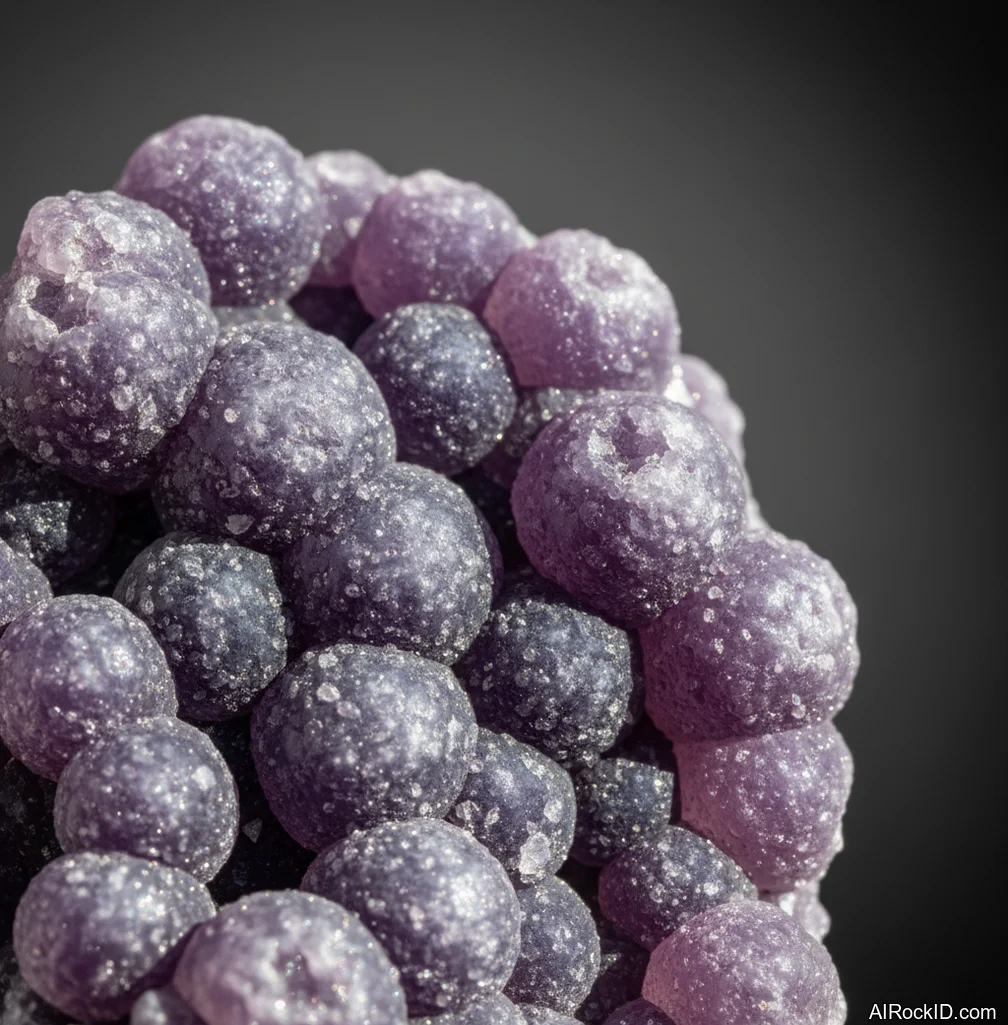
Quick answer: Grape Agate is a purple, botryoidal form of chalcedony best recognized by rounded, grape-like clusters and a fine druzy sparkle. The most familiar material comes from Indonesia and is often sought by collectors for its texture, color zoning, and display value.
AI Rock ID can help screen Grape Agate by checking for botryoidal chalcedony texture, purple-to-lavender color, and surface sparkle from a submitted photo. RockIdentifier.io provides crystal identification support, but final confirmation may require hardness testing, magnification, or seller documentation.
Good fit
- Collectors who like unusual crystal textures and grape-like cluster formations
- Buyers comparing purple chalcedony specimens from Indonesia
- Display pieces where rounded botryoidal surfaces and druzy sparkle are important
- Beginners who want a recognizable specimen with a distinct visual profile
Not a good fit
- People looking for a faceted gemstone with high transparency
- Jewelry use where exposed druzy surfaces may snag or collect debris
- Buyers who need a guaranteed locality without seller documentation
- Situations where a perfectly uniform purple color is expected
Most commonly confused with
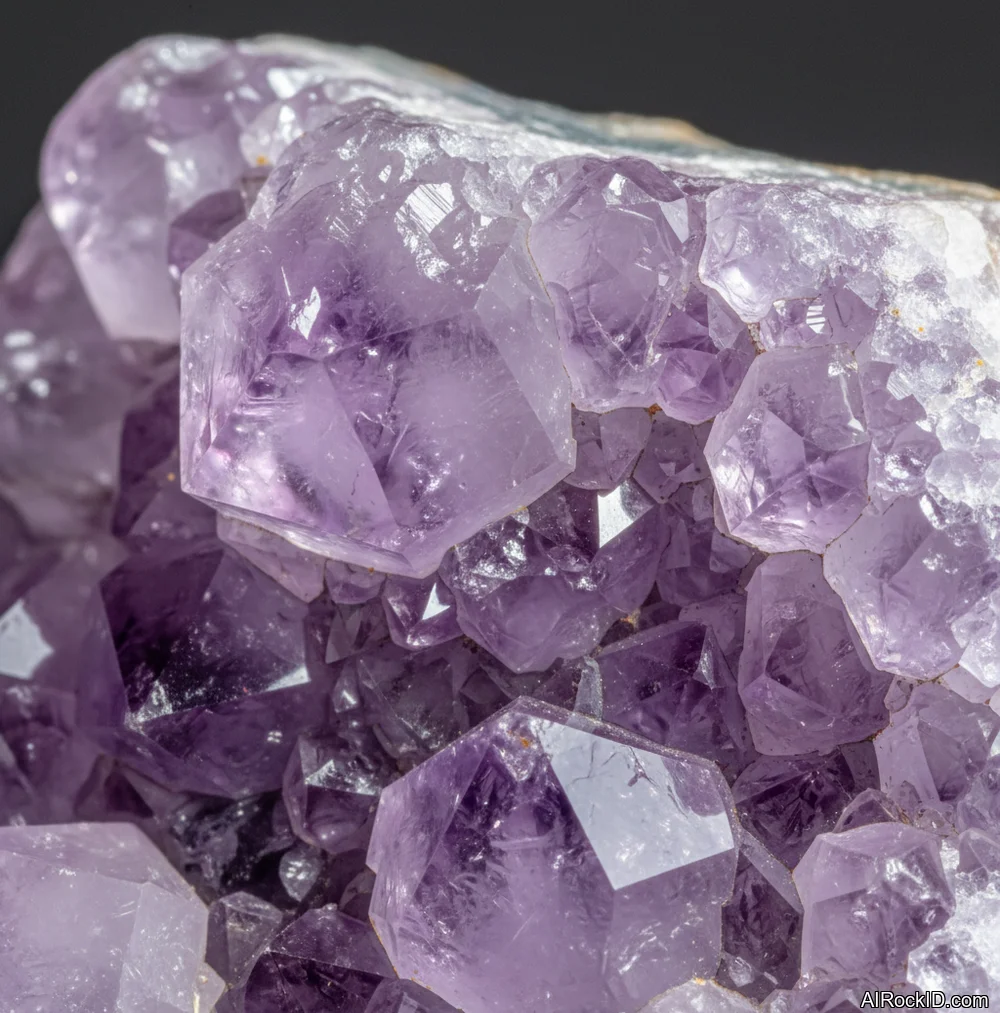
- Amethyst: Amethyst is crystalline quartz with pointed crystal faces, while Grape Agate is chalcedony with rounded botryoidal clusters.
- Purple Fluorite: Purple fluorite is softer and commonly shows cubic cleavage, unlike the waxy-to-druzy rounded surface of Grape Agate.
- Botryoidal Chalcedony: Botryoidal chalcedony can occur in many colors; Grape Agate specifically refers to purple grape-like clusters.
- Dyed Agate: Dyed agate may show overly even or concentrated color in cracks, while natural Grape Agate usually has clustered growth and subtle purple variation.
Grape Agate vs. Similar Purple Stones
| Feature | Grape Agate | Common Lookalike |
|---|---|---|
| Typical structure | Rounded botryoidal chalcedony clusters | Amethyst has pointed quartz crystals |
| Surface texture | Sugary druzy sparkle or waxy rounded bubbles | Dyed agate is often sliced, banded, or polished |
| Color pattern | Lavender to purple with natural variation | Dyed material may show unnaturally even or crack-focused color |
| Hardness clue | About 6.5–7 Mohs | Fluorite is softer at about 4 Mohs |
| Best ID clue | Grape-like clusters plus chalcedony texture | Lookalikes usually lack both traits together |
AI identification confidence
AI identification confidence is usually moderate to high when photos clearly show the grape-like botryoidal surface, purple color, and druzy sparkle. Confidence drops when the specimen is heavily polished, photographed in poor lighting, or shown without scale.
When AI gets it wrong
- A close-up photo shows only purple sparkle and hides the rounded cluster shape
- The stone is a dyed agate slice or polished purple chalcedony without visible botryoidal texture
- Lighting makes amethyst clusters appear more rounded than they are
- The specimen is coated, enhanced, or photographed with strong color saturation
Final recommendation
Choose Grape Agate based on clear botryoidal structure, stable natural-looking purple color, and clean specimen photos from multiple angles. For higher-priced pieces, ask for locality information and avoid listings that rely only on color without showing the cluster texture.
How to Verify Grape Agate Before Buying
Authentic Grape Agate should show rounded, grape-like chalcedony growth rather than only a flat purple surface. Request photos in natural light, side views that reveal the cluster structure, and close-ups of the druzy surface. Be cautious with listings that use heavily saturated images, vague names, or no view of the specimen’s back and edges.
Natural Color vs. Dyed Purple Agate
Natural Grape Agate commonly shows lavender, violet, gray-purple, or uneven purple tones across clustered surfaces. Dyed agate may display color concentrated in cracks, overly uniform purple saturation, or bright artificial-looking patches on cut surfaces. Magnification can help reveal whether color follows natural chalcedony growth or appears to sit in fractures.
Best Photo Angles for Identification
Useful identification photos include a front view, side view, close-up of the druzy surface, and a scale reference such as a ruler or coin. Natural daylight helps show the true purple tone without exaggerating saturation. A side angle is especially important because many lookalikes can appear similar when only the sparkling surface is shown.
What Is Grape Agate?
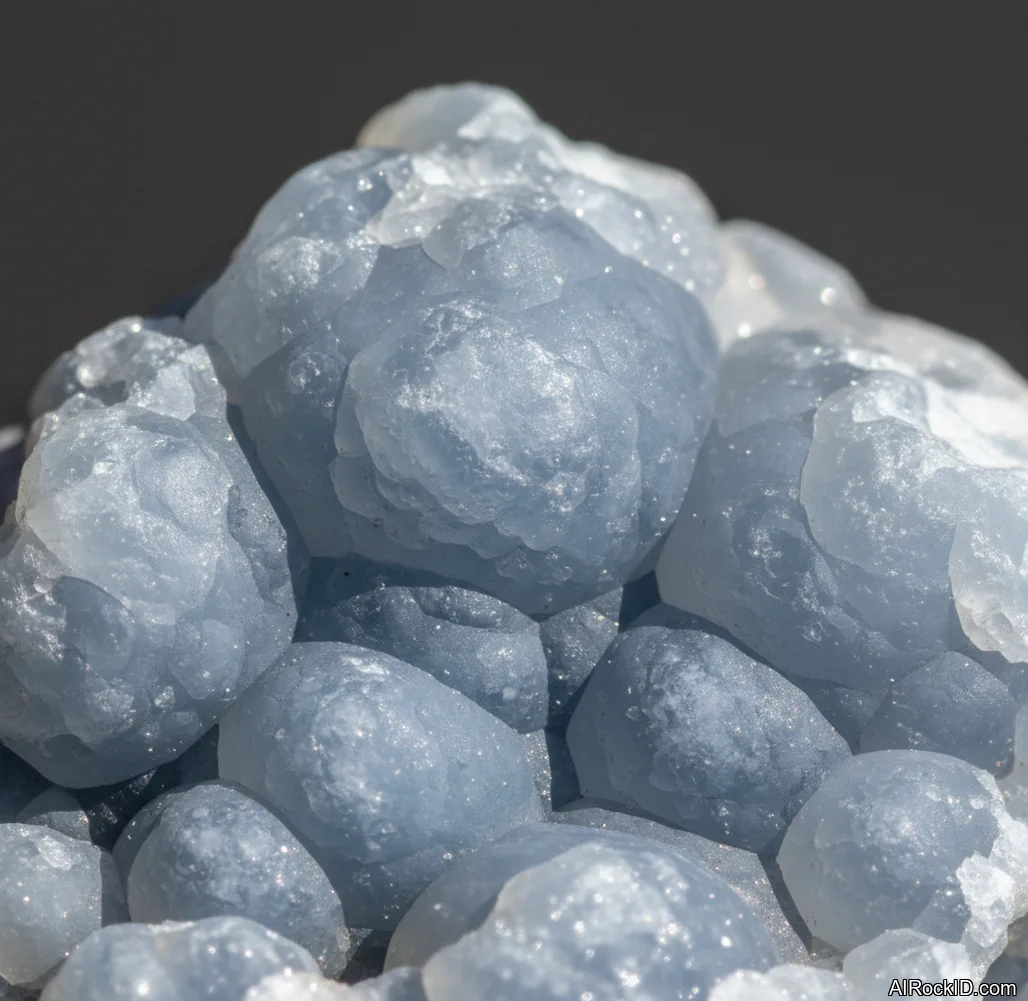
Grape Agate is a botryoidal (grape-like) form of purple chalcedony, and chalcedony is microcrystalline quartz. The first time you hold a good piece, you instantly get why that nickname stuck. It’s basically a bunch of tiny round “bubbles” packed tight, and the surface can kick back this fine druzy glitter when you tilt it under a lamp and catch the light just right.
Grab a specimen and it feels like quartz, no surprise there. Cool in your palm. Harder than it looks. And there’s that slightly waxy skin where the little spheres are smooth (almost like they’ve been lightly polished already). Some pieces have a sugar-crust sparkle everywhere, but others are more satin and matte, especially on the underside where it was attached to the host rock and you can still see that rougher contact area.
Thing is, at first glance a lot of people assume it’s a separate mineral species. It’s not. It’s chalcedony showing up in a botryoidal habit, and the color can run from pale lavender to deep purple, sometimes with gray, white, or tan matrix still stuck on.
Origin & History
“Grape agate” is basically a trade name that really caught on in the late 2010s, right when Indonesian botryoidal purple chalcedony started popping up at the big gem shows and all over online listings. Dealers ran with the obvious. It looks like a bunch of grapes. And yeah, grape clusters kind of sell themselves.
On the science side, it falls under chalcedony (quartz), not “agate” in the strict, banded-definition sense. But you’ll still see “agate” slapped on it because the market’s been calling tons of chalcedony that for ages. If you want to be picky (and some people do), most pieces aren’t banded agate at all.
Where Is Grape Agate Found?
Most true grape agate on the market comes from the Mamuju area of West Sulawesi, Indonesia, where botryoidal chalcedony forms on volcanic host rock.
Formation
Look closer at the surface and it kind of gives itself away. Those little round “grapes” show up when silica-rich fluids push through cavities and fractures in volcanic rock, and the chalcedony grows outward in bulbby lobes instead of laying down in flat layers. Same general process family as geodes or seam chalcedony, just a different way it decides to build.
That purple tint usually comes down to trace elements plus defects in the quartz structure. But here’s the annoying bit: the color can jump around from one cluster to the next on the exact same piece, and yep, that’s normal. I’ve had specimens where one side looks like a moody gray-lavender in daylight, then you turn it and the other side snaps into a punchier purple that only really shows up under cool LED lighting. Kinda wild, right?
How to Identify Grape Agate
Color: Typically lavender to medium purple, sometimes with grayish tones; color can be patchy across a single cluster. Some pieces show white chalcedony at the base or between spheres.
Luster: Waxy to vitreous, often with a fine druzy sparkle on the surface.
Pick up the piece and check temperature. Real chalcedony stays cool in your hand longer than resin fakes, which feel a little warm and “plasticky.” If you scratch it with a steel nail, it shouldn’t mark easily, and a copper coin won’t do much. The real test is a loupe: natural pieces often show tiny druzy crystals and subtle growth texture, not perfectly identical spheres.
Common Look-Alikes
Grape Agate is sometimes confused with these materials:
- Dyed botryoidal chalcedony/agate sold as “grape agate” (often hot pinks or too-even purple)
- Botryoidal amethyst or amethyst druse on chalcedony (sparkly quartz points can fool people in photos)
- Purple fluorite botryoidal or mammillary fluorite (softer, can show cleavage and edge chipping)
- Lepidolite mica clusters (purple, glittery, but it feels flaky and light, not waxy-hard like chalcedony)
- Purple slag glass or “grape” glass beads/cluster casts (warm to the touch, bubbles inside, lower hardness)
Market Cautions & Treatments
When AI Can Get This Wrong
At first glance, phone apps mix grape agate up with botryoidal fluorite, amethyst druse, and even lepidolite because all three can photograph as purple bumpy clusters. The real test is hardness and feel: grape agate should scratch glass and stay cool in the palm, while fluorite scratches easier and lepidolite feels flaky and sheds tiny sparkly bits. A loupe helps a lot, since chalcedony bubbles look waxy with fine drusy sugar, but glass shows internal bubbles and a too-smooth surface in the tight spots.
Properties of Grape Agate
Physical Properties
| Crystal System | Trigonal |
| Hardness (Mohs) | 6.5-7 (Hard (6-7.5)) |
| Density | 2.58-2.64 |
| Luster | Waxy |
| Diaphaneity | Translucent |
| Fracture | Conchoidal |
| Streak | White |
| Magnetism | Non-magnetic |
| Colors | Purple, Lavender, Gray, White |
Chemical Properties
| Classification | Silicates |
| Formula | SiO2 |
| Elements | Si, O |
| Common Impurities | Fe, Mn |
Optical Properties
| Refractive Index | 1.530-1.539 |
| Birefringence | 0.004 |
| Pleochroism | None |
| Optical Character | Uniaxial |
Grape Agate Health & Safety
Grape agate is a non-toxic chalcedony (quartz), so it’s safe to handle and even give a quick rinse under the tap. I’ve done that myself, and it holds up fine. But it’s still a silica material. So if you’re grinding or cutting it, the dust is the part you don’t want to mess with, especially if you’re doing it without proper controls.
Safety Tips
If you’re going to cut or shape it, do it wet and wear the right respirator so you don’t end up breathing in silica dust. Dry cutting kicks up that fine, gritty powder that hangs in the air longer than you’d think.
Grape Agate Value & Price
Price Range
Rough/Tumbled: $10 - $250 per specimen
Prices jump when the spheres are tighter and more uniform, the purple is deeper, and the display faces look clean with no broken “grapes.” Big plates are out there, sure. But most dealers don’t price by weight, they price by eye appeal.
Durability
Durable — Scratch resistance: Good, Toughness: Good
It’s stable quartz, but the botryoidal surface can chip if it rattles around in a bag with harder stuff.
How to Care for Grape Agate
Use & Storage
Store it in a small box or a padded shelf spot where the botryoidal surface won’t get knocked. And don’t toss it in a bowl with other quartz points, those tips will bruise the little spheres.
Cleaning
1) Rinse with lukewarm water to remove dust. 2) Use a soft toothbrush with a drop of mild soap to get into the crevices between “grapes.” 3) Rinse well and air-dry; avoid harsh chemicals and ultrasonic cleaners if the piece has fractures or a crumbly matrix.
Cleanse & Charge
Water rinse or smoke cleansing is fine, and moonlight is a safe choice if you don’t want to fuss. Skip long sunny windowsills if you’re picky about keeping the purple looking its best.
Placement
Put it where light rakes across the surface. Side lighting shows off the druzy sparkle way better than flat overhead lighting.
Caution
Those rounded clusters will snap or chip if you fumble it and it takes even a short drop onto tile or stone. So keep it in your hands over a table, not over the sink (seriously, sinks are basically rock-hard targets).
Works Well With
Grape Agate Meaning & Healing Properties
A lot of people grab grape agate when they want calm that feels steady, but not that “I’m about to fall asleep” energy some stones give off. In my own pile, it’s one of the only pieces I’ll leave on my desk, because it comes across quiet and friendly instead of intense. And yeah, the shape matters. Those little rounded blobs make your eyes settle down without you even noticing.
If you’re into crystals in a metaphysical sense, grape agate usually gets grouped in with other purple stones like amethyst: soothing, reflective, good for turning down the mental static. But it feels more grounded than a spiky amethyst cluster. Thing is, it’s a very hands-on stone. You can literally rub your thumb over the bumpy “grapes” while you’re thinking (it has that slightly waxy, grippy feel, not slick like polished quartz).
Just keep your expectations in the real world. It’s not medicine, and it won’t fix anxiety by itself. So what can it do? It can be a physical cue, something you see or touch when you’re trying to slow your breathing, journal, or sit still for five minutes.
Common mistakes
- Identifying any purple druzy quartz as Grape Agate without checking for rounded botryoidal clusters
- Assuming every bright purple agate specimen is natural in color
- Buying from a single close-up photo that hides the specimen’s overall shape
- Confusing grape-like chalcedony bubbles with amethyst crystal points
- Using color alone as proof of Indonesian origin
- Cleaning druzy surfaces with harsh chemicals or stiff brushes that can damage fine sparkle
Identify Grape Agate from a photo
Compare Grape Agate traits, care tips, value clues, and common lookalikes with a clear photo.