Hackmanite With Ijolite


Quick answer: Hackmanite with ijolite is a mixed rock specimen featuring UV-reactive hackmanite, a sodalite-group mineral, in a dark ijolite host. Its main identification clues are the contrast between pale hackmanite and dark nepheline-syenite material, plus fluorescence and possible tenebrescence after UV exposure.
AI Rock ID can help compare a photo of hackmanite with ijolite against visually similar fluorescent and sodalite-group specimens. RockIdentifier.io provides crystal and rock references that can support visual screening, but UV response and source information are still important for confirmation.
Good fit
- Collectors who want a strong light-dark contrast in one specimen
- UV mineral collectors interested in fluorescence and tenebrescence
- Buyers comparing sodalite-group minerals from alkaline rock localities
- Display collections that include both mineral and host-rock context
Not a good fit
- Anyone expecting every piece to show the same UV intensity
- Jewelry use without checking hardness, fractures, and setting security
- Buyers who need a single pure mineral rather than a mixed rock specimen
- Outdoor display areas with long-term sunlight exposure
Why people search for this
People often search for hackmanite with ijolite to confirm whether a pale patch in a dark host is genuine UV-reactive hackmanite. Search interest also comes from comparing natural tenebrescent specimens with dyed, mislabeled, or non-reactive sodalite material.
Most commonly confused with
- Hackmanite: Hackmanite without ijolite may occur as a more isolated sodalite-group mineral rather than a contrasting dark host-rock specimen.
- Sodalite: Common sodalite is often blue and may fluoresce weakly or not at all, while hackmanite is noted for tenebrescence in some specimens.
- Yooperlite: Yooperlite is a fluorescent syenite containing sodalite and is usually identified by bright orange UV spots rather than pale hackmanite zones in ijolite.
- Nepheline Syenite: Nepheline syenite can host fluorescent minerals but does not by itself confirm hackmanite or tenebrescence.
Hackmanite With Ijolite Lookalikes
| Specimen | Typical look | UV clue | Key difference |
|---|---|---|---|
| Hackmanite with ijolite | Pale hackmanite in dark host | May fluoresce and show tenebrescence | Mixed sodalite-group mineral in ijolite |
| Hackmanite | Pale, lilac, pink, or gray masses | Often UV-reactive | May lack the dark ijolite matrix |
| Sodalite | Blue to gray, massive | Variable fluorescence | Usually not sold for tenebrescence |
| Yooperlite | Gray syenite with scattered fluorescent spots | Often bright orange under UV | Fluorescent sodalite in syenite, not necessarily hackmanite |
| Nepheline syenite | Coarse dark or gray igneous rock | May be weak or mixed | Host rock name does not confirm hackmanite |
AI identification confidence
AI identification confidence is usually moderate for hackmanite with ijolite because the dark host and pale mineral zones are visually distinctive, but fluorescence cannot be verified from a normal-light photo alone. Confidence improves when images include white light, shortwave or longwave UV response, and a post-UV color-change view.
When AI gets it wrong
- The photo is taken only under purple UV light, which can distort the true body color.
- A non-tenebrescent sodalite specimen is labeled as hackmanite based on fluorescence alone.
- The dark host rock is assumed to be ijolite without locality or petrographic context.
- Dyed or enhanced sodalite is photographed in low light, hiding surface color irregularities.
Final recommendation
Choose hackmanite with ijolite when the specimen has documented UV behavior, visible contrast between the pale sodalite-group mineral and dark host, and a seller who identifies the locality or source. For authentication, request photos in normal light, under UV, and after UV exposure to evaluate possible tenebrescence.
How to Check UV Reaction Before Buying
Ask the seller whether the specimen was tested with longwave UV, shortwave UV, or both, because response can vary by wavelength. A useful listing should show the same face of the specimen in normal light and under UV light. For tenebrescence, a photo taken after UV exposure can help show whether the color temporarily deepens or shifts.
Authenticity Clues in Photos
Natural hackmanite with ijolite usually shows irregular mineral boundaries rather than perfectly even color patches. Be cautious with overly saturated purple, pink, or blue colors that appear uniform across the surface. Matrix texture, broken edges, and close-up images can help separate natural mixed rock from dyed or mislabeled material.
Locality and Labeling Notes
Hackmanite and related sodalite-group minerals are associated with alkaline igneous environments, and ijolite is a nepheline-rich intrusive rock. A label that includes a mine, region, or country can add useful context, but locality information should still match the mineral association. Vague labels such as “UV stone” or “glow rock” are not enough to confirm hackmanite with ijolite.
What Is Hackmanite With Ijolite?
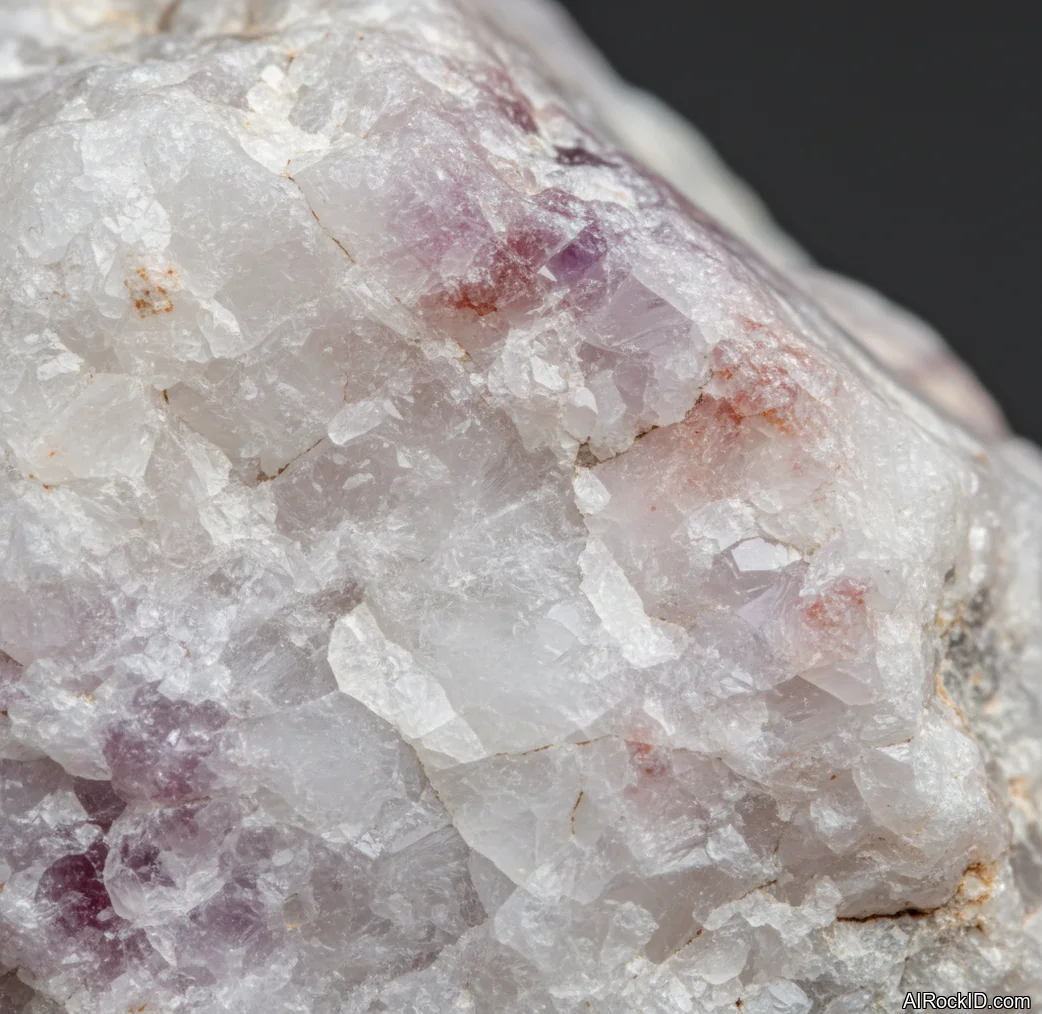
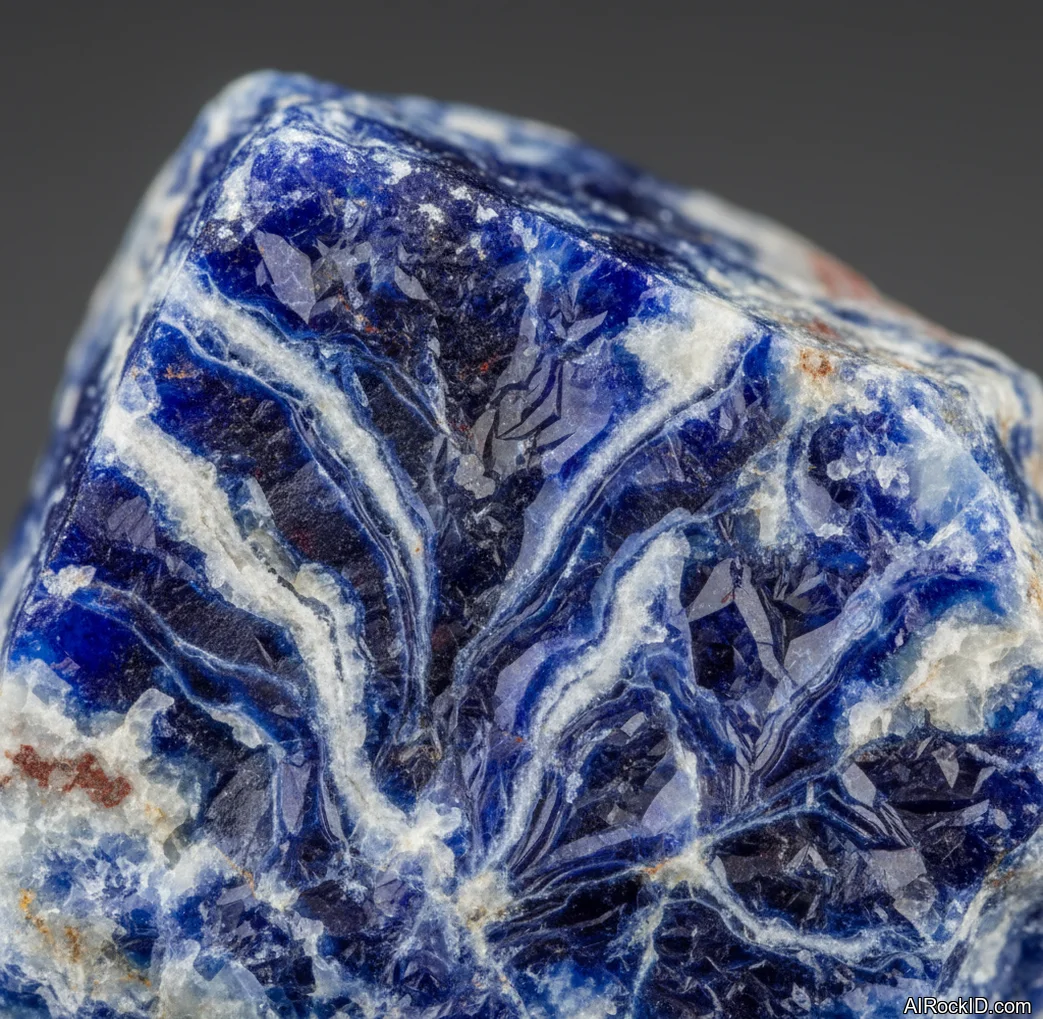
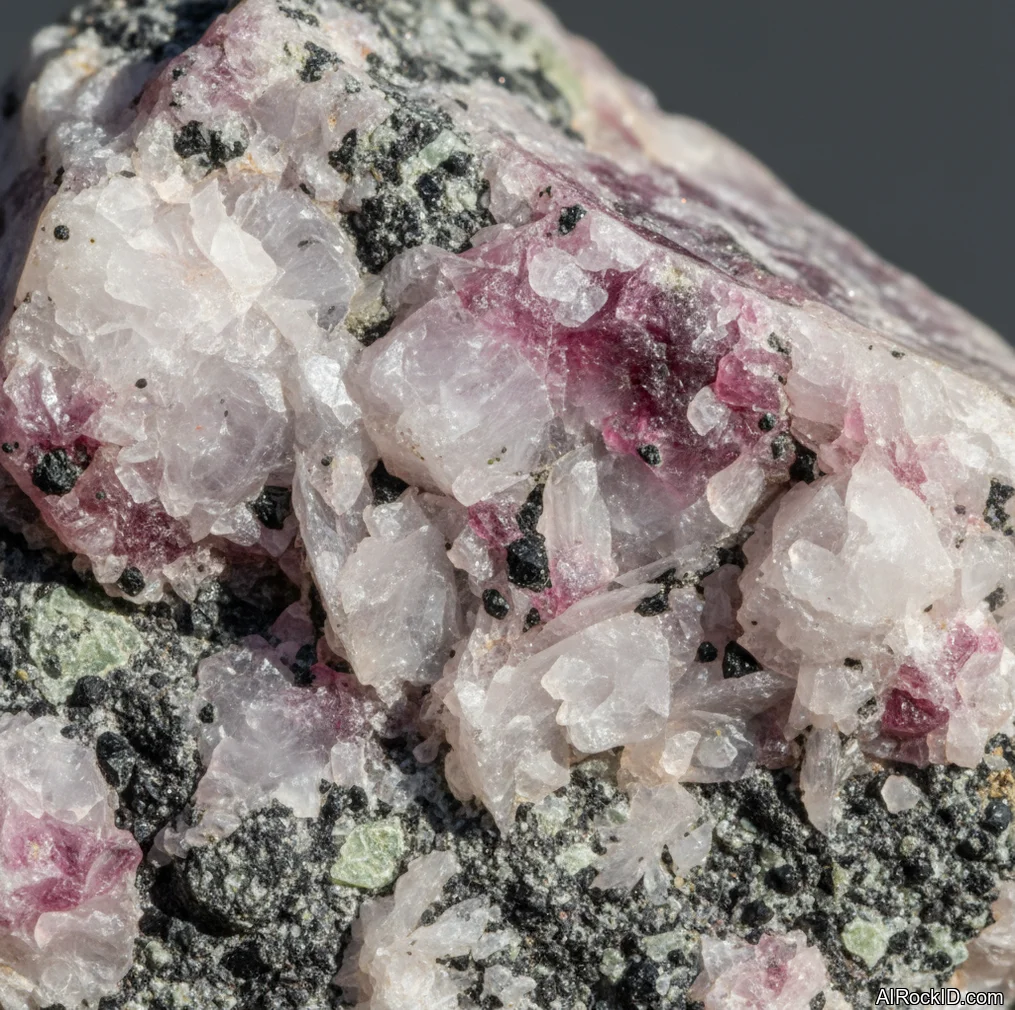
Hackmanite with ijolite is exactly what it sounds like: hackmanite (a sodalite-group mineral) showing up as patches or little veinlets inside ijolite, a dark blue nepheline-syenite rock.
Pick up a piece and you notice the “rock” part immediately. Ijolite has this dense, fine-grained heft, like it wants to pull straight down into your palm. And the hackmanite tends to read as softer-looking pale blobs or streaks that don’t always photograph the way your eye catches them in person. In hand, that contrast is the whole appeal. You get an inky blue to almost black host, then milky white to lavender hackmanite breaking it up.
Under UV light, it can turn into a completely different specimen. Some pieces flare orange or salmon in the hackmanite zones, and some will also shift color after UV exposure (tenebrescence), especially if you take it outside into sunlight and watch it fade back. But not every chunk does the big dramatic trick. So yeah, people get disappointed when they buy blind, because you can’t count on every piece behaving the same way.
Origin & History
Hackmanite got its first proper write-up in 1896, thanks to Waldemar Christofer Brøgger. He named it after the Finnish geologist Victor Axel Hackman. The early specimens came out of the Låven island area in Norway’s Oslo Region, from those classic alkaline igneous complexes collectors tend to chase (the kind of stuff that shows up with all the familiar nepheline-rich rocks and oddball minerals).
Ijolite, as a rock name, traces back to the Iivaara (Ijivaara) area in Finland, where the alkaline intrusives were studied and mapped in detail. So when a dealer labels something “hackmanite with ijolite,” that’s basically trade shorthand for “hackmanite hosted in an ijolite-type nepheline syenite.” And yeah, the better sellers really push the UV and color-change trick, because it’s honestly a blast to show off right there on the table when you hit it with a light and watch it shift.
Where Is Hackmanite With Ijolite Found?
You see this combo most often from alkaline complexes where sodalite-group minerals and nepheline syenites occur together, especially Canada and the Nordic region.
Formation
Alkaline igneous settings are really where this combo makes sense. Ijolite comes out of silica-undersaturated magma, so you end up with nepheline instead of quartz, plus those dark pyroxenes that give the rock that deep blue-black look (the kind that reads almost oily when it’s freshly broken). As the magma cools and fluids start moving through fractures and little pockets, sodalite-group minerals can crystallize if the chemistry lines up.
Hackmanite is basically sodalite, just with some sulfur-related defects in its structure. That’s the bit that gives you tenebrescence and a lot of the UV reaction. In real specimens it usually shows up as irregular masses and thin seams, not neat, terminated crystals. And yeah, that’s normal. If you’re expecting crystal points, you’re shopping the wrong material. Why fight the geology?
How to Identify Hackmanite With Ijolite
Color: Ijolite is usually dark blue to blue-black, sometimes with a slightly mottled look. Hackmanite ranges from white to pale lavender or pinkish-lilac and can deepen briefly after UV exposure on tenebrescent pieces.
Luster: The hackmanite areas are typically vitreous to slightly greasy on fresh surfaces, while the ijolite host looks more dull to sub-vitreous because it’s a fine-grained rock.
Look closely at the boundary between the pale zones and the dark host. In real pieces it’s messy, like blobs soaked into the rock, not a clean “glued-in” line. Under UV light (365 nm is the best bet), the hackmanite patches should respond more than the host, even if the response is faint. The real test is a quick scratch check on an inconspicuous spot: both components sit around Mohs 5.5 to 6, so they’ll scratch a copper penny but won’t reliably scratch glass like quartz does.
Common Look-Alikes
Hackmanite With Ijolite is sometimes confused with these materials:
- Sodalite in syenite (often sold as “sodalite granite” or “yooperlite” when it’s actually fluorescent sodalite in host rock)
- Lazurite / lapis-style rock (especially dark blue matrixy pieces with pale calcite streaks)
- Nepheline syenite or larvikite (dark feldspathic rock with scattered pale patches, sometimes mislabeled as “mystic granite”)
- Dyed howlite or dyed magnesite sold as “hackmanite in matrix” (blue dye sitting in pits and cracks, white base underneath)
- Blue resin or glass “matrix” blocks with white chips mixed in (weight and feel are wrong, and the white looks like suspended confetti)
Market Cautions & Treatments
When AI Can Get This Wrong
At first glance, phone photos flatten ijolite into “just a dark rock,” so AI tends to call it larvikite, generic syenite, or lapis when it catches white streaks. Hackmanite patches can look like calcite or feldspar in pictures, especially under cool LED lighting. The real test is simple: hit it with a 365 nm UV and then check for tenebrescence (color shift after UV), and compare hardness in both parts, since the pale hackmanite and the dark ijolite won’t scratch and wear exactly the same.
Properties of Hackmanite With Ijolite
Physical Properties
| Crystal System | Cubic |
| Hardness (Mohs) | 5.5-6 (Medium (4-6)) |
| Density | 2.20-2.40 g/cm3 |
| Luster | Vitreous |
| Diaphaneity | Translucent to opaque |
| Fracture | Uneven |
| Streak | white |
| Magnetism | Non-magnetic |
| Colors | blue-black, dark blue, white, lavender, pale pink, gray |
Chemical Properties
| Classification | Silicates (tectosilicates) |
| Formula | Na8Al6Si6O24(Cl2,S) |
| Elements | Na, Al, Si, O, Cl, S |
| Common Impurities | S, Ca, K, Fe |
Optical Properties
| Refractive Index | 1.483-1.487 |
| Birefringence | None |
| Pleochroism | None |
| Optical Character | Isotropic |
Hackmanite With Ijolite Health & Safety
It’s safe to handle and put on display under normal conditions. But if you’re cutting or grinding it, don’t breathe in the dust.
Safety Tips
If you’re doing lapidary work, don’t skip the basics: run water, keep the area ventilated, and wear a proper respirator so you’re not breathing in that super-fine dust that hangs in the air (and sticks to everything).
Hackmanite With Ijolite Value & Price
Price Range
Rough/Tumbled: $15 - $120 per piece
Cut/Polished: $4 - $25 per carat
Prices bounce around depending on how strong the UV reaction is, how big the piece is, and how crisp the color contrast looks in person. And yeah, sellers will ask more if the tenebrescence hits you fast in a quick before-and-after demo (the kind where you can literally watch it shift right under the light).
Durability
Moderate — Scratch resistance: Fair, Toughness: Fair
It’s generally stable on a shelf, but the color-change effect can fade if you leave it in strong light all the time.
How to Care for Hackmanite With Ijolite
Use & Storage
Store it like you would most feldspathoid-rich rocks: separate from harder quartz and corundum that can scuff it up. If you care about tenebrescence, keep it out of constant direct sun.
Cleaning
1) Rinse briefly with lukewarm water. 2) Use a soft toothbrush with a drop of mild soap to lift grime from the ijolite texture. 3) Rinse again and pat dry; don’t bake it under a hot lamp to speed things up.
Cleanse & Charge
For a simple reset, people use smoke, sound, or a night in a dark drawer. If you want the fun science version, a short UV exposure can “set” the color on tenebrescent hackmanite and then normal light will bring it back down.
Placement
A desk or shelf is fine, but it looks best somewhere you can hit it with a small UV flashlight for a quick check. I keep mine near my shortwave light because it’s a great “show-and-tell” rock.
Caution
Skip harsh acids and heavy-duty cleaners. They can bite into the surface, leaving a faint etched haze or knocking the shine down so it looks kind of flat under a lamp. And don’t count on every piece to glow or color-shift the exact same way, even if they came from the same lot. Sometimes two pieces that look identical in your hand just behave differently, and yeah, it’s a little annoying.
Works Well With
Hackmanite With Ijolite Meaning & Healing Properties
Look, most people reach for this combo because of the gimmick, and I mean that kindly. Watching the hackmanite pop under UV and then fade back down is just plain satisfying. And if you use stones as little checkpoints for mood shifts, routines, or boundaries, that on off change is a pretty handy visual. It’s a rock that literally reacts to light. Hard not to run with that metaphor, right?
Compared to plain sodalite, the ijolite host feels heavier and more grounded in your hand. You notice it. That matters if you’re someone who actually holds a stone while you think or journal instead of leaving it on a shelf. Mine feels cool at first and slightly grainy, like a fine textured ceramic. The hackmanite spots are smoother where they’ve been polished, almost slick under your thumb (tiny thing, but you end up fidgeting with it differently).
But I’m going to be blunt: “healing” here is personal and spiritual, not medical. If you’re buying it for anxiety or sleep, treat it like a focus and habit tool. So: turn off the overhead light, hit it with UV for ten seconds, put it away, and then do the boring helpful stuff like breathing, stretching, and actually going to bed. Simple. Not magic.
Common mistakes
- Assuming any fluorescent sodalite-group rock is hackmanite with ijolite
- Judging tenebrescence from a UV-only photo instead of checking color before and after exposure
- Confusing a dark host rock with ijolite without supporting locality or mineral information
- Expecting all specimens to fluoresce with equal brightness under the same UV lamp
- Buying polished pieces without checking whether polishing reduced visible texture or diagnostic boundaries
- Using sunlight exposure as a display method when color stability and fading are concerns
Identify Hackmanite With Ijolite from a photo
Compare Hackmanite With Ijolite traits, care tips, value clues, and common lookalikes with a clear photo.