Mica In Quartz
What Is Mica In Quartz?
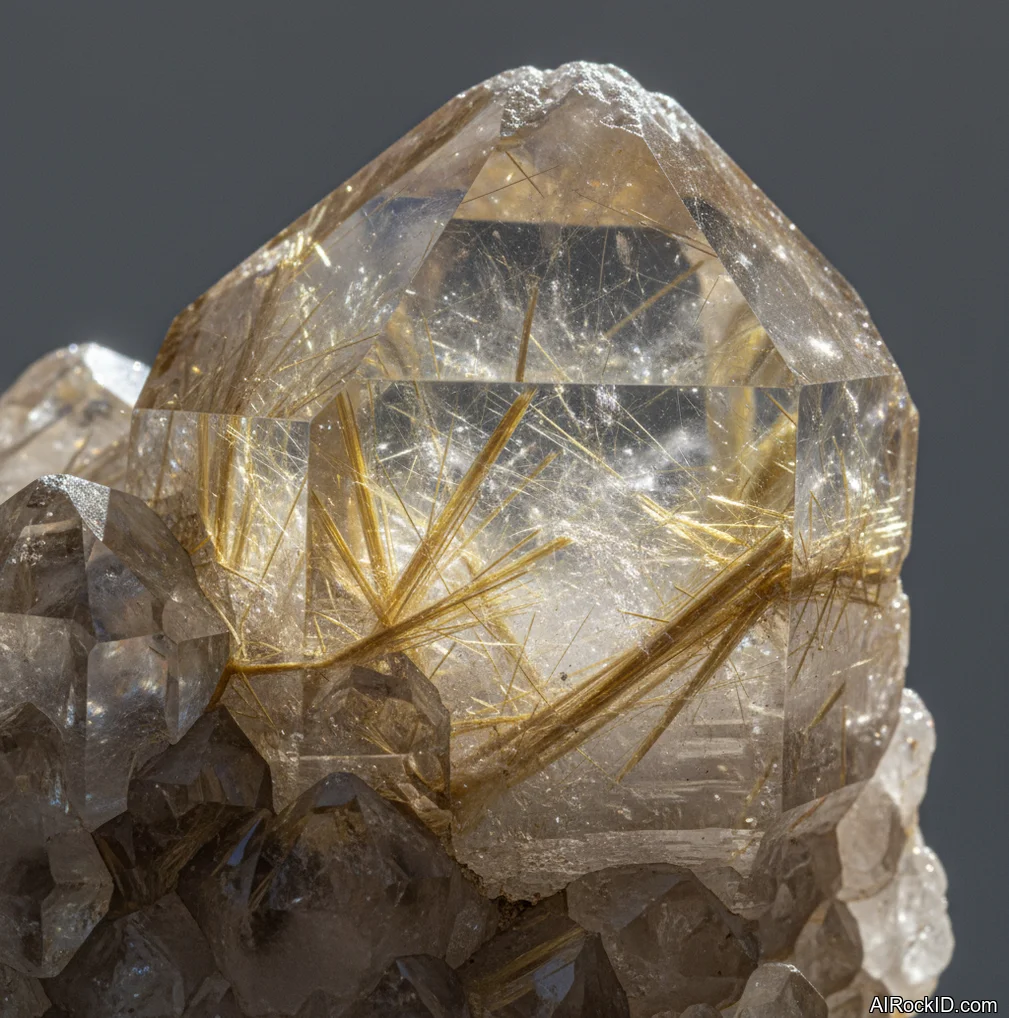
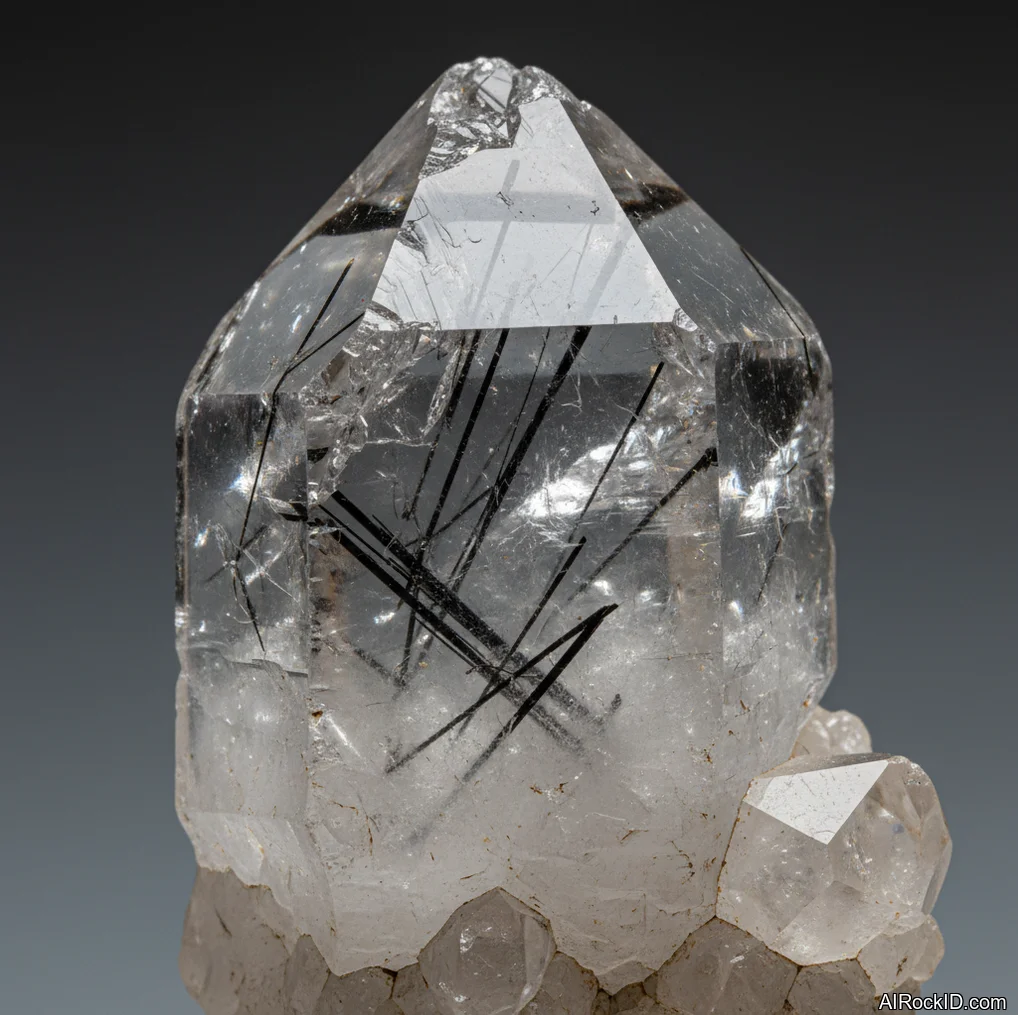
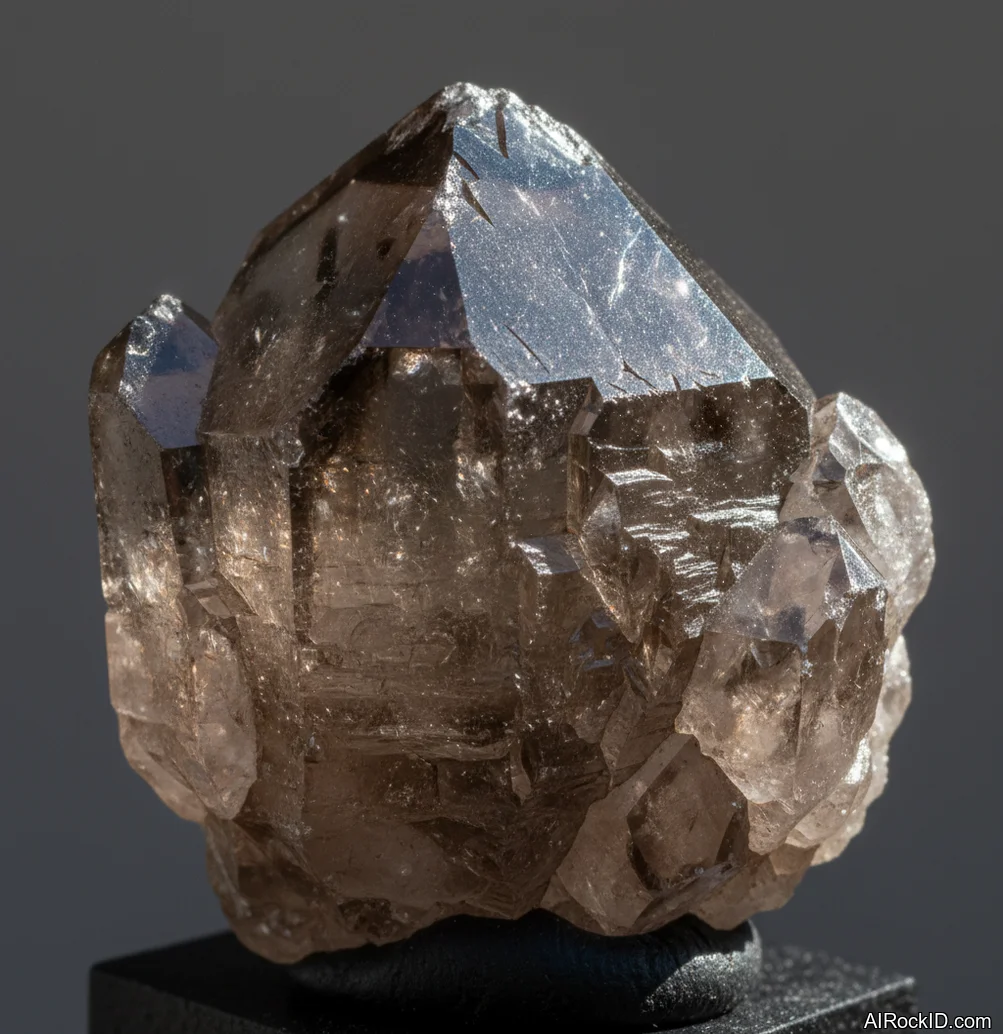
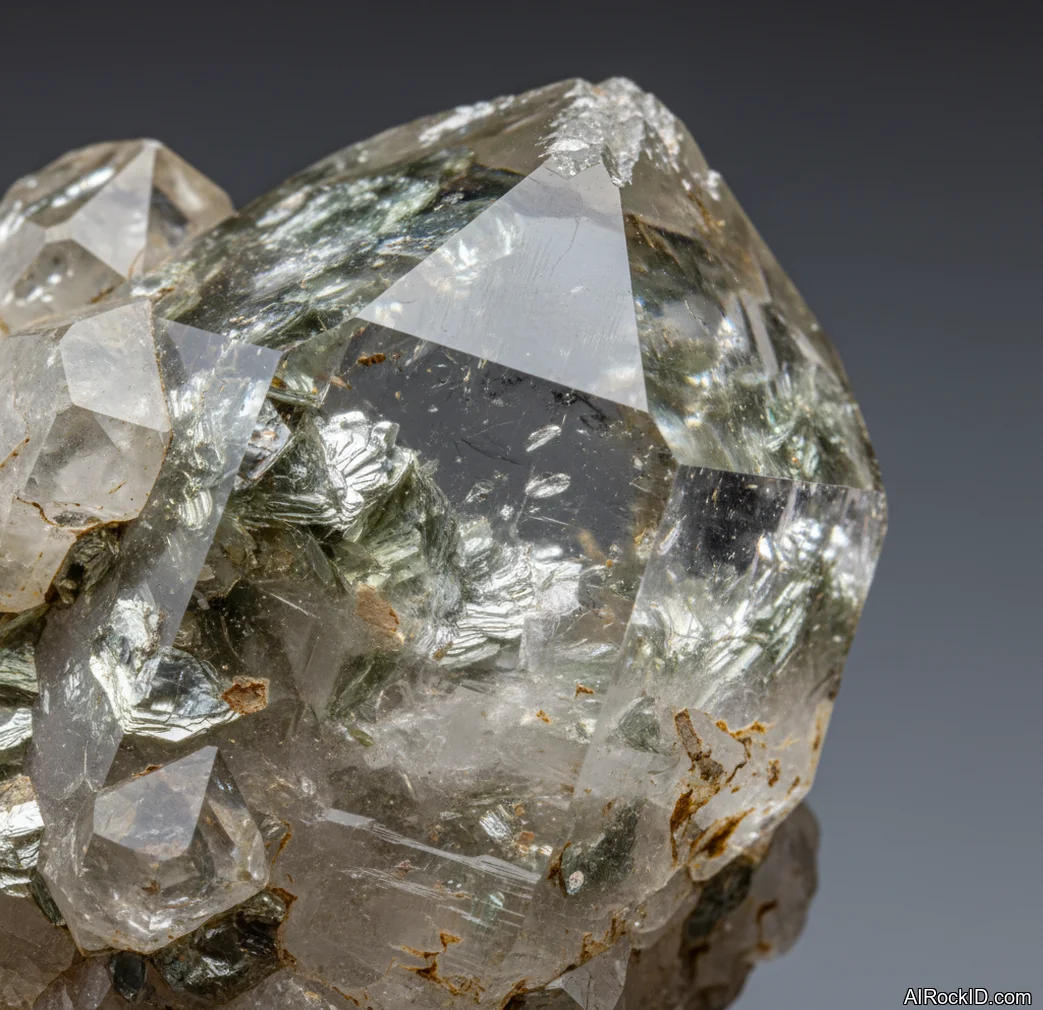
Mica In Quartz is just quartz (SiO2) with visible mica flakes or plates trapped inside the crystal. At a quick glance it can pass for “dirty quartz,” then you turn it in your fingers and, under a shop light, the mica kicks back these little confetti-like flashes. The quartz itself feels like quartz always does, cool and glassy, but those inclusions change the whole feel of the piece.
Pick one up and you’ll notice the surface texture difference fast if any mica is actually exposed. Quartz is slick. Mica is platy, and the edges can feel a bit papery, especially muscovite. I’ve handled pieces where a few mica books were sticking halfway out of the quartz, and you can literally catch a fingernail on the layers (it’s oddly satisfying).
Most of what you see for sale is tumbled quartz with tiny sparkly specks. The collector-grade stuff is different: bigger, clearer quartz with obvious mica plates you can spot from across a table. But don’t expect perfection. A lot of specimens have internal fractures around the mica because quartz and mica don’t expand or grow the same way.
Origin & History
Quartz has been talked about and used since antiquity, but “mica in quartz” is really just a trade and collector label, not one formally defined mineral species. Quartz itself, as a mineral species in modern mineralogy, was described in the 18th century, and the name “quartz” comes from the German word “Quarz,” a term miners used.
Mica, on the other hand, is a whole group. The word “mica” goes back to the Latin “micare,” meaning “to glitter,” and yeah, that checks out the second you tilt a piece under a lamp and the flakes flash back at you. And dealers will sometimes name the mica type if it’s obvious, like green fuchsite or dark biotite. But at plenty of show bins it’s just a hand-scribbled “mica in quartz,” and that’s that.
Where Is Mica In Quartz Found?
It turns up anywhere quartz grows alongside mica, especially in pegmatites and mica schists. Brazil produces a lot of the clean, sparkly retail pieces.
Formation
Raw pegmatite chunks are usually where you’ll see the nicest mica plates. Pegmatites are those coarse-grained granitic bodies where the crystals have enough elbow room to get chunky, so mica can grow in book-like stacks while quartz grows right around it. If the timing lines up, the quartz basically catches the mica partway through its growth and locks it in place.
Next to plain clear quartz, quartz with mica inside is a bit more geologically noisy. You’ll often spot growth zoning, healed fractures, and odd little internal planes that mark where the mica was sitting. And in metamorphic settings, quartz can recrystallize around mica from schist or gneiss, which usually means you get cloudier quartz with scattered glitter rather than that clean “museum window” clarity.
How to Identify Mica In Quartz
Color: Base quartz ranges from clear to milky. The mica shows as silvery, champagne-gold, black, or green flakes depending on whether it’s muscovite, phlogopite, biotite, or fuchsite.
Luster: Quartz is vitreous, while mica flashes pearly to slightly metallic on its cleavage faces.
Look closely and rotate it under a single bright light. Mica gives sharp, mirror-like flashes from flat plates, not the soft shimmer you get from fibrous inclusions. If you scratch it with a steel pin, the quartz won’t budge much, but an exposed mica edge can crumble or peel a bit. The real test is a loupe: mica plates have straight edges and sheet-like stacking, and the “sparkles” line up along flat planes.
Properties of Mica In Quartz
Physical Properties
| Crystal System | Trigonal |
| Hardness (Mohs) | 7 (Hard (6-7.5)) |
| Density | 2.60-2.65 g/cm3 |
| Luster | Vitreous |
| Diaphaneity | Transparent to translucent |
| Fracture | Conchoidal |
| Streak | white |
| Magnetism | Non-magnetic |
| Colors | colorless, white, smoky, gray, silvery, golden, black, green |
Chemical Properties
| Classification | Silicates |
| Formula | SiO2 |
| Elements | Si, O |
| Common Impurities | Al, Fe, K, Mg, Li, Mn, Ti |
Optical Properties
| Refractive Index | 1.544-1.553 |
| Birefringence | 0.009 |
| Pleochroism | None |
| Optical Character | Uniaxial |
Mica In Quartz Health & Safety
Yeah, it’s generally safe to handle, and it’s fine if it hits water for a short time. The real problem isn’t chemicals or anything, it’s physical: the thin mica edges are kind of delicate, so they can chip and shed tiny flakes (you’ll sometimes notice a faint, glittery dust if you rub it).
Safety Tips
If you’re going to cut or grind it, handle it the same way you would quartz. Keep a steady trickle of water on the blade or wheel (you’ll see the slurry build up fast), and wear a respirator so you’re not breathing in silica dust.
Mica In Quartz Value & Price
Price Range
Rough/Tumbled: $5 - $120 per piece
Cut/Polished: $2 - $20 per carat
Price jumps around depending on how clear the piece is and how loud the mica shows up. A big, glassy quartz chunk with those shiny mica plates you can catch with a tilt of your wrist will run higher than the little pepper-speckled tumbles.
Durability
Durable — Scratch resistance: Excellent, Toughness: Fair
Quartz holds up well day-to-day, but exposed mica can chip or flake if it gets knocked around.
How to Care for Mica In Quartz
Use & Storage
Store it where it won’t bang into harder stones, even though quartz is tough. If there’s exposed mica, I keep it wrapped so the plates don’t catch and peel.
Cleaning
1) Rinse with lukewarm water and a drop of mild soap. 2) Use a soft toothbrush around crevices, brushing gently in one direction if mica is exposed. 3) Rinse well and pat dry; don’t heat-dry it on a sunny windowsill.
Cleanse & Charge
Running water is fine for most pieces, and smoke cleansing won’t bother it. If the mica is flaky on the surface, skip salt and anything abrasive.
Placement
On a desk it looks best under a single lamp so the mica flashes when you move past it. For shelves, angle it slightly forward so you can see into the quartz instead of just the surface glare.
Caution
Skip ultrasonic cleaners and strong acids. They can creep into tiny cracks, undercut existing fractures, and even start loosening any mica that’s already exposed on the surface. And don’t just throw it loose in a bag with other specimens. Those thin, flaky mica edges get scuffed up fast and they’ll take the hits first (you’ll see little chips and frayed-looking corners before you know it).
Works Well With
Mica In Quartz Meaning & Healing Properties
Grab a piece of mica-included quartz and it’s like you’re holding two different feels at once. Quartz has that crisp, clean, almost glassy slickness, and then the mica catches the light in thin little plates that shimmer like someone dusted the inside with metallic confetti (you can even feel tiny ridges if the polish isn’t perfect).
In crystal circles, people use that combo as a really practical metaphor. Quartz gets treated as the clarity and amplification tool. Mica, on the other hand, gets linked to reflection, boundaries, and sorting through mental noise.
But look, there are limits. None of this is medical care, and no rock fixes a hard problem by itself. What it *can* do is give you something physical to hold onto when you’re trying to stay focused or calm. I’ve kept a mica-in-quartz point on my bench during sorting sessions at shows, and those little “sparkle interrupts” are weirdly useful when your eyes are fried from staring at tiny labels for hours. (You know that dry, blurry feeling? Yeah.)
Compared to something like rutile in quartz, mica in quartz comes off softer in the usual “energy” language, more paper-thin, because mica literally splits into sheets. People who journal or meditate tend to use it as a cue to slow down and watch thoughts go by instead of wrestling them. And if you’re into ritual at all, just rotating it under a lamp and watching the plates flash gives you a built-in pause. A tiny moment of attention, on purpose. Why not.
Identify Any Crystal Instantly
Snap a photo and get properties, value, care instructions, and healing meanings in seconds.