Mystic Merlinite
What Is Mystic Merlinite?
Mystic Merlinite is just a trade name for indigo gabbro, a dark, coarse-grained igneous rock made mostly of plagioclase feldspar with darker mafic minerals.
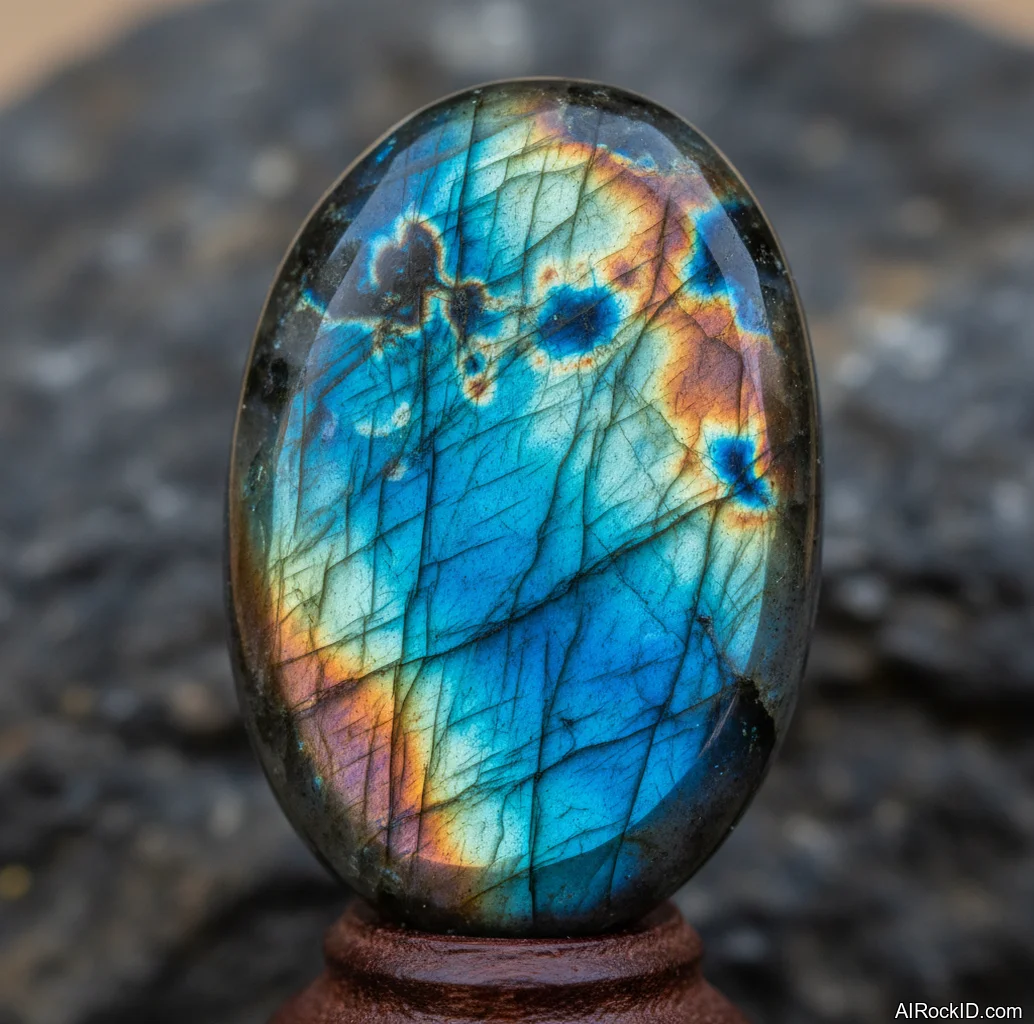
Grab a polished palm stone and you feel it instantly. It’s dense, cool, and kind of “quiet” in your hand, like basalt that decided to clean up and put on a nice shirt. Most pieces sit in that black-to-charcoal range, with cloudy gray or off-white patches that look like little islands scattered across the surface. And once in a while, under warm indoor bulbs, the lighter areas pick up a faint indigo tint, but don’t go hunting for neon blue because it’s not that.
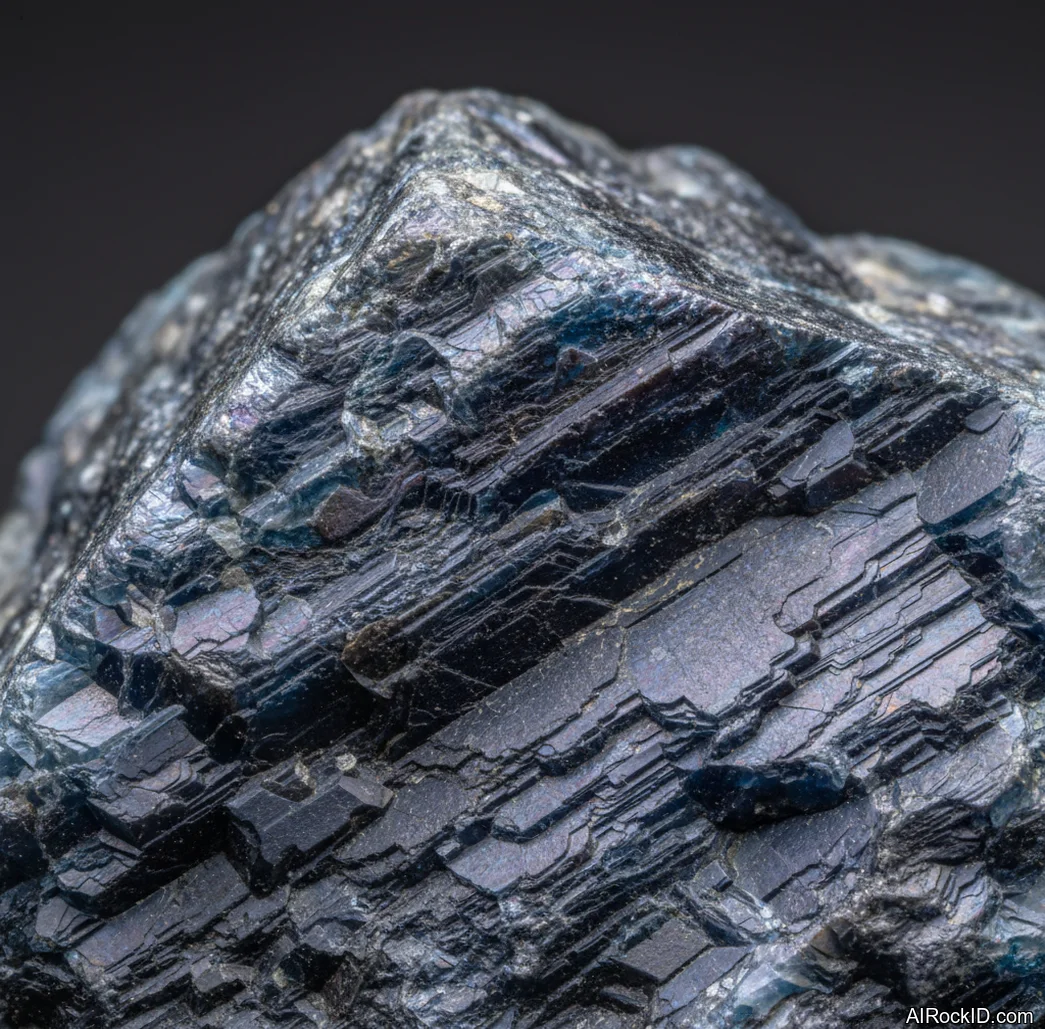
People glance at it and assume it’s one mineral. But it isn’t. It’s a mix, and that’s the whole point. You can spot chunky feldspar sitting right next to the darker pyroxene or amphibole, and the look changes stone to stone because you’re staring at a frozen rock texture. Most of what you’ll come across is tumbled or carved. Raw material is out there, sure, but it’s not the flashy “crystal” kind of rough. It’s blocky, granular rock (the kind that just looks better once somebody cuts and polishes it).
Origin & History
“Mystic Merlinite” is just marketing, plain and simple. It really took off in the 2010s, right when material from Madagascar started showing up at gem shows in real volume, tray after tray under those harsh fluorescent lights.
Thing is, the name piggybacks on the older “Merlinite” nickname people were already using for a black-and-white, opal-like material from the US. So you get the predictable mess at booths: labels don’t match, buyers think they’re holding the same stone, and sellers end up doing the whole back-and-forth explanation (sometimes with a finger tapping the tag).
Geologically, gabbro has been a known rock type since the 1700s. It’s named after Gabbro, a town in Tuscany, Italy, where the rock was described. “Indigo gabbro” is the more straight-up label for the Madagascar material. And if someone’s telling you it’s a rare ancient crystal from secret caves, come on, that’s sales talk, not a real origin story.
Where Is Mystic Merlinite Found?
Most Mystic Merlinite on the market is indigo gabbro from Madagascar; gabbro as a rock type occurs worldwide, including Italy and the USA.
Formation
Gabbro forms when mafic magma cools slowly underground, so the minerals get the time they need to grow big enough that you can pick them out with your bare eyes, no hand lens required. That’s why it looks speckly and chunky in your palm, not smooth or glassy. It’s basically basalt’s intrusive, coarse-grained cousin.
The “indigo” vibe really comes from what’s in the mix and how big the grains are: pale plagioclase feldspar right up against darker pyroxene or amphibole, and sometimes you’ll spot a little biotite or other iron-rich flecks that push the color deeper. Look, if you tilt a polished face under a desk lamp, those grain boundaries pop and you can almost trace where one mineral stopped and the next one finished growing. So you’re not hunting some single crystal habit here. You’re looking at a cut-and-polished slice of a cooled magma body (pretty much frozen in place).
How to Identify Mystic Merlinite
Color: Typically black to charcoal with cloudy gray to off-white feldspar patches; some pieces show a subtle bluish or indigo cast depending on lighting. Patterns are mottled, not banded.
Luster: Polished pieces show a glassy to slightly waxy surface luster; raw surfaces look dull and granular.
Look closely for a salt-and-pepper, coarse-grained texture rather than a uniform color. The real test is with a loupe: you should see interlocking mineral grains, not dye pooling in cracks. And if you scratch it with a steel nail, it usually won’t gouge easily, but the lighter feldspar areas can take a faint mark if you really lean in.
Properties of Mystic Merlinite
Physical Properties
| Crystal System | Amorphous |
| Hardness (Mohs) | 6.0-6.5 (Hard (6-7.5)) |
| Density | 2.9-3.1 g/cm3 |
| Luster | Vitreous |
| Diaphaneity | Opaque |
| Fracture | Uneven |
| Streak | white to gray |
| Magnetism | Non-magnetic |
| Colors | black, charcoal, gray, off-white, indigo (subtle) |
Chemical Properties
| Classification | Igneous rock (silicate minerals) |
| Formula | No single formula (mixture; typically plagioclase feldspar + pyroxene/amphibole) |
| Elements | Si, O, Al, Ca, Na, Fe, Mg |
| Common Impurities | Ti, K, Mn |
Optical Properties
| Refractive Index | None (rock aggregate; varies by mineral components) |
| Birefringence | None |
| Pleochroism | None |
| Optical Character | Isotropic |
Mystic Merlinite Health & Safety
Normal handling is pretty low risk. But if you’re cutting or grinding it, use basic precautions, because that fine stone dust (the stuff that hangs in the air and coats your fingertips) can irritate your lungs if you breathe it in.
Safety Tips
Wear a respirator, and keep things wet if you’re going to saw, sand, or polish it. Dry dust gets everywhere (you’ll see it on your hands and the edge of the cut), and that’s the stuff you don’t want to breathe in.
Mystic Merlinite Value & Price
Price Range
Rough/Tumbled: $8 - $60 per piece
Prices bounce around depending on the polish, the contrast, and the size. And yeah, most dealers will charge extra for that crisp black-and-white patterning, especially on bigger palm stones that feel glassy-smooth in your hand and don’t have pits or that annoying undercut feldspar that leaves little divots.
Durability
Durable — Scratch resistance: Good, Toughness: Good
It’s generally stable for normal wear, but the mixed-grain texture can chip on sharp corners if it takes a drop onto tile.
How to Care for Mystic Merlinite
Use & Storage
Store it so it doesn’t bang into softer stones that can scratch, and so it doesn’t take corner hits that can chip. I keep mine in a tray with little dividers because gabbro edges love finding concrete floors.
Cleaning
1) Rinse with lukewarm water and a drop of mild soap. 2) Use a soft toothbrush to get into pits or seams. 3) Rinse again and dry with a microfiber cloth.
Cleanse & Charge
If you do energetic cleansing, simple stuff works: a quick rinse, smoke, or a night on a shelf away from sunlight. Avoid salt water if there are surface pits that might trap residue.
Placement
It looks best under angled light, like on a desk lamp, because the feldspar patches pop when the surface is glossy. Keep it away from spots where it can get knocked off, because even tough rocks chip when gravity wins.
Caution
Don’t reach for harsh acids or bleach. They’ll slowly knock the shine down, and they don’t behave well around mixed silicates anyway. And if you’re shopping online, keep an eye out for those heavy-handed filters, the kind that make plain gray gabbro look like some fake “indigo” stone.
Works Well With
Mystic Merlinite Meaning & Healing Properties
A lot of dealers talk about Mystic Merlinite like it’s one single magical mineral. But in my experience, it acts more like a steady “grounding plus insight” stone in someone’s stash, probably because it’s literally a blend of light and dark minerals, and it looks that way the second you see it. Put it next to the flashy stuff and it doesn’t shout. It just sits there.
Grab a palm stone on a long, noisy day at a show and you’ll understand why people reach for it during meditation. It’s cool when it hits your skin, it’s got that satisfying little heft, and the pattern gives your eyes somewhere to land without getting pulled into a bunch of sparkle. I’ve watched customers, without even noticing, rub those pale feldspar spots like a worry stone while they’re talking. Then they wander off calmer. Is that medicine? No. That’s a tactile object doing tactile-object things.
Thing is, there’s some friction here: “Mystic Merlinite” is a trade name, so sellers hang all kinds of claims on it and it turns into a catch-all term. So if you want something grounded, treat it like a focus tool. Use it for journaling, quiet time, as a reminder to slow down (especially when you’re spinning out), and keep your expectations realistic. And if you’ve got anxiety or sleep issues, that’s a health conversation, not a rock conversation.
Identify Any Crystal Instantly
Snap a photo and get properties, value, care instructions, and healing meanings in seconds.