Nephrite Jade
What Is Nephrite Jade?
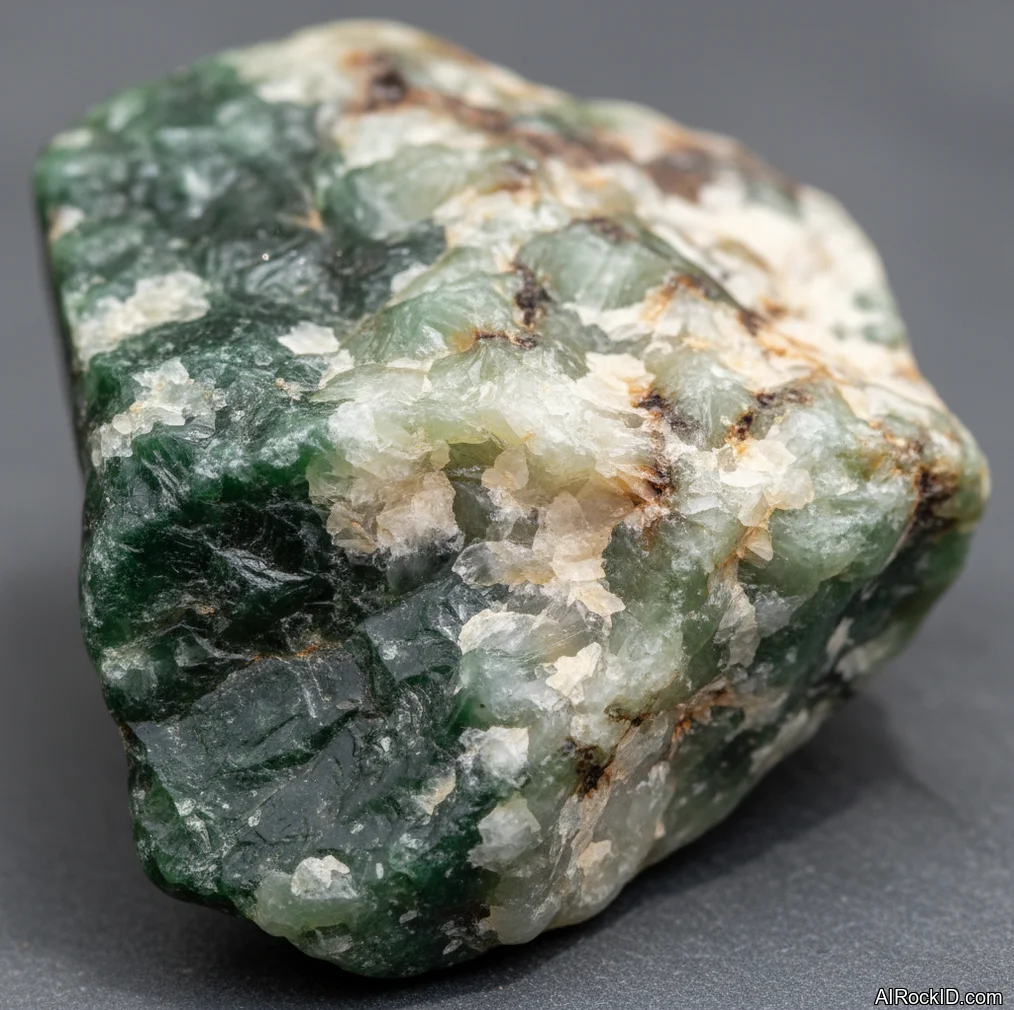
Nephrite jade is basically a tight, felted mass of amphibole, specifically tremolite to actinolite, and people prize it because it’s absurdly tough as an ornamental stone. It doesn’t show up as those flashy crystals you can line up on a shelf like quartz. It’s a dense, interlocked mesh of tiny fibers, and that “all woven together” texture is the whole reason it survives carving, knocks, and daily-wear jewelry without falling apart.
Grab a decent chunk and you feel the “body” immediately. It’s heavier than you expect for something that looks that smooth, and it stays cool in your palm longer than glass or plastic ever does (almost like it’s holding onto the cold). Most of what you see at shows has been tumbled, or it’s been cut into bangles, cabochons, little polished slabs you can rub your thumb across, and it gives off that soft, waxy glow instead of a hard mirror shine.
People look at it and just call it “jade,” but jade’s actually a two-mineral club: nephrite and jadeite. Nephrite’s the tougher, more fibrous one, usually a bit more muted in color, and it often has that classic mottling or cloudy zoning that gives you this weird sense of depth under the surface. Kind of like you could fall into it if you stared too long.
Origin & History
“Nephrite” comes from an old belief that the stone had something to do with kidneys, tied back to the Greek root “nephros.” That’s why people call it the “stone of the kidney,” and yeah, you’ll still see sellers using that angle. The word “jade” comes through Spanish, linked to the phrase meaning “stone of the side,” which is basically the same body-part idea showing up again.
In scientific terms, nephrite got split from jadeite once mineralogy finally caught up with the old trade names. Nephrite is an amphibole. Jadeite is a pyroxene. Same umbrella name in jewelry stores, but in the lab they’re in totally different mineral groups. And out in the field, it actually matters: nephrite tends to form in big, tough masses, while jadeite turns up in other geologic settings and can hit those electric greens that nephrite usually doesn’t.
Where Is Nephrite Jade Found?
Nephrite turns up in metamorphic belts worldwide, especially where ultramafic rocks and serpentinite are involved. Big carving-grade masses are strongly associated with China, New Zealand, Canada, Russia, and parts of the western United States.
Formation
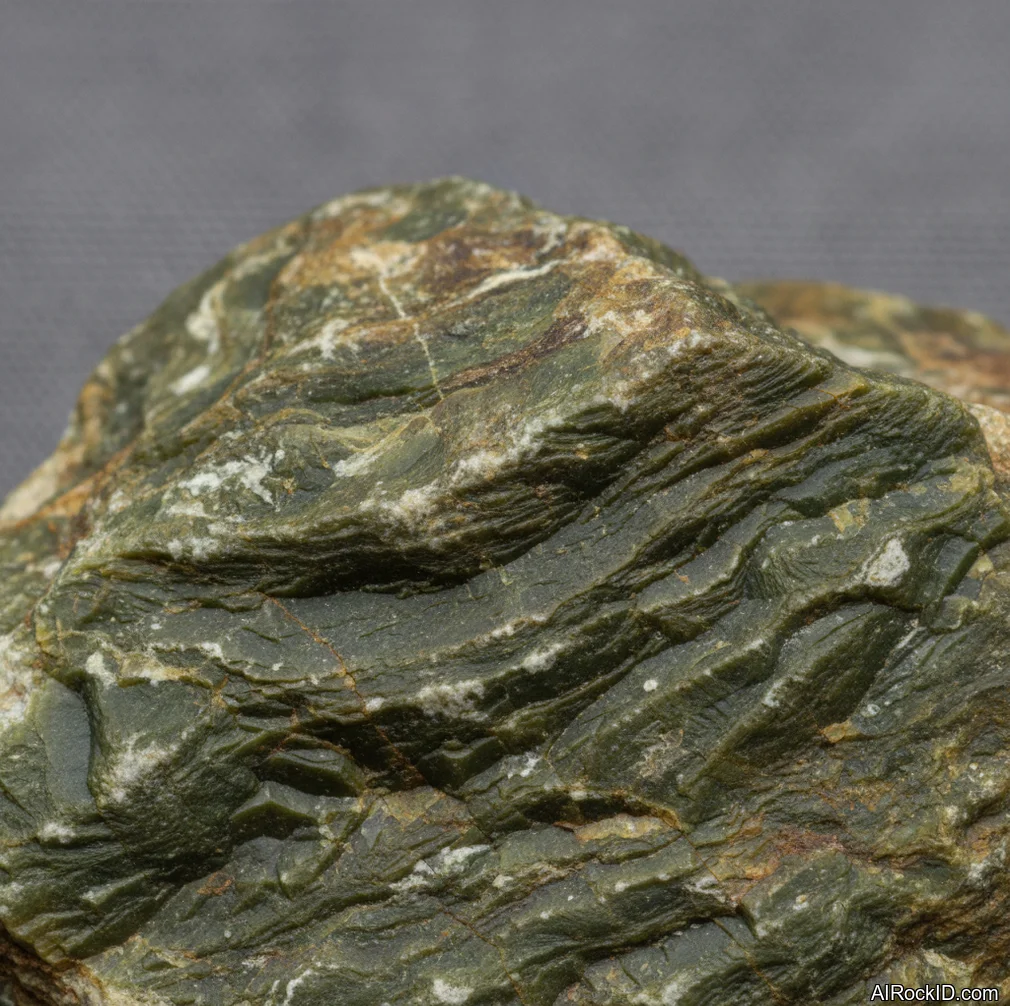
Most nephrite shows up in metamorphic settings, where calcium-magnesium silicates get rearranged under pressure and with fluids moving through. You’ll usually find it hanging around serpentinite bodies and shear zones, basically spots where the rock got squeezed, warmed up, and soaked in the right chemistry so amphibole fibers could grow and knit themselves together.
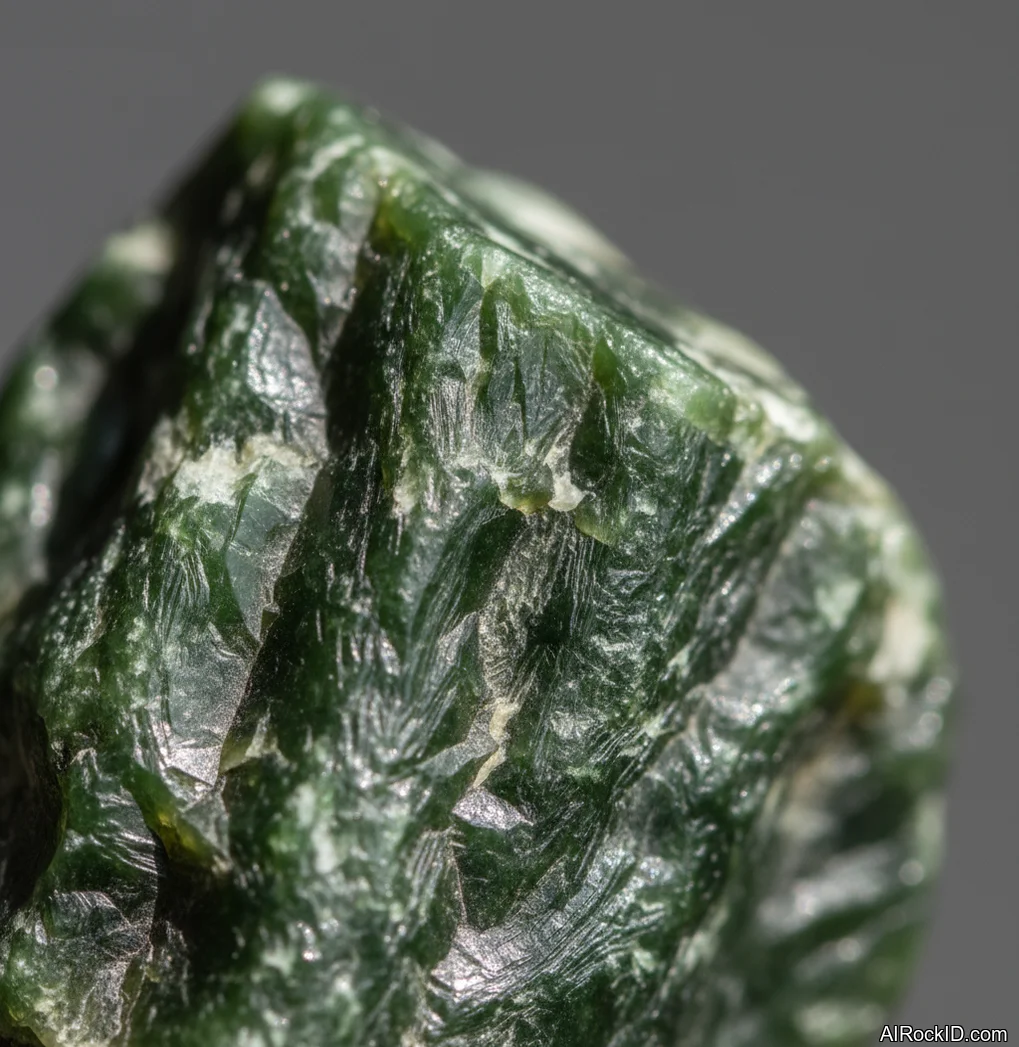
Break a piece and stare at the fresh surface for a second. You can sometimes catch why it’s so tough. Instead of splitting along one neat cleavage plane, it’s this tangled, almost felt-like mass of microscopic fibers. That locked-in texture makes it resist cracking, even compared to plenty of other stones that might be harder on paper but still snap a lot easier.
How to Identify Nephrite Jade
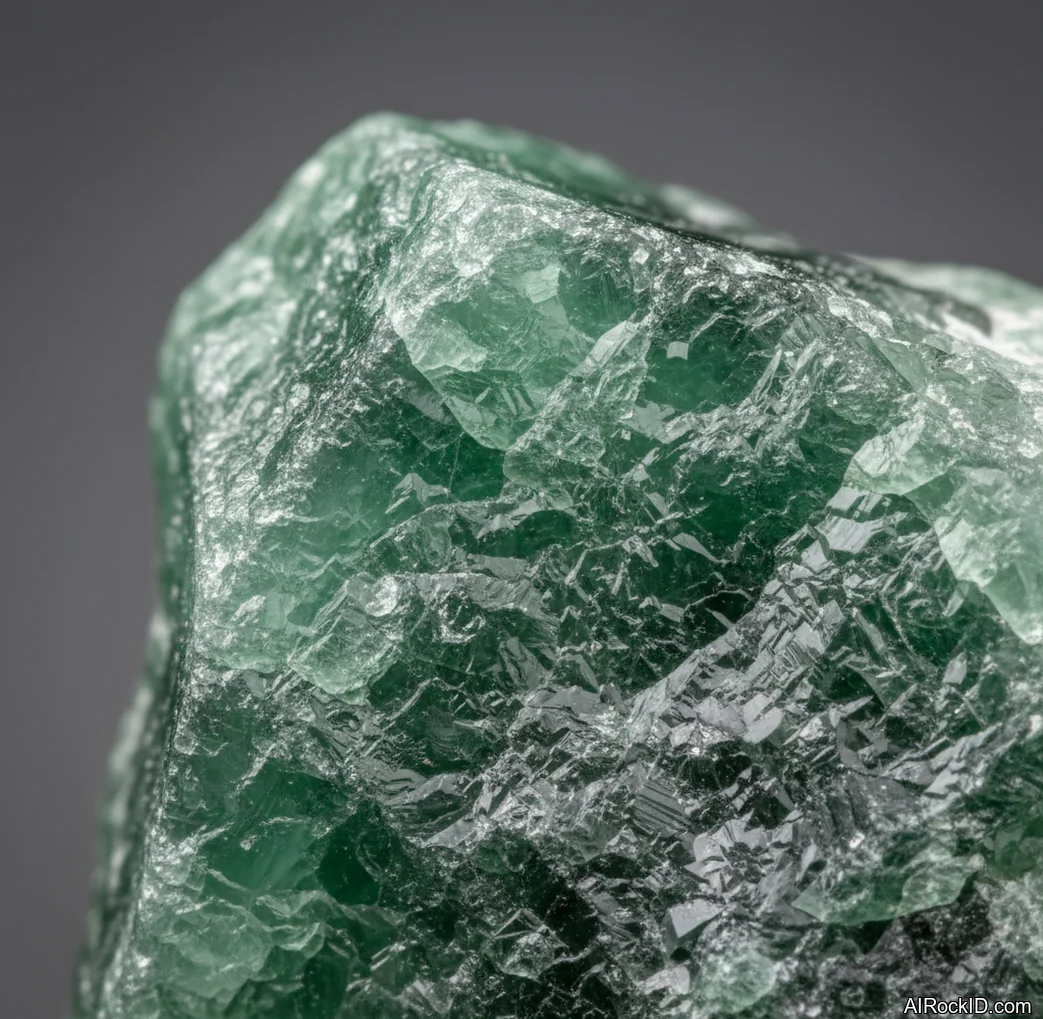
Color: Color runs creamy white through gray-green to deep spinach green, often mottled or cloudy rather than perfectly even. Darker greens usually come from more iron (actinolite-leaning material).
Luster: Waxy to greasy in polished pieces, rarely truly glassy.
Pick up a bangle or palm stone and feel the temperature. Real nephrite tends to feel cool and dense, and it doesn’t warm up as fast as resin or glass fakes. If you scratch it with a steel knife, you usually won’t get an easy gouge, but you might see a faint metal streak that rubs off. The real test is toughness: tap it gently and it has a solid, “dead” sound compared to glassy imitations, and chipped edges often look splintery-fibrous instead of clean and sharp.
Properties of Nephrite Jade
Physical Properties
| Crystal System | Monoclinic |
| Hardness (Mohs) | 6.0-6.5 (Hard (6-7.5)) |
| Density | 2.90-3.10 g/cm3 |
| Luster | Waxy |
| Diaphaneity | Translucent to opaque |
| Fracture | Splintery |
| Streak | White |
| Magnetism | Non-magnetic |
| Colors | White, Cream, Gray, Gray-green, Apple green, Spinach green, Dark green, Brown |
Chemical Properties
| Classification | Silicates |
| Formula | Ca2(Mg,Fe)5Si8O22(OH)2 |
| Elements | Ca, Mg, Fe, Si, O, H |
| Common Impurities | Fe, Cr, Ni, Mn |
Optical Properties
| Refractive Index | 1.60-1.62 |
| Birefringence | 0.027 |
| Pleochroism | Weak |
| Optical Character | Biaxial |
Nephrite Jade Health & Safety
Nephrite’s fine to handle, and it’s fine in water for everyday use too. The only real worry is the dust if you’re cutting or grinding it, because that’s the part that can get into the air (and your lungs).
Safety Tips
If you’re going to cut it with tools, do it wet so the dust stays down, and put on a real respirator, not just a paper mask, because that fine mineral dust gets in the air fast and you don’t want it in your lungs.
Nephrite Jade Value & Price
Price Range
Rough/Tumbled: $5 - $80 per tumbled stone or small palm stone; $50 - $500+ per bangle or carving (quality dependent)
Cut/Polished: $2 - $30 per carat (typical cabochon material); $50+ per carat (fine, translucent, even color)
Price mostly follows translucency, how even the color is, and how tidy the polish looks when you tilt it under a harsh light (the kind that shows every tiny swirl). And provenance can bump things up too, especially with pounamu and the classic Chinese carving-grade material.
Durability
Very Durable — Scratch resistance: Good, Toughness: Excellent
Nephrite is very stable for everyday wear, but high polish can dull if it’s constantly rubbed against harder grit like quartz sand.
How to Care for Nephrite Jade
Use & Storage
Store nephrite so it won’t bang against harder stones like quartz or topaz, since those can scuff the polish. A soft pouch or a divided box works fine.
Cleaning
1) Rinse with lukewarm water. 2) Use a drop of mild soap and a soft brush or cloth to lift skin oils from carvings and crevices. 3) Rinse again and dry fully with a clean cloth.
Cleanse & Charge
If you do energetic cleansing, running water, smoke, or a night on a clean piece of selenite are all gentle options. Skip salt if the piece has fractures or a glued setting.
Placement
On a desk it feels great as a worry stone, and in a pocket it holds up well. Keep it out of direct sun if you’re worried about dyed material fading over time.
Caution
Skip harsh acids, bleach, and ultrasonic cleaners, especially if the jewelry’s been treated or has tiny fractures you can sometimes spot when the light hits it just right. And keep an eye out for dyed or polymer-impregnated pieces, because heat and solvents can mess with them fast.
Works Well With
Nephrite Jade Meaning & Healing Properties
Most dealers love to talk about “jade energy.” But in real life, nephrite just has its own thing. It’s steady. When I’m holding a cool nephrite palm stone, it doesn’t feel buzzy like some high-sparkle pieces. It feels grounding in a plain, physical way, like your fingers loosen up because the surface is slick as glass and the weight sits heavy and reassuring in your palm.
People link nephrite with calm, balance, and protection. And yeah, I get it. It’s a stone that actually holds up to being used. Old bangles and carvings end up with that soft, rubbed shine from skin oils and years of handling, and that long, lived-with feel is a big part of the whole vibe. Thing is, it’s still not medicine. If you’ve got anxiety, sleep problems, or anything medical going on, treat nephrite like a comfort object you keep close, not a replacement for real care.
The headache with shopping for “healing jade” is the market’s kind of a mess. Some pieces are dyed. Some are composite. And a lot of listings won’t even say if you’re looking at nephrite or jadeite (so what are you even buying?). If you want that traditional, tactile experience people talk about, buy from someone who’ll tell you what it is, then actually use it. Carry it around for a week. Touch it when you’re stressed. That’s usually where the meaning shows up for people.
Identify Any Crystal Instantly
Snap a photo and get properties, value, care instructions, and healing meanings in seconds.