Peanut Wood


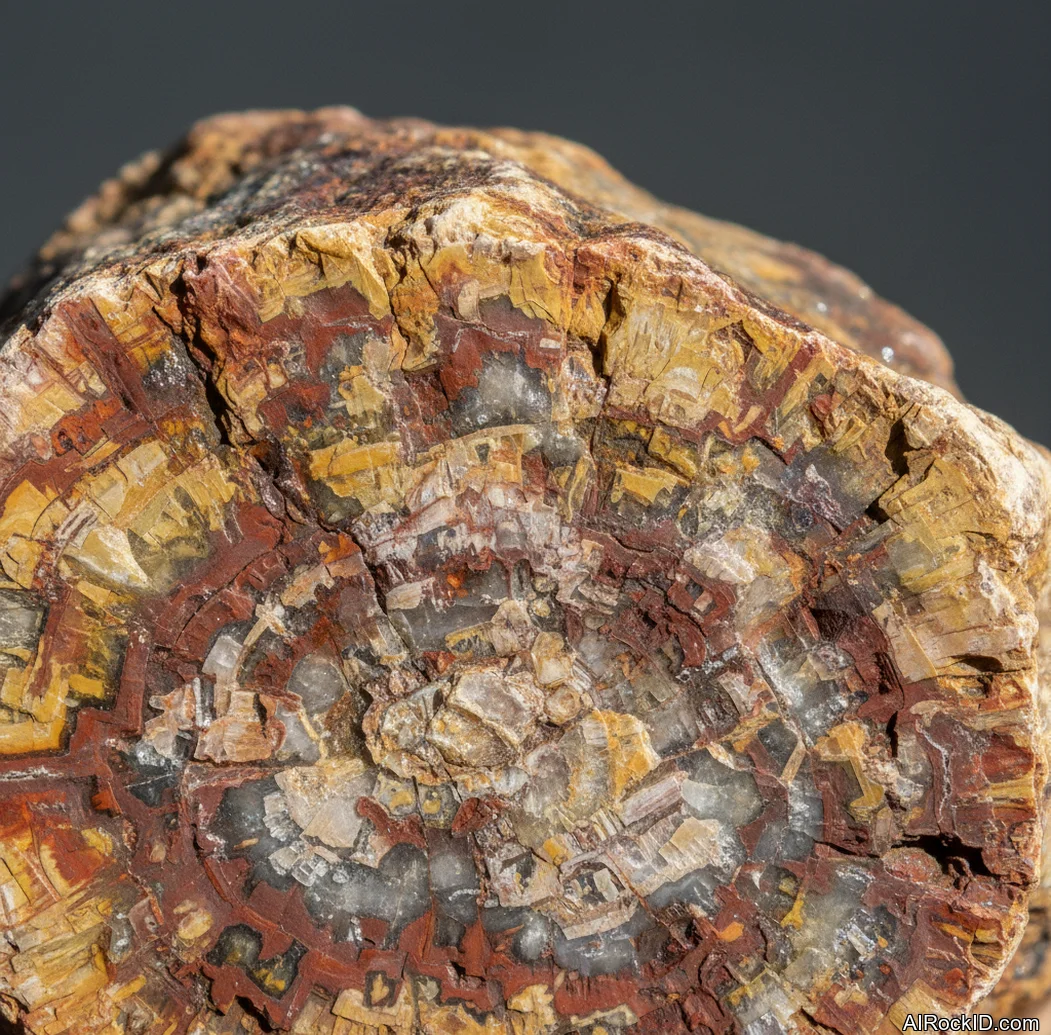
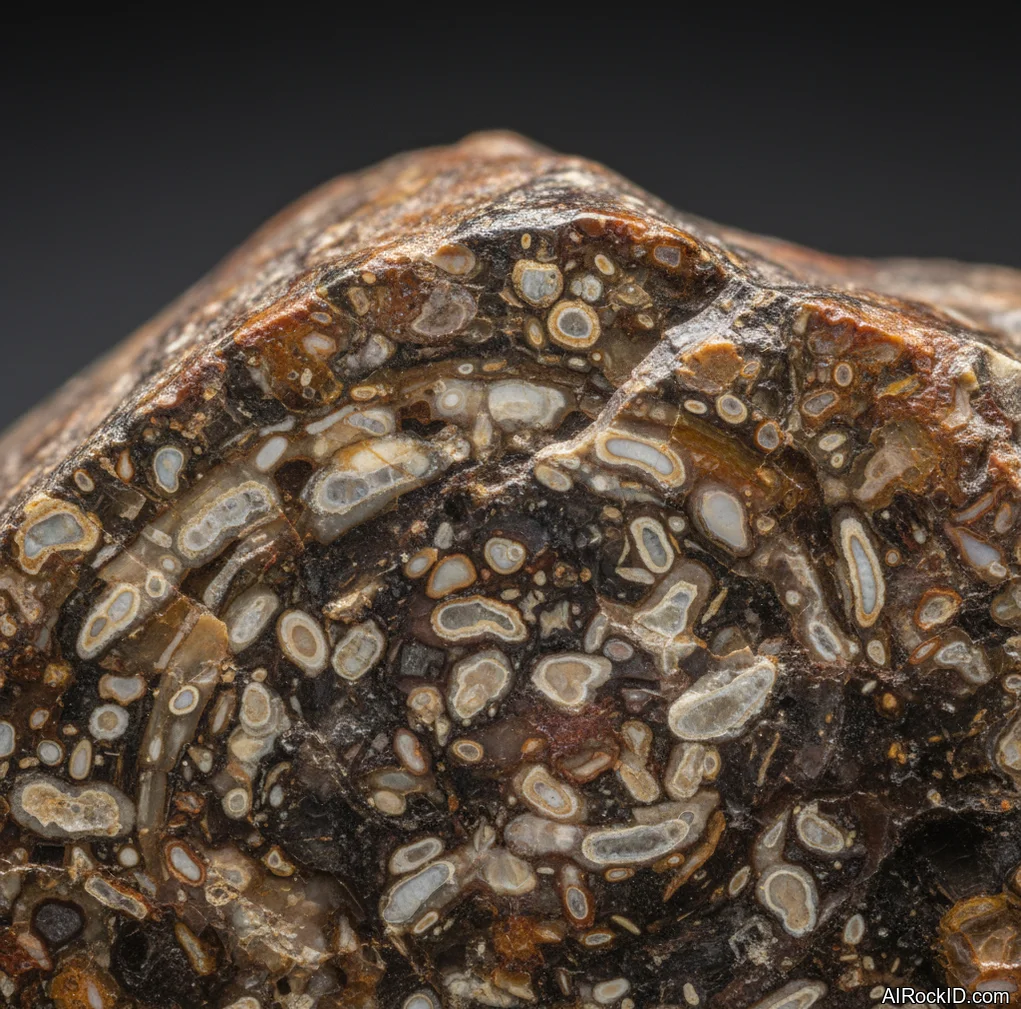
Quick answer: Peanut Wood is a form of silicified fossil wood recognized by its cream-to-tan oval or worm-like markings in a darker brown to black matrix. The pattern comes from ancient marine bivalve borings that were later filled and preserved during silicification.
AI Rock ID can help flag Peanut Wood by matching its fossil-wood texture, brown matrix, and peanut-shaped infill patterns against visual references. RockIdentifier.io provides identification support, but results should be checked against hardness, fracture, and pattern continuity for higher confidence.
Good fit
- Collectors who want a fossil material with a distinctive natural pattern
- Lapidary users looking for cabochons, slabs, or display pieces with strong contrast
- Beginners comparing fossil wood varieties from Western Australia
- Buyers who prefer durable silica-rich material suitable for polished specimens
Not a good fit
- Anyone seeking a transparent or faceted gemstone
- Collectors who want unaltered wood grain without marine-boring patterns
- Buyers who need a lightweight material, since silicified wood can feel dense
- Anyone expecting every piece to show clear oval “peanut” markings
Most commonly confused with
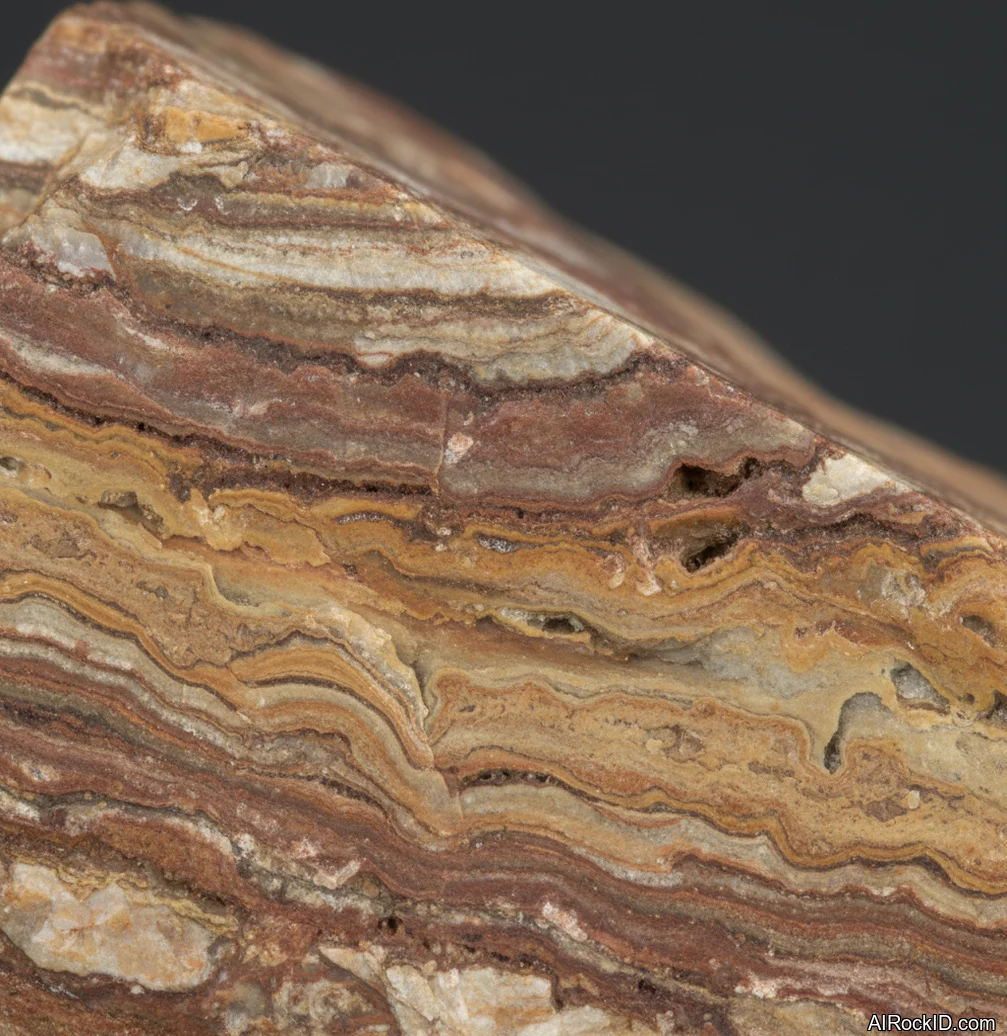
- Petrified Wood: Peanut Wood is a specific type of silicified wood with oval infill marks, while ordinary petrified wood may show grain, rings, or bark textures without the peanut-like pattern.
- Palm Wood: Palm Wood usually shows dotted or rod-like vascular bundles rather than irregular oval bivalve-boring fills.
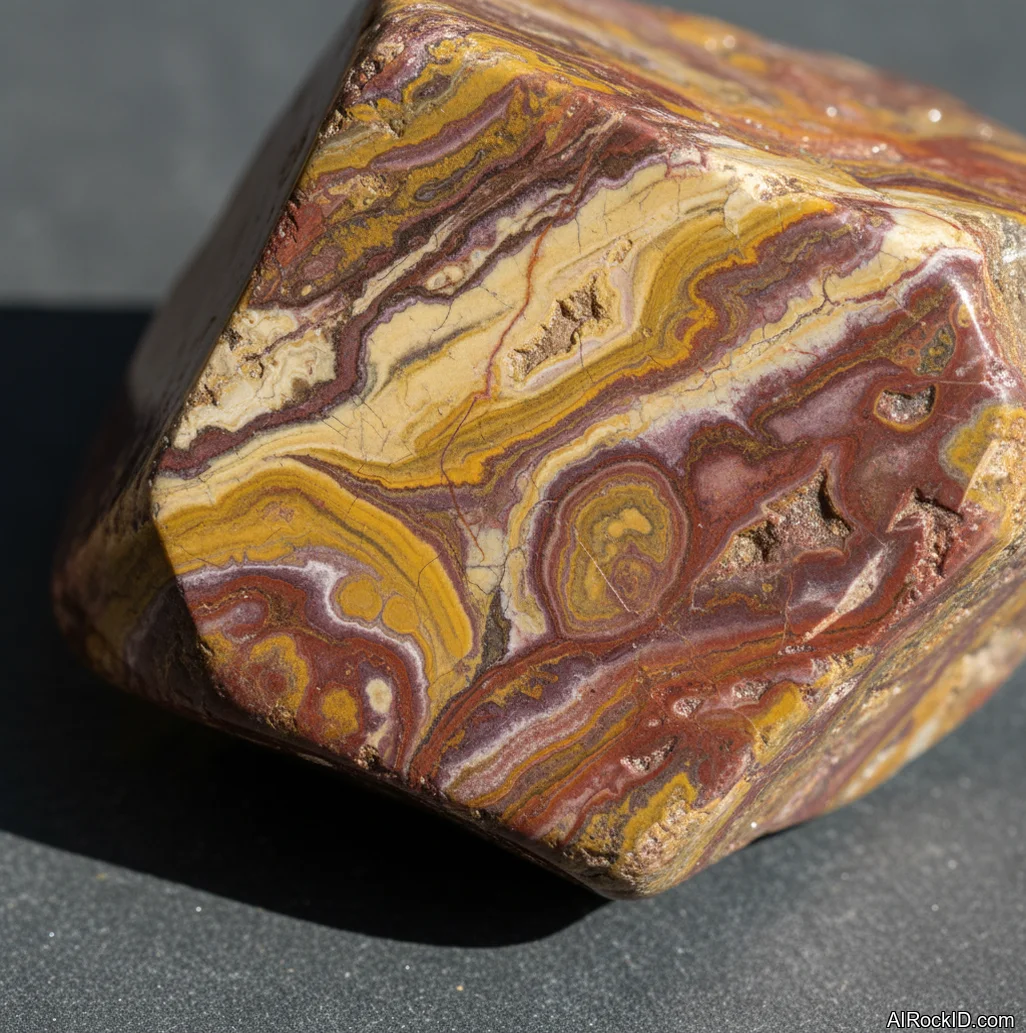
- Jasper: Jasper can share brown, cream, or red colors, but it lacks preserved wood structure and fossil-boring patterns.
- Agatized Wood: Agatized Wood may show translucent chalcedony and wood grain, while Peanut Wood is identified by its darker matrix with pale oval infill features.
Peanut Wood vs. Common Lookalikes
| Material | Key Visual Clue | Best Distinguishing Check |
|---|---|---|
| Peanut Wood | Cream or tan oval marks in dark silicified wood | Look for repeated irregular “peanut” infill patterns and fossil-wood texture |
| Petrified Wood | Wood grain, rings, or bark-like structure | May lack oval marine-boring fills |
| Palm Wood | Small dot or rod patterns from palm vascular bundles | Dots are typically more uniform than Peanut Wood markings |
| Jasper | Opaque patterned silica with earthy colors | No preserved wood anatomy or fossil-boring structure |
| Agatized Wood | Wood replaced by chalcedony, sometimes translucent | Often shows banding or grain rather than dark matrix with pale ovals |
AI identification confidence
AI photo identification is usually more reliable when the specimen is polished, well lit, and shows multiple oval markings across the surface. Confidence is lower for small chips, highly weathered pieces, or photos where the pattern could also resemble jasper, palm wood, or general petrified wood.
When AI gets it wrong
- The image shows only a small area without enough pattern repetition
- Strong glare on a polished cabochon hides the fossil texture
- The specimen is a mixed lapidary slab with both Peanut Wood and other silicified material
- Color has been enhanced in the photo, making natural contrast difficult to judge
Final recommendation
Choose Peanut Wood when the specimen clearly shows pale oval or worm-like infill features within a darker silicified wood matrix. For higher confidence, compare the pattern with known Western Australian examples and confirm that the material has quartz-like hardness rather than a soft or resin-like feel.
How to Identify Authentic Peanut Wood
Authentic Peanut Wood should show natural variation in the pale oval marks rather than perfectly repeated printed shapes. The markings should continue into the stone surface or slab structure, not sit only on top like paint or coating. A quartz-like hardness and a waxy to vitreous polish are consistent with silicified fossil wood.
Buying Peanut Wood Specimens
When buying Peanut Wood, look for clear photographs of both the polished face and any rough edges. Stronger pattern contrast and well-distributed oval markings are usually more desirable for display or cabochon cutting. Locality information, especially Western Australia, can support identification but does not replace visual and physical checks.
Natural Pattern Variation
Peanut Wood patterns can appear as rounded ovals, elongated tunnels, or irregular cream-colored patches depending on how the fossil wood was cut. Cross sections and lengthwise cuts may show different pattern shapes from the same piece. Some specimens may be mostly dark or mostly pale, so the classic peanut-like look is not equally visible in every sample.
What Is Peanut Wood?
Peanut Wood is a type of petrified wood where the silicified grain shows repeating oval, peanut-like shapes when you look at it in cross section.
Grab a palm stone and you feel it right away. It has that quartz feel. Cool against your skin, a touch heavier than you’d guess from something that looks like plain tan wood, and the shiny spots pick up a glassy polish fast, especially along the little raised ridges. And the pattern is the whole reason people love it: small ovals, sometimes ringed with a darker brown line, sometimes crammed in so tight they look like a honeycomb that got tugged sideways.
People glance at it and go, “jasper.” Fair. In a tumbler it acts a lot like jasper, too. But it’s actually fossil wood that’s been replaced by silica, so if you slow down and really look, you can catch the wood clues: faint grain lines, uneven banding, and those tiny pits where the softer parts didn’t take the polish the same (annoying, but kind of the charm).
Origin & History
Most dealers call it “Peanut Wood” as a trade name, not an actual species name, and it comes straight from that peanut-shaped pattern you notice once the wood’s been cut, sanded, and brought up to a polish. And you’ll hear “Peanut Wood Jasper” too, mostly because the market loves tossing the word jasper onto any opaque chalcedony.
Petrified wood, as fossil material, has been collected and written about forever. But “Peanut Wood” as a specific named look is pretty modern, the kind of tag that pops up at shows once there’s enough rough floating around the lapidary crowd. I first started seeing it regularly from Australian sellers, usually as slabs or worry stones, with that repeating oval texture you can feel under your thumb when you rub the surface.
Where Is Peanut Wood Found?
Most Peanut Wood on the market is sold as Australian petrified wood, especially from Western Australia where silicified wood deposits are widespread in arid country.
Formation
Look at those “peanuts” up close and you’re basically staring at the plant’s original structure, just preserved by replacement. The wood gets buried, groundwater shows up carrying dissolved silica, and over a long stretch of time the organic stuff gets traded out for microcrystalline quartz. Slow. Steady. And, yeah, it depends a lot on whatever the local chemistry is doing.
Thing is, the giveaway is how it polishes. If the silicification went all the way through, it finishes like good chalcedony, that waxy-glassy shine you can see when you tilt it under a light. But some pieces have tiny porous patches or softer seams (you can sometimes feel them grab a bit on the wheel), and those spots undercut when you cut a cab or they come out kind of dull after tumbling. That’s not you screwing it up. That’s the rock telling you the replacement’s mixed.
How to Identify Peanut Wood
Color: Usually tan, cream, caramel, and medium brown, with oval or peanut-shaped spots that can be lighter or darker than the background. Some pieces lean gray-beige, and a few have rusty iron staining.
Luster: Polished surfaces show a waxy to vitreous luster, like jasper or chalcedony.
If you scratch it with a steel nail, it shouldn’t bite. Try it on a hidden edge first. And if you touch it to your cheek, it stays cool like quartz, not warm like resin. Look for the oval pattern continuing through the piece, not just printed on the surface. Cheap versions are sometimes dyed or stabilized; the giveaway is color that looks too even and sits in cracks or pores.
Common Look-Alikes
Peanut Wood is sometimes confused with these materials:
- Leopard skin jasper (rhyolite) tumbled stones with orbicular spots
- Dalmatian stone (aplite) with black speckling, sometimes sold as “fossil wood” by mistake
- Palm wood petrified wood (especially the “coconut/palm root” type) with tighter dot-and-ring patterns
- Orbicular jasper (ocean jasper style) with cream and tan orbs that mimic the peanut ovals in photos
- Dyed petrified wood or dyed jasper with darkened “grain lines” to fake stronger peanut contrast
- Resin or glass “fossil wood” cabochons with printed or too-perfect repeating ovals
Market Cautions & Treatments
When AI Can Get This Wrong
Phone apps mix Peanut Wood up with leopard skin jasper and orbicular jasper all the time because they’re all tan with spots, and the oval cross sections read as “orbs” in flat photos. Pick up a piece and do the boring tests: it should feel quartz-cool, take a crisp glassy polish, and it’ll scratch a steel blade without much drama. A quick loupe check helps too, since real Peanut Wood often shows subtle grain direction between the ovals instead of random spot clusters.
Properties of Peanut Wood
Physical Properties
| Crystal System | Trigonal |
| Hardness (Mohs) | 6.5-7 (Hard (6-7.5)) |
| Density | 2.58-2.65 g/cm3 |
| Luster | Waxy |
| Diaphaneity | Opaque |
| Fracture | Conchoidal |
| Streak | White |
| Magnetism | Non-magnetic |
| Colors | Tan, Cream, Beige, Brown, Caramel, Gray |
Chemical Properties
| Classification | Silicates |
| Formula | SiO2 |
| Elements | Si, O |
| Common Impurities | Fe, Mn, Al, Ca |
Optical Properties
| Refractive Index | 1.53-1.54 |
| Birefringence | None |
| Pleochroism | None |
| Optical Character | Uniaxial |
Peanut Wood Health & Safety
Peanut Wood is a silicified, quartz-based material, and it’s safe to handle in your hands. The only real risk is the same one you get with other silica rocks: if you cut or grind it and end up breathing the dust.
Safety Tips
If you’re going to saw or sand it, keep a little water on it to hold the dust down. And don’t skip the mask, you’ll want a real respirator that’s actually rated for silica dust.
Peanut Wood Value & Price
Price Range
Rough/Tumbled: $5 - $40 per piece
Cut/Polished: $1 - $6 per carat
Price bounces around based on how sharp the pattern looks, how much contrast you can actually see, and how clean it takes a polish. Big slabs that stay crack-free and show that tight “peanut” texture (the kind you can feel with your fingertip before it’s even finished) go for more than the smaller tumbles with a mixed, muddier pattern.
Durability
Durable — Scratch resistance: Good, Toughness: Good
It’s basically quartz, so it holds up well in daily handling, but bruised edges and natural fractures can chip if it gets knocked around.
How to Care for Peanut Wood
Use & Storage
Keep it in a pouch or a divided box if you’ve got a lot of stones, because it can scratch softer stuff. And if it has natural cracks, store it where it won’t rattle against harder quartz points.
Cleaning
1) Rinse with lukewarm water. 2) Use a drop of mild soap and a soft brush for skin oils in pits. 3) Rinse well and dry with a soft cloth.
Cleanse & Charge
If you do energetic cleansing, smoke, sound, or a quick rinse all work fine for quartz-based fossil wood. Don’t overthink it.
Placement
It looks best where side light hits it, like on a desk near a lamp, because the ovals pop when the polish catches. For a shelf piece, prop a slab upright so you can actually see the pattern.
Caution
Skip harsh acids and bleach. They can slowly etch the surface and leave the polish looking flat and tired. And if the piece is fractured or has little voids in it, don’t toss it in an ultrasonic cleaner, because that buzzing vibration can pry cracks open (it’s the same kind of stress you can feel if you’ve ever held one while it’s running).
Works Well With
Peanut Wood Meaning & Healing Properties
Next to the flashier stones, Peanut Wood is pretty quiet. It’s the piece I’ll press into someone’s palm when they’re stressed and fidgeting, because your eyes can latch onto that repeating pattern, and the stone has this smooth, steady heft that just sits there in your hand.
Grab a polished chunk and run your thumb across the little ovals. You’ll feel tiny shifts right where one “peanut” bumps into the next, even if the surface looks super glossy under the light. That tactile stuff is exactly why people reach for it when they’re doing grounding-style practices, counting breaths, or trying to stay present in a long meeting. Boring meeting? Yeah. It helps.
But look, I’m going to be straight with you. None of that is medical care. If you’re into the symbolism, petrified wood in general gets linked with patience, stability, and slow growth because it’s literally wood turned to stone over a ridiculous time span. Peanut Wood carries that same vibe, just with a more playful pattern that’s easy to lock your focus onto (especially if your brain won’t sit still).
Common mistakes
- Assuming every brown-and-cream patterned stone is Peanut Wood
- Confusing palm vascular-dot patterns with marine-boring infill marks
- Judging authenticity by color alone instead of checking pattern structure
- Expecting all Peanut Wood to show obvious wood grain
- Buying small tumbled pieces without enough visible surface area for identification
- Mistaking surface dye, resin fills, or printed patterns for natural fossil structure
Identify Peanut Wood from a photo
Compare Peanut Wood traits, care tips, value clues, and common lookalikes with a clear photo.