Ruby Fuchsite
What Is Ruby Fuchsite?
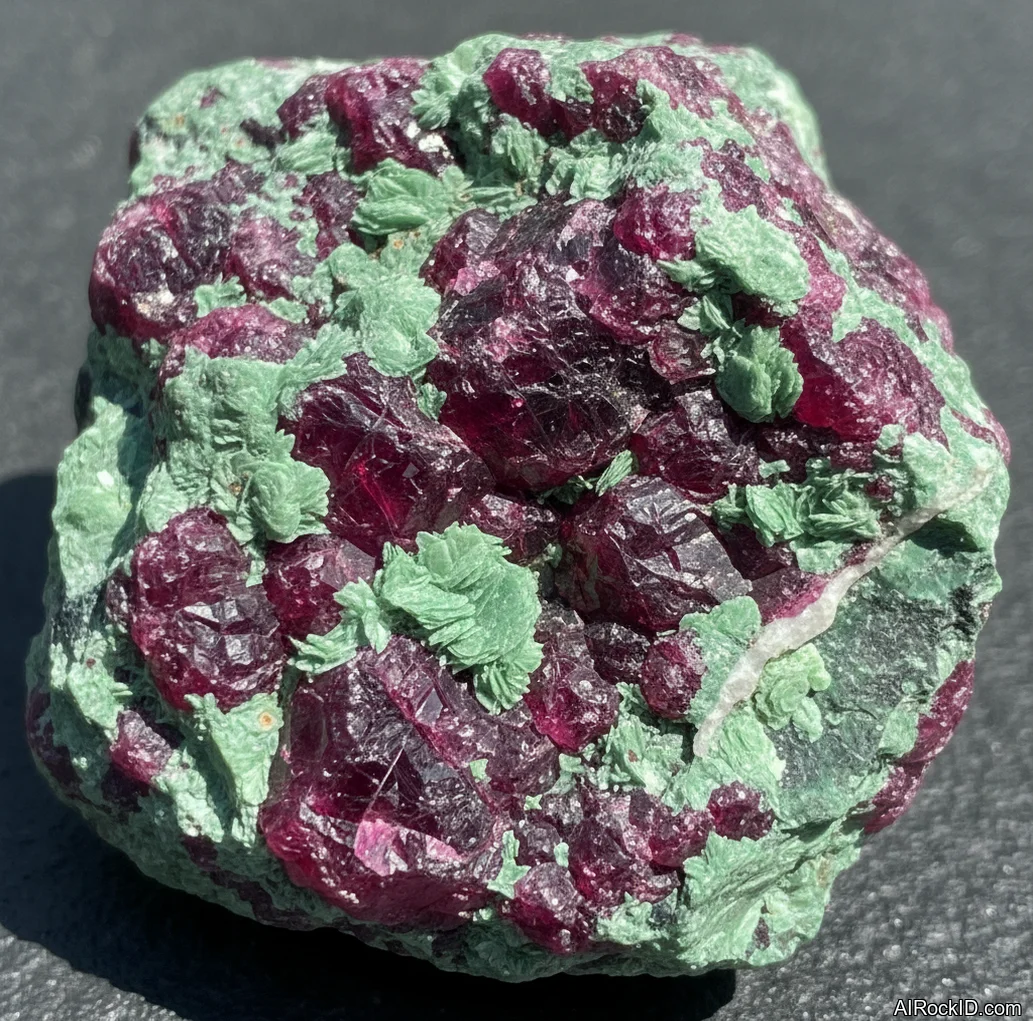
Ruby Fuchsite is a rock made of green fuchsite mica with ruby (corundum) crystals or grains sitting in it.
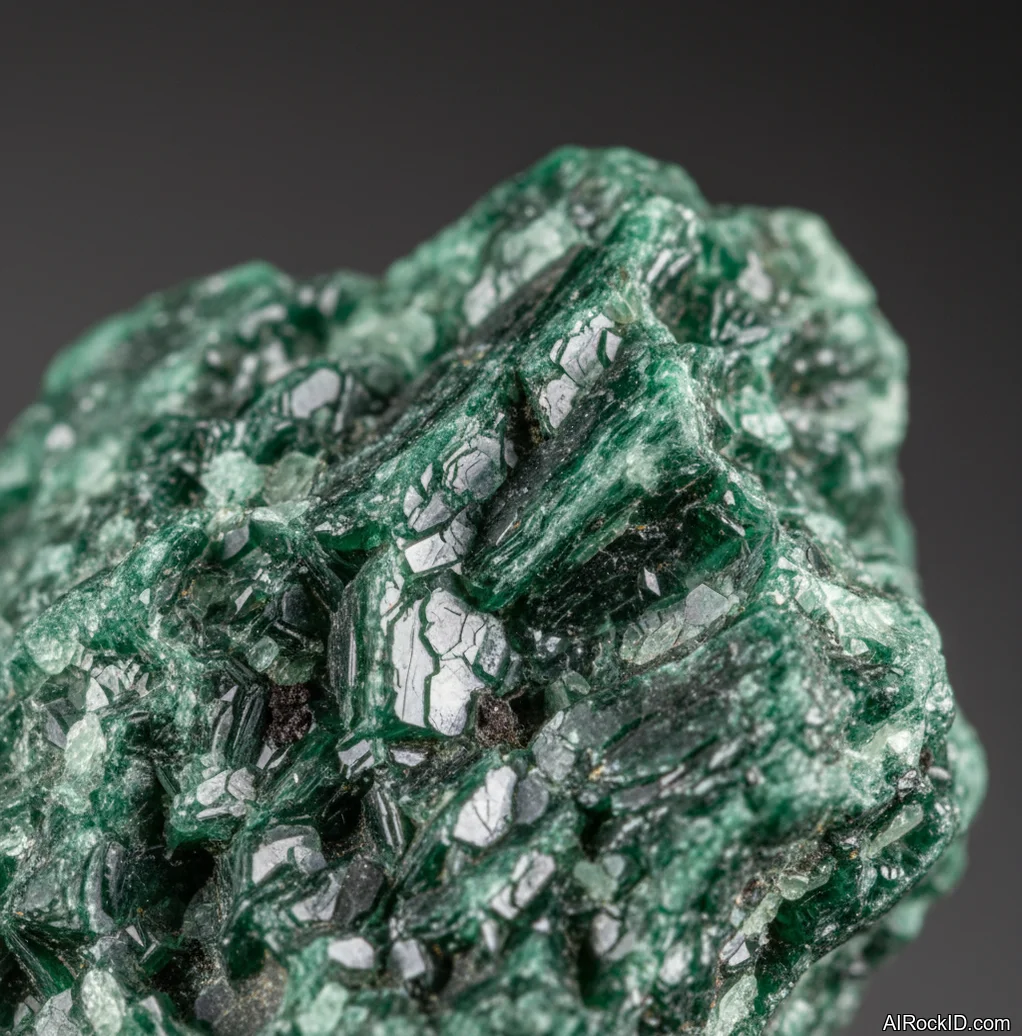
Grab a slab and the first thing you notice is the mica. It has that light, slightly papery feel muscovite gets, and if you bend it the wrong way it’ll try to peel into thin sheets. Then your eye lands on the ruby spots. They’re usually kind of rounded, like little pink raspberries stuck in a spinach-green shimmer, and most of them don’t read as “ruby” in a faceted, jewelry way until you hit the surface with a strong light.
Look, really stare at the green. On good pieces, the fuchsite throws bright flashes when you tilt it under overhead lights, like a bunch of tiny mirrors, because you’re basically catching cleavage faces stacked like pages. But don’t expect it to act like one clean mineral specimen. It’s a mix. And that’s the whole appeal, honestly, but it’s also why some sellers oversell it as “gem ruby” when it’s really corundum in a mica schist.
Origin & History
Fuchsite is just muscovite with chromium in it, and it got its name back in 1842 in honor of the German chemist Johann Nepomuk von Fuchs. Ruby is the red form of corundum, and people have known it since antiquity. But “ruby in fuchsite”? That’s a newer trade label that showed up once lapidaries started slicing up the green mica rock with obvious ruby specks, then turning it into carvings, palm stones, plus cabochons.
And yeah, the name gets pushed around in the market. Some sellers will tag any green mica with pink dots as ruby fuchsite, even if the “ruby” is really just pink garnet, or the green stuff is closer to chlorite. The real deal gives off that muscovite sheen (that slightly slippery, flaky sparkle you notice the second it catches a lamp), and the ruby stays stubbornly hard if you try to scratch it. Seriously, it just doesn’t want to budge.
Where Is Ruby Fuchsite Found?
Commercial ruby fuchsite is most often sourced from metamorphic belts, with India (especially Karnataka) being a major producer. Smaller amounts show up from Brazil, Russia, parts of East Africa, and the USA.
Formation
Pick up a chunk from mica-schist country and it spells things out pretty quick. Ruby shows up as corundum under high-grade metamorphic conditions, when aluminum-rich rocks get cooked and squeezed hard enough that corundum stays stable. Meanwhile the mica is busy growing in thin sheets, and if there’s chromium in the mix, muscovite can shift over into green fuchsite.
But stacked up against “ruby in zoisite,” ruby fuchsite usually comes off as a more micaceous, foliated rock. You can actually spot the mica plates lining up, kind of like wood grain, and when you tilt the piece the surface can flash a little as those sheets catch the light. And yeah, that grain matters once you start cutting it. Lapidaries learn to orient the cab so it won’t flake along cleavage, because mica will split clean and fast if you smack or grind it from the wrong angle. Why fight the rock when it’s basically telling you where it wants to break?
How to Identify Ruby Fuchsite
Color: Bright to medium green mica with pink to red ruby spots, sometimes with purplish tones or black inclusions. The green often has a glittery, reflective look from mica cleavage.
Luster: Pearly to vitreous on the fuchsite, with the ruby spots looking duller to vitreous depending on surface polish.
Pick up a piece and tilt it under a single light source. The fuchsite should flash in plates, not just sparkle like random glitter. If you scratch it with a steel nail, the green mica may mark or scuff, but the ruby spots should resist and feel like you’re skating on something harder. The problem with mislabeled material is that dyed green stones look too even in color and feel warmer in the hand, while real mica stays cool and has that slightly slick, layered feel at the edges.
Properties of Ruby Fuchsite
Physical Properties
| Crystal System | Monoclinic |
| Hardness (Mohs) | 2-9 (Soft (2-4)) |
| Density | 2.8-3.2 g/cm3 |
| Luster | Pearly |
| Diaphaneity | Opaque |
| Fracture | Uneven |
| Streak | white |
| Magnetism | Non-magnetic |
| Colors | green, pink, red, purple, black |
Chemical Properties
| Classification | Silicates |
| Formula | KAl2(AlSi3O10)(OH)2 (fuchsite, Cr-bearing muscovite) + Al2O3 (ruby/corundum) |
| Elements | K, Al, Si, O, H, Cr |
| Common Impurities | Fe, Ti, Mn |
Optical Properties
| Refractive Index | 1.56-1.60 (muscovite/fuchsite); 1.76-1.77 (corundum) |
| Birefringence | 0.036-0.040 (muscovite); 0.008-0.009 (corundum) |
| Pleochroism | Moderate |
| Optical Character | Biaxial |
Ruby Fuchsite Health & Safety
Day-to-day handling is low risk. But if you’re sawing, grinding, or sanding it and you see that fine powder kicking up (the kind that sticks to your fingertips and leaves a chalky film on the bench), don’t breathe it in. So use wet cutting and basic dust control, the same standard precautions people use in lapidary work.
Safety Tips
If you’re doing any shaping, keep a little water running so it stays damp, throw on a fitted respirator that actually seals around your nose and cheeks, and wipe up the slurry while it’s still wet instead of sweeping up dry dust.
Ruby Fuchsite Value & Price
Price Range
Rough/Tumbled: $5 - $60 per palm stone or small slab
Cut/Polished: $2 - $20 per carat (cabochon material, not faceting grade)
Price jumps around depending on how sharp the contrast is and how stable the stone feels in your hand. Strong green mica with clean, clearly defined ruby spots costs more. And the pieces that are solid and well-polished, with no flaky edges trying to peel up at the corners, bring the best money.
Durability
Nondurable — Scratch resistance: Poor, Toughness: Fair
It handles normal display well, but the mica can scratch and cleave easily, so it doesn’t love rough wear or pocket carry.
How to Care for Ruby Fuchsite
Use & Storage
Store it where it won’t rub against harder stones, because the mica face will pick up scratches fast. I keep mine in a soft pouch or a compartment tray, not loose in a bowl.
Cleaning
1) Rinse quickly with lukewarm water. 2) Use a soft toothbrush and a drop of mild soap to lift skin oils from the mica. 3) Pat dry and let it air-dry fully before putting it away.
Cleanse & Charge
For a gentle reset, use smoke, sound, or a short sit on a selenite plate. Skip salt piles if the piece has flaky edges, since grit can work into cleavage and make it look rougher.
Placement
On a desk or nightstand, it reads best under angled light so the mica flashes. Keep it out of constant direct sun if you’re picky about color staying even over time.
Caution
Don’t ultrasonic clean it. And don’t just toss it in your pocket next to quartz or corundum chips, either. Yeah, the ruby’s hard. But the fuchsite it’s sitting in isn’t, and that softer matrix is the part that gets chewed up first (you’ll see it scuff and crumble around the edges). Why risk it?
Works Well With
Ruby Fuchsite Meaning & Healing Properties
People notice ruby fuchsite because the pink-red ruby pops against that leafy green, sure. But the feel is what hooks you if you’re using it for calming stuff. The mica stays cool and slick, then you hit this tiny natural “grab” right where the layers meet, like a worry stone that already has its own texture. When I’m sorting rough at a show, I can spot it instantly just from that mica slip against my fingertips (even before I really look down).
In crystal culture, ruby gets tied to drive and heart energy, and green fuchsite gets tied to soothing and recovery. Put them together and people treat it like a “soft strength” stone, something you keep close when you’re trying to stay kind without letting everyone walk all over you. But look, it’s still a rock, not a treatment. If someone’s dealing with anxiety, burnout, or anything medical, this goes in the comfort-tool bucket, right alongside tea, a walk, maybe a long shower, not as a replacement for real care.
And here’s the honest snag: a lot of pieces are stabilized with resin, or they’re cut from crumbly schist, and those won’t survive constant handling. So if you want one for everyday touch, go for a denser, well-polished palm stone and run your thumb around the edges. If it feels flaky or you end up with green dust on your skin, that’s a display piece, not a pocket buddy.
Identify Any Crystal Instantly
Snap a photo and get properties, value, care instructions, and healing meanings in seconds.