Blue Kyanite
What Is Blue Kyanite?
Blue kyanite is the blue, blade-shaped kind of kyanite, an aluminosilicate (Al2SiO5) that forms in high-pressure metamorphic rocks.
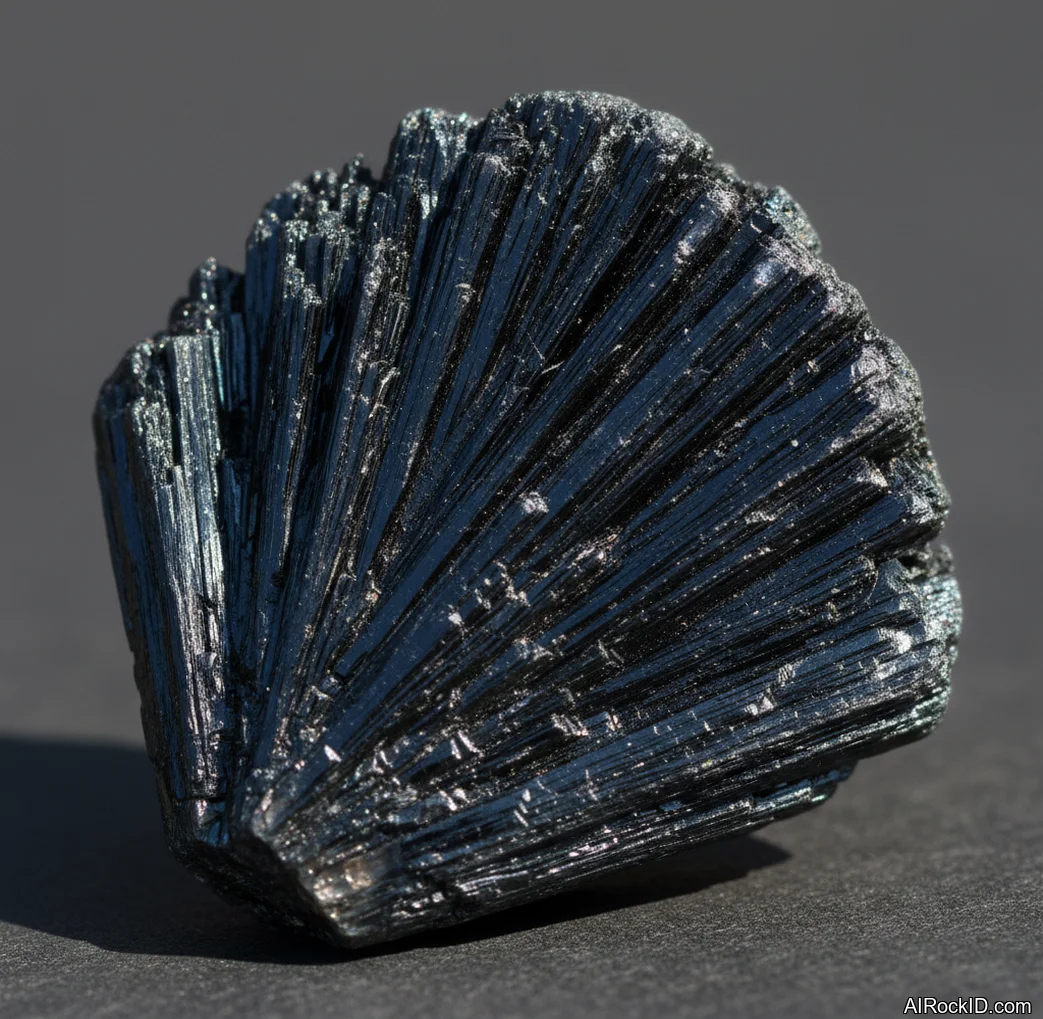
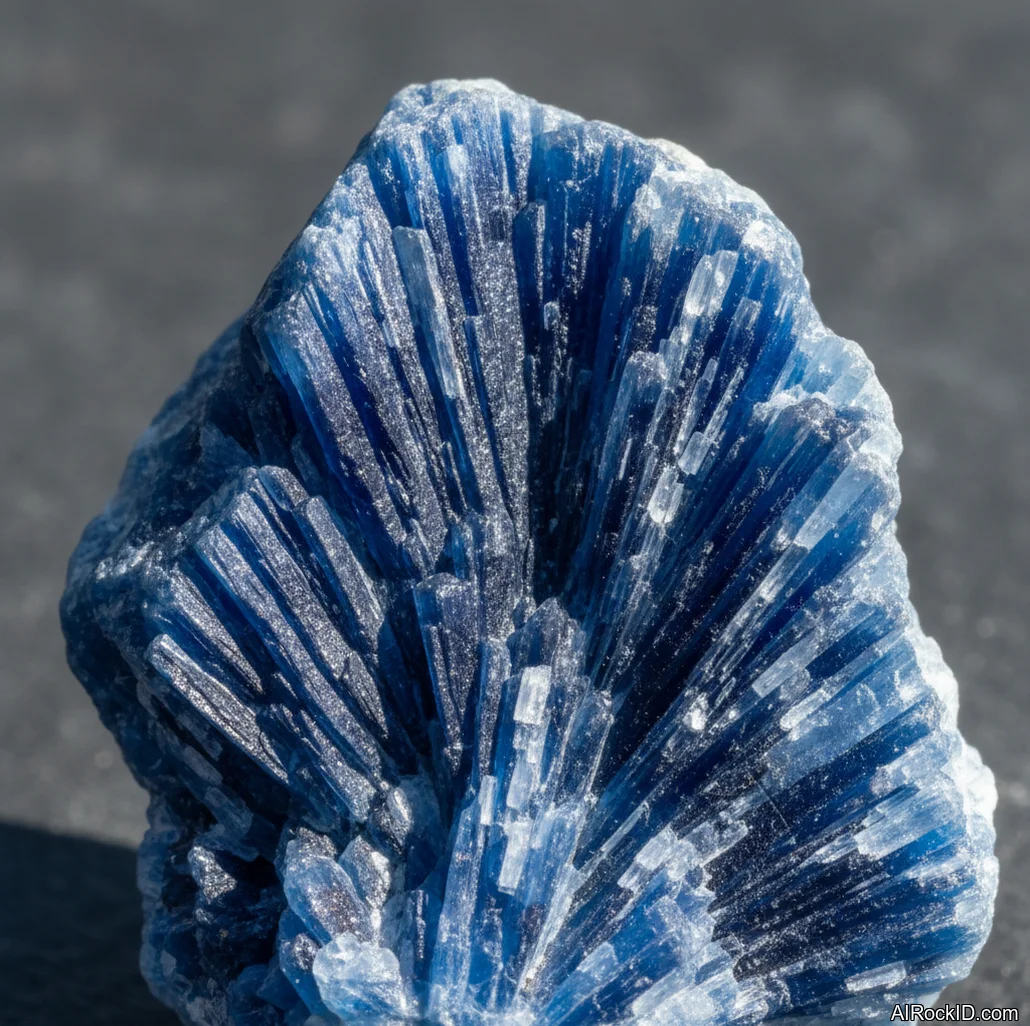
Pick up a piece and you notice the shape right away. Not chunky like quartz. It comes as long, flat blades that feel like a little stack of thin popsicle sticks that got fused into one (and yeah, those edges can be sharp enough to snag a fingertip if you’re not paying attention). Turn it under a shop light and there’s that quick silvery flash off the cleavage faces, then it drops back to dark the second you shift it a few degrees.
Most of what’s for sale is a spray or cluster of blades, sometimes with a bit of white quartz stuck on the base. Deep denim-blue pieces do exist. But a lot of real material is more smoky blue to blue-gray, with lighter streaks running along the length. And if it shows up as a perfectly uniform “electric blue” bar with zero texture, I get suspicious fast. Why wouldn’t I?
Origin & History
Kyanite got formally described as a mineral species in the late 18th century, usually credited to Abraham Gottlob Werner in 1789. The name traces back to the Greek “kyanos,” meaning blue, which clicks the second you’ve held a clean, bladed crystal up in daylight and watched that steel-blue sheen run along the flat face.
But you’ll also see older books call it “disthene” (or “disthen”), and that’s the same mineral. Thing is, that older name is basically a nod to kyanite’s weird directional hardness, meaning it doesn’t scratch the same way in every direction. Not just trivia. Try a scratch test along the length of a blade and it can feel stubborn, then turn the angle and it’ll suddenly give way like you switched to a different stone (on the same piece). How can one crystal do that? That’s kyanite.
Where Is Blue Kyanite Found?
Blue kyanite shows up in high-grade metamorphic belts worldwide, especially where schists and gneisses formed under high pressure. Material on the retail market often comes from Brazil, Nepal/India, and parts of Africa and the USA.
Formation
Most blue kyanite shows up after clay-rich sediments get cooked and squeezed during mountain building. It’s a high-pressure aluminosilicate, and it “prefers” the conditions where other minerals would be andalusite or sillimanite. That pressure part is the whole trick. Out in the field, kyanite is one of those classic metamorphic grade tells when you’re standing over schist and trying to read the rock like a story.
Look, if you get close to a kyanite schist, you’ll usually catch the blades lined up with the foliation, like the rock literally combed them into place while it was deforming. And sometimes the crystals grow as sprays or fans, which is what collectors go for because they sit nicely on their own without a stand. But here’s the thing: those blades love to split along perfect cleavage. So a lot of pieces show up with those little step-like breaks (that stair-step feel under your fingertip), and plenty of that damage happened way before it ever got to you.
How to Identify Blue Kyanite
Color: Typically blue to blue-gray, often with lighter and darker streaks along the length of the blades; strong pleochroism can shift it from deep blue to nearly colorless depending on angle. Some pieces lean green-blue or slatey.
Luster: Vitreous to pearly, with bright silvery flashes on cleavage faces.
If you scratch it with a steel nail, try both directions. Across the blade it can scratch easier, but along the length it resists more than you’d expect. The real test is the bladed habit plus that clean, reflective cleavage that pops when you tilt it under a single overhead light. And in your hand, it stays cool and feels “dry,” not waxy like dyed glassy stuff that gets passed off as kyanite sometimes.
Properties of Blue Kyanite
Physical Properties
| Crystal System | Triclinic |
| Hardness (Mohs) | 4.5–5 (across) and 6.5–7 (along) (Medium (4-6)) |
| Density | 3.53–3.67 g/cm3 |
| Luster | Vitreous |
| Diaphaneity | Transparent to translucent |
| Fracture | Uneven |
| Streak | White |
| Magnetism | Non-magnetic |
| Colors | Blue, Blue-gray, Slate blue, Greenish blue, Colorless (rare in thin edges) |
Chemical Properties
| Classification | Silicates |
| Formula | Al2SiO5 |
| Elements | Al, Si, O |
| Common Impurities | Fe, Ti, Mn |
Optical Properties
| Refractive Index | 1.712–1.734 |
| Birefringence | 0.012–0.020 |
| Pleochroism | Strong |
| Optical Character | Biaxial |
Blue Kyanite Health & Safety
Blue kyanite’s usually fine to handle, and it isn’t considered toxic. Thing is, the real issue is just physical: it can cleave really easily, and those sharp edges can kick off tiny slivers that’ll catch in your skin if you’re not paying attention.
Safety Tips
If you’re trimming matrix or doing any lapidary work, put on eye protection and keep the dust under control, same as you would with any silicate. But if it’s just a display piece, handle it over a towel, because one little slip and a dropped blade can turn into confetti on the floor.
Blue Kyanite Value & Price
Price Range
Rough/Tumbled: $5 - $120 per piece
Cut/Polished: $10 - $60 per carat
Prices jump when the blue is really saturated, the blades look clean, and the sprays are still intact, not scuffed up from mining and shipping. Big, undamaged fans with a nice luster go for more than those common skinny blades that are glued into those gift-box sets (you know the ones).
Durability
Nondurable — Scratch resistance: Fair, Toughness: Poor
Kyanite is stable in normal conditions, but it cleaves easily and its hardness varies by direction, so it chips and scuffs faster than most people expect.
How to Care for Blue Kyanite
Use & Storage
Store it so the blades aren’t rubbing other stones, because the edges nick easily. I keep mine in a small box with foam or in a compartment tray where nothing can press on the tips.
Cleaning
1) Rinse quickly in lukewarm water. 2) Use a soft toothbrush to flick dirt out of the grooves, brushing along the blades, not across them. 3) Pat dry and let it air-dry fully before putting it away.
Cleanse & Charge
Most people use smoke, sound, or moonlight since kyanite’s blades can be fragile in mixed bowls. If you do water, keep it short and don’t bang it against the sink.
Placement
Set it flat on a shelf or in a small stand that supports the base, not the tips. If it’s a spray, give it elbow room, because one bump can snap a blade clean off.
Caution
Skip ultrasonic cleaners, steam cleaning, and any kind of rough tumbling. And don’t fall into the trap of thinking it’s “hard” just because it can test around 7 in one direction.
Works Well With
Blue Kyanite Meaning & Healing Properties
At shows, blue kyanite gets tossed into the “communication” bin all the time, and yeah, I see it. Pick up one of those thin blades, tilt it under the booth lights, and the blue flashes from inky to silvery in a way that kind of yanks your focus into this quiet, watch-the-tiny-things headspace. It’s the sort of stone people park by a notebook or beside a mic, not because it’s magic, but because it nudges the vibe in a certain direction.
And I’ve noticed it’s a go-to for people who hate fussy routines. Dealers love to say it “doesn’t need cleansing,” which is definitely a metaphysical claim, but the everyday part checks out: you can leave a piece on your desk for months and it still won’t look grimy or oily. No tacky, waxy feel, either, so it doesn’t collect fingerprints the way some polished stones do (you know the ones).
But look, I want to be plain about this. Any wellness angle here is personal and traditional, not medical. If you want to use blue kyanite as a little cue to slow your breathing before a hard conversation, cool. Just don’t swap out real help for anxiety, sleep, or anything serious because a crystal happened to feel good in your hand.
Identify Any Crystal Instantly
Snap a photo and get properties, value, care instructions, and healing meanings in seconds.