Saussurite
What Is Saussurite?
Saussurite is what you get when plagioclase feldspar gets altered into a fine-grained metamorphic mashup. It’s usually a mix of albite plus epidote or clinozoisite, with a few other bits along for the ride.
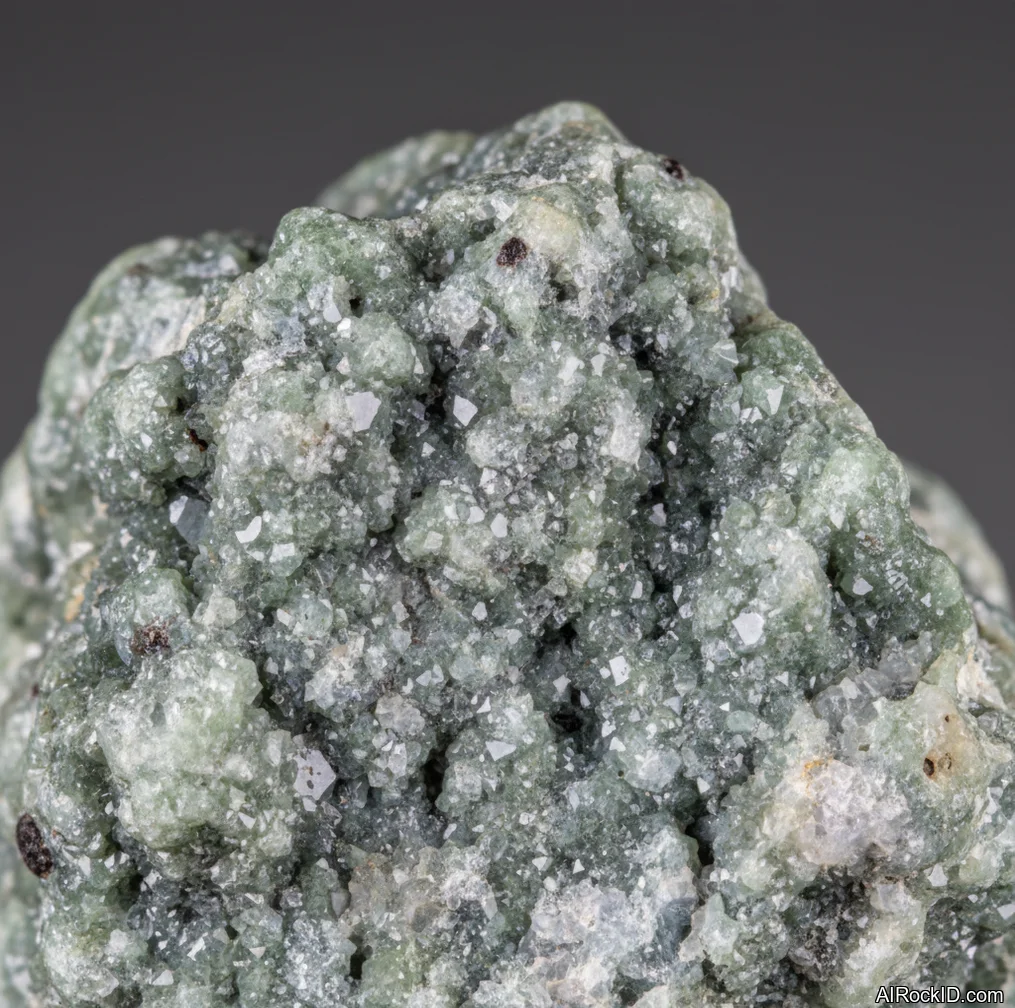
Grab a chunk and it doesn’t feel like a neat, single crystal at all. It feels tough. Compact. Like a little brick of rock, because that’s basically what you’re holding. Most pieces come out mottled pistachio-green, gray-green, and off-white, and if you snap a fresh edge you’ll see that sugary, granular break. And when you tip it under a shop light? You don’t get that clean feldspar flash. You get a softer, scattered sheen, since you’re looking at a bunch of tiny grains all aimed in different directions.
People take one look and call it “jade” all the time, especially after it’s been tumbled and it picks up that waxy polish. But it’s not jade. It doesn’t have the fibrous texture, and it won’t have that slightly greasy, ropey feel nephrite gets when you rub it with your thumb.
Origin & History
The name traces back to Horace-Bénédict de Saussure, the Swiss naturalist and Alpine explorer whose work in the late 1700s helped kickstart modern mountain geology. “Saussurite” ended up stuck to that green replacement stuff you see when feldspars get altered in Alpine-type metamorphic rocks, since it was something people kept running into in the field in those exact settings (you crack a piece and there it is).
Thing is, it’s a weird “mineral name” in the collector scene because it isn’t one neat species with a single formula. You’ll still spot old show labels that say saussurite like it’s a stand-alone mineral. But talk to dealers who’ve been burned by a microscope report, and they’ll call it what it really is: an alteration product. And that’s the honest way to treat it.
Where Is Saussurite Found?
You see saussurite anywhere plagioclase has been cooked and squeezed: Alpine belts, metamorphosed gabbros, and altered basalts. A lot of the lapidary-grade green material shows up as mixed-source rough sold under broad “green stone” labels.
Formation
Saussurite shows up when calcium-rich plagioclase (think labradorite to anorthite) gets messed with during metamorphism or a hydrothermal overprint. The feldspar basically breaks down, then settles back into a fine-grained mosaic. Most of the time that mosaic is albite plus epidote or clinozoisite. But depending on what the fluids are doing and the pressure temperature conditions, you can also get amphibole, garnet, scapolite, or sericite mixed in.
Look, if you stare at a saussuritized gabbro long enough, you’ll usually catch the old plagioclase outlines. They hang around as ghosty, blocky shapes, except now they’re packed with that green, gritty granular material instead of clean feldspar. In a hand sample it can come off kind of blah. But in thin section? Whole different deal. All those replacement textures jump out, and that’s the part petrology people actually care about. Why else would they keep bringing it up?
How to Identify Saussurite
Color: Most saussurite is pistachio to gray-green with white or pale gray patches, often in a mottled, speckled pattern. Some pieces lean more yellow-green if the epidote content is higher.
Luster: Typically dull to waxy on polished surfaces and dull to slightly vitreous on fresh breaks.
Pick up a piece and try to find a clean crystal face. You usually can’t, because it’s an intergrown aggregate, not a single crystal. If you scratch it with a steel nail, some areas might mark and some won’t, since it’s a blend, but overall it should resist better than calcite. The problem with “jade” claims is texture: saussurite breaks granular and sugary, while nephrite tends to look felted or fibrous even when it’s not obvious at first.
Properties of Saussurite
Physical Properties
| Crystal System | Amorphous |
| Hardness (Mohs) | 6.0-7.0 (Hard (6-7.5)) |
| Density | 2.70-3.35 g/cm3 |
| Luster | Waxy |
| Diaphaneity | Opaque |
| Fracture | Uneven |
| Streak | white to pale greenish white |
| Magnetism | Non-magnetic |
| Colors | pistachio green, gray-green, yellow-green, white, gray |
Chemical Properties
| Classification | Silicates |
| Formula | Aggregate; commonly NaAlSi3O8 + Ca2(Al,Fe)3(SiO4)3(OH) and/or Ca2Al3Si3O12(OH) |
| Elements | Na, Ca, Al, Si, O, H, Fe |
| Common Impurities | Fe, Mg, Mn |
Optical Properties
| Refractive Index | 1.53-1.74 |
| Birefringence | None |
| Pleochroism | None |
| Optical Character | Isotropic |
Saussurite Health & Safety
Normal handling is pretty low risk. But it’s still a silicate rock, so if you’re cutting or grinding it and that fine, chalky dust starts hanging in the air (and sticking to your hands), don’t breathe it in.
Safety Tips
Use water and keep the air moving when you sand. And for lapidary work, wear a properly fitted dust mask or respirator (the kind that seals to your face, not the loose one that fogs your glasses).
Saussurite Value & Price
Price Range
Rough/Tumbled: $5 - $60 per piece
Price usually follows the color first. That clean pistachio-green moves fast. Then it’s about how the piece behaves on a wheel, like whether it actually takes a crisp polish or just stays kind of waxy no matter how long you lean on it. And the host rock matters more than people admit. If it’s sitting in something interesting like saussuritized gabbro, buyers notice. Straight green tumble rough is cheap, but once it’s tagged with an Alpine locality label, the price can jump higher than it really “should.”
Durability
Durable — Scratch resistance: Good, Toughness: Good
It’s generally stable, but because it’s a mixed aggregate, one soft micaceous patch can undercut when you polish or wear it.
How to Care for Saussurite
Use & Storage
Store it like you would most lapidary rocks: separate from softer stuff so it doesn’t scuff them, and cushion nicer polished pieces so they don’t chip on edges. I keep my green aggregates in a tray because the mottling looks better together than buried in a box.
Cleaning
1) Rinse under lukewarm water to remove grit. 2) Wash with mild soap using a soft brush, especially if the surface is sugary. 3) Rinse well and pat dry; don’t bake it in direct sun to “dry faster.”
Cleanse & Charge
If you do energy-style care, a quick rinse and a night on a windowsill away from harsh midday sun is plenty. But plain cleaning is the part that actually matters for this material.
Placement
On a shelf, it reads best under angled light so the granular texture pops. In a bowl of tumbles, pick pieces with mixed green and white so it doesn’t just look like generic green rock.
Caution
Don’t lump every green, saussurite-looking stone into one bucket. I’ve seen sellers slip in serpentine or even dyed stuff, and you can tell because it doesn’t act the same once you get it wet or try to polish it (the surface goes weirdly slick or the color shifts a bit).
Works Well With
Saussurite Meaning & Healing Properties
A lot of people who pick up saussurite for metaphysical stuff are really just reacting to the whole “green rock” feel. It’s steady. Earthy. Zero flash.
In my own little pile, it’s the one I reach for when I want something that feels plain and grounded, in a practical way, not a mystical fireworks way. And if you’ve ever held one of those palm stones for a minute, you’ll notice it stays cool longer than resin or glass, like it hangs onto the room temp instead of warming up right away in your hand.
But here’s the thing. Plenty of “saussurite” being sold is mislabeled jade, or it’s a mixed lot of epidote-albite rock, and that means the feel is all over the place from piece to piece. One will be smooth and almost waxy. Another will still feel grainy, like sugar under your thumb, even after it’s been polished. If you’re actually using it for meditation or you keep it as a pocket stone, that texture difference is basically the whole experience, isn’t it?
Metaphysical talk isn’t medical care, and I don’t treat it like it is. Still, I get why people lean on it for routines that are about consistency: journaling, quiet focus, carrying something that doesn’t read as jewelry (just a rock in your pocket). Compared to the flashier stones, saussurite is more of a “keep showing up” buddy, especially if you like your crystals looking like they came out of real rock, because they did.
Identify Any Crystal Instantly
Snap a photo and get properties, value, care instructions, and healing meanings in seconds.