Orthoclase
What Is Orthoclase?
Orthoclase is a potassium-rich feldspar mineral with the formula KAlSi3O8. It’s one of those minerals that’s basically everywhere in the crust, but most of the time it looks pretty plain until you’ve got a decent crystal or a clean cleavage chunk sitting in your palm.
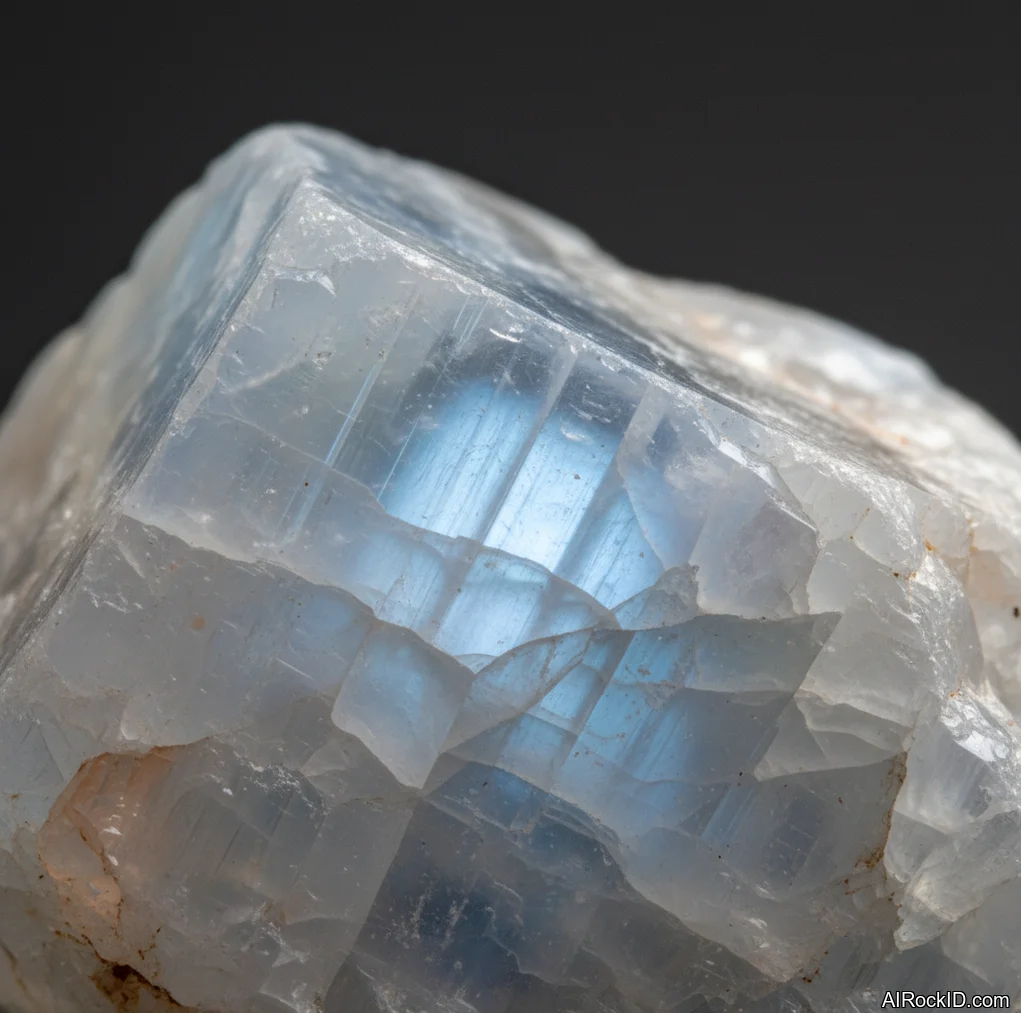
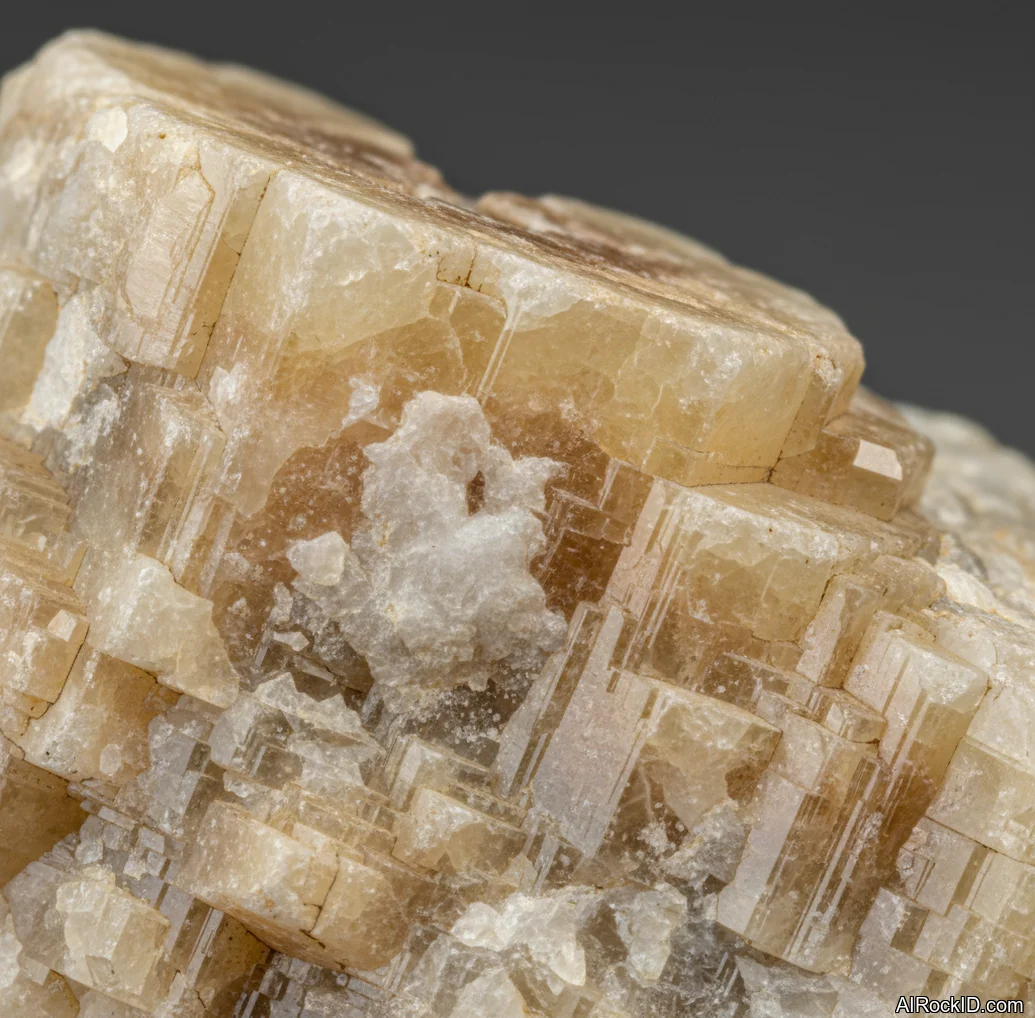
Pick up a fresh piece and, honestly, the shape jumps out before the color does. Orthoclase really likes flat faces. The big giveaway is the two cleavages that meet close to 90 degrees, and when the light catches them you’ll get these broad, glassy flashes off those planes. But the outside of rough pieces can look kind of chalky. I’ve cracked rocks that were dull tan on the surface and then suddenly bright, almost porcelain white inside (that moment’s always satisfying).
At first glance, people mix it up with quartz all the time, especially if it’s pale and a bit translucent. But quartz doesn’t break like a box. Orthoclase does. And once you’ve handled enough feldspar, you start to recognize the feel: slightly softer, a little more grippy than quartz, and it shows that step-like cleavage instead of a smooth, curved break. Why does that matter? Because it’s the quickest tell in the field.
Origin & History
Back in the early 1800s, mineralogists were still untangling the feldspars and figuring out they weren’t all the same “white rock” miners kept calling spar. A lot of it looked similar at a glance. But orthoclase got singled out as its own species in 1823 by August Breithaupt, a German mineralogist who went on to name a bunch of classic minerals.
The word “orthoclase” comes from Greek roots that mean “straight fracture/cleavage,” which is basically a tip of the hat to how it splits along those flat planes. And yeah, that checks out in your hands: crack a sample on a show table (you can feel that little snap through the piece), and it breaks into neat, flat-faced blocks instead of those ugly, ragged shards. Pretty satisfying, honestly.
Where Is Orthoclase Found?
Orthoclase turns up worldwide in granites, pegmatites, and some metamorphic rocks. The showy crystals most people remember usually come out of pegmatites where the crystals had room to grow.
Formation
Most of the orthoclase you’ll bump into is the plain, everyday granite kind. It crystallizes out of silica-rich magma as the melt cools, usually right alongside quartz, biotite, and plagioclase. If you’ve ever held a granite hand sample, it’s the pink or cream feldspar that looks a little blocky compared to the glassier quartz.
But the real collector pieces? Those usually come out of pegmatites. Pegmatites are those slow-cooling, water-rich pockets where minerals have the time and space to grow bigger and cleaner. In them, orthoclase can show up as chunky crystals with crisp, sharp edges, sometimes intergrown with quartz or sitting next to smoky quartz, tourmaline, and mica books (the ones that split into thin, shiny sheets if you mess with them).
And if the chemistry and cooling history line up just right, related K-feldspar can pick up that soft glow people call moonstone. That’s the bit that draws a lot of attention from the metaphysical market.
How to Identify Orthoclase
Color: Orthoclase is commonly white, cream, gray, tan, or salmon-pink, and it can be translucent to opaque. Some pieces show a subtle sheen or glow if there are fine internal layers (especially moonstone-type material).
Luster: Vitreous to pearly, with the pearly look strongest on cleavage faces.
Look closely at broken faces: orthoclase tends to split into flat steps, and the two main cleavage directions meet close to a right angle. If you scratch it with a steel knife, it usually won’t cut easily, but it also won’t feel as “bulletproof” as quartz. The real test is comparing it to quartz in-hand: quartz breaks with curved, glassy conchoidal fractures, while orthoclase breaks like a block and the cleavage planes flash when you tilt them under overhead light.
Properties of Orthoclase
Physical Properties
| Crystal System | Monoclinic |
| Hardness (Mohs) | 6 (Hard (6-7.5)) |
| Density | 2.55-2.63 g/cm3 |
| Luster | Vitreous |
| Diaphaneity | Transparent to translucent |
| Fracture | Uneven |
| Streak | white |
| Magnetism | Non-magnetic |
| Colors | white, cream, gray, tan, salmon, pink, pale green |
Chemical Properties
| Classification | Silicates |
| Formula | KAlSi3O8 |
| Elements | K, Al, Si, O |
| Common Impurities | Fe, Na, Ca, Rb, Ba |
Optical Properties
| Refractive Index | 1.518-1.526 |
| Birefringence | 0.007-0.009 |
| Pleochroism | None |
| Optical Character | Biaxial |
Orthoclase Health & Safety
Orthoclase is usually fine to handle and keep on a shelf. Thing is, like most silicate minerals, the one thing you really don’t want is breathing in the dust if you’re cutting or grinding it (that gritty, powdery stuff that settles on your fingers and the bench).
Safety Tips
If you’re lapping, sawing, or sanding this stuff, run water while you do it and wear a proper respirator. That fine silica-bearing dust gets everywhere (you can feel it grit on your teeth), and you really don’t want it in your lungs.
Orthoclase Value & Price
Price Range
Rough/Tumbled: $3 - $60 per piece
Cut/Polished: $5 - $80 per carat
Clean, sharp crystals with nice-looking color zoning can spike the price in a hurry, and the big pegmatite crystals can shoot up into the hundreds. But most plain cleavage chunks are pretty cheap. Clear faceting rough, and the real moonstone-grade stuff, though? That’s where it gets pricey.
Durability
Moderate — Scratch resistance: Good, Toughness: Fair
It’s stable in normal conditions, but the perfect cleavage means it can chip or split if you knock it against harder minerals.
How to Care for Orthoclase
Use & Storage
Store orthoclase so it can’t bang into quartz or corundum in a mixed box. A little padding matters because the cleavage will punish careless handling.
Cleaning
1) Rinse with lukewarm water to remove grit. 2) Use a soft toothbrush with a drop of mild soap and gently scrub along the cleavage faces. 3) Rinse well and pat dry; avoid ultrasonic cleaners if the piece has cracks or obvious cleavage seams.
Cleanse & Charge
For a simple reset, rinse and let it dry fully, or set it on a windowsill for indirect light. Don’t bake it in harsh sun for days if the color is delicate or you’re trying to preserve a surface sheen.
Placement
I like orthoclase on a shelf where side light can rake across the cleavage and show the flash. Keep it out of high-traffic edges because one fall can turn a nice block into a handful of slabs.
Caution
Go easy on it. If you bang it around or let it tumble hard, that cleavage can bite you and you’ll end up with chips or little bruised spots along the edges. And don’t clean it with strong acids, don’t do any high-heat cleaning either.
Works Well With
Orthoclase Meaning & Healing Properties
Most folks who walk in asking about orthoclase are circling the same two things: steadiness, and that mental “sorting” feeling. In my own stash, I’ll grab a clean orthoclase cleavage chunk when I want the desk to feel plain and structured. It’s got that neat right-angle geometry, and honestly, just staring at it is like sliding loose papers into a folder.
But look, there are limits. Any calming or focus effect here lives in personal practice, not medicine. If somebody’s pitching orthoclase as a miracle anything, I’m out. What I see again and again is people using feldspar as a gentle support stone: journaling, study sessions, and the slow daily self-management stuff where you’re trying to stay consistent (even when you don’t feel like it).
And if you really look at how it handles light, you’ll get why it ends up in “soothing” routines. A good cleavage face gives you that soft, even reflection instead of a sharp sparkle. No fireworks. If you’ve got moonstone-grade material (still feldspar, just with that internal glow), the vibe people describe tends to lean more toward intuition and emotional pacing. Regular orthoclase feels more practical to me. Quiet. No drama.
Identify Any Crystal Instantly
Snap a photo and get properties, value, care instructions, and healing meanings in seconds.