Shiva Lingam


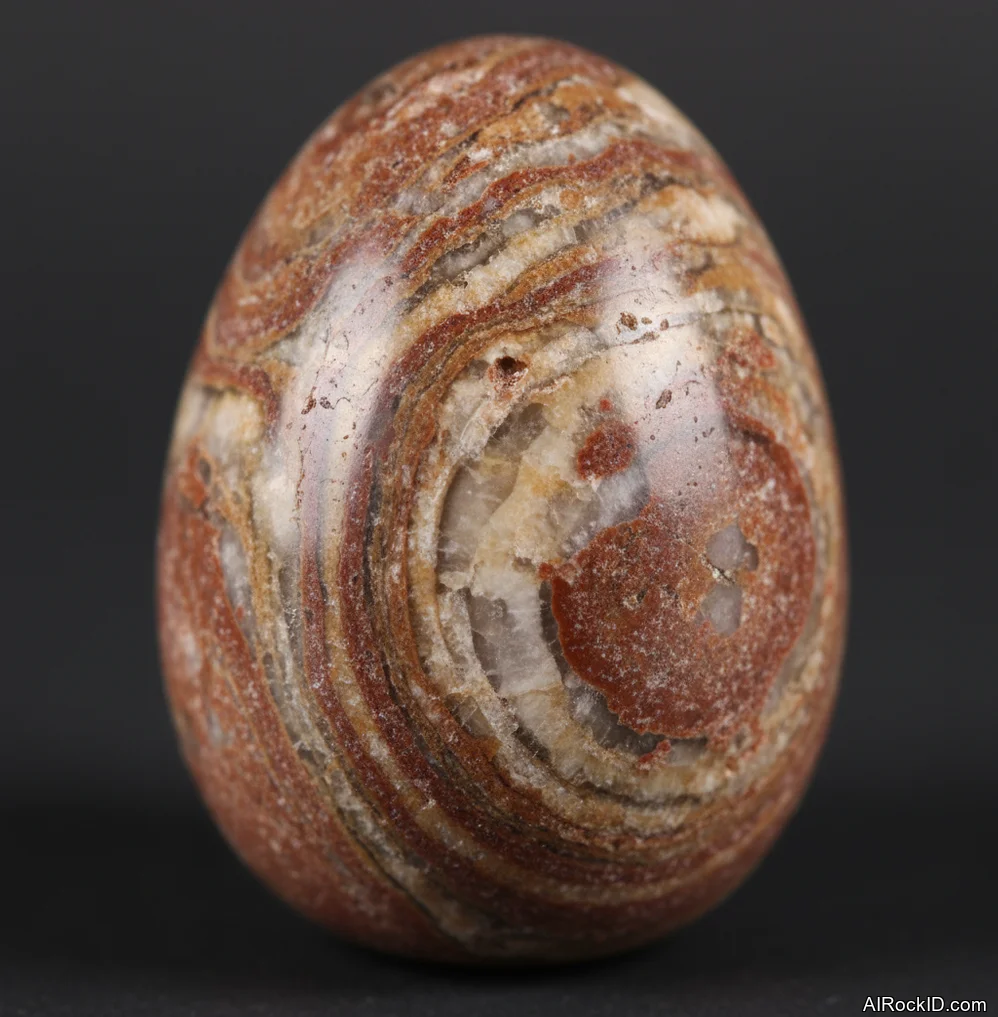
Quick answer: Shiva Lingam is a naturally shaped, river-tumbled stone associated with the Narmada River region of India. It is typically identified by its smooth oval form and tan, brown, reddish, or gray markings in a quartz-rich, jasper-like material.
AI Rock ID can help compare a Shiva Lingam stone’s shape, color zones, and surface texture against visually similar river stones and jaspers. RockIdentifier.io provides crystal and rock reference information that can support visual checks before buying or cataloging a specimen.
Good fit
- Collectors who want a naturally water-worn stone with distinctive oval shaping
- Buyers comparing tan, brown, and gray banded stones sold as Shiva Lingam
- People interested in stones connected to Indian cultural and spiritual traditions
- Beginners who want a durable quartz-rich stone that is easy to handle and display
Not a good fit
- Anyone needing a laboratory-confirmed mineral species name from appearance alone
- Buyers expecting every oval river stone from India to be authentic Shiva Lingam
- Collectors who prefer untreated, unpolished specimens with visible natural matrix
- People looking for medical or health outcomes from a crystal
Most commonly confused with
- Jasper: Many Shiva Lingam stones are jasper-like, but ordinary jasper is not defined by the same Narmada River origin or traditional oval form.
- Agate: Agate often has sharper translucent banding, while Shiva Lingam is usually more opaque with muted earthy markings.
- River Rock: Generic river rocks may share a smooth oval shape but lack the recognized origin, pattern style, and trade identity of Shiva Lingam.
- Septarian: Septarian has angular crack-like patterns and calcite-filled seams, unlike the softer, water-worn markings of Shiva Lingam.
Shiva Lingam Lookalike Comparison
| Stone | Typical look | Key difference |
|---|---|---|
| Shiva Lingam | Smooth oval or egg shape with tan, brown, red-brown, or gray markings | Trade identity is tied to Narmada River stones and traditional shaping |
| Jasper | Opaque earthy colors, sometimes banded or spotted | Not necessarily river-shaped or associated with the Shiva Lingam source |
| Agate | Distinct bands, often partly translucent | Usually shows clearer banding and more translucency |
| River rock | Rounded natural pebble in many colors | May lack consistent quartz-rich texture and documented origin |
| Septarian | Brown, yellow, and gray with angular crack patterns | Pattern is vein-like rather than softly banded |
AI identification confidence
AI identification confidence is usually moderate for Shiva Lingam because the stone is defined by a mix of appearance, shape, and source rather than a single diagnostic mineral formula. Clear photos of the full oval shape, close-up surface markings, and any seller origin information improve the result.
When AI gets it wrong
- A generic polished river rock may be labeled as Shiva Lingam if it has a similar oval shape.
- Opaque agate or jasper may be confused with Shiva Lingam when the image does not show scale, translucency, or origin details.
- Overly polished or dyed stones can hide natural texture and make visual identification less reliable.
- Photos with warm lighting can exaggerate red or brown tones and affect comparison results.
Final recommendation
Choose Shiva Lingam from sellers who provide clear photos, size, weight, and a stated source rather than relying only on the name. For higher-value pieces, prioritize documented origin and consistent natural patterning over unusually perfect symmetry or overly bright color.
How to Check Shiva Lingam Authenticity
A typical Shiva Lingam should look naturally river-worn, with a smooth oval profile and earthy markings that appear integrated into the stone rather than painted on the surface. Ask for photos from multiple angles, including close-ups of any bands, pits, or color transitions. Very uniform shapes, identical patterns across multiple pieces, or unusually glossy coatings may indicate heavy shaping, surface treatment, or a generic decorative stone.
Buying Shiva Lingam Online
Listings should include dimensions, weight, photos in natural light, and a clear statement of origin when available. Smaller stones are commonly sold by piece, while larger display specimens may be priced by size, symmetry, and pattern contrast. Be cautious with vague listings that use only spiritual descriptions and do not show the actual stone being sold.
Cultural Context and Naming
The name Shiva Lingam refers to a form with significance in Hindu traditions, so respectful handling and description are important. In the crystal trade, the term is often applied to oval river stones associated with the Narmada River region. Cultural meaning and geological identification are separate points, and neither confirms authenticity by itself.
What Is Shiva Lingam?
A Shiva Lingam is a naturally river-tumbled, quartz-rich stone (jasper/agate type) gathered from the Narmada River in India, and it’s usually polished into an egg or lingam shape.
Pick one up and the first thing you clock is the weight. It sits heavy in your palm for something that size, and the surface feels slick and glassy, like microcrystalline quartz does after a proper polish (the kind where your thumb almost skates over it). The colors tend to run sandy tan with cocoa-brown streaks, and every so often there’s a smoky gray patch that looks like somebody dragged a brush across it.
A lot of people assume the shape is carved. But the river does most of the rounding long before any lapidary work happens. So what you see on the market is usually pieces that have been cleaned and polished, and the better ones still have that natural-looking taper on one end instead of reading like a perfectly machined egg.
Origin & History
Most dealers call these stones “Shiva Lingam” because that classic lingam shape is a sacred symbol tied to Shiva in Hindu practice, and the Narmada River has been treated as holy for a long time. And in the trade you’ll also hear “Narmada lingam,” which is really just people being more specific about where they came from.
There isn’t one clean “first described by” moment like you get with a newly named mineral species. Why? Because this is a river-worn rock type, not a formally defined mineral. The modern crystal-market identity basically took off once polished stones started showing up everywhere at gem shows and import booths, usually tagged by the river and region instead of a strict petrographic name.
Where Is Shiva Lingam Found?
Authentic Shiva Lingam material is collected from the Narmada River in central India, especially in Madhya Pradesh, then cleaned and often polished for sale.
Formation
It starts out as silica rich rock, basically microcrystalline quartz that’s got iron oxide staining and banding. Depending on the chunk you pick up, it can read more jaspery, or more agate like.
Then time does what time does. The rock breaks loose, gets carried downstream, and it gets knocked around over and over in the river. You can hear it in your head, right? That clack and grind as stones bump each other.
And that tumbling is the whole trick. All that constant rolling rounds the edges, pops off weak spots, and sometimes you end up with a naturally eggy cobble before anyone ever touches it with sandpaper.
But here’s what sellers don’t always say out loud: a lot of them get ground later into a more intentional lingam outline, then polished up to a high gloss. You can still spot the ones that started as naturally rounded cobbles because they keep slightly uneven curves and that “wild” banding that doesn’t line up in a neat, symmetrical way (it kind of wanders).
How to Identify Shiva Lingam
Color: Most Shiva Lingam stones are tan to beige with brown, rust, or gray banding and patches. Some show soft, blurry striping rather than crisp agate lines.
Luster: Polished pieces have a vitreous to waxy shine typical of microcrystalline quartz.
Look closely at the patterning: real ones tend to have earthy, iron-stained bands that look like they soaked into the stone rather than sitting on top. Pick up a few at a shop and compare temperature, too. Quartz-rich stones stay cool longer in your hand, while resin or composite fakes warm up fast and feel a little sticky instead of slick.
Common Look-Alikes
Shiva Lingam is sometimes confused with these materials:
- Polished jasper egg (mookaite, picture jasper, or generic "river jasper" sold as Shiva Lingam)
- Banded agate/chalcedony egg (Botswana agate style banding can read similar in photos)
- Dyed agate egg (tan/brown dye to mimic the Narmada look, especially when the real piece is too gray)
- Hematite or magnetite egg (dark gray, heavy, metallic sheen when the polish is too sharp)
- Resin or reconstituted stone egg (powder + binder with painted streaks)
- Glass egg (smoky-brown glass with swirly internal flow lines)
Market Cautions & Treatments
When AI Can Get This Wrong
At first glance, photo ID bots mix Shiva Lingam up with any polished jasper or banded agate egg because the tan-and-brown streaks read the same on a screen. The real test is in-hand: it should feel cool and dense like microcrystalline quartz, scratch glass, and it won’t show mold seams, bubbles, or those glassy internal flow ribbons when you tilt it under a hard light.
Properties of Shiva Lingam
Physical Properties
| Crystal System | Trigonal |
| Hardness (Mohs) | 6.5-7 (Hard (6-7.5)) |
| Density | 2.58-2.65 g/cm3 |
| Luster | Waxy |
| Diaphaneity | Opaque |
| Fracture | Conchoidal |
| Streak | White |
| Magnetism | Non-magnetic |
| Colors | tan, beige, brown, gray, rust |
Chemical Properties
| Classification | Silicates |
| Formula | SiO2 |
| Elements | Si, O |
| Common Impurities | Fe, Al, Mn |
Optical Properties
| Refractive Index | 1.53-1.54 |
| Birefringence | 0.009 |
| Pleochroism | None |
| Optical Character | Uniaxial |
Shiva Lingam Health & Safety
Shiva Lingam is mostly quartz (SiO2), so it’s generally safe to hold in your hands and rinse off with water. And honestly, you don’t need some complicated routine here. Basic care usually does the job for most people.
Safety Tips
If you’re going to cut or grind it, handle it like any other silica-heavy stone. Don’t breathe the dust. Wet it down with water (a steady spray keeps that fine powder from hanging in the air), and wear proper respiratory protection.
Shiva Lingam Value & Price
Price Range
Rough/Tumbled: $8 - $80 per piece
Price mostly comes down to size, how good the polish actually is, and how clean the surface looks when you turn it in the light. Stuff with nice, natural-looking banding and a good taper usually gets marked higher than the perfectly plain tan pieces. And you can see why, right? The banding just pops once it’s polished, especially when the surface doesn’t have those little hazy scuffs that show up around the edges (the kind you only notice after you’ve handled a few).
Durability
Very Durable — Scratch resistance: Excellent, Toughness: Good
It’s quartz-based, so it holds up well in day-to-day handling and doesn’t mind normal room conditions.
How to Care for Shiva Lingam
Use & Storage
Store it where it won’t get knocked onto tile or concrete, even though it’s tough. I keep polished lingams in a tray or a cloth bag so they don’t scuff other softer stones.
Cleaning
1) Rinse under lukewarm water with a drop of mild soap. 2) Use a soft cloth or a soft toothbrush to clean the polish around any small pits. 3) Rinse well and dry completely so you don’t get water spots.
Cleanse & Charge
A quick rinse and a wipe-down works fine for most folks who like a reset ritual. If you use smoke or sound, keep it simple and don’t overthink it.
Placement
On a desk it feels like a worry stone with some heft, and it won’t tip over easily. If you put it on a windowsill, it’ll be fine, but dust shows up fast on that glossy polish.
Caution
Skip harsh cleaners and don’t leave it sitting in salty water for ages, because that combo will slowly knock the shine down and leave the surface looking kind of tired. And look, don’t just trust the label online either. Not every “Shiva Lingam” you see is actually river-sourced material; plenty of them are basically generic jasper eggs being sold under the name.
Works Well With
Shiva Lingam Meaning & Healing Properties
Most folks who buy a Shiva Lingam come in for the cultural meaning just as much as the geology side of it. In my own stash, it feels steady and grounded, and honestly that’s mostly because of how it sits in your hand. Smooth. Heavy. Quiet. The tactile part counts more than people want to admit.
If you’re using one for meditation or a personal ritual, it usually works like a focus object. Your hands have something to do, and your brain settles down a notch. But it’s still a rock. If somebody’s pitching it like it can replace therapy, sleep, or medical care, that’s a hard no from me.
One practical thing from handling a bunch of them at shows: the strongest “feel” tends to come from pieces that aren’t over-shaped. When the curves look too perfect, they’re usually coming off a factory-type polish line, and you can feel it, that slick, uniform finish. And they just don’t have that river-worn character that makes the stone interesting in the first place.
Common mistakes
- Assuming every egg-shaped brown stone is a Shiva Lingam
- Ignoring seller origin information when comparing similar river stones
- Mistaking painted or coated surface patterns for natural banding
- Expecting Shiva Lingam to be a single pure mineral species
- Using color alone to identify the stone without checking texture and shape
- Treating metaphysical tradition as proof of geological authenticity
Identify Shiva Lingam from a photo
Compare Shiva Lingam traits, care tips, value clues, and common lookalikes with a clear photo.