Skeletal Quartz
What Is Skeletal Quartz?
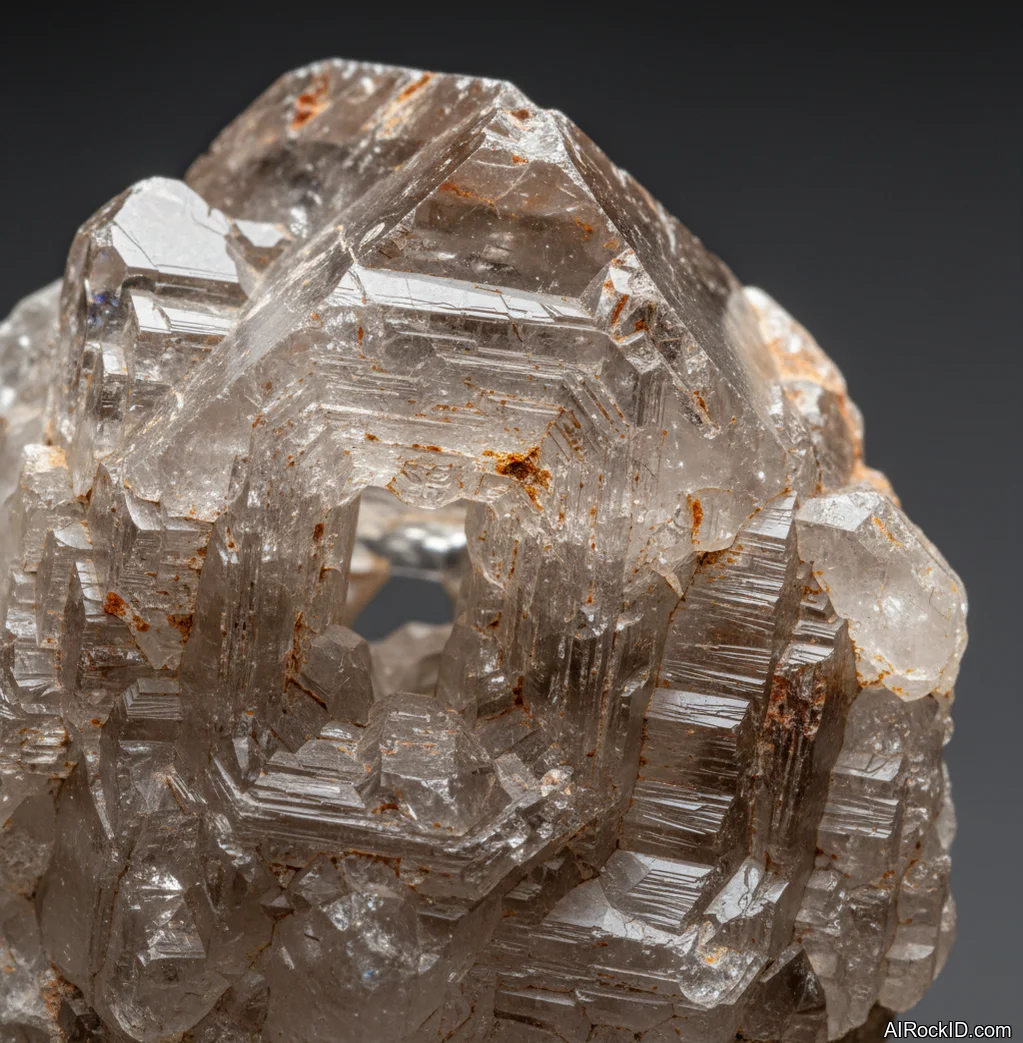
Skeletal Quartz is a quartz crystal growth habit where the edges grow faster than the center, so you end up with hollowed, stepped faces and little window-like openings.
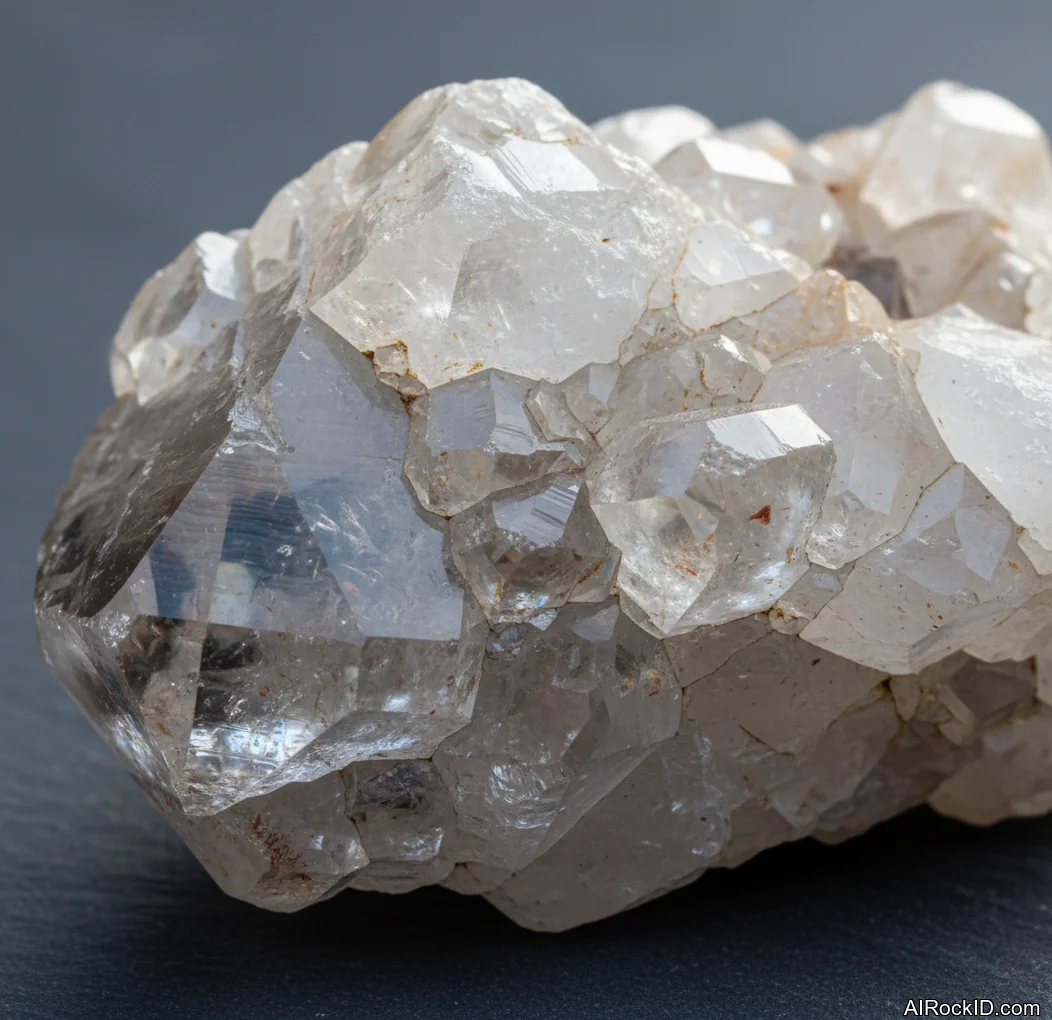
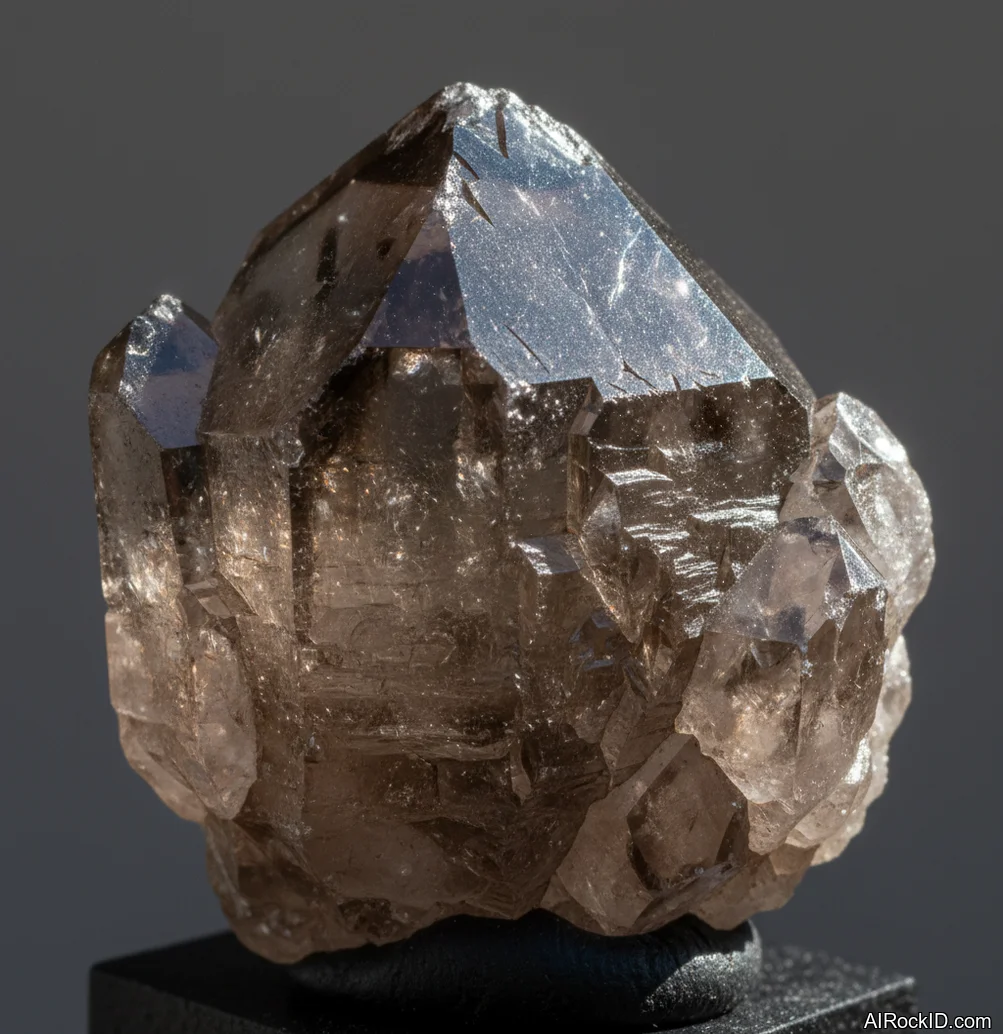
Hold a decent skeletal piece and you notice it instantly. It’s got that familiar quartz heft in your palm, but visually it looks oddly unfinished, like someone stopped building it halfway on purpose. There are tiny terraces, sharp little rims, and open “windows” you can actually look into (and if there’s dust in there, you’ll see it sitting in the corners). Turn it under a lamp and the step faces light up in stripes, like miniature staircases flashing one riser at a time. Some pieces are water-clear. Others are smoky. And a lot of them have iron staining tucked into the cracks, which makes the geometry stand out way more than you’d expect.
People often take one look and assume it’s broken or etched. But the skeletal look is growth, not damage. The edges read as crisp and deliberate, and the cavities tend to have that clean, geometric symmetry that chips and random fractures just don’t. And yeah, it’s still quartz, so it scratches glass easily. But those thin ridges can be surprisingly delicate when a piece is really hopper-y. Fragile little lips.
Origin & History
“Skeletal” is really a collector and dealer word. It’s what people call quartz that looks kind of hollowed out, all framework, like you’re staring at the bones of how the crystal grew.
In mineralogy you’ll hear “hopper quartz” and “fenster quartz,” too. “Fenster” is German for “window,” which makes sense once you’ve actually held one and tipped it under a light. The faces don’t close up, so you get these little pane-like openings you can literally see through (or at least peek through).
Quartz as a species got described ages before anyone bothered slicing every growth habit into its own separate name. So, skeletal growth isn’t a different mineral. It’s about how it formed. But in the trade the label stuck because it’s quick, visual, and it helps at a show table. Walk past a bunch of flats of quartz and one piece has those step-like cutouts and little “missing” sections? That’s the one people tap with a fingernail and go, “skeletal.”
Where Is Skeletal Quartz Found?
Skeletal quartz shows up anywhere quartz grows fast under the right conditions, especially in pegmatites and alpine-style veins. Brazil is a steady source, and similar habits are also found in parts of Russia, the USA, and the Alps.
Formation
Fast growth is the whole trick here. When quartz drops out of silica-rich fluids in a hurry, the edges and corners can race ahead while the middle of a crystal face just can’t keep up. So you end up with those hollow “hopper” pits, little stepped terraces, and sometimes actual window openings you can literally see through if you tilt the piece toward the light.
Look, if you stare at the steps long enough, you can almost read the growth pulses like tree rings. I’ve held specimens where the terraces are so even they feel weirdly precise under a fingernail, like somebody ran a tool over them, and then the next one will be a total mess because the chemistry or temperature kept bouncing around. And in pockets, a skeletal crystal can later pick up a dusting of tiny quartz points, chlorite, or iron oxide staining (you’ll see it sitting in the corners). But the framework underneath is still telling the same story: the edges sprinted, the center lagged.
How to Identify Skeletal Quartz
Color: Most skeletal quartz is colorless to white, but smoky gray is common, and iron oxide can paint the steps in yellow, orange, or rusty red. Some pieces look milky overall with clearer windows inside.
Luster: Vitreous luster on fresh faces, with a glassy flash on the step terraces.
Pick up the crystal and run a fingertip lightly across the faces. Real skeletal growth feels like tiny stair steps, not random roughness. The real test is the geometry: hopper depressions are centered and symmetrical on a face, while damage is irregular and usually follows fractures. If you scratch it with a steel knife, it won’t take a scratch, but it will leave the knife looking sad.
Properties of Skeletal Quartz
Physical Properties
| Crystal System | Trigonal |
| Hardness (Mohs) | 7 (Hard (6-7.5)) |
| Density | 2.65 g/cm3 |
| Luster | Vitreous |
| Diaphaneity | Transparent to translucent |
| Fracture | Conchoidal |
| Streak | White |
| Magnetism | Non-magnetic |
| Colors | Colorless, White, Smoky gray, Yellow, Orange, Brown, Reddish brown |
Chemical Properties
| Classification | Silicates |
| Formula | SiO2 |
| Elements | Si, O |
| Common Impurities | Fe, Al, Ti, Mn |
Optical Properties
| Refractive Index | 1.544-1.553 |
| Birefringence | 0.009 |
| Pleochroism | None |
| Optical Character | Uniaxial |
Skeletal Quartz Health & Safety
Skeletal quartz is non-toxic, so it’s safe to handle. But if you’re cutting, grinding, or sanding it, watch out for the super-fine silica dust. Don’t breathe that stuff in.
Safety Tips
If you’re actually working the material, keep it wet, make sure you’ve got good airflow, and wear a proper respirator that’s rated for silica. But if it’s just a display piece you’re picking up now and then, normal careful handling is plenty.
Skeletal Quartz Value & Price
Price Range
Rough/Tumbled: $10 - $250 per specimen
Prices jump when the step faces are sharp and clean, the piece is nicely transparent, and the window openings look dramatic when you tilt it under a light. But if those thin ridges are dinged up or there’s a thick iron crust stuck on (the kind that feels gritty and looks rusty), the price usually drops fast.
Durability
Durable — Scratch resistance: Excellent, Toughness: Good
Quartz is chemically stable for normal wear and display, but skeletal edges can chip if they bang into harder minerals or glass shelves.
How to Care for Skeletal Quartz
Use & Storage
Store it where the stepped edges won’t rub against other crystals, because those ridges chip easier than a chunky prism face. I keep mine in a small box with foam or on a stand with a little clearance around it.
Cleaning
1) Rinse with lukewarm water to remove loose dust. 2) Use a soft toothbrush with a drop of mild soap to get into the windows and step grooves. 3) Rinse well and air-dry; a microfiber cloth helps keep water spots off clear faces.
Cleanse & Charge
For people who do energetic upkeep, running water, smoke, or leaving it on a shelf overnight are common choices. Keep it simple and don’t over-handle the fragile edges.
Placement
A side light source shows skeletal steps best, so a windowsill-adjacent shelf or a lamp-lit case works well. But don’t let it tumble around in direct sun and heat where it can get knocked over.
Caution
Skip harsh acids and heavy-duty chemical cleaners, and don’t put it in an ultrasonic cleaner either. That buzzing vibration can snap those thin skeletal ridges right off. And do your handling over a towel. Seriously. One little slip onto a hard counter is how most of those “mystery chips” show up in the first place.
Works Well With
Skeletal Quartz Meaning & Healing Properties
Next to a plain terminated quartz point, skeletal quartz just feels busier. In your palm, it’s all tiny ledges, sharp little steps, and pockets that catch the light instead of giving you one clean, shiny face to stare at. And it kind of pulls your attention inward, like your eyes want to drop into the crystal and wander around.
When I’m sorting a tray at a show, I notice I do this without thinking: I keep flipping the skeletal pieces, again and again, and my thumb ends up riding those terraces like I’m reading braille (or following a trail on a topographic map). It’s got that “can’t stop messing with it” feel. The edges can be surprisingly crisp, too, especially on the cleaner windows, and you’ll feel the difference right away compared to a smooth point.
In crystal culture, quartz gets tied to clarity and focus. Skeletal quartz usually gets lumped into that, but with a specific angle: people use it for looking at what’s missing, what’s unfinished, or what’s been built up in layers. So, how I say it in the shop is pretty simple. If you want a stone that makes you slow down and actually notice details, this one does. Not as a medical thing. More like a tactile reminder you can hold.
But here’s the catch. A lot of sellers will toss “record keeper” (or other labels) onto anything with a stepped face, and sometimes you’re just looking at normal growth texture or minor etching. Real skeletal, hopper-like structure has that intentional, repeating geometry. If you’re buying for the look plus the symbolism, pick a piece with genuinely clean windows and terraces, because that’s what your eyes and hands are going to lock onto day after day.
Identify Any Crystal Instantly
Snap a photo and get properties, value, care instructions, and healing meanings in seconds.