White Brecciated Jasper


Quick answer: White Brecciated Jasper is a compact, opaque chalcedony rock made of broken jasper or chalcedony fragments naturally cemented together. It is usually durable enough for beads, cabochons, and everyday jewelry, but its fractured pattern can make surface pits, filled seams, or dyed material harder to spot.
AI Rock ID can help screen White Brecciated Jasper by checking for opaque chalcedony texture, brecciated fragment patterns, and color contrast. RockIdentifier.io provides visual identification support, but final confirmation may require hardness testing, magnification, or a gem professional when the stone is dyed, stabilized, or sold as a high-value variety.
Good fit
- Buyers who like opaque white, gray, cream, red, brown, or black fragment patterns
- Jewelry designs needing a hard quartz-family stone with a natural mosaic appearance
- Collectors comparing jasper, agate, and chalcedony textures
- Beginners who want a recognizable patterned stone that does not require delicate care
Not a good fit
- Anyone seeking a transparent or faceted gemstone
- Buyers who need a uniform white stone with no matrix or dark cement
- Collectors who want untreated material but cannot verify dyeing or stabilization
- Jewelry uses that require a stone free of natural seams, pits, or irregular patches
Most commonly confused with
- Howlite: Howlite is softer and often shows gray web-like veining rather than cemented chalcedony fragments.
- White Agate: White agate commonly shows banding or translucency, while White Brecciated Jasper is generally opaque and fragmental.
- Magnesite: Magnesite is softer and may react weakly to acid, unlike quartz-family jasper.
- Marble: Marble is calcite-based, softer than jasper, and reacts to acid; jasper does not fizz under normal acid testing.
White Brecciated Jasper vs. Common Lookalikes
| Stone | Typical Look | Key Check | Mohs Hardness |
|---|---|---|---|
| White Brecciated Jasper | Opaque white or pale fragments with darker cement | Angular breccia texture; no acid fizz | 6.5–7 |
| Howlite | White with gray web-like lines | Softer; lines are usually vein-like rather than cemented fragments | 3–3.5 |
| White Agate | White to translucent chalcedony, sometimes banded | More translucency or banding than jasper | 6.5–7 |
| Magnesite | Chalky white with gray matrix | Softer; may show weak acid reaction | 3.5–4.5 |
| Marble | White or gray crystalline stone with veining | Calcite-based; fizzes with acid | 3 |
AI identification confidence
AI identification is often moderate for White Brecciated Jasper because the stone’s angular white fragments and darker cement are visually distinctive. Confidence drops when photos are overexposed, the stone is polished into small beads, or the material has been dyed, filled, or mislabeled as howlite, magnesite, or agate.
When AI gets it wrong
- Small round beads may hide the fragment boundaries that distinguish brecciated jasper.
- Bright lighting can make gray, cream, or pale brown matrix look uniformly white.
- Dyed howlite or magnesite can mimic jasper patterns in product photos.
- Highly polished slabs may resemble agate if some areas are slightly translucent.
Final recommendation
Choose White Brecciated Jasper when you want an opaque quartz-family stone with a natural broken-fragment pattern and good wear resistance. For buying confidence, look for clear photos, disclosure of dyeing or stabilization, and a seller who distinguishes jasper from softer white lookalikes.
How to Check Authenticity Before Buying
Authentic White Brecciated Jasper should feel dense, take a good polish, and show irregular fragments rather than printed or painted lines. Ask whether the material has been dyed, resin-filled, or stabilized, especially for very bright white-and-black beads. A simple hardness comparison can help separate jasper from softer howlite, magnesite, or marble, but scratch testing should only be done on an inconspicuous area.
Photo Clues for Online Listings
Reliable listing photos should show close-up surface detail, side views of beads or cabochons, and natural variation between pieces. Watch for identical repeated patterns, overly saturated colors, or a uniformly chalky surface, which may suggest imitation, dyeing, or a different mineral. Natural brecciated jasper usually has uneven fragment sizes and subtle color transitions within the cemented areas.
Best Uses in Jewelry
White Brecciated Jasper is commonly cut into beads, cabochons, pendants, and inlay because it is hard enough for regular wear. Rings and bracelets can still pick up scratches or edge chips if struck against harder materials. Settings that protect exposed corners are useful for angular cabochons or stones with visible natural seams.
What Is White Brecciated Jasper?
White Brecciated Jasper is an opaque jasper made up of broken, angular chalcedony and quartz fragments that were naturally cemented back together.
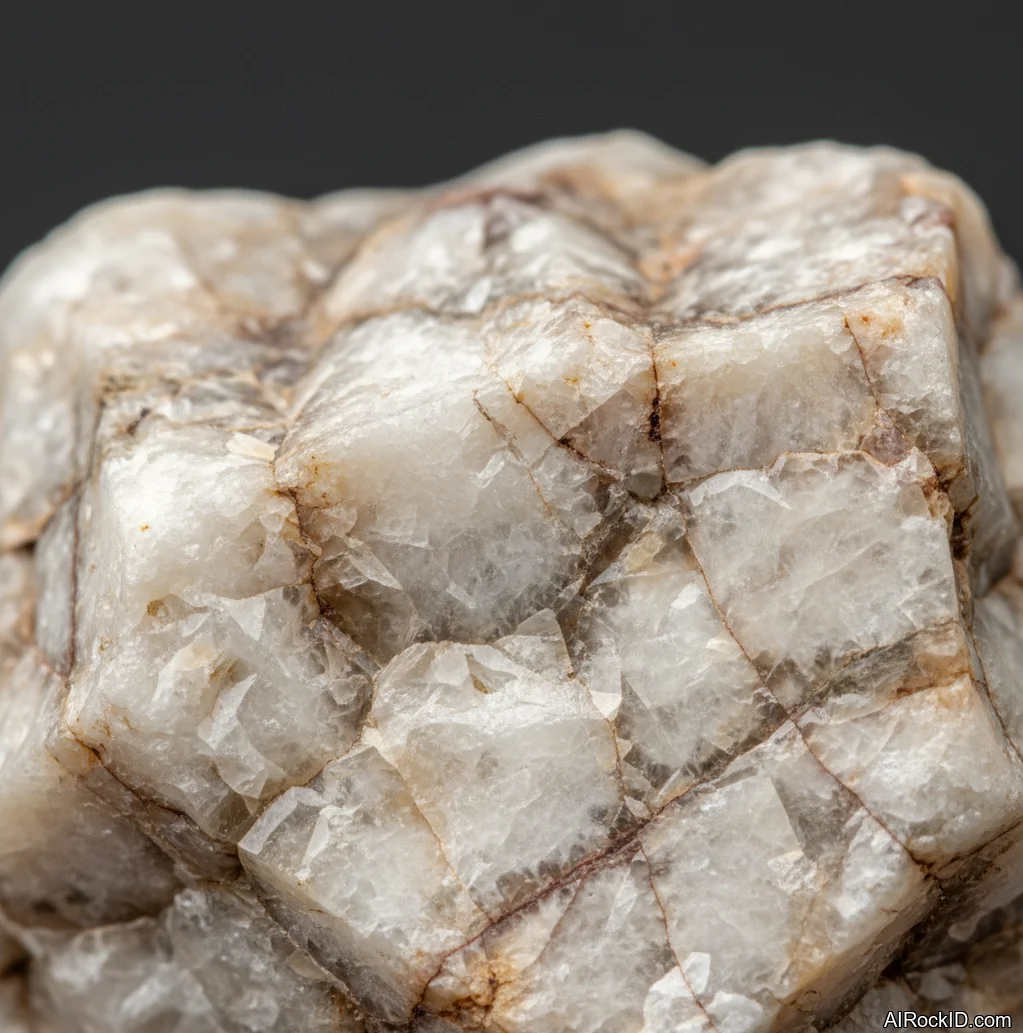
Grab a palm stone and you notice that steady quartz weight straight away. It hits your skin cool at first, then it warms up slowly, like it’s taking its time. And the pattern really does look like somebody shattered porcelain and then glued it back with smoky gray or rusty brown lines. Some pieces run almost snowy, with that fine hairline webbing. Others are more “tile-like,” with chunkier fragments where the breccia clasts are big enough to count one by one.
Most of what you’ll see for sale is tumbled or cut into cabochons, since brecciated material can take a clean polish when it’s solidly cemented. But here’s the catch: not every piece is equally tight. I’ve handled batches where a few stones had tiny undercut pits along the darker seams, and you can catch them with a fingernail even after a polish (annoying, right?).
Origin & History
People have been describing and selling jasper since antiquity, but “brecciated jasper” isn’t really a strict mineral species. It’s more of a lapidary and field term. “Breccia” comes from the Italian word for broken rubble, and that’s the whole idea: you’re literally looking at a rock made of broken fragments cemented back together (kind of like nature glued it and moved on).
White Brecciated Jasper is a name you’ll mostly see in the modern gem trade to separate the pale, high-contrast stuff from the more common red brecciated jasper. Thing is, most dealers are using it as a pattern and color label, not a formal locality name, so two pieces sold under the same tag can come from completely different deposits. And you can usually spot that in hand: one piece might have crisp, angular shards and sharp color breaks, while another has softer edges and a more washed-out look.
Where Is White Brecciated Jasper Found?
Brecciated jasper turns up anywhere you have silica-rich fluids and rock that’s been cracked and re-cemented, so it’s found in multiple countries and geologic settings.
Formation
Look at the pattern for a minute and you can kind of tell what happened. You start with a brittle host rock that snaps, usually from fault movement, an impact, or rapid changes in stress. Then silica-rich fluids push through those fresh fractures. Given time, that silica turns into a gel and then hardens into chalcedony and microcrystalline quartz, basically welding the broken bits back together.
A lot of the white, brecciated stuff stays light because the silica is relatively clean. But the gray, tan, or rusty seams? That’s usually iron oxides, clay, or a fine-grained matrix that got dragged into the cracks. Compared to banded agate, breccia jasper looks like a mess. And that’s the whole idea. It isn’t laying down neat layers, it’s patching damage.
If you ever have a slab in your hand and you notice the “cement” goes a little translucent right along the edges, that’s a good clue. It’s chalcedony doing the glue work, not just mudstone sort of holding everything together (you can usually see it when you tilt it under a light).
How to Identify White Brecciated Jasper
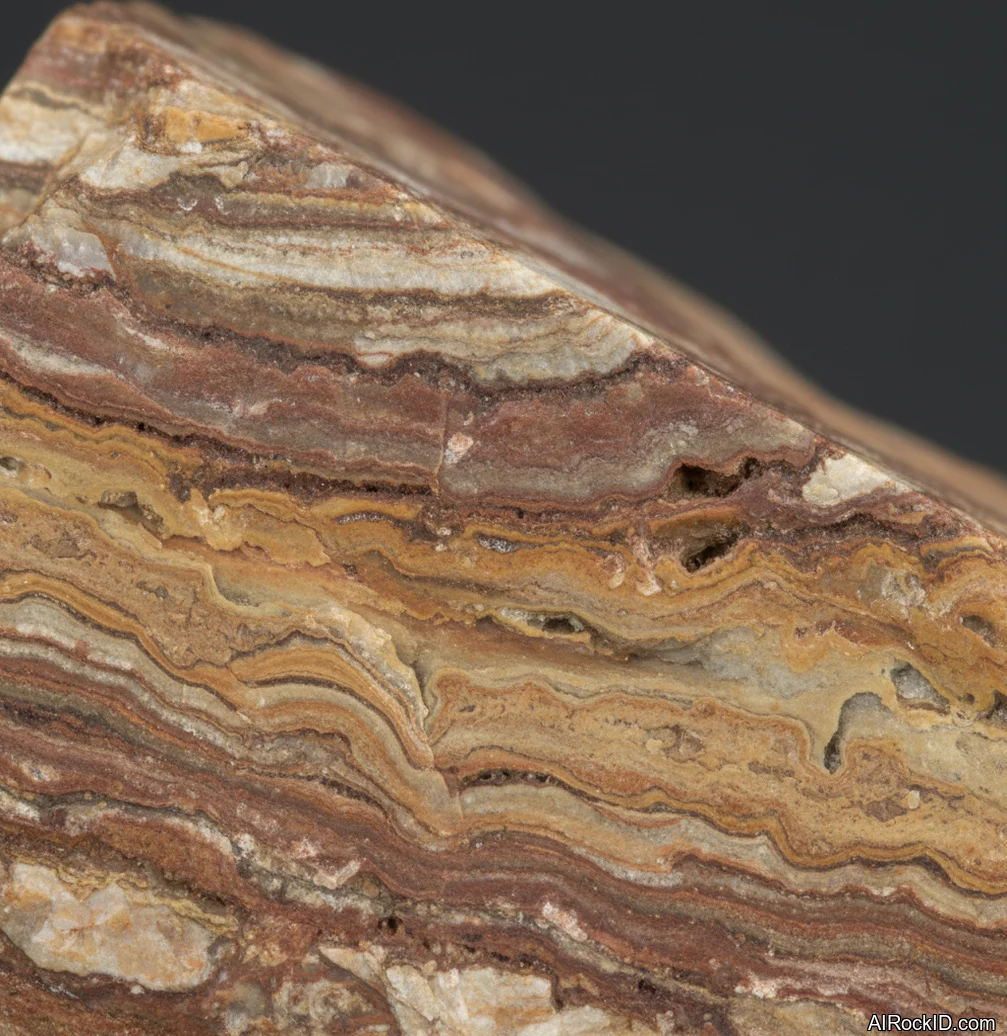
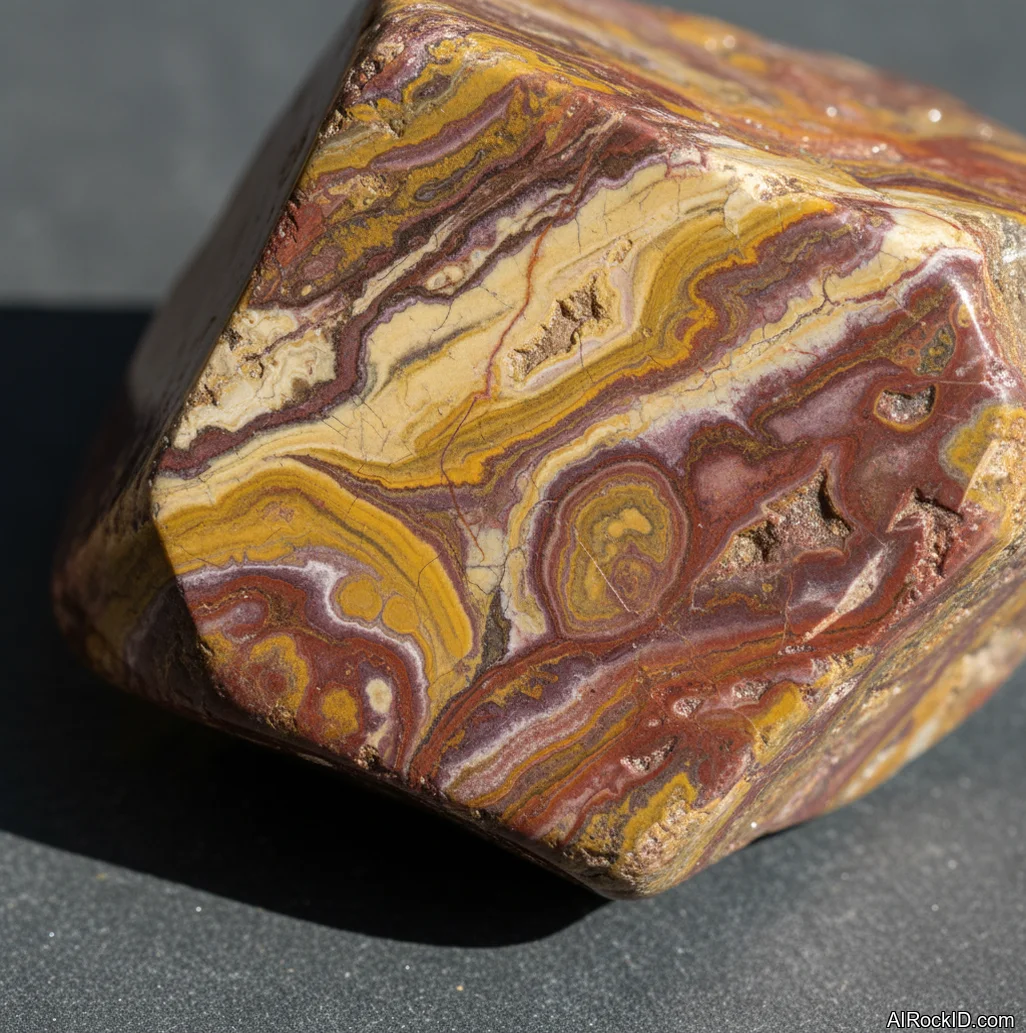
Color: Mostly white to off-white with angular fragments, cut by gray, tan, brown, or rusty red veining and patchy matrix. Patterns look cracked, tiled, or mosaic-like rather than banded.
Luster: Waxy to vitreous when polished, usually more waxy on a fresh broken surface.
Pick up a tumbled piece and run your thumb across the dark seams. If they feel slightly lower than the white areas, it’s a softer matrix and the polish may undercut over time. If you scratch it with a steel nail, it shouldn’t bite easily, but it will scratch glass like any quartz-rich jasper. The real test is a loupe: you’ll see sugary microcrystalline texture, not big individual crystals or sparkly mica plates.
Common Look-Alikes
White Brecciated Jasper is sometimes confused with these materials:
- Howlite or magnesite (often dyed gray or tan to mimic breccia veining)
- White marble or calcite (especially when it has gray veining and is sold as “jasper” palm stones)
- Brecciated quartz/chalcedony sold as “white brecciated jasper” (same look, but marketed differently)
- White “spiderweb” jasper (trade name material with black/gray webbing that can look like fine breccia lines in photos)
- Dyed crackle quartz/chalcedony (dye settles into the fracture network and fakes that glued-together breccia look)
- White/gray resin or reconstituted stone (powder + glue blocks cut into palm stones, sometimes passed off as brecciated jasper)
Market Cautions & Treatments
When AI Can Get This Wrong
At first glance, photo ID gets tripped up by anything white with webbing: howlite, magnesite, spiderweb “jasper,” even veined marble. The real test is simple in hand: White Brecciated Jasper should be hard enough to scratch glass and it won’t fizz on a drop of vinegar, while marble and calcite will. Pick up both and you’ll feel it, too: quartz-based jasper stays cool longer and sits heavier than the chalkier howlite/magnesite look-alikes.
Properties of White Brecciated Jasper
Physical Properties
| Crystal System | Trigonal |
| Hardness (Mohs) | 6.5-7 (Hard (6-7.5)) |
| Density | 2.58-2.64 |
| Luster | Waxy |
| Diaphaneity | Opaque |
| Fracture | Conchoidal |
| Streak | White |
| Magnetism | Non-magnetic |
| Colors | White, Cream, Gray, Tan, Brown, Rust red |
Chemical Properties
| Classification | Silicates |
| Formula | SiO2 |
| Elements | Si, O |
| Common Impurities | Fe, Mn, Al |
Optical Properties
| Refractive Index | 1.53-1.54 |
| Birefringence | None |
| Pleochroism | None |
| Optical Character | Uniaxial |
White Brecciated Jasper Health & Safety
You can handle it without worry, and it’s fine in water too, same as most quartz-heavy jaspers. The one thing to watch out for? Silica dust if you’re cutting or grinding it, especially once that fine powder starts hanging in the air and settling on everything.
Safety Tips
If you’re sanding or doing cabbing, keep it wet and don’t do it dry. Put on a real respirator that’s actually rated for fine silica dust, not just a paper mask.
White Brecciated Jasper Value & Price
Price Range
Rough/Tumbled: $3 - $25 per palm stone or tumble
Cut/Polished: $1 - $6 per carat
Prices jump when the breccia pattern has that sharp, high-contrast look, and the seams take a polish that feels slick under your fingertips instead of getting peppered with little pits. Big, clean slabs cost more too. Thing is, the stone has to be well-cemented to make it through cutting without falling apart (you can hear it when it’s not, kind of a dull, crumbly sound).
Durability
Very Durable — Scratch resistance: Excellent, Toughness: Good
It’s stable in normal light and air, but softer seam material can undercut if it gets knocked around or aggressively polished.
How to Care for White Brecciated Jasper
Use & Storage
Store it like you would other jaspers: separate from softer stones so it doesn’t scratch them, and pad polished pieces so the seams don’t get chipped on corners.
Cleaning
1) Rinse with lukewarm water. 2) Wash with mild soap using a soft brush for seam lines. 3) Rinse well and dry with a cotton cloth.
Cleanse & Charge
For a simple reset, rinse and let it air dry, or leave it on a shelf overnight away from direct sun. If you do smoke cleansing, keep soot off polished faces so it doesn’t dull the shine.
Placement
On a desk, it reads like a little geology lesson and it won’t baby-scratch like selenite. I like it where I can actually pick it up, because the texture changes from smooth white to slightly grippy seam lines.
Caution
Skip harsh acids and scratchy abrasive cleaners. And don’t toss anything into an ultrasonic cleaner if the seams have that crumbly, porous matrix that flakes a little when you touch it.
Works Well With
White Brecciated Jasper Meaning & Healing Properties
At first glance, White Brecciated Jasper sits firmly in “quiet stone” territory. It isn’t flashy. That’s exactly why I keep a chunk in my work bag, knocking around next to my keys and a half-crushed receipt. When I get fidgety, that broken-then-stitched-back-together look gives my brain somewhere to park without yanking my attention the way a glittery druzy will.
In crystal lore, brecciated jaspers get mentioned a lot for steadiness, and for helping you get your feet back under you when things feel cracked or scattered. I’m not going to pitch it as medicine. But as a tactile tool, it does the job. Grab a cool palm stone, feel that little chill it holds even after it’s been sitting in your hand a minute, and run your thumb along the seams (the tiny ridges catch, just slightly). It’s basically a built-in grounding exercise.
But don’t mix up “grounding” with “sedating.” Some pieces have a busy mosaic pattern that actually snaps my eyes awake, especially under those harsh bright shop lights that make everything look sharper than it is. If you want a calmer vibe, pick material with broader white fields and fewer dark fracture lines. And if you’re buying online, ask for a photo in natural light, because warm lighting can make the seams look more dramatic than they really are.
Common mistakes
- Assuming every white stone with gray lines is jasper; howlite and magnesite are common substitutes.
- Judging authenticity by color alone instead of checking hardness, translucency, and pattern structure.
- Confusing natural brecciation with damage; breccia is a rock texture formed from broken fragments cemented together.
- Overlooking dye disclosure on very high-contrast black-and-white beads.
- Using acid or scratch tests on finished jewelry without considering possible damage to polish or settings.
Identify White Brecciated Jasper from a photo
Compare White Brecciated Jasper traits, care tips, value clues, and common lookalikes with a clear photo.