Black Opal
What Is Black Opal?
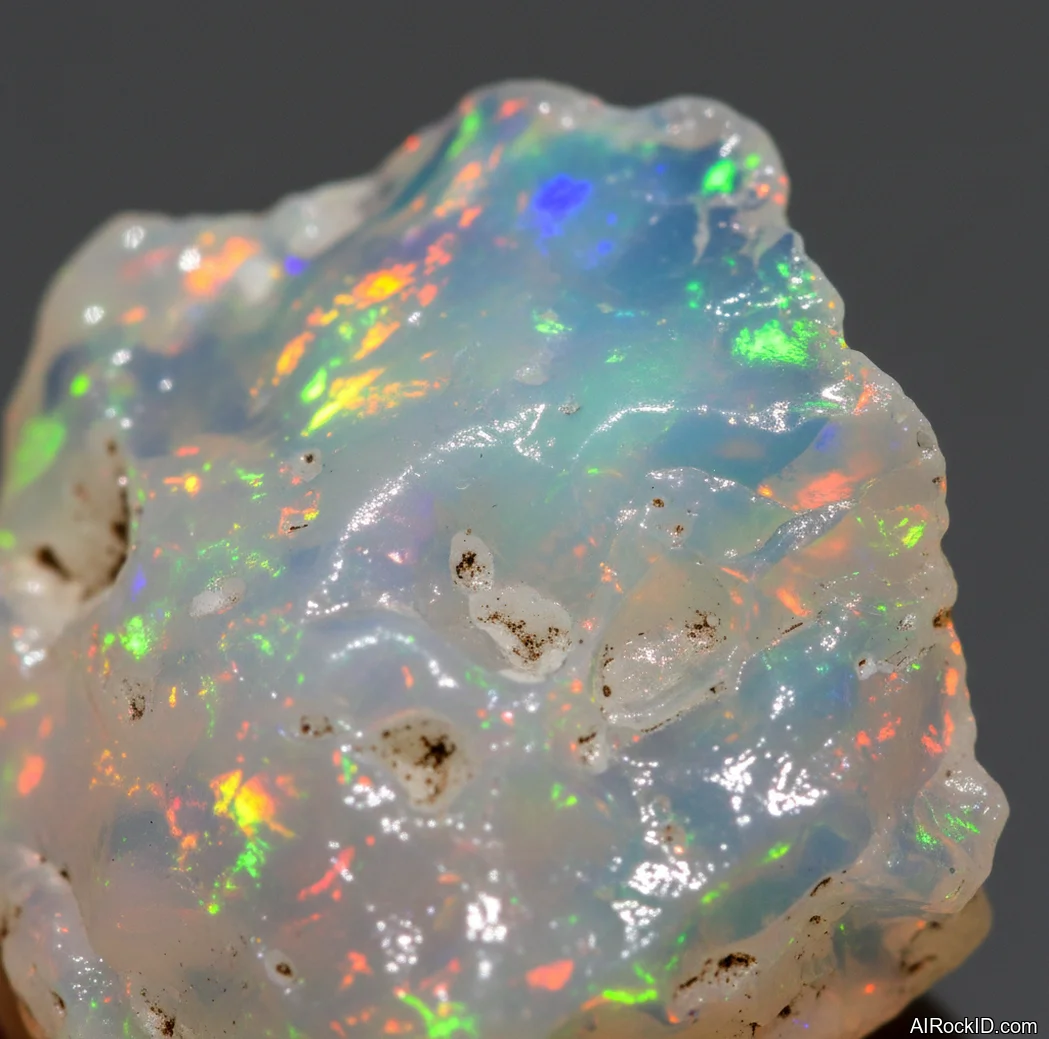
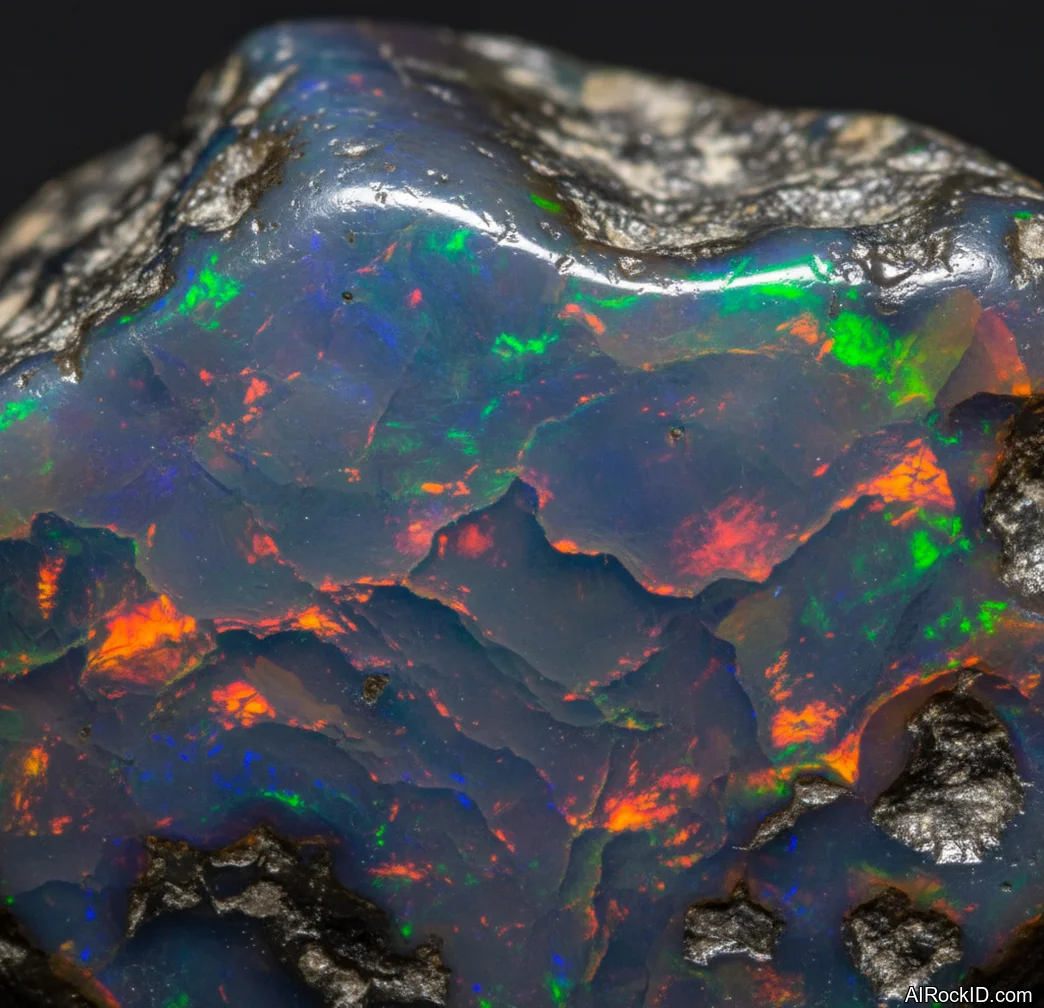
Black opal is still opal, just with a dark gray to jet-black body tone, and it shows play-of-color.
Look, at first glance most people think it’s going to read like onyx. But then you tip it a few degrees and the color jumps out, like somebody flicked on tiny LEDs inside the stone. And a good black opal won’t just throw one shade at you, either. It can slide from green to electric blue, then smack you with a red pinfire when you catch the angle just right.
Pick one up and you’ll feel it right away. It doesn’t have that hard, glassy vibe quartz has. It’s lighter, a bit softer, and it warms up in your palm quicker than you’d expect. Thing is, if you’ve handled enough opal, you start to recognize the skin of it (sounds weird, but you know what I mean). Polished opal has this slick, almost waxy glide under your thumb, but it still comes off gentler than a corundum or spinel cab.
Origin & History
“Opal” has been around forever as a word. It runs back through the Latin *opalus*, which ties into older terms that basically meant “precious stone,” and if you keep going you end up at the Sanskrit *upala*, just “stone.” Black opal, though? That’s a much newer trade label, and it’s based on body tone grading, not on opal being some different species.
Thing is, when most collectors say “black opal,” they’re picturing Lightning Ridge in Australia. And it makes sense. That district is what turned black opal into a headline gem in the late 1800s and early 1900s, once the fields were getting worked and the stones started showing up in the broader jewelry market. Walk into a shop and you’ll still hear dealers talk about classic Ridge patterns like harlequin and rolling flash, the way people talk about famous baseball cards. Like, you can almost see them tilting the stone under the counter light to catch the color (you know the move).
Where Is Black Opal Found?
Fine black opal is most strongly associated with Lightning Ridge in New South Wales, Australia, with other dark-body opal coming from a handful of deposits worldwide.
Formation
Look closely at opal and you’re basically staring at silica that never quite got its act together and turned into quartz. It starts when silica-rich water seeps through rock, then, as conditions shift, it leaves behind microscopic silica spheres in cracks, cavities, and seams. Give it time and those tiny spheres can stack just right to bend light, and that’s the whole reason you see that play-of-color.
Black opal? It’s as much about the background as it is about the flashes. Out at Lightning Ridge, a lot of the opal sits in Cretaceous sediments and claystone, and that dark body tone is linked to carbonaceous material and iron oxides in the host rock and in the opal itself. But here’s the headache: two seams only a few meters apart can act like they’re from different planets. One’s just gray potch. The next one over throws bright color. And no, you can’t sweet-talk it into showing up.
How to Identify Black Opal
Color: Body tone ranges from dark gray to black, with play-of-color that can include green, blue, yellow, orange, and red in patches, pinfire, or broad flashes.
Luster: Waxy to vitreous luster when polished.
Pick up the stone and tilt it under a single bright light. Real play-of-color shifts with angle, while many fakes just look like static glitter. The real test is the body tone plus depth, good black opal looks like color is sitting under a skin, not painted on top. And if you can, use a loupe: doublets and triplets often show a clear cap line or a dark backing at the edge.
Properties of Black Opal
Physical Properties
| Crystal System | Amorphous |
| Hardness (Mohs) | 5.5-6.5 (Medium (4-6)) |
| Density | 1.98-2.25 |
| Luster | Waxy |
| Diaphaneity | Opaque |
| Fracture | Conchoidal |
| Streak | White |
| Magnetism | Non-magnetic |
| Colors | Black, Dark gray, Blue, Green, Yellow, Orange, Red, Multicolor |
Chemical Properties
| Classification | Silicates |
| Formula | SiO2·nH2O |
| Elements | Si, O, H |
| Common Impurities | C, Fe |
Optical Properties
| Refractive Index | 1.37-1.47 |
| Birefringence | None |
| Pleochroism | None |
| Optical Character | Isotropic |
Black Opal Health & Safety
Black opal’s safe to handle, and it isn’t considered toxic. The real issue isn’t you getting hurt, it’s the stone taking a hit. Drop it on a hard floor or bang it against something and you’ll see what I mean (tiny chips happen fast).
Safety Tips
Don’t hit it with high heat. Skip the harsh cleaners too. And try not to shock it with fast temperature swings, like going from cold water to hot. When you put it away, tuck it somewhere it won’t rattle around and smack into harder gems (those little knocks add up).
Black Opal Value & Price
Price Range
Rough/Tumbled: $50 - $5,000+ per piece
Cut/Polished: $200 - $20,000+ per carat
Body tone, brightness, the pattern (harlequin, broadflash, that kind of thing), and how much red you’re actually seeing can swing the price in a hurry. But if there are cracks, those little “sand” pepper spots you can feel with a fingernail, thin color bars, or anything that hints it’s a doublet or triplet, the value drops fast.
Durability
Nondurable — Scratch resistance: Fair, Toughness: Fair
Opal can craze or crack from dehydration, heat, or sudden temperature swings, so stability depends a lot on how it’s stored and worn.
How to Care for Black Opal
Use & Storage
Store black opal in a padded box or soft pouch, away from diamonds and sapphire that can scratch it. If your climate is very dry, don’t leave it sitting out on a sunny shelf for months.
Cleaning
1) Wipe with a soft damp cloth using lukewarm water. 2) If needed, use a tiny drop of mild soap and rinse gently. 3) Pat dry and let it air dry before storing.
Cleanse & Charge
For ritual cleansing, stick to smoke, sound, or a quick pass under cool running water, then dry it well. Skip salt bowls and long soaks if you’re trying to keep the polish pristine.
Placement
Keep it out of direct sun and away from heat vents. In a display case, I like it on a soft stand so you can tilt it and catch the flash without it sliding.
Caution
Don’t use an ultrasonic cleaner or a steam cleaner on it. And skip wearing black opal for workouts, gardening, or any kind of job where it might get knocked around.
Works Well With
Black Opal Meaning & Healing Properties
Put black opal next to clear quartz or amethyst and it just hits different. It feels moodier in your palm. Not creepy. Just… inward. When I’m at the table sorting fresh buys, it’s the stone I keep grabbing without meaning to, because that color shift makes your brain slow down and actually stare. Tilt it a hair and the blues pop. Turn it again and you get that rolling green flash that looks like it’s moving under the surface.
In the metaphysical world, people link black opal with protection, grounding, and big, messy emotions. And look, I’ll say it the same way I say it at a gem show: it’s not medicine. It won’t replace therapy or a doctor. But as a focus object? Yeah, it can be really good for journaling or meditation, since the play-of-color gives your eyes something to follow while you breathe (like a little visual anchor you can keep coming back to).
But here’s the part people don’t say often enough. Some black opal can be a lot. Especially those brighter pieces with that constant, rolling flash that won’t sit still. If you’re already anxious, that kind of stimulation can make it worse, not better. So you might find a calmer stone like smoky quartz easier to hold and sit with, and then circle back to opal when you actually want something more intense. Why force it?
Identify Any Crystal Instantly
Snap a photo and get properties, value, care instructions, and healing meanings in seconds.