Blue Flower Agate
What Is Blue Flower Agate?
Blue Flower Agate is a blue-toned variety of chalcedony (microcrystalline quartz) with flower-like plume inclusions.
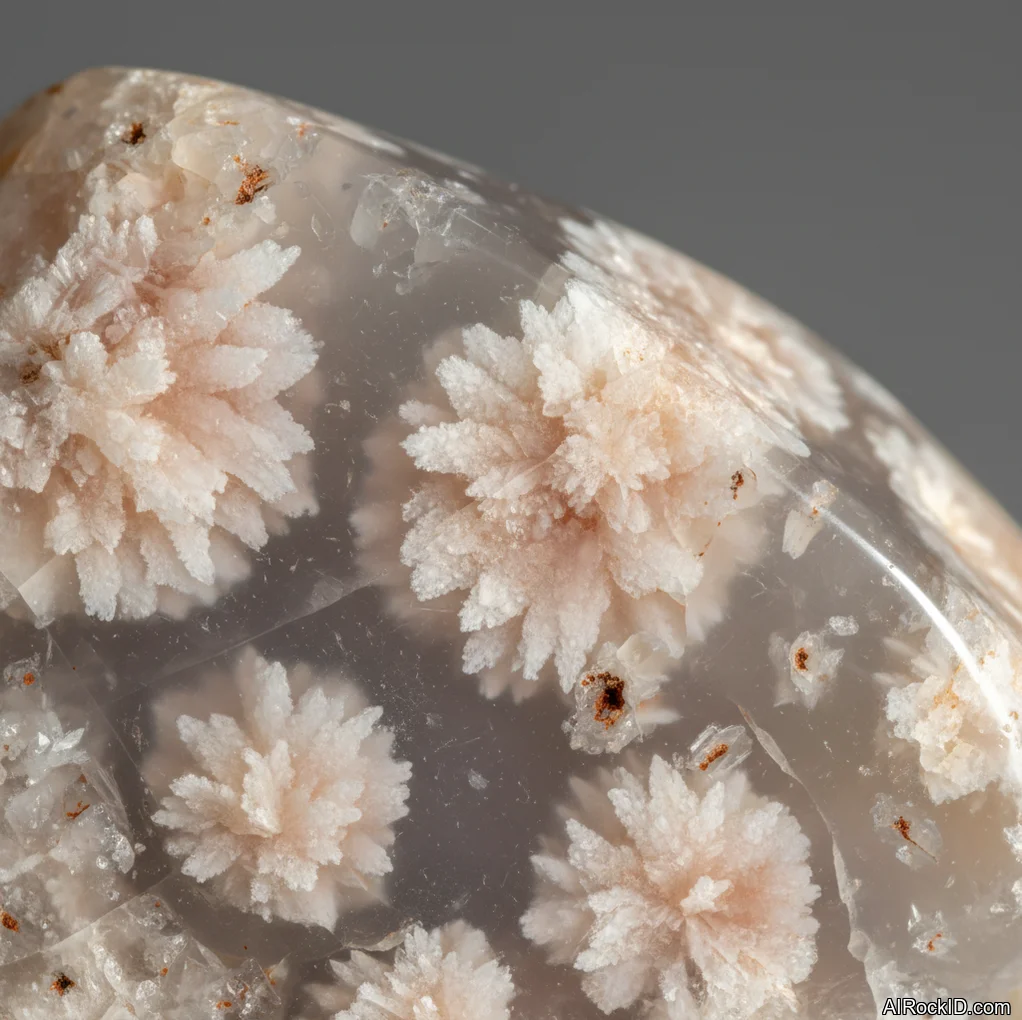
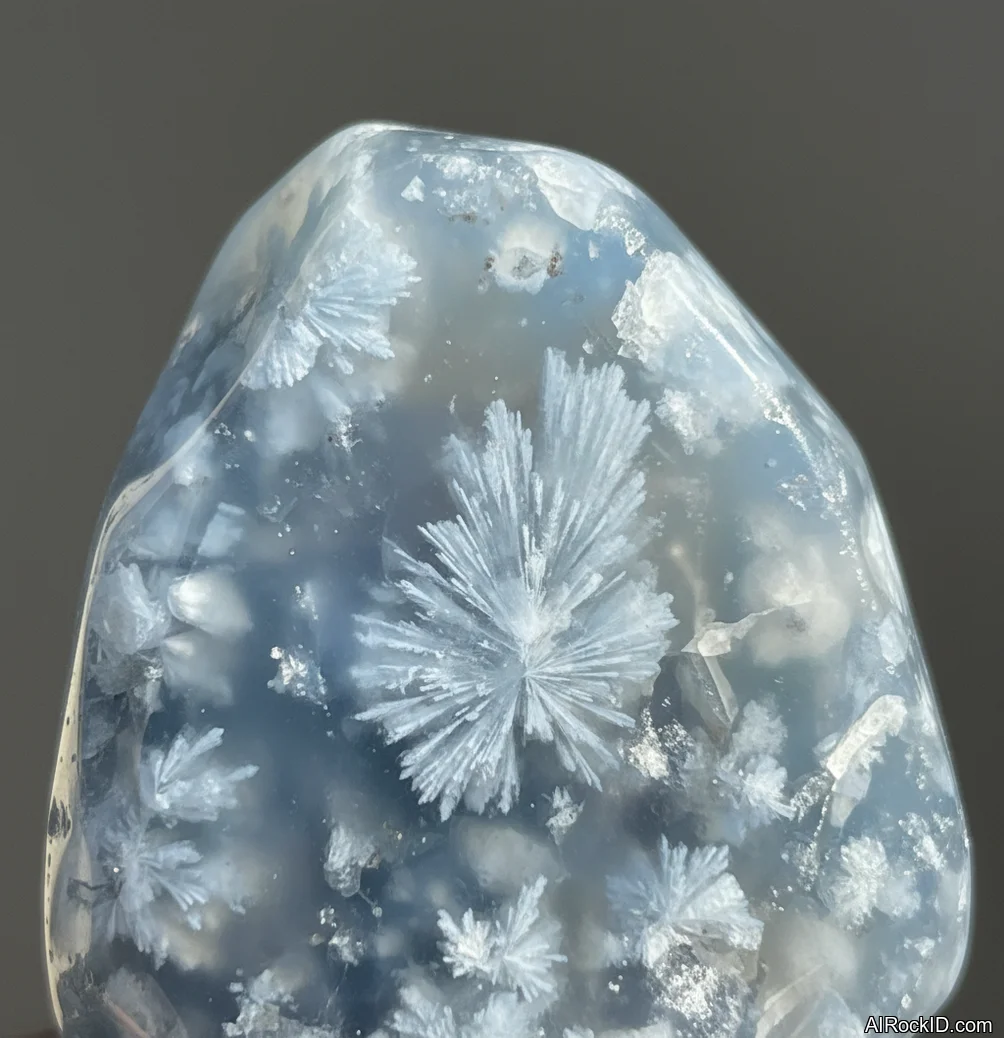
Look, the first time you see it, it honestly looks like someone flicked tiny drops of ink into milky chalcedony and then hit pause mid-swish. Weirdly satisfying. The “flowers” aren’t petals (obviously). They’re soft plumes and little sprays trapped inside the stone, usually white, gray, or that powdery blue, sitting on a background that runs from sky blue to denim.
And if you pick up a palm stone, you feel it immediately. Cool like quartz always is, and it doesn’t have that plasticky vibe dyed material can get. Most pieces you run into are polished into towers, freeforms, slabs, even little display faces, because the pattern shows up way better on a flat surface than it does on a rounded tumble.
Origin & History
“Agate” traces back to the Achates River in Sicily (modern Dirillo). It’s an old-school name that got recycled for pretty much any banded chalcedony people ran into. “Flower agate,” though, is just a trade label, not an official mineral name, and it showed up fairly recently when dealers started splitting plume and blossom-pattern chalcedonies off into their own buckets.
Blue Flower Agate lives in that same plume-agate neighborhood. It wasn’t “first described” like somebody found a brand-new mineral species and filed paperwork. It’s more like a look that caught on once enough rough started showing up at gem shows and in online shops, and once cutters noticed that blue base color photographs insanely well under shop lights (seriously, it pops).
Where Is Blue Flower Agate Found?
Most Blue Flower Agate on the market is sold as a Madagascar-type plume chalcedony, with other plume agates in similar colors coming out of Brazil, India, Indonesia, and parts of the western USA.
Formation
Look close and you can usually spot the rhythm in it. It didn’t all form at once. Chalcedony seeps into cavities and fractures in volcanic rock in pulses, stacking up layer by layer as silica-rich fluids cool, then gel, then do it again over time.
That “flower” pattern? It’s from plume inclusions that grew while the silica was still going down. Picture tiny mineral filaments, or those dendritic little sprays, getting caught in place as the chalcedony sealed the pocket shut (like watching frost creep across a window, only trapped in stone). The blue color usually comes from trace elements plus the way light scatters through microcrystalline silica, sometimes pushed a bit by iron or other impurities. And yeah, some of the super-blue pieces you see online are dyed. Whole separate headache, honestly.
How to Identify Blue Flower Agate
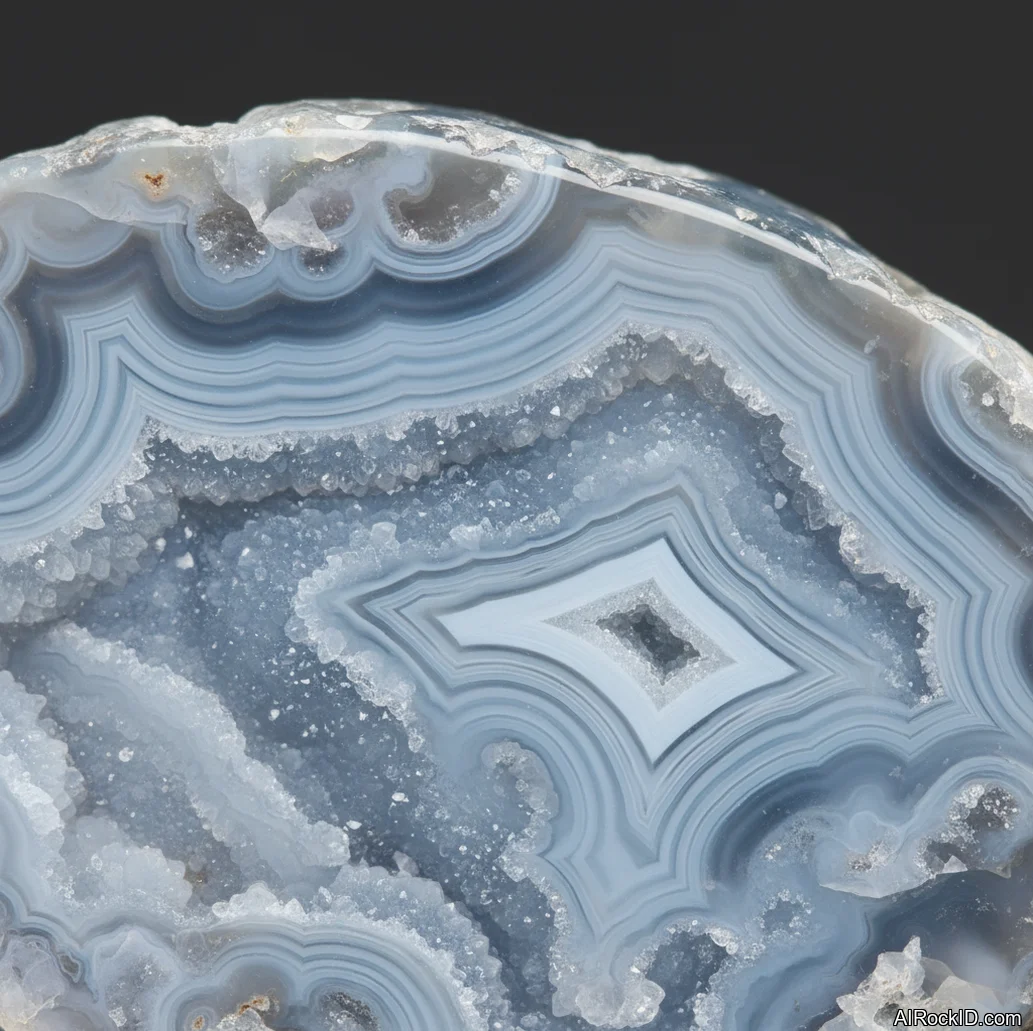
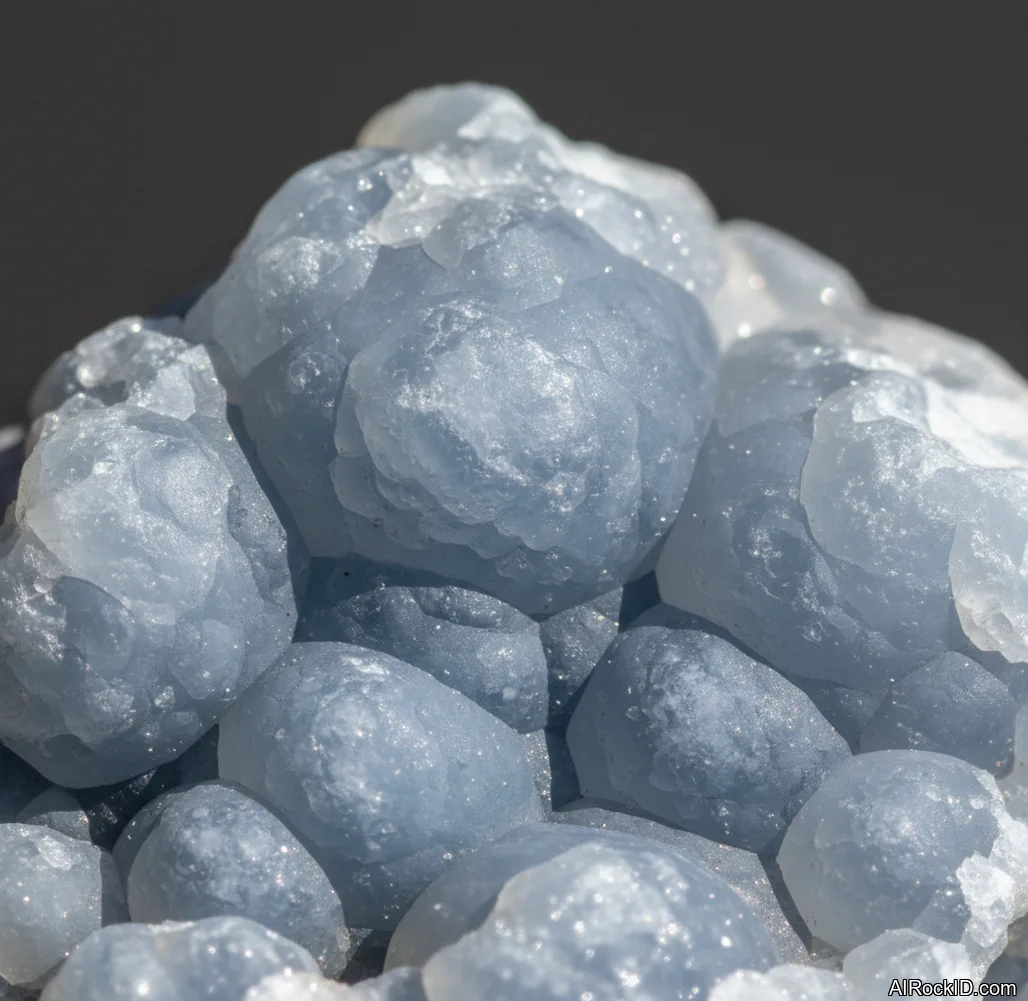
Color: Base color ranges from pale icy blue to medium denim-blue, usually with white to gray-blue plume “flowers” floating inside. Some pieces show faint banding, but the plumes are the main event.
Luster: Polished surfaces show a waxy to vitreous luster, like most good chalcedony.
Pick up a piece and check the temperature. Real chalcedony stays cool in your hand longer than glass or resin. If you scratch it with a steel nail, it shouldn’t take a mark, but it will scratch common window glass at Mohs 7. And watch for dye: color pooled in fractures, super-uniform electric blue, or blue that concentrates around the edges is a red flag.
Properties of Blue Flower Agate
Physical Properties
| Crystal System | Trigonal |
| Hardness (Mohs) | 6.5-7 (Hard (6-7.5)) |
| Density | 2.58-2.64 g/cm3 |
| Luster | Waxy |
| Diaphaneity | Translucent to opaque |
| Fracture | Conchoidal |
| Streak | White |
| Magnetism | Non-magnetic |
| Colors | Light blue, Sky blue, Gray-blue, White, Gray |
Chemical Properties
| Classification | Silicates |
| Formula | SiO2 |
| Elements | Si, O |
| Common Impurities | Fe, Mn, Al |
Optical Properties
| Refractive Index | 1.530-1.540 |
| Birefringence | None |
| Pleochroism | None |
| Optical Character | Uniaxial |
Blue Flower Agate Health & Safety
Blue Flower Agate is non-toxic, so it’s safe to hold in your hand. Thing is, like any silica-based stone, the solid chunk isn’t the problem. The real risk shows up when you cut or grind it and that super-fine dust gets in the air (the kind that clings to your fingertips and leaves a faint grit on the workbench).
Safety Tips
If you’re shaping it, keep a spray bottle or hose handy to wet things down, make sure you’ve got decent airflow, and wear a proper respirator that’s actually rated for silica dust. (Not a flimsy paper mask.)
Blue Flower Agate Value & Price
Price Range
Rough/Tumbled: $5 - $120 per piece
Cut/Polished: $2 - $12 per carat
Price bounces around depending on how crisp the pattern is, how “3D” those plumes actually look when you tilt it, and how clean the polish comes across up close. Thing is, with online listings the lighting can crank the blue way up, so it ends up looking louder on screen than it does in normal room light.
Durability
Durable — Scratch resistance: Good, Toughness: Good
It’s stable like most quartz, but dyed material can fade if it lives in strong sun for months.
How to Care for Blue Flower Agate
Use & Storage
Store it like you’d store any polished quartz. Keep it from rubbing against softer stones that can pick up scuffs, and separate it from harder stuff like topaz that can scratch the polish.
Cleaning
1) Rinse with lukewarm water. 2) Use a drop of mild soap and a soft brush for skin oils. 3) Rinse again and dry with a microfiber cloth.
Cleanse & Charge
Running water, smoke, or a night on a clean selenite plate all work fine for most people’s routines. If you suspect dye, skip long sun baths and stick to gentle methods.
Placement
On a desk, it reads calm and tidy because the pattern looks like little clouds. If you’ve got a shelf with backlighting, set it where light can pass through the thinnest edge for the best depth.
Caution
Skip harsh chemicals and don’t use an ultrasonic cleaner, especially if the piece has any fractures or there’s stabilizing resin in it. And if the material looks dyed, don’t park it in a sunny window either. Why risk the color fading?
Works Well With
Blue Flower Agate Meaning & Healing Properties
Most dealers sell Blue Flower Agate as this gentle, steadying stone, and honestly, that tracks with how it feels when you actually use it.
When I’m sorting inventory at a show, I’ll toss a palm stone in my pocket. Not for the “vibes,” exactly. It’s the cool weight sitting against your leg, the slick polish, the way the edges feel slightly rounded from being handled a thousand times. Simple. You run your thumb over that smooth spot and, for a minute, your brain quits sprinting.
People also link the “flower” pattern to growth stuff, like starting small and letting it build into something real. I get it. Those plumes look like tiny bursts frozen in place (almost like someone paused a little firework mid-pop), and it’s easy to stare at them while you journal and use them as a visual anchor when you’re trying to stay on track. Why not?
But look, here’s the honest catch. If you’re waiting for some dramatic jolt of energy, this isn’t that kind of stone. It’s more like background support. Quiet. And the effect is mostly about attention and ritual, not medicine.
Thing is, if anxiety or sleep is a serious issue, crystals can feel comforting in your hands, sure, but they don’t replace real care.
Identify Any Crystal Instantly
Snap a photo and get properties, value, care instructions, and healing meanings in seconds.