Candle Quartz
What Is Candle Quartz?
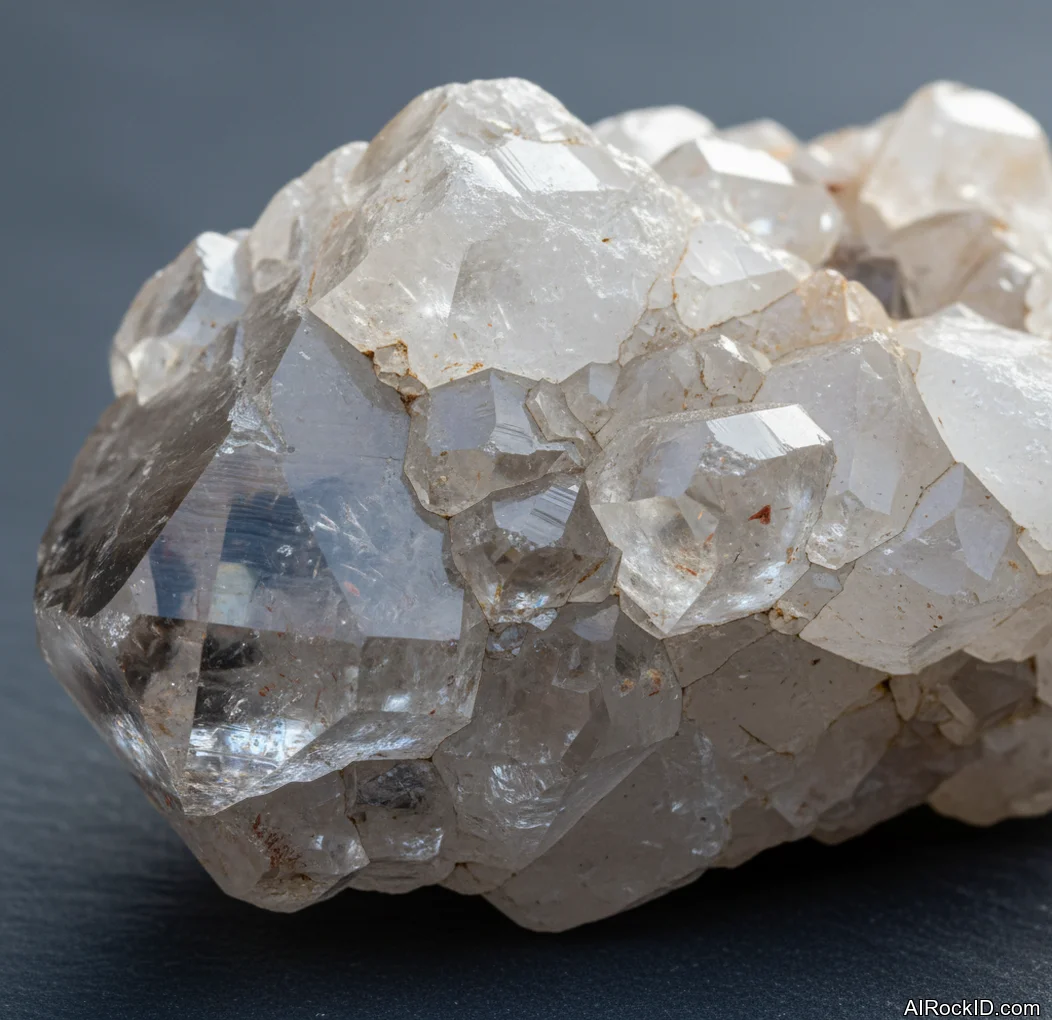
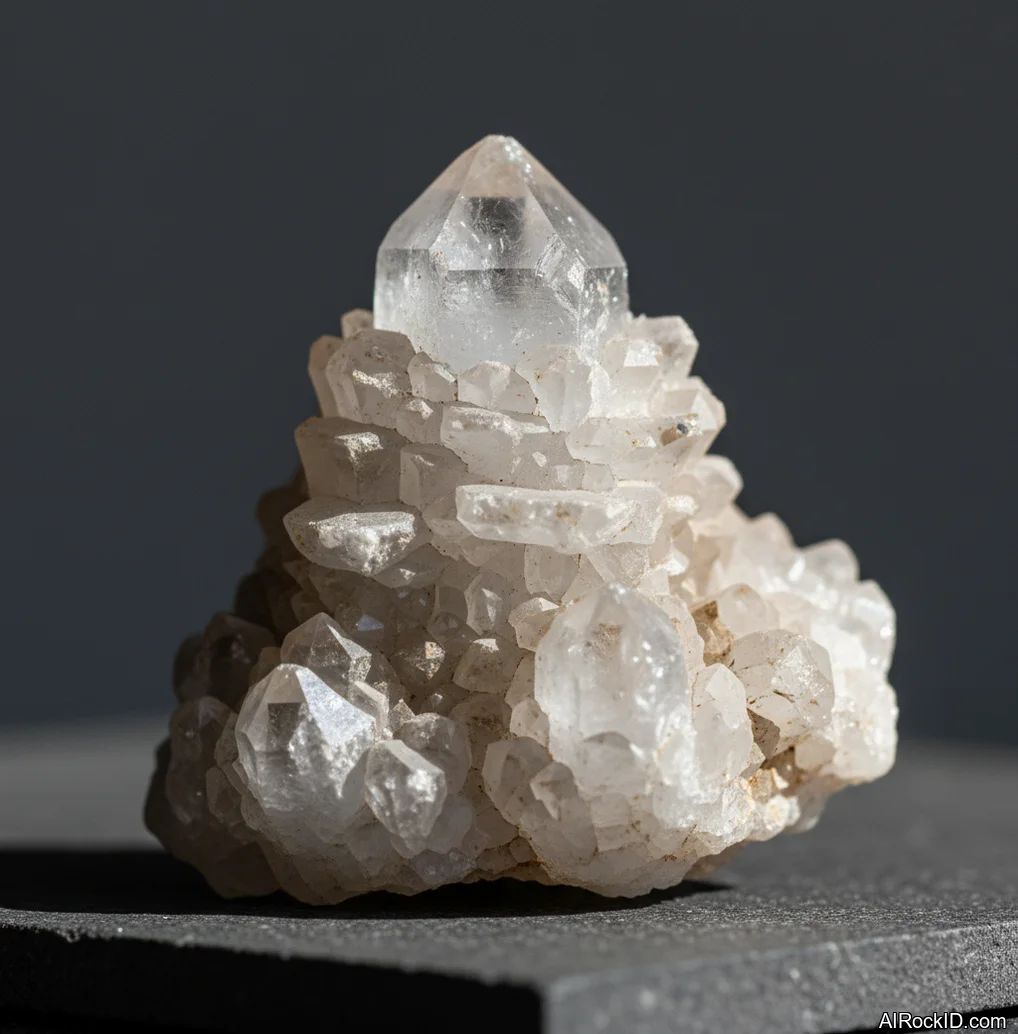
Candle Quartz is just quartz that grew in a weirdly specific way: the surface piles up in stacked layers around a point, like candle wax that dripped and then stopped mid-run. From a distance, sure, it reads as a regular quartz point. But then you tilt it and those little ridges jump out, like tiny frozen drips climbing up the sides.
Hold one and it’s got that familiar quartz heft. Nothing surprising there. But the feel gives it away fast. Your thumb snags on the terraces as you turn it under a lamp, and you can almost “count” the steps without trying. Some pieces stay glassy and clear near the tip, then get cloudy and sugary down the body (that grainy-looking stuff). Others are frosty all the way. And look, if you’ve handled enough quartz, you start to notice when the layering is real versus when someone’s sandblasted it to fake that matte, etched finish. The fake ones feel kind of uniformly rough, like the texture’s been sprayed on, not grown.
Most dealers call it “Candle Quartz” as a trade name, not because it’s some strict mineral species. So yeah, it overlaps with other quartz habits. Sometimes you’ll see a main point with a bunch of little side points stuck on. Sometimes it’s one crystal that just has really heavy stepped growth. That’s normal. It’s still quartz, just quartz that happened to grow in a way that left it looking like it was built up in layers.
Origin & History
Candle Quartz isn’t some formal, old-school mineral name like “amethyst” or “smoky quartz.” It’s a newer trade label that really caught on in the specimen world once those more textured quartz points started showing up out of Brazil (and a few other spots).
And yeah, the “candle” part is basically literal. Dealers were reaching for a quick way to explain that wax-drip, layered surface you can actually feel with your fingertip, and the name stuck because you can picture it in two seconds. So you might also hear “candlelight” or “candelabra” when a piece has extra side points. But none of these labels are regulated, so two sellers can look at the same crystal and call it two different things.
Where Is Candle Quartz Found?
Candle Quartz is most often sold from Brazilian quartz areas, especially Minas Gerais, but similar layered-growth quartz can show up anywhere quartz crystals grow in open space.
Formation
This habit usually turns up in rough chunks pulled from pegmatites and hydrothermal veins. Quartz needs elbow room to grow, and it also needs silica-rich fluids pushing through cracks or little pockets in the rock. When the conditions change mid-growth, like temperature swings, pressure shifts, chemistry changing, or the fluid speeding up or slowing down, the crystal can flip between smooth faces and that stepped, layered kind of build-up.
Look closely at those “drips” and you’re basically staring at a growth log. The ridges? Those are growth zones that stacked up over time. It’s not melting. Not wax. Just quartz being quartz, except it grew in fits and starts instead of forming those perfectly slick, textbook points. But here’s the thing: a lot of quartz gets cleaned pretty aggressively after it’s mined, and heavy acid baths or rough mechanical scrubbing can make the texture pop more than it did in the ground, so you’ve gotta keep the context in mind when you’re judging a piece.
How to Identify Candle Quartz
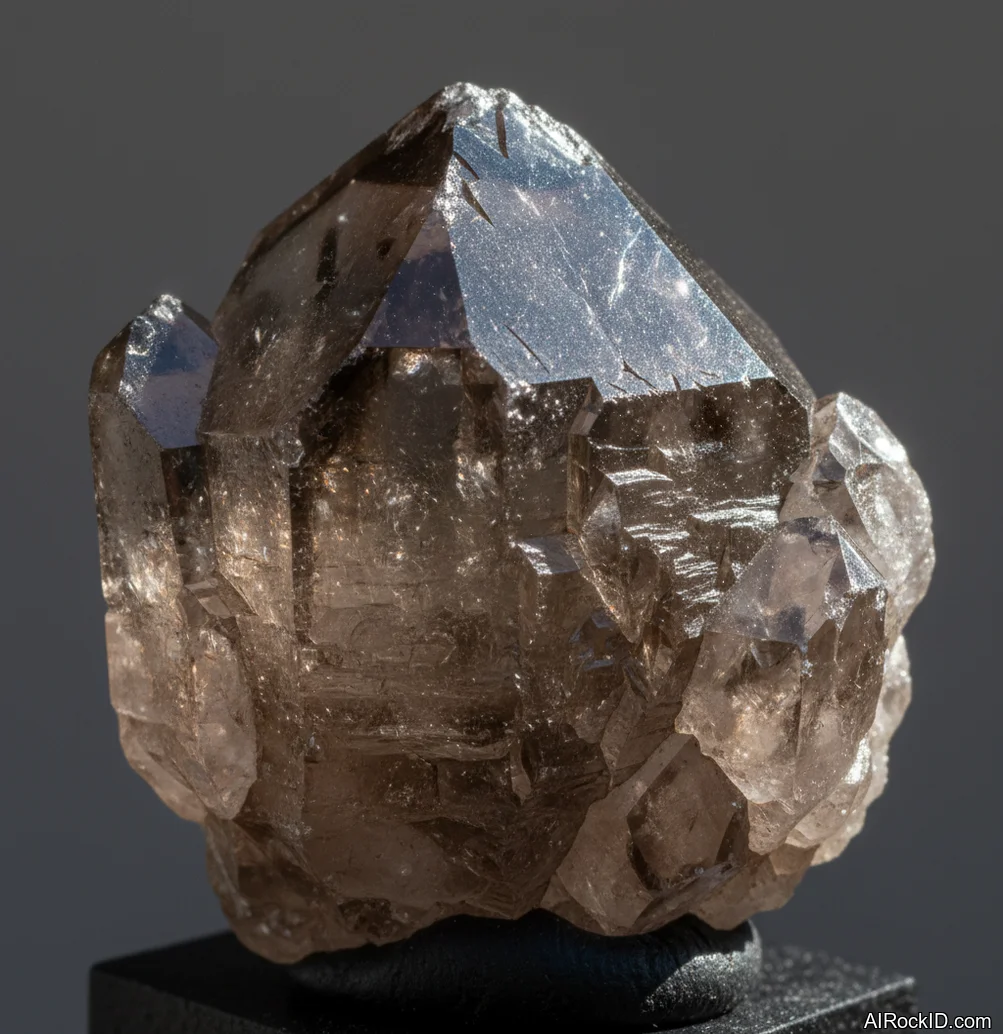
Color: Most Candle Quartz is colorless to milky white, sometimes with smoky gray tones or faint honey staining from iron oxides on the surface. You’ll also see pieces that are clear at the tip and cloudy at the base, like a fog line inside.
Luster: Vitreous on clean faces, shifting to a duller, frosty sparkle on the layered areas.
Pick up the point and run a fingernail up the sides. Real layered growth feels like tiny steps, not like uniform grit from a sandblaster. The real test is light: tilt it under a lamp and the terraces catch and release highlights in bands instead of one smooth flash. If you scratch it with a steel nail, it won’t bite, and it should scratch glass like any other quartz.
Properties of Candle Quartz
Physical Properties
| Crystal System | Trigonal |
| Hardness (Mohs) | 7 (Hard (6-7.5)) |
| Density | 2.65 g/cm3 |
| Luster | Vitreous |
| Diaphaneity | Transparent to translucent |
| Fracture | Conchoidal |
| Streak | White |
| Magnetism | Non-magnetic |
| Colors | Colorless, White, Milky white, Smoky gray, Pale yellow, Honey-brown (surface staining) |
Chemical Properties
| Classification | Silicates |
| Formula | SiO2 |
| Elements | Si, O |
| Common Impurities | Fe, Al, Ti, Li, Na, K |
Optical Properties
| Refractive Index | 1.544-1.553 |
| Birefringence | 0.009 |
| Pleochroism | None |
| Optical Character | Uniaxial |
Candle Quartz Health & Safety
Candle Quartz is just quartz, non-toxic, and totally safe to handle. The real hazard isn’t some chemical thing, it’s mechanical: if one snaps, those little points can get razor-sharp and you can end up with a chip or a small cut (ask me how I know).
Safety Tips
Don’t grind or saw it unless you’ve got real dust control in place. And when you store points, set them up so the tips can’t knock into other stones (those little clicks and chips happen fast).
Candle Quartz Value & Price
Price Range
Rough/Tumbled: $15 - $250 per piece
Price jumps when the termination is clean, the layers feel strong (you can catch them with a fingernail), and the piece has good size with no chips or cracks. And yeah, most dealers will ask more if it’s natural and not heavily repaired or re-polished at the tip.
Durability
Durable — Scratch resistance: Excellent, Toughness: Good
Quartz is stable in normal home conditions, but sharp blows can chip terminations and knock off small layered edges.
How to Care for Candle Quartz
Use & Storage
Keep points in a padded tray or a cabinet where they won’t tip over and take a hit. If you’ve got several, don’t let the terminations touch, because quartz-on-quartz leaves little crescent chips.
Cleaning
1) Rinse with lukewarm water and a drop of mild dish soap. 2) Use a soft toothbrush to work around the layered ridges where dust loves to sit. 3) Rinse well and air-dry, or pat dry with a microfiber cloth to avoid lint in the texture.
Cleanse & Charge
If you do energetic cleansing, stick to gentle stuff like smoke, sound, or leaving it on a shelf overnight. Direct sun won’t hurt clear quartz much, but surface iron staining can look different after long window time, so I don’t bake mine in sunlight.
Placement
Looks best with side lighting, like a desk lamp, because the terraces pop when light rakes across them. For stability, sit it on museum putty if it’s a tall point.
Caution
Don’t use harsh acids or abrasive cleaners. They’ll scuff the surface and leave it looking weirdly frosted, like someone hit it with a powdery scrub pad, and they can also weaken those tiny edges that are already thin.
Works Well With
Candle Quartz Meaning & Healing Properties
Next to a slick, glassy clear quartz point, Candle Quartz feels kind of grippy. You notice it right away the second it hits your palm. The surface has those little step-like ridges, and it changes how people actually handle the stone.
I’ve stood at shows and watched customers keep rubbing the ridges with their thumb while they’re talking, almost like they need something to do with their hands. It’s the same absentminded motion as worrying a smooth worry stone, except this has texture that catches your skin a bit (you can feel the tiny edges). That isn’t magic. But it is real. And if a stone makes you slow down just because it’s tactile, you’re already getting something useful out of it.
In crystal-healing circles, Candle Quartz usually gets filed under the usual quartz themes like clarity, focus, amplification, plus this idea of “layered growth” or “step-by-step” progress. I’m fine with that as a metaphor, honestly. Just keep it in the right lane. It’s not medical care, and it won’t replace meds, therapy, or sleep. But as a reminder object on your desk, it works because you can literally see the layers and think, yeah, change can be incremental.
But here’s the market side of it. A lot of the “spiritual meaning” talk gets slapped onto any textured quartz. Some pieces sold as Candle Quartz are just frosty quartz or lightly etched points. If you want that layered vibe for your own practice, pick one where the growth steps are obvious and natural-looking, not a uniform matte finish that feels like it came out of a blasting cabinet. (You know the kind: evenly dull all over, nothing to follow with your thumb.)
Identify Any Crystal Instantly
Snap a photo and get properties, value, care instructions, and healing meanings in seconds.