Caribbean Blue Calcite
What Is Caribbean Blue Calcite?
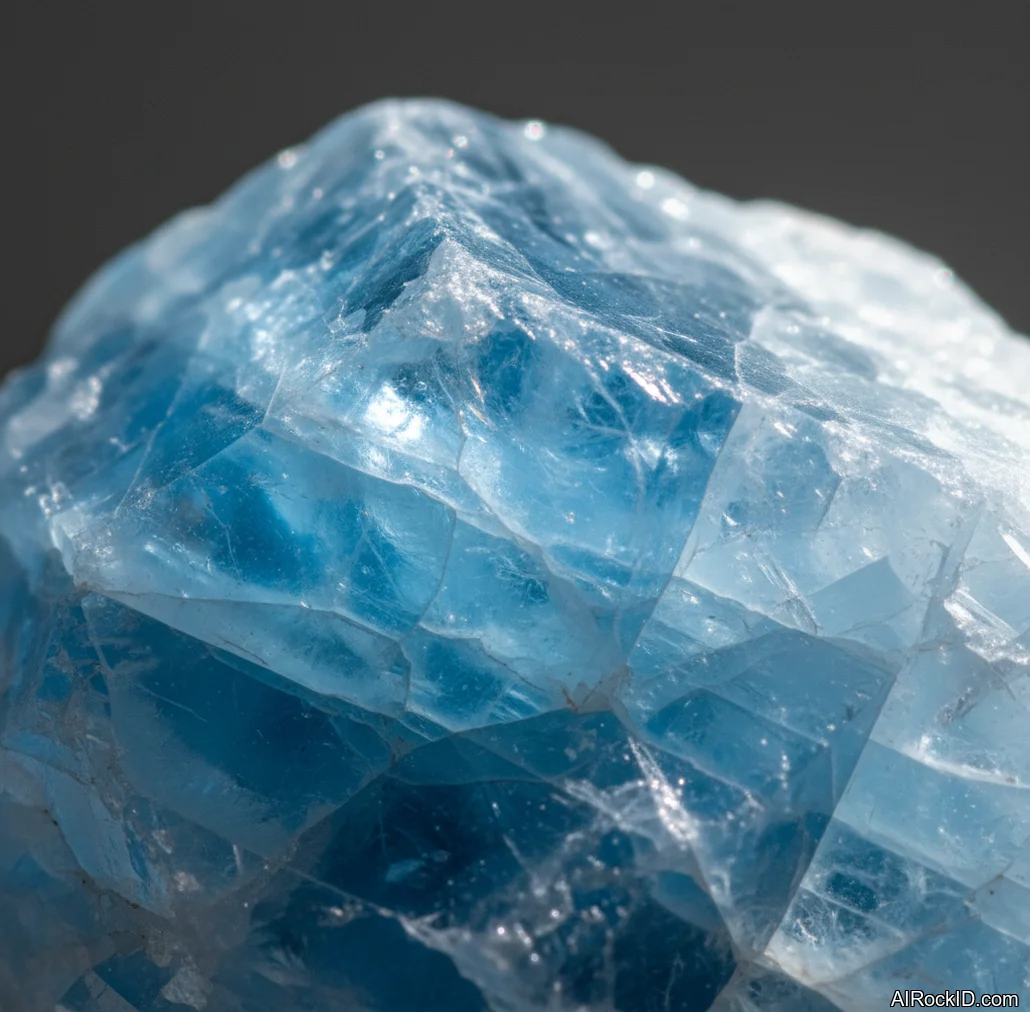
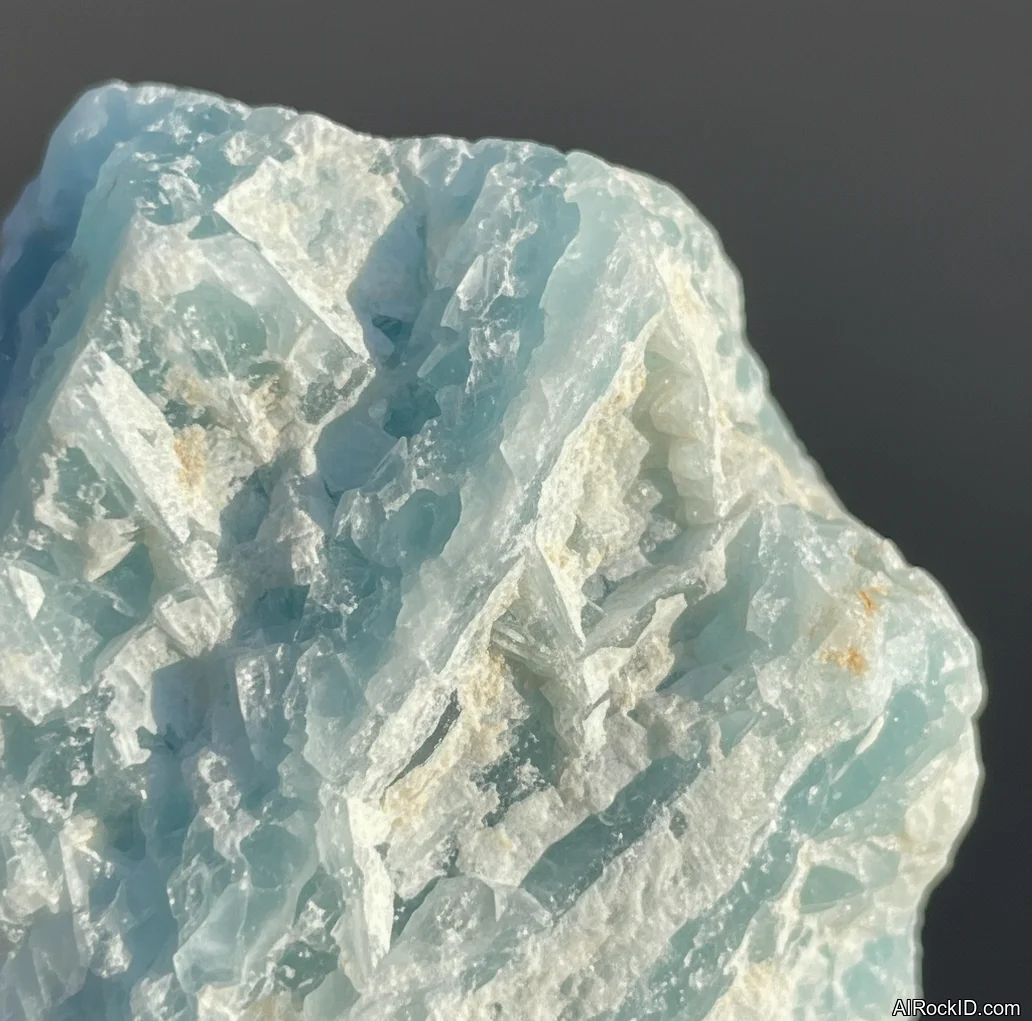
Caribbean Blue Calcite is just a trade name for pale blue calcite that commonly shows up intergrown with tan to brown aragonite.
Hold a chunk in your hand and, honestly, the first weird surprise is how soft it feels for something that looks so beachy and solid. It’s got that classic calcite feel: cool to the touch, a little chalky-cold. And if the piece is polished, the surface can have that sea-glass look for a second, until your thumb slides into a rough patch and you catch that tiny bit of grit (you know the spot).
Look in close and it’s not a single flat color, either. The blue isn’t uniform. It sort of clouds and swirls around, and the brown aragonite pops up as little islands, streaks, or this sandy-looking matrix that breaks things up. Most of what you’ll see for sale is cut as freeforms or palm stones, since the rough material usually doesn’t come out as neat, sharp calcite crystals.
And here’s the straightforward part: some sellers talk about it like it’s its own mineral. But it isn’t. It’s basically a good-looking calcite-and-aragonite combo that ended up with a catchy name.
Origin & History
“Caribbean Blue Calcite” isn’t an official mineral species name. It’s a newer trade label that really started popping up everywhere in the late 2010s, right when fresh material began hitting the market in bigger volume. And the “Caribbean” bit? That’s just marketing shorthand for the ocean-blue color, not a clue about where it was mined.
Calcite itself was described ages ago, and its name comes from the Latin *calx*, meaning lime. Aragonite got its name in 1797, after Molina de Aragón in Spain. So what’s actually new here isn’t the chemistry. It’s the exact look, plus the fact that sizable batches of that blue-and-tan mix suddenly became easy for cutters and crystal shops to get their hands on (and you see it right away once it’s been sliced and polished).
Where Is Caribbean Blue Calcite Found?
Most Caribbean Blue Calcite on the market is reported from Pakistan, where blue calcite occurs with brown aragonite in carbonate deposits.
Formation
Most of the time, this material shows up in low-temperature carbonate environments, where calcium carbonate can drop out of fluids as they move through limestone or marble. Calcite and aragonite have the same chemistry (CaCO3). But their structures aren’t the same, and they can trade places depending on temperature, pressure, and what’s in the fluid.
Compared to a clean vein-calcite crystal pocket, the “Caribbean” material feels like a layered, chunky fill. I’ve held pieces where the blue calcite looks like it literally flowed around older brown aragonite (you can feel the subtle ridges where the bands meet if you run a fingernail across a raw face), and then later it got cut and polished into that swirly, shoreline pattern people go for.
How to Identify Caribbean Blue Calcite
Color: Light to medium pastel blue to blue-green calcite with tan, caramel, or brown aragonite patches or banding. The blue is usually cloudy rather than transparent.
Luster: Vitreous to pearly on fresh cleavage, often waxy-looking when polished.
If you scratch it with a copper coin, it’ll mark pretty easily, and a steel nail will definitely bite in because it’s calcite-soft. The real test is a drop of weak acid or even vinegar on an unpolished spot: it should fizz (calcite reacts fast, aragonite can react too but sometimes a touch slower). And in your hand, it stays cool and a bit “slick” on polished faces, not warm and plastic-like the way resin fakes feel.
Properties of Caribbean Blue Calcite
Physical Properties
| Crystal System | Trigonal |
| Hardness (Mohs) | 3 (Soft (2-4)) |
| Density | 2.71 g/cm3 |
| Luster | Vitreous |
| Diaphaneity | Translucent |
| Fracture | Uneven |
| Streak | white |
| Magnetism | Non-magnetic |
| Colors | pale blue, blue-green, tan, brown, white |
Chemical Properties
| Classification | Carbonates |
| Formula | CaCO3 |
| Elements | Ca, C, O |
| Common Impurities | Mg, Fe, Mn, Sr |
Optical Properties
| Refractive Index | 1.486-1.658 |
| Birefringence | 0.172 |
| Pleochroism | None |
| Optical Character | Uniaxial |
Caribbean Blue Calcite Health & Safety
It’s safe to touch and work with. Thing is, it’s pretty soft, so the real “danger” is you gouging or chipping the stone, not it hurting you. If you’re cutting or sanding it, try not to kick up dust.
Safety Tips
If you’re doing any shaping, put on a dust mask. And don’t sweep the powdery slurry up once it dries, that stuff goes airborne fast. Rinse the slurry away with water instead.
Caribbean Blue Calcite Value & Price
Price Range
Rough/Tumbled: $8 - $60 per palm stone or small freeform
Price mostly comes down to color (that cleaner sky-blue costs more), how much brown aragonite you can actually see in the piece, and whether the polish looks glassy or has those little pinhole pits you feel when you run a fingernail over it. And yeah, the big, chunky freeforms that stay a strong blue with minimal fractures get expensive fast.
Durability
Nondurable — Scratch resistance: Poor, Toughness: Fair
It’s stable as a display piece, but it scratches easily and can chip along calcite cleavage if you knock it around.
How to Care for Caribbean Blue Calcite
Use & Storage
Store it where it won’t rub against quartz, agate, or other harder stones. I keep mine in a little tray with felt because calcite scuffs just from being jostled.
Cleaning
1) Rinse quickly with lukewarm water if needed. 2) Use a soft microfiber cloth and a tiny bit of mild soap for fingerprints. 3) Dry right away and don’t soak it for long periods.
Cleanse & Charge
For non-water methods, smoke cleansing or sound are safe picks. If you like moonlight, keep it out of harsh sun because the polish and surface can look tired over time.
Placement
Looks best where light comes from the side so the blue cloudiness has depth. Keep it away from the edge of shelves since one drop can take a corner off.
Caution
Don’t use acids or any harsh cleaners on it. And skip steam cleaning, ultrasonic cleaning too. Also, don’t just toss it into a bowl with harder tumbles, because it’ll come out with little scratches all over the surface (the kind you can catch with a fingernail if you tilt it under a light).
Works Well With
Caribbean Blue Calcite Meaning & Healing Properties
Most people pick up Caribbean Blue Calcite for the color first. It looks like calm seawater, and honestly that alone can shift the mood on a desk or a nightstand. In my own little pile, it’s the stone I grab when I want something visually quiet. Not flashy.
In crystal-healing circles, it’s usually tied to calming, emotional cooling-off, and gentle communication. I treat that as personal practice, not medicine. But look, there’s something real about the physical part: a calcite palm stone tends to feel cool and slick at first touch, and when it warms up in your hand, it’s like your body gets a tiny cue to slow down. Like a pause button. The softer, almost buttery feel matters (you notice it right away).
But don’t count on it as some rugged everyday pocket stone. It’s a stay-at-home piece. If you toss it in a pocket with keys, it’ll get scuffed up fast, sometimes in a week, and then people get bummed and assume they got a fake. It wasn’t fake. It was just calcite doing calcite things.
Identify Any Crystal Instantly
Snap a photo and get properties, value, care instructions, and healing meanings in seconds.