Cheetah Jasper
What Is Cheetah Jasper?
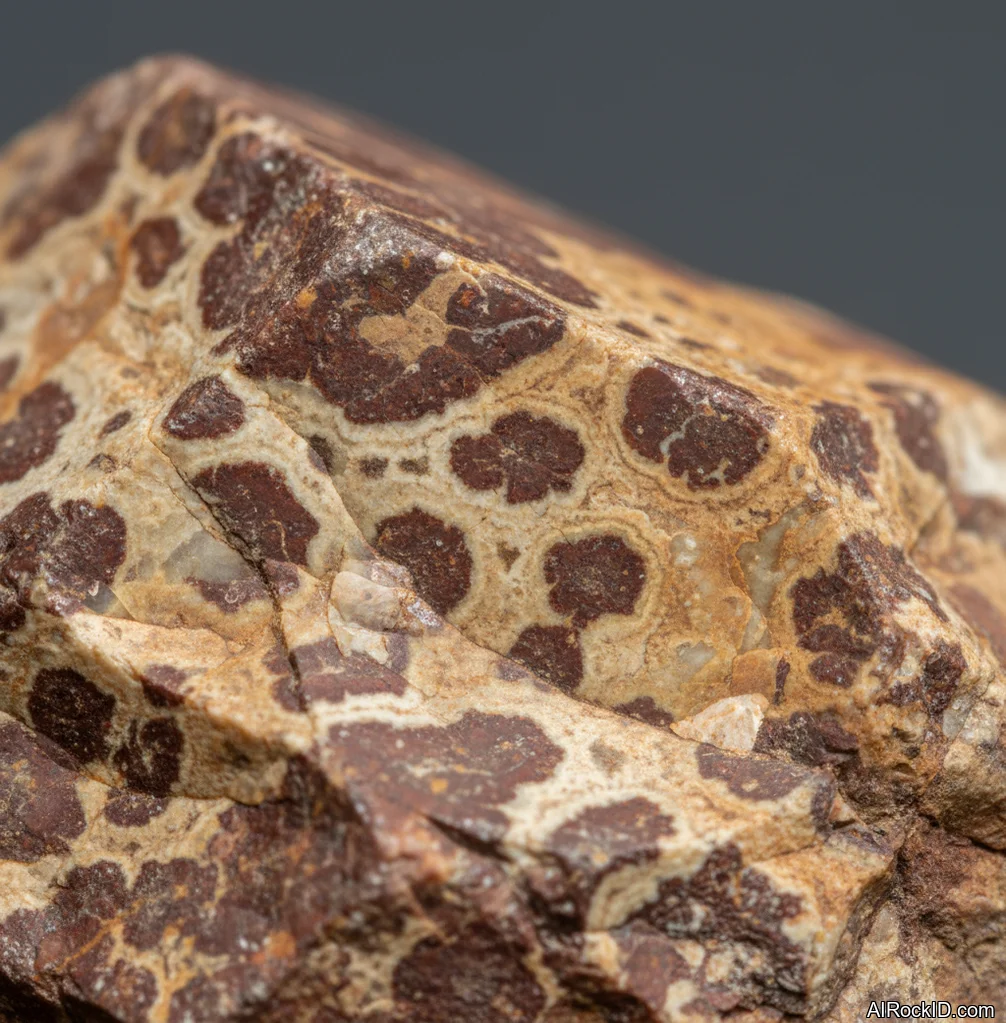
Cheetah Jasper is a patterned type of jasper, which is an opaque microcrystalline quartz. You can spot it by that tan-to-cream base covered in brown and black “spots” that really do look like a cheetah coat.
Pick one up and the feel hits you first. It’s got that smooth, almost soapy tumble-polish jasper gets, and it stays cool in your hand longer than glass (I always notice that). Most pieces you’ll see for sale are tumbled stones, palm stones, or beads, because the pattern pops once it’s polished.
At first glance people call it “cheetah agate,” but it doesn’t act like banded agate and it’s usually not translucent at all. Look closer and those spots often have fuzzy edges, like ink bleeding into paper. And the background can swing from sandy beige to caramel brown depending on how much iron staining is in that slice.
Origin & History
Cheetah Jasper is a modern trade name, not a formally defined mineral species. Dealers use it the same loose way they toss around names like “picture jasper” or “ocean jasper.” Jasper itself has been used forever as a lapidary material, but “Cheetah Jasper” mostly starts popping up in late 20th century to early 2000s retail and bead markets, right when patterned material became a big thing at gem shows.
The name comes straight from how it looks. If the rough has those clustered brown spots on a warm tan base, someone at a wholesaler table will call it cheetah without even thinking twice. And it sticks because it’s easy to remember. Customers can clock it from a few feet away, sitting in a bowl of tumbles (you know the kind, the ones that clack together when you dig around).
Where Is Cheetah Jasper Found?
Most Cheetah Jasper in the retail market is sold as African jasper, with a lot of material labeled from South Africa or Namibia; similar spotted jaspers also come through Madagascar and India.
Formation
Most jasper starts out when silica-rich fluids snake through a rock and the silica turns into this jelly-like stuff, then tightens up and hardens into microcrystalline quartz. The “cheetah” pattern happens because the chemistry isn’t uniform while that’s going on. Little pockets form where iron oxides and other fine mineral grains get caught in place, and once everything sets, those pockets show up as spots after you cut it and run it under the wheel (the polish really makes them pop).
Put it next to banded agate and the feel is different. Jasper usually reads more solid and jumbled, not neatly organized. You won’t get that crisp fortification banding. Instead it’s clouds, freckles, blotches, and sometimes those hairline cracks that got sealed back up with silica. So a slab can look wildly different from one end of the same nodule to the other, which is kind of the whole point, right?
How to Identify Cheetah Jasper
Color: Usually a beige, tan, or creamy base with brown to dark brown spots, sometimes with black flecks or smoky gray areas. The pattern can be tight and speckled or big, blobby patches depending on the cut.
Luster: Waxy to dull in rough, waxy to vitreous once polished.
If you scratch it with a steel nail, it shouldn’t take the scratch easily, but the nail might leave a faint metal streak you can rub off. The real test is a glass plate: it should scratch glass like other jaspers do. And in your hand, it feels dense and cool, not light and warm like resin or plastic “stone” beads.
Properties of Cheetah Jasper
Physical Properties
| Crystal System | Trigonal |
| Hardness (Mohs) | 6.5-7 (Hard (6-7.5)) |
| Density | 2.58-2.64 |
| Luster | Waxy |
| Diaphaneity | Opaque |
| Fracture | Conchoidal |
| Streak | White |
| Magnetism | Non-magnetic |
| Colors | Beige, Tan, Cream, Brown, Dark brown, Black, Gray |
Chemical Properties
| Classification | Silicates |
| Formula | SiO2 |
| Elements | Si, O |
| Common Impurities | Fe, Mn, Al, Ca |
Optical Properties
| Refractive Index | 1.530-1.540 |
| Birefringence | None |
| Pleochroism | None |
| Optical Character | Uniaxial |
Cheetah Jasper Health & Safety
Cheetah Jasper is basically microcrystalline quartz, so it’s fine to pick up, handle, and even rinse off under the tap. But if you’re cutting or grinding it, treat the dust like you would any other lapidary dust. Mask up, keep things wet if you can, and don’t breathe that fine powder (it gets everywhere, like it clings to your fingers).
Safety Tips
If you’re shaping or sanding, put on a respirator, and keep things wet with water so the silica dust doesn’t kick up.
Cheetah Jasper Value & Price
Price Range
Rough/Tumbled: $3 - $20 per piece
Price mostly comes down to two things: how much the pattern pops and how clean the polish looks. Big palm stones with tight, high-contrast spotting usually run higher than those small tumbles that look kind of muddy, like they never really got past that dull, slightly chalky stage.
Durability
Very Durable — Scratch resistance: Good, Toughness: Good
It’s a tough quartz rock that handles daily carry well, but a high polish can still get dulled by gritty sand and keys.
How to Care for Cheetah Jasper
Use & Storage
Store it in a pouch or a divided box if it’s polished, because quartz-on-quartz scuffs happen fast in a mixed bowl. Keep it out of gritty places like beach sand if you want the shine to last.
Cleaning
1) Rinse with lukewarm water. 2) Wash with mild soap and a soft brush or cloth. 3) Rinse again and dry fully with a towel to avoid water spots in tiny surface pits.
Cleanse & Charge
For a non-fussy reset, I use running water and a quick wipe, or set it on a windowsill for indirect light. Don’t bake it in harsh sun for days if you care about the exact tone of the polish.
Placement
On a desk or by the door works well because it’s durable and doesn’t mind getting handled. If you’re displaying a bunch together, give each piece a little space so the polished faces don’t rub.
Caution
Skip ultrasonic cleaners and harsh acids. And don’t toss it in a tumbler with softer stones unless you’re fine with them coming out all scuffed and scratched.
Works Well With
Cheetah Jasper Meaning & Healing Properties
Most dealers just toss Cheetah Jasper into the whole “grounding jasper” category, and honestly, that’s pretty much what it’s for. It’s the kind of stone you drop in your pocket so you’ve got something solid to grab when you need to feel steady. And I get why people do it. The surface feels nice in your fingers, sort of smooth but not slippery, and the spotted pattern gives your eyes a place to rest when your thoughts are doing laps.
But look, it’s not a flashy stone. If you’re hoping for fireworks, you’re gonna be let down. What it’s good at, in a metaphysical practice, is the everyday stuff. Routine. It’s a worry stone that doesn’t chip, a palm stone you can clamp down on during a boring meeting, a bead bracelet that holds up to daily wear without you having to baby it (or take it off every time you wash your hands).
And none of this is medical. It’s not a replacement for care from an actual professional. I treat it like a tactile tool, plain and simple. When I’m sorting flats at a show or stuck standing at a register all day, I’ll roll a cheetah jasper tumble in my hand, and it helps keep me in my body instead of floating off in my head. Why overcomplicate it?
Identify Any Crystal Instantly
Snap a photo and get properties, value, care instructions, and healing meanings in seconds.