Chlorite On Quartz
What Is Chlorite On Quartz?
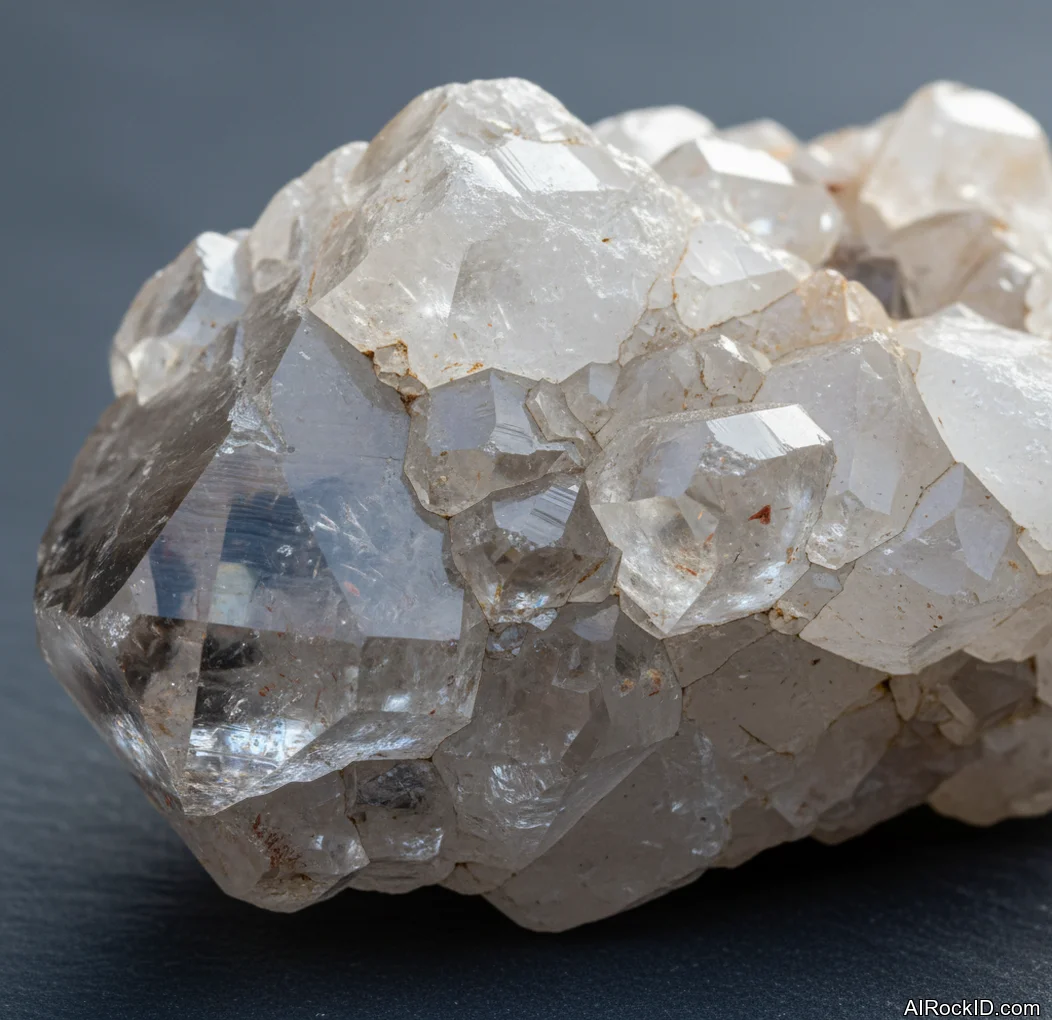
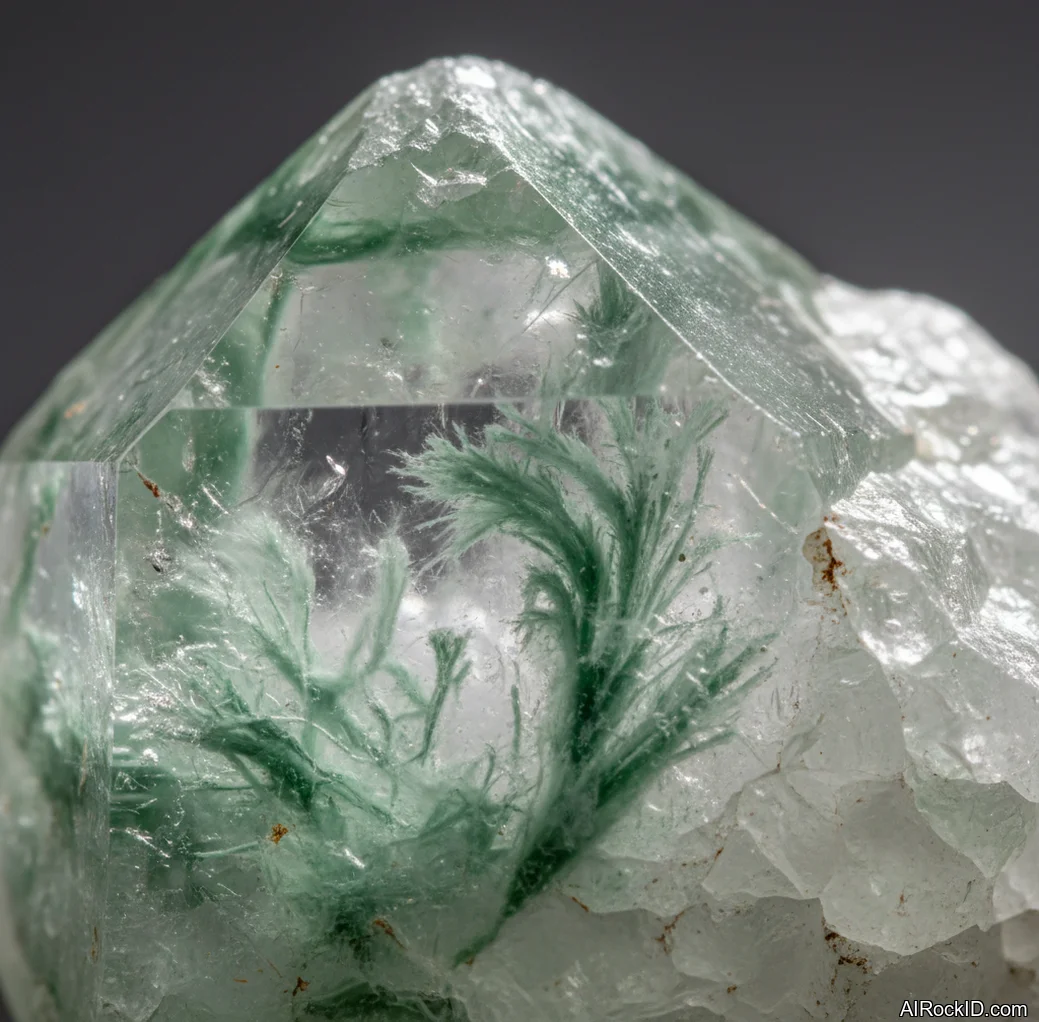
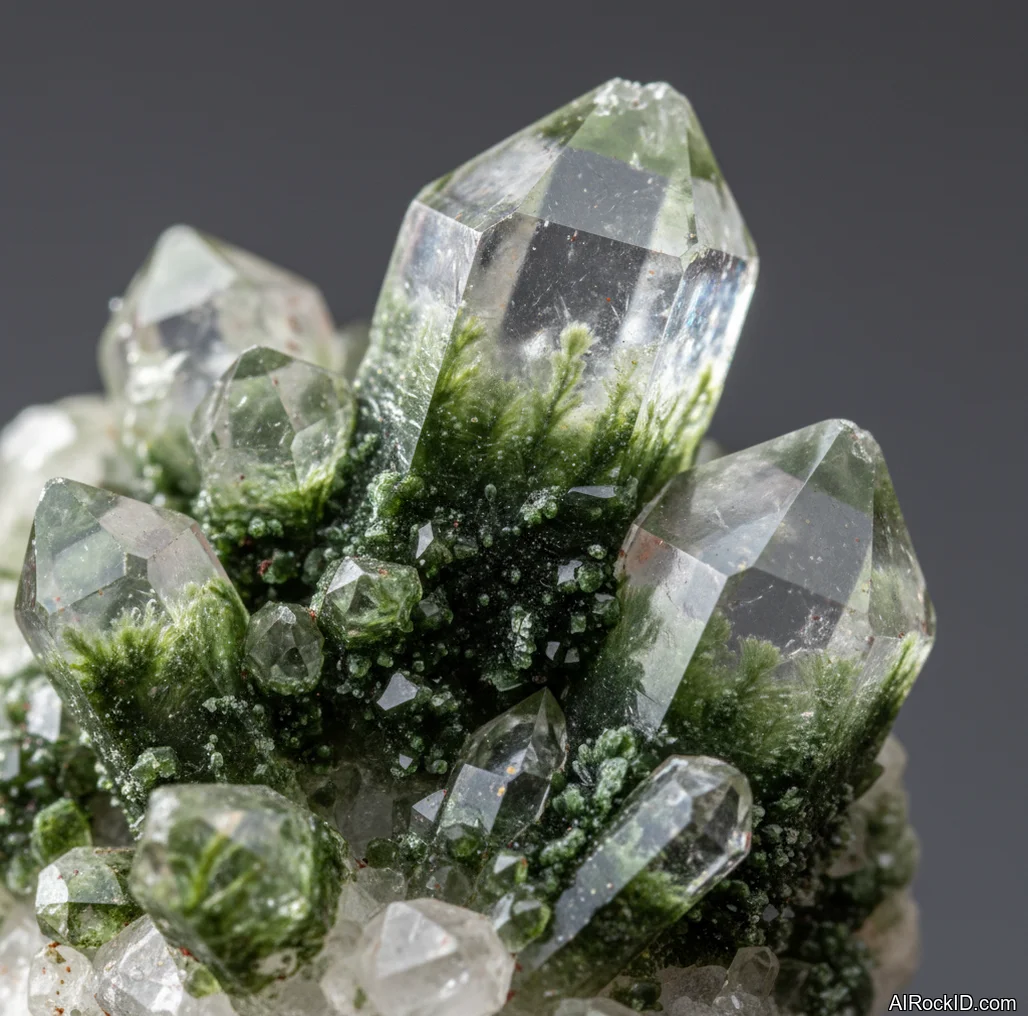
Chlorite on quartz is basically a quartz crystal with chlorite group minerals either trapped inside it or sitting right on the outside as green coatings, wisps, or those phantom-ish layers people talk about.
Pick up a solid specimen and you notice the contrast fast. Quartz is hard and slick, and it’s usually cool against your palm even after it’s been sitting out. Chlorite, though, looks like somebody dusted the crystal with green powder or sealed little mossy clouds inside. Some pieces are glass-clear except for a faint olive haze that only shows up when you tilt it. Others have thick, dark green plumes that make the quartz look smoky and kind of foresty, especially if you hold it up to a window and let the light cut through.
People often glance at it and go, “Oh, green phantom quartz.” But that’s only sometimes accurate. True phantoms are those ghost outlines from an older stage of quartz growth, and chlorite can trace those shapes really cleanly when it lines up right. But a lot of chlorite-on-quartz is just a surface dusting or internal wisps with no crisp phantom outline at all. Still awesome. Just not the same thing.
Origin & History
Chlorite, as a mineral group, got its name in 1828 from Berthier. He pulled it from the Greek “chloros,” which means green. And yeah, it tracks. Even the darker, iron-rich chlorites still flash green if you tilt the piece under a bright light (the kind that makes the quartz glare a bit and shows every smudge).
Quartz has been described and used forever. But “chlorite on quartz” is basically a collector and dealer line that came out of the modern specimen trade. You’ll spot it at shows on those flat display cards, or on little handwritten labels with ink that’s slightly bled into the paper, because it’s saying what your eyes already picked up: quartz first, then that green chlorite tagging along for the ride.
Where Is Chlorite On Quartz Found?
It turns up anywhere quartz grows in hydrothermal or metamorphic settings and chlorite is present, with a lot of well-known material coming from Alpine pockets and Brazilian quartz districts.
Formation
Raw pieces from the Alps tell it better than any chart ever will. Quartz grows out into open pockets, and chlorite either shows up early and gets sealed in as the quartz keeps building, or it comes in later and lightly coats the faces and cracks. So you end up with everything from sharp green phantoms to that messy green “smoke” just hanging inside. Weirdly satisfying to stare at, right?
Next to iron-oxide included quartz, chlorite usually reads softer. More fuzzy. And it’ll sometimes bunch up along the growth lines, too. Look, if you tilt a terminated crystal under a lamp and rotate it a little (you can catch it in the reflection), you’ll occasionally see green sitting in tiny steps and shelves inside, almost like sediment layers, because the quartz paused and then started growing again while fluids kept moving through the pocket.
How to Identify Chlorite On Quartz
Color: The chlorite shows as olive to dark forest green, sometimes almost black-green in thick patches, inside or on the surface of colorless to milky quartz. In strong light it can look mossy, feathery, or like green fog.
Luster: Quartz is vitreous and glassy, while chlorite areas look duller to slightly pearly where they coat the surface.
Pick up the specimen and run a fingertip lightly over the green areas. On surface-coated pieces, chlorite can feel a bit dusty or satiny instead of slick like clean quartz faces. If you scratch it with a steel needle, the quartz won’t care much, but the green chlorite film can scuff or smear because chlorite is soft. And if the seller calls it “epidote in quartz,” ask for a loupe view. Epidote usually looks more chunky and pistachio, not like a fine green wash.
Properties of Chlorite On Quartz
Physical Properties
| Crystal System | Trigonal |
| Hardness (Mohs) | 7 (quartz); chlorite coatings/inclusions are ~2-2.5 (Hard (6-7.5)) |
| Density | 2.65 g/cm3 (quartz); chlorite typically ~2.6-3.3 g/cm3 |
| Luster | Vitreous |
| Diaphaneity | Transparent to translucent |
| Fracture | Conchoidal |
| Streak | White (quartz); greenish-white to pale green (chlorite) |
| Magnetism | Non-magnetic |
| Colors | Colorless, White, Green, Olive green, Dark green |
Chemical Properties
| Classification | Silicates |
| Formula | SiO2 (quartz) + chlorite group (general) (Mg,Fe,Al)6(Si,Al)4O10(OH)8 |
| Elements | Si, O, Mg, Fe, Al, H |
| Common Impurities | Fe, Mn, Ti |
Optical Properties
| Refractive Index | 1.544-1.553 (quartz) |
| Birefringence | 0.009 |
| Pleochroism | None |
| Optical Character | Uniaxial |
Chlorite On Quartz Health & Safety
Hand-handling this stuff is pretty low risk. But when you’re doing lapidary work, don’t create dust and definitely don’t breathe it in. And if you’ve been dealing with gritty, broken pieces (the kind that leave that sandy film on your fingertips), go rinse your hands off afterward.
Safety Tips
If you’re cutting or sanding, keep it wet, crack a window or set up decent ventilation, and wear a proper respirator that’s actually rated for silica dust.
Chlorite On Quartz Value & Price
Price Range
Rough/Tumbled: $10 - $250 per specimen
Cut/Polished: $3 - $20 per carat (cabochons/rounds, depending on clarity and pattern)
Clean quartz with crisp, sharp terminations and a green phantom you can actually read will run you more than a cloudy chunk that just has random green smears (you’ve seen those, right?). And when you get into big Alpine-style crystals, with the phantom sitting in a spot that just looks “right” and hardly any chips or bruising, the price climbs in a hurry.
Durability
Durable — Scratch resistance: Excellent, Toughness: Good
Quartz holds up well, but surface chlorite can rub off or dull if it’s handled a lot or cleaned aggressively.
How to Care for Chlorite On Quartz
Use & Storage
Store it where it won’t get knocked around, because quartz points chip on the tips and edges. If the chlorite is a surface dusting, keep it from rubbing against harder specimens in the same box.
Cleaning
1) Rinse briefly in lukewarm water to remove loose grit. 2) Use a soft toothbrush only on the clear quartz areas, not the green coating. 3) Pat dry and let it air-dry fully before putting it back on a shelf.
Cleanse & Charge
If you do energetic cleansing, stick to gentle stuff like smoke, sound, or a quick rinse. Long salt soaks aren’t my favorite on surface-coated pieces because you can end up with crust in little pits.
Placement
Looks best with backlighting, so a windowsill nearby is tempting, but don’t cook it in direct sun all day if the chlorite layer looks delicate. A spot with angled lamp light makes the internal green layers pop.
Caution
Skip acids and any harsh cleaners. They can etch the quartz, and then the green spots start looking blotchy and uneven (like they’ve been rubbed thin). And don’t put chlorite-coated pieces in an ultrasonic cleaner.
Works Well With
Chlorite On Quartz Meaning & Healing Properties
Look at chlorite on quartz for a second and tell me your brain doesn’t jump straight to “cleaning” and “clearing.” That’s the whole thing people are after with this combo, especially when the quartz is bright and the chlorite sits in there like green smoke caught halfway through a swish. In my own stash, it’s the one I reach for when I want the room to feel less cluttered, and I mean in my head too, not just on the table. And yeah, that’s my take, not a lab report.
Grab a palm-sized cluster and you’ll notice there’s a real difference between pieces that are surface-coated and ones where the chlorite is included. The coated ones feel textured under your thumb. They pick up dust, fingerprints, and sometimes that tiny sandy grit that ends up in a field bag (you know the stuff that somehow gets everywhere), which honestly kind of matches the “earthy cleanup” idea people attach to it. But look, don’t treat it like medicine. If you’re dealing with anxiety, sleep issues, or anything physical, crystals can be a comfort object or a focus tool, but they’re not a replacement for actual care.
Compared to plain clear quartz, chlorite-on-quartz tends to get used for grounding plus clarity at the same time. Sounds like it shouldn’t work, right? But sit with one under a lamp and watch how those green layers make the clear parts look sharper. Thing is, the market gets messy because sellers will slap “phantom” on basically anything green inside quartz. If you want the classic phantom look, ask for side photos and a strong backlight shot so you can really see the ghost outline.
Identify Any Crystal Instantly
Snap a photo and get properties, value, care instructions, and healing meanings in seconds.