Hyalite Opal
What Is Hyalite Opal?
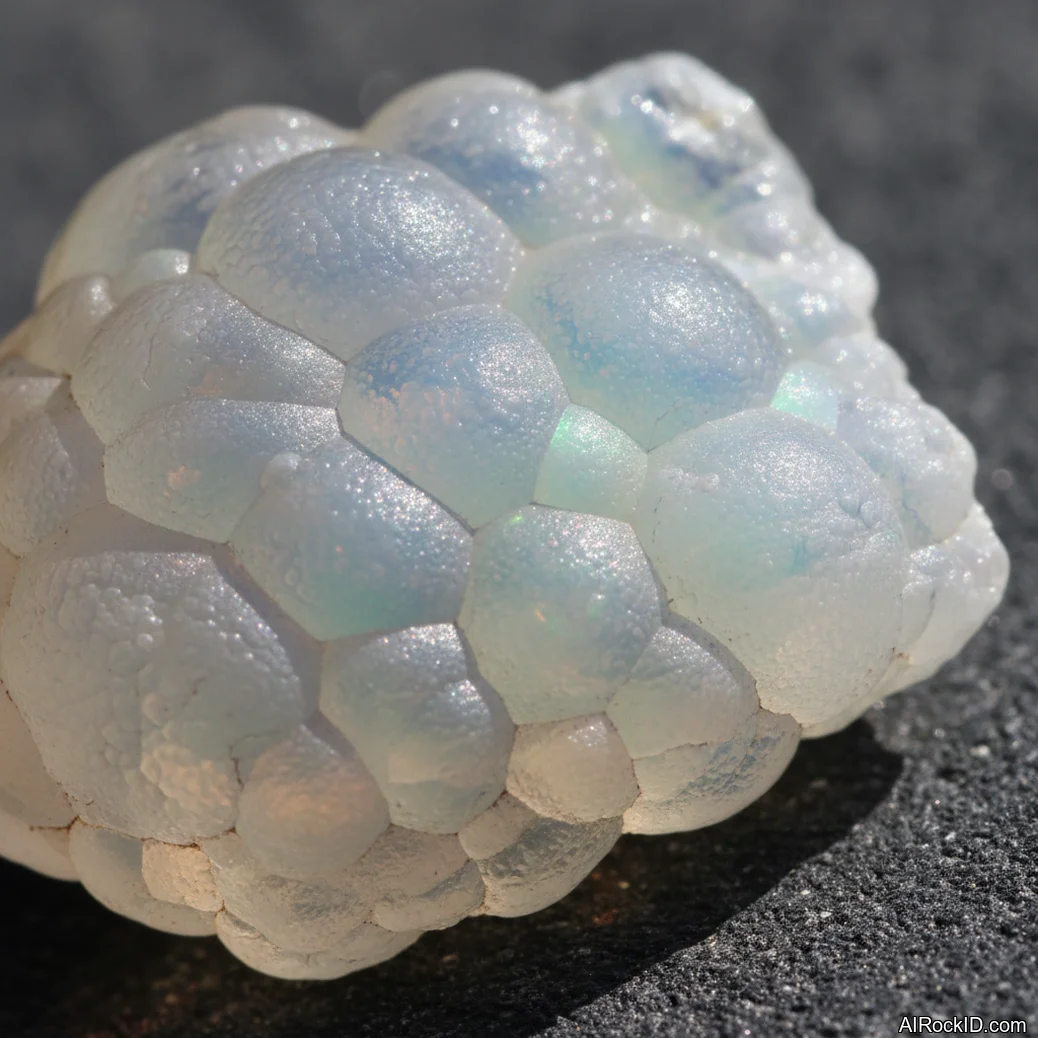
Hyalite opal is a colorless to milky, glassy variety of common opal. It shows up as botryoidal crusts, little droplets, or thin coatings, and a lot of it fluoresces bright green under UV. In your hand, it honestly feels like a tiny blob of frozen water stuck to a rock, and the best pieces look almost too perfect to be real. Pick one up and you’ll notice it’s lighter than quartz, with a slick, glass-bead kind of surface that can get weirdly tacky if there’s dust on it.
People hear “opal” and expect rainbow play-of-color right away. But hyalite usually isn’t that kind of opal. What it *does* do is glow, and it’s hard to forget once you’ve seen it. Under a 365 nm UV light, good material lights up neon green from trace uranium, and it’s one of those show-and-tell minerals that makes even non-collectors lean in. But under normal room light, a lot of hyalite just looks like clear resin or hot glue, so it gets overlooked in flats and bargain boxes.
Look, if you really stare at the surface you’ll often catch rounded bubbles, tiny flow lines, and that wet-looking shine. And it’s touchy stuff. I’ve had hyalite skins craze and turn cloudy after sitting a little too close to a heater for a winter, so I treat it like humidity-sensitive glass, not a “tough stone.”
Origin & History
“Hyalite” comes from the Greek word for glass, *hyalos*, and yeah, that tracks the second you’ve handled a fresh, clean piece in good light. It’s got that wet, glassy look, and when you turn it in your fingers it can feel almost slick, like polished bottle glass (until you hit a rough edge).
Back in the 18th and 19th century mineral books, writers started calling it out as its own opal variety. Collectors and early mineralogists were beginning to sort opal by how it looked, instead of tossing every kind into one big “opal” bucket.
A lot of the older European material ended up in the classic collections for a simple reason: hyalite shows up in volcanic settings, and those spots were reachable for early field collectors. But the green UV reaction wasn’t part of the original hype. That came later, once UV lamps were common at shows and people figured out that some “boring clear opal” was actually a blacklight star. Funny how that works, right?
Where Is Hyalite Opal Found?
Hyalite shows up in volcanic and hydrothermal districts, often as coatings on basalt, rhyolite, or in cavities and fractures where silica-rich fluids cooled fast.
Formation
Most hyalite shows up when cool, silica-heavy fluids snake through volcanic rock, then dump their silica fast as the fluid cools off or just dries out. There’s no slow, patient crystal growth like you’d get with quartz. So instead you end up with this amorphous gel that firms up into rounded, drippy forms, sometimes stacking in layers that really do look like tiny clear grapes.
The rough I run into most is from Mexico, usually a glittery, clear botryoidal crust sitting on dark matrix (the contrast is half the appeal, honestly). Brazil turns out cleaner “water clear” blobs that look like someone piped them on with a pastry bag. And Czech material has been circulating with collectors for ages.
Thing is, hyalite can be touchy. It’s got water in it, and if that water bails out too quickly the surface can craze, go milky, or split. Did you mess it up? Probably not. That’s just opal doing what opal does.
How to Identify Hyalite Opal
Color: Typically colorless, water-clear, or milky white; it can look faintly yellowish or smoky depending on included dust or the host rock. Under longwave UV, many specimens fluoresce bright green.
Luster: Vitreous to resinous, like a clear candy coating.
Under UV light is the quick check. A legit fluorescent hyalite will glow an even, punchy green that looks like it’s coming from inside the blobs, not just reflecting off the surface. If you scratch it with a steel needle in an inconspicuous spot, it’ll mark easier than quartz, and the scratch looks a little “draggy” instead of crisp. And if it feels warm and plasticky in your fingers, be suspicious, because real hyalite stays cool like glass and usually sits on natural matrix with messy edges.
Properties of Hyalite Opal
Physical Properties
| Crystal System | Amorphous |
| Hardness (Mohs) | 5.5-6 (Medium (4-6)) |
| Density | 1.9-2.3 g/cm3 |
| Luster | Vitreous |
| Diaphaneity | Transparent to translucent |
| Fracture | Conchoidal |
| Streak | white |
| Magnetism | Non-magnetic |
| Colors | colorless, clear, milky white, pale yellow, smoky gray |
Chemical Properties
| Classification | Silicates |
| Formula | SiO2·nH2O |
| Elements | Si, O, H |
| Common Impurities | U, Fe, Al, Ca |
Optical Properties
| Refractive Index | 1.44-1.46 |
| Birefringence | None |
| Pleochroism | None |
| Optical Character | Isotropic |
Hyalite Opal Health & Safety
Normal handling is safe, and if it gets a quick splash or rinse, that’s fine. But don’t grind or sand it unless you’ve got proper dust control, the same way you’d treat any silica material (that fine powder gets everywhere, even clinging to your hands).
Safety Tips
Wash your hands after you’ve been handling dusty matrix (that fine powder gets stuck in the creases around your nails). And if you’re cutting or shaping opal, don’t breathe the dust. Use wet methods, and wear a respirator.
Hyalite Opal Value & Price
Price Range
Rough/Tumbled: $10 - $200 per specimen
Cut/Polished: $20 - $150 per carat
Price moves around depending on clarity, how strong the fluorescence is, and how clean those botryoidal (grape-like) surfaces look. Big crusts that haven’t been dinged up, sitting on a nice dark matrix, sell fast. But little cloudy crumbs? Those usually stay cheap.
Durability
Nondurable — Scratch resistance: Fair, Toughness: Fair
It can dehydrate and craze or turn cloudy with heat, very dry storage, or rapid humidity changes.
How to Care for Hyalite Opal
Use & Storage
Store it out of direct sun and away from vents and heaters. I keep my nicer hyalite in a closed box with a little padding so it doesn’t rattle and chip.
Cleaning
1) Rinse quickly with cool water to remove dust. 2) Use a soft brush or cotton swab with a tiny bit of mild soap if needed. 3) Pat dry and let it air-dry in the shade before putting it back in a box.
Cleanse & Charge
If you do energetic cleansing, keep it simple: a quick rinse and a rest in a dark drawer works fine. Skip salt bowls and skip heat.
Placement
Under UV is where it shines, so a shelf where you can hit it with a 365 nm flashlight is fun. Don’t park it on a sunny windowsill unless you like surprises.
Caution
Keep it away from heat, harsh sun, and super-dry display spots, because opal can craze (you’ll see those tiny hairline cracks up close). And skip ultrasonic cleaners or steam altogether. Don’t soak it for long stretches, either.
Works Well With
Hyalite Opal Meaning & Healing Properties
If you look at hyalite through the metaphysical angle, people treat it like a “clean signal” stone. It’s clear. It’s light. And it doesn’t visually steamroll everything sitting next to it. When I’m sorting a tray after a long show weekend, I’ll sometimes park a hyalite piece right by my hand because it feels like a visual reset (especially when the rest of the table is all dark, heavy-looking material).
But the honest collector answer? A lot of the reaction is about the glow. That green UV pop is seriously dramatic, and it can make a small specimen feel special in a hurry. Folks who use crystals for meditation often pair it with breath work or journaling, because it’s quiet in daylight and then it flips “on” under UV, which kind of mirrors that switch from normal mind to focused mind. Funny, right?
None of this is medical advice, and I wouldn’t treat hyalite like a cure for anything. If you want something practical out of it, it’s basically a reminder to slow down and pay attention. You literally have to change the lighting to see its best side. That lesson lands on its own.
Identify Any Crystal Instantly
Snap a photo and get properties, value, care instructions, and healing meanings in seconds.