Lemurian Seed Crystal
What Is Lemurian Seed Crystal?
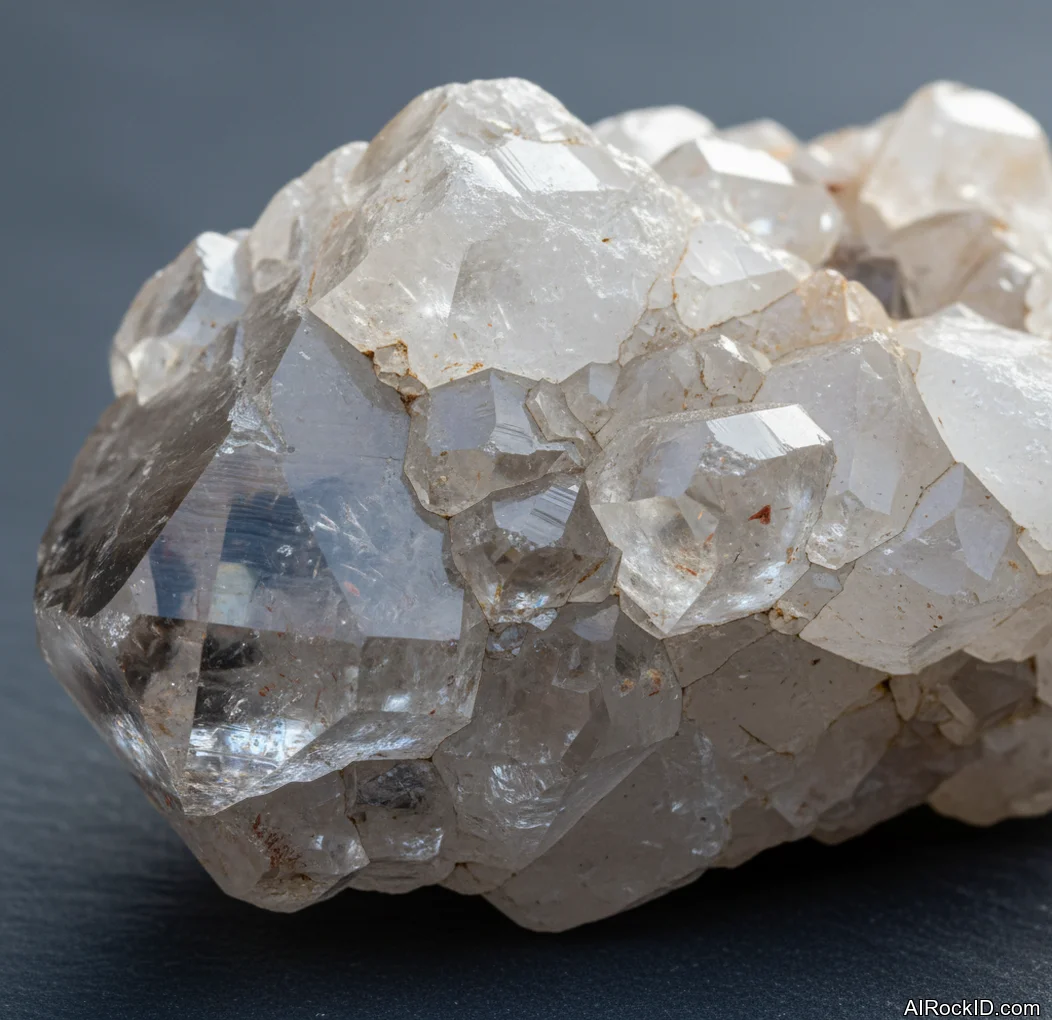
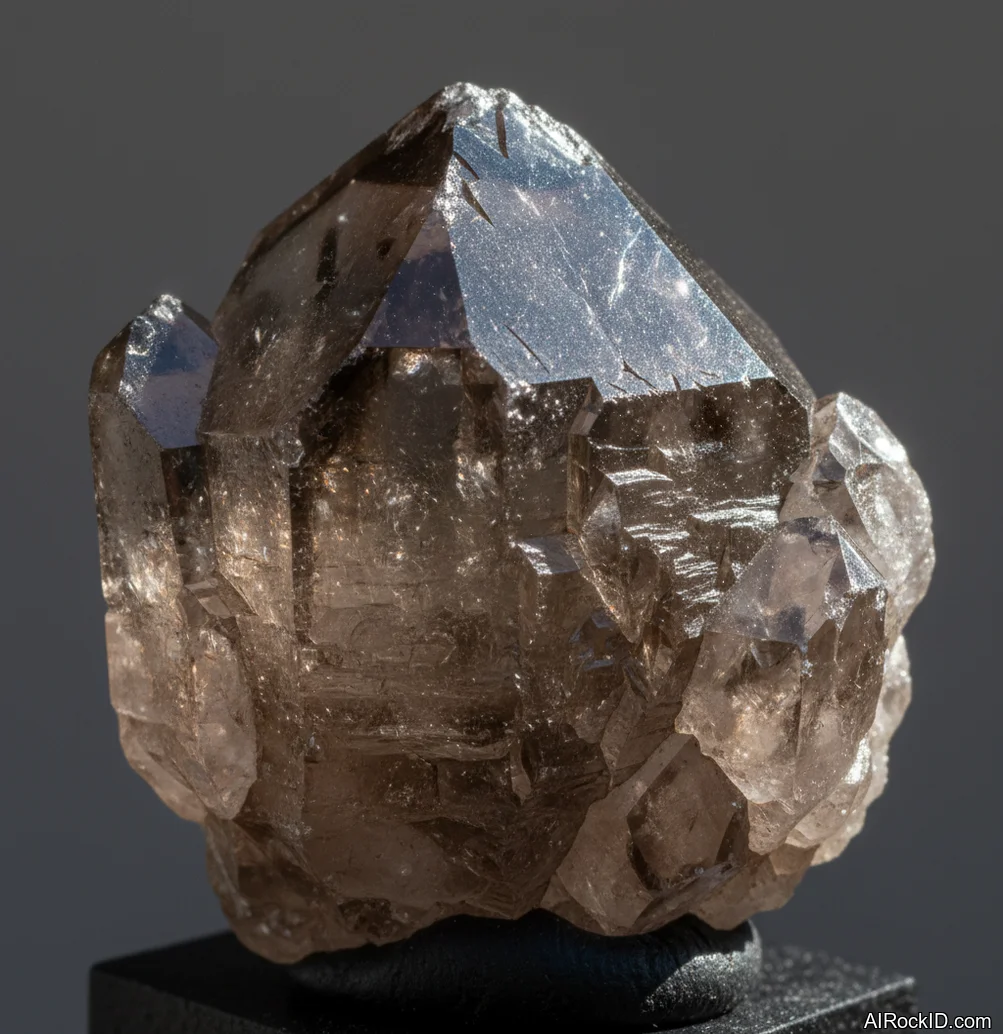
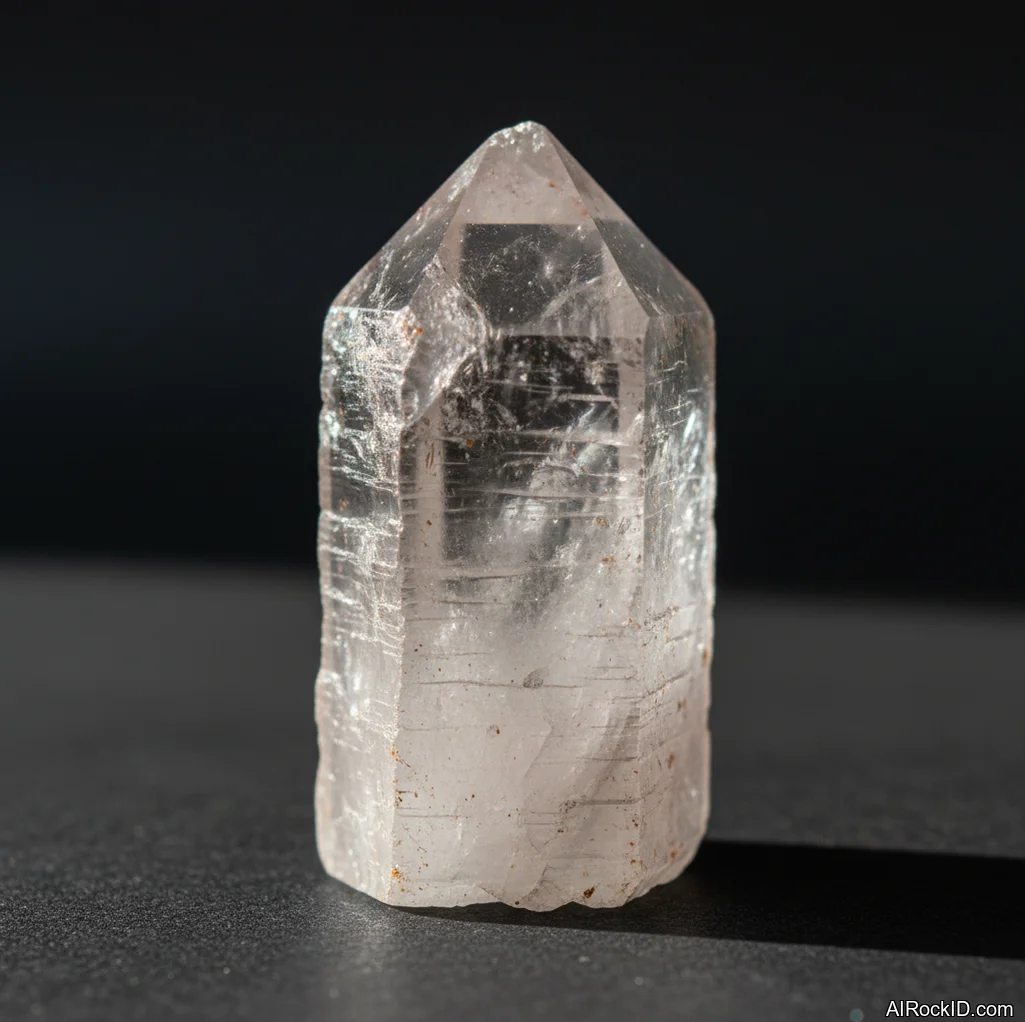
“Lemurian Seed Crystal” is a trade name people use for quartz crystal points, usually clear to slightly smoky, with obvious horizontal striations on one or more faces.
Hold a solid one in your hand and you’ll feel it fast. Your thumb bumps over those little ridges right away, like tiny washboard lines running across the side of the point. It’s still just quartz for all practical purposes, but those stripes are the thing sellers will literally circle in a photo, and it’s what collectors end up paying extra for.
But the whole situation’s kind of messy. Not every striated quartz point actually comes from the classic Brazilian source, and not every “Lemurian” label is even pointing to natural striation. I’ve had pieces where the lines feel too sharp and way too evenly spaced, like somebody ran a tool across the face on purpose. Real growth striations usually wander a bit, fade in and out, and they don’t all start and stop in the exact same place.
Origin & History
“Lemurian Seed Crystal” isn’t something you’ll find in a lab report or a formal mineral guide. It’s a newer marketplace label that started floating around in the late 20th century, mostly tied to metaphysical books and wholesalers moving big batches of quartz points out of Brazil.
And the “Lemurian” bit? That’s borrowed from the old Lemuria idea, a proposed lost landmass that shows up in 1800s science history and later got repurposed into New Age lore. Geologically, none of that changes a thing. It’s quartz. But the name still matters, because it drives the price tags and shapes how the pieces get sold at shows.
Where Is Lemurian Seed Crystal Found?
Most of what’s sold as Lemurian Seed Crystal is attributed to Minas Gerais, Brazil, with similar striated quartz also turning up in other pegmatite and hydrothermal quartz localities worldwide.
Formation
Quartz points like this start out in silica-rich fluids. Most of the time they form in hydrothermal veins and little pockets, where the chemistry and temperature stay steady long enough for those flat crystal faces to come in clean and sharp (you can feel that crisp edge if you run a fingernail along it). In Brazil, a lot of the classic material is tied to vein quartz and those pockety zones that show up in granitic and metamorphic terrains.
Look, if you stare at the ridges for a minute, you’re basically reading the crystal’s growth history. Those striations on quartz faces can come from tiny shifts in growth rate, changes in fluid chemistry, or repeated small changes in how the crystal stacks on new layers. And yeah, that “barcode” look? Half the time it’s just unusually well-developed growth lines on a prism face, not some mystical signature.
How to Identify Lemurian Seed Crystal
Color: Most Lemurian Seed pieces are colorless to milky-clear; some run slightly smoky, slightly golden, or have chlorite or iron staining in patches. The striations are usually easiest to see when the crystal is clean and the faces aren’t heavily frosted.
Luster: Vitreous, glassy luster on clean faces, with a softer sheen where the surface is naturally etched or lightly frosted.
Pick up the point and drag your thumbnail across a striated face. Natural growth striations usually feel like gentle, uneven ridges, not razor-sharp grooves. At first glance, a lot of these points have one face that looks “laddered” while the neighboring faces stay smoother. The real test is light. Tilt it under a single overhead bulb and watch how the striated face flashes in bands while the smooth faces flash more evenly. If the lines look perfectly uniform, identical spacing, same depth end to end, be skeptical.
Properties of Lemurian Seed Crystal
Physical Properties
| Crystal System | Trigonal |
| Hardness (Mohs) | 7 (Hard (6-7.5)) |
| Density | 2.65 g/cm3 |
| Luster | Vitreous |
| Diaphaneity | Transparent to translucent |
| Fracture | Conchoidal |
| Streak | white |
| Magnetism | Non-magnetic |
| Colors | colorless, white, smoky gray, pale yellow, brown, green inclusions |
Chemical Properties
| Classification | Silicates |
| Formula | SiO2 |
| Elements | Si, O |
| Common Impurities | Fe, Al, Ti, Li |
Optical Properties
| Refractive Index | 1.544-1.553 |
| Birefringence | 0.009 |
| Pleochroism | None |
| Optical Character | Uniaxial |
Lemurian Seed Crystal Health & Safety
Solid quartz is non-toxic, so it’s safe to handle. Thing is, the real hazard is mechanical: if a point snaps, you can end up with razor-sharp edges or little chips that’ll cut you.
Safety Tips
If you’re cutting or grinding quartz, put on a respirator and keep things wet so you don’t kick up silica dust. But for everyday stuff like handling it or just rinsing it off in the sink, you don’t need any special precautions.
Lemurian Seed Crystal Value & Price
Price Range
Rough/Tumbled: $10 - $250 per piece
Cut/Polished: $1 - $15 per carat
Prices can swing a lot depending on clarity, how clean the termination is (that tip matters), and whether the striations look bold and genuinely natural up close, not the too-perfect kind you see on treated pieces. And provenance claims or those “named mine” stories can bump an otherwise basic quartz point into a way higher bracket.
Durability
Durable — Scratch resistance: Excellent, Toughness: Good
Quartz is chemically stable for everyday wear and display, but sharp terminations chip if you let points clack together in a tray.
How to Care for Lemurian Seed Crystal
Use & Storage
Store points so the tips don’t touch each other. I use divided boxes or wrap the termination in a bit of tissue if it’s a clean, sharp point.
Cleaning
1) Rinse with lukewarm water to remove dust. 2) Use a soft toothbrush with mild soap to get into striation grooves and around the base. 3) Rinse well and air-dry; pat dry to avoid water spots on glossy faces.
Cleanse & Charge
For a low-drama routine, rinse and let it sit somewhere clean and dry. If you like moonlight, a windowsill overnight is fine, but don’t leave it baking in harsh sun for days if it has delicate surface coatings or iron staining you want to keep looking crisp.
Placement
Set it on a stable shelf where it won’t get bumped. If it’s a tall point, a little museum putty under the base saves a lot of heartbreak.
Caution
Don’t hit it with sudden temperature swings, and don’t just drop it into a bowl with other points. Quartz is hard, sure, but it’ll still chip if it takes a knock. And if you’re seeing surface iron staining or there’s clay packed down in the grooves, leave the harsh acids and aggressive cleaners alone.
Works Well With
Lemurian Seed Crystal Meaning & Healing Properties
A lot of people who buy “Lemurians” are really buying a vibe: clear quartz that feels more tactile and kind of deliberate because of those ridges. In real life, I’ve watched people use them like a little meditation pointer. You just run your thumb along the lines while you breathe. Simple. And yeah, that tiny physical loop can help you stay focused.
Compared to a super glossy, polished tower, a natural striated point feels grippier and more grounded in your hand. The one I’ve got usually stays cool even when the room’s warm, and that ridged face gives your fingers something to mess with. Small detail. But it’s real. If you’re using crystals as cues for mindfulness, texture matters.
But keep your feet on the ground. Any “healing” angle here is spiritual or personal, not medical. And the market is stuffed with big claims, especially about origin stories. So if you want one, get it because you like quartz points, you like the striations, and you like how it feels when you actually hold it. Why pretend it’s anything else?
Identify Any Crystal Instantly
Snap a photo and get properties, value, care instructions, and healing meanings in seconds.