Orange Feldspar
What Is Orange Feldspar?
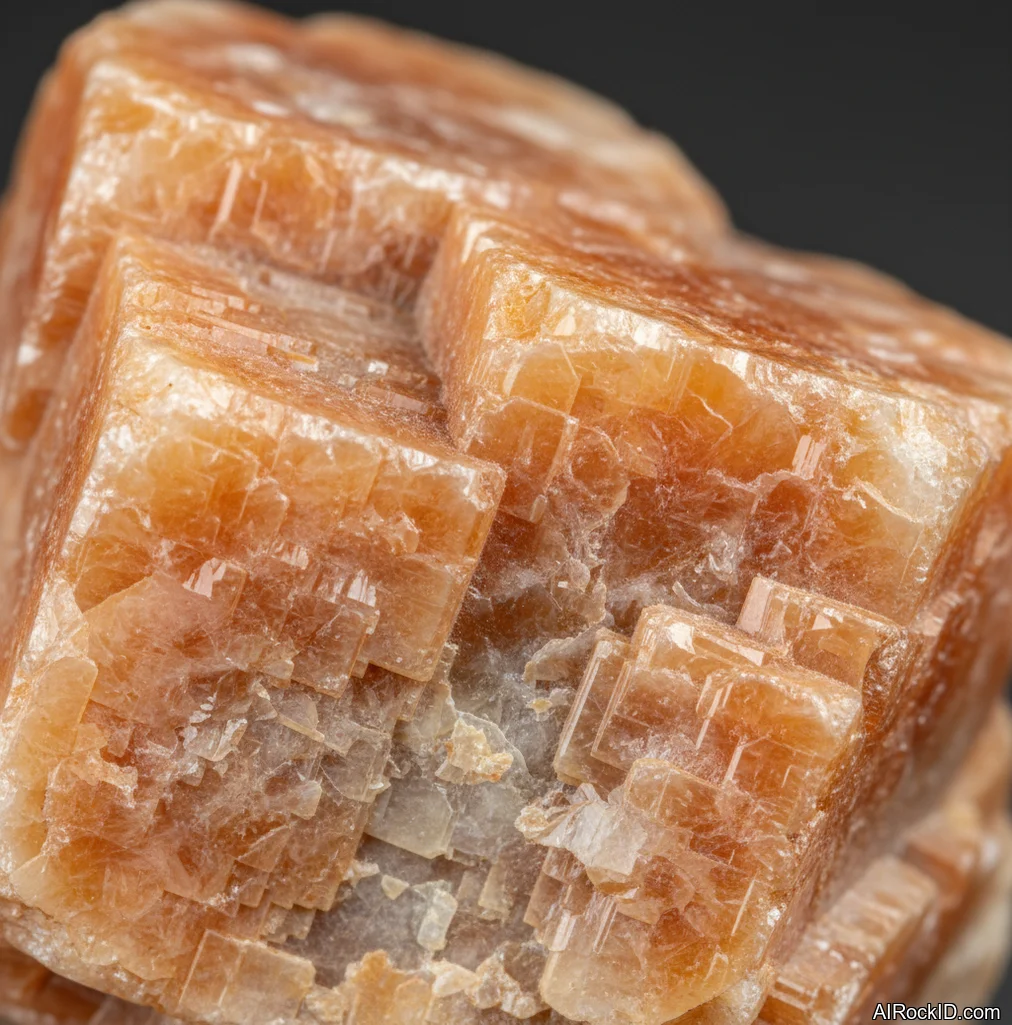
Orange feldspar is just feldspar with an orange body color, usually from iron-related staining or tiny inclusions in potassium feldspar or plagioclase.
Hold a tumbled piece in your hand and you notice the feldspar vibe immediately. It’s lighter than you’d guess for its size. And the surface? Smooth, but not glassy. More like it’s trying to look vitreous, then it gives up and turns into this soft, satiny shine (the kind that almost feels like worn ceramic under your thumb).
People see anything peachy and call it “sunstone,” which… not really. Most orange feldspar doesn’t have true sunstone flash. Real sunstone shows that glittery aventurescence when you tilt it under a lamp, like coppery confetti trapped inside. Plain orange feldspar can still look great, though. You’ll get those warm creamsicle tones, sometimes a pale white patch or two, and once in a while you’ll spot a clean cleavage face that kicks back light like a tiny mirror, then goes dull again when you move it.
Origin & History
Feldspar, as a group, got described and named in 1783 by Abraham Gottlob Werner. He used the German word “Feldspat,” which basically means “field spar,” since you run into it everywhere in rocks and even in weathered soils. And “Feldspat” itself comes from older German usage tied to “field” and “spar,” with “spar” being that old miners’ term for minerals that cleave easily.
“Orange feldspar” isn’t an official mineral name. It’s a trade and collector tag. Dealers slap it on orange-toned orthoclase, microcline, or plagioclase, and sometimes on stuff that’s just a step away from being sold as sunstone. I’ve stood at shows with those shallow plastic bins, the ones that get that chalky scuffing on the rim, and watched orange microcline, Oregon sunstone look-alikes, and plain stained feldspar all land under the same hand-lettered sign. So yeah, you’ve got to look closer.
Where Is Orange Feldspar Found?
Orange feldspar turns up in granites, pegmatites, and some metamorphic rocks worldwide, especially where feldspar is abundant and iron staining is common.
Formation
Most orange feldspar starts out the same plain old way feldspar usually does. It crystallizes as magma cools in granites and syenites, or it grows big and blocky in pegmatites when the melt’s loaded with water and extra elements that let crystals get chunky.
The orange color can be original, coming from tiny inclusions or trace chemistry, but a lot of the time it’s basically nature doing a staining job. Iron oxides work their way into microfractures and along cleavage planes, and the color ends up pooling in patches. If you’ve ever snapped a piece and stared at the fresh break under decent light, you’ll sometimes catch the orange sitting right in the grain boundaries, not perfectly even like something that’s been dyed (it can look a little blotchy, honestly). But here’s the catch: some material on the market is heat-treated feldspar sold under friendlier names, so if the orange looks uniform and too perfect, it’s worth being suspicious.
How to Identify Orange Feldspar
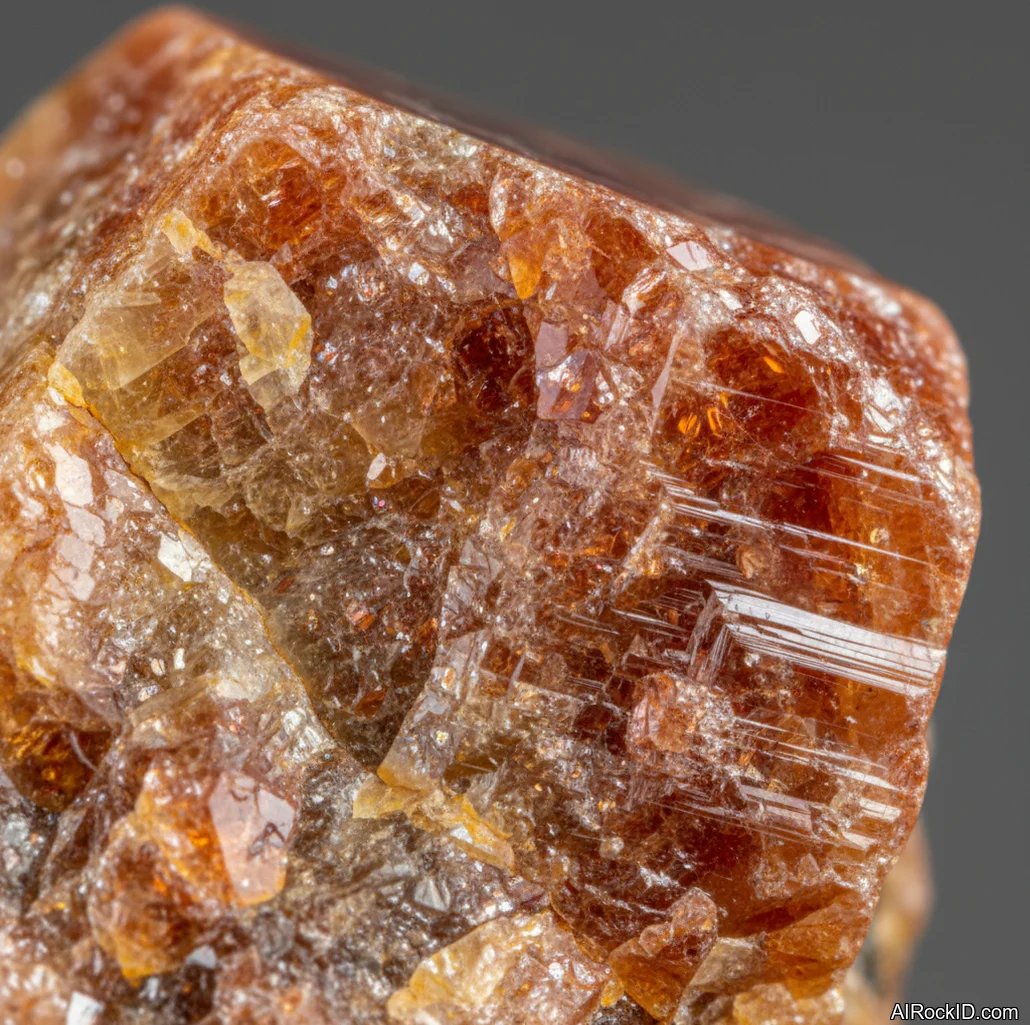
Color: Orange feldspar ranges from pale peach and apricot to deeper orange-brown, often with creamy or white feldspar zones and uneven color patches.
Luster: Usually vitreous to slightly pearly on cleavage faces, and more waxy on tumbled surfaces.
Pick up a piece and tilt it under a single overhead light. If you see broad, flat flashes that switch on and off along a plane, you’re catching feldspar cleavage, not metallic glitter. If you scratch it with a steel nail, it usually won’t take a mark, but it will scratch glass with some effort because it sits around Mohs 6 to 6.5. The real test is the break. A fresh chip often shows two good cleavages meeting close to 90 degrees, and that’s a feldspar giveaway even when the color is doing something weird.
Properties of Orange Feldspar
Physical Properties
| Crystal System | Triclinic |
| Hardness (Mohs) | 6-6.5 (Hard (6-7.5)) |
| Density | 2.55-2.76 g/cm3 |
| Luster | Vitreous |
| Diaphaneity | Translucent to opaque |
| Fracture | Uneven |
| Streak | White |
| Magnetism | Non-magnetic |
| Colors | orange, peach, apricot, tan, cream, white |
Chemical Properties
| Classification | Silicates |
| Formula | KAlSi3O8 (common for orange K-feldspar; plagioclase varieties vary) |
| Elements | K, Al, Si, O |
| Common Impurities | Fe, Ca, Na |
Optical Properties
| Refractive Index | 1.518-1.526 |
| Birefringence | 0.007 |
| Pleochroism | Weak |
| Optical Character | Biaxial |
Orange Feldspar Health & Safety
Orange feldspar is usually safe to pick up and keep on a shelf. But if you’re cutting or grinding it, treat it like any other rock: dust is the problem. I’m talking about that fine, gritty powder that clings to your fingers and ends up on the workbench. So follow the normal rock-dust precautions when you make it into dust.
Safety Tips
If you’re going to lap or saw it, keep a steady trickle of water on the cut and put on a real, proper respirator. You don’t want to be breathing that super-fine silica-bearing dust floating around in the air (it gets everywhere, even on your sleeves).
Orange Feldspar Value & Price
Price Range
Rough/Tumbled: $3 - $35 per piece
Cut/Polished: $5 - $80 per carat
Prices jump when the color stays clean and the rough is clear enough that you can actually cut it without it turning into a foggy mess. If it’s got real sunstone-style aventurescence (that glittery flash you see when you tilt it under a light), most sellers will tag it as sunstone, not just plain orange feldspar.
Durability
Moderate — Scratch resistance: Good, Toughness: Fair
It holds up fine in a display or pocket stone, but the cleavage means it can chip if you drop it on tile.
How to Care for Orange Feldspar
Use & Storage
Store it so it isn’t rattling against quartz points or harder gems. I keep feldspar in soft pouches because those cleavage edges love to catch a chip.
Cleaning
1) Rinse with lukewarm water. 2) Use a drop of mild soap and a soft toothbrush to get into small pits. 3) Rinse well and pat dry; don’t bake it in sun to “dry faster.”
Cleanse & Charge
If you do energy-style cleansing, running water or a quick smoke cleanse works fine, and moonlight is gentle. I skip salt bowls for feldspar just to avoid crusty residue in tiny cracks.
Placement
It looks best under warm indoor light where the peach tones don’t wash out. On a windowsill it can look flat, and some pieces seem to fade a bit over long sun exposure.
Caution
Skip ultrasonic cleaners and stay away from harsh acids. Thing is, cleavage planes and tiny microfractures are already there, and one little flaw can suddenly pop into a fresh chip. Treat it the way you’d handle a feldspar countertop sample, not the way you’d treat a diamond.
Works Well With
Orange Feldspar Meaning & Healing Properties
Orange feldspar tends to get filed under the “warmth and motivation” stones in the metaphysical crowd, and honestly, I get it. When you’ve got one in your hand, it looks sunny without screaming for attention. And if color hits you in that weird, subtle way, that soft orange can bump your mood a notch.
Grab a palm stone and the first thing you’ll notice is the temperature. It stays cool longer than glass or those resin knockoffs, the ones that warm up fast and feel a little too slick. That cool, steady weight is what I connect with, day to day. People lean on it when they’re trying to get unstuck, stick to routines, and keep showing up for their own projects after the initial excitement burns off. But look, if you’re waiting for fireworks like a flashy Oregon sunstone, plain orange feldspar can feel kind of… quiet. Underwhelming, even, both to look at and to work with.
I treat it like a “daily driver” stone. Simple. Steady. Not precious. I’ve kept a chunk on my desk during long work stretches, and it’s the kind of piece you can handle without stressing that you’ll rub off a coating or fog up a polish (you know that milky haze some finishes get). Still, none of this is medical. If you’re dealing with anxiety, depression, or anything physical, crystals can be a comfort object, not a treatment plan.
Identify Any Crystal Instantly
Snap a photo and get properties, value, care instructions, and healing meanings in seconds.