Red Coral
What Is Red Coral?
Red Coral is an organic gemstone, and it comes from the calcium carbonate skeleton of Corallium corals.
Hold a strand of real beads in your hand and you notice it fast. It’s lighter than you’d guess. And it doesn’t have that icy, straight-up “stone” chill you get from quartz or agate when you first pick them up.
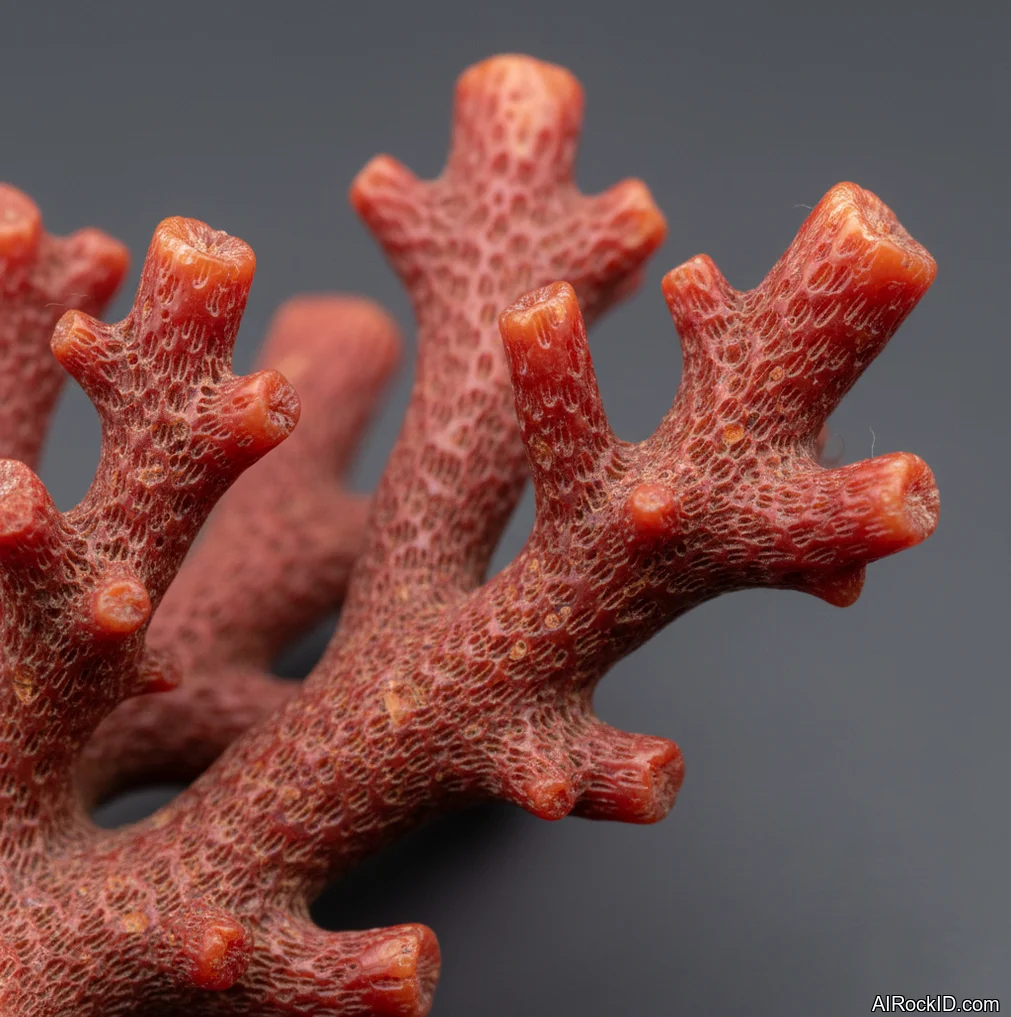
The really well-polished stuff can look like old lacquer, slick and even. But tilt it under a bright desk lamp and you’ll still spot the tells: tiny pores, a faint growth texture, little specks of unevenness here and there (the kind that makes you think, yeah, this grew). Not something that crystallized in a rock.
A lot of red coral out there looks almost too uniform at first glance. Like it came out of a mold. But good material usually wanders a bit in color from bead to bead, sliding from orangey red into a deeper oxblood.
Thing is, if you’ve handled enough of it, you start to hear it too. Tap two beads together gently and the sound is softer, a duller click than glass or jasper. That tiny difference is real.
Origin & History
Pliny the Elder was already writing about coral back in the 1st century CE, and Mediterranean fishermen and traders were hauling it from port to port long before anyone had a modern idea of “gem materials.” The word “coral” comes down through Latin *corallium*, from the Greek *korallion*, basically the old name people used for the sea growth itself.
In the gem trade, “precious coral” usually means *Corallium rubrum* from the Mediterranean, especially around Italy, Sardinia, and North Africa. Jewelers have been using it forever for carvings, beads, and cabochons, but it’s harder to get now as harvesting rules tightened up and reefs declined.
Where Is Red Coral Found?
Fine red coral is sourced mainly from the Mediterranean (Corallium rubrum) and parts of the western Pacific where other Corallium species occur.
Formation
Down on the seafloor, Corallium corals grow these branching skeletons made of calcium carbonate, mostly high-magnesium calcite, with some aragonite mixed in depending on the species and the conditions. It’s slow. Like, years slow. What you’re holding is a biological structure that thickened bit by bit, then got harvested, sliced, and polished up like a gem.
If you’ve ever stared at the cut end of a branch specimen under decent light (the kind that throws a clean highlight across the surface), you can sometimes pick out the internal structure. It looks more like a fine, tight grain than clear, separate layers. But it’s not a “crystal” the way quartz is. No crystal faces. No cleavage planes. Just dense biogenic carbonate that can take a really good polish when the material’s sound.
How to Identify Red Coral
Color: Color runs from salmon and orange-red to deep blood red; natural pieces often show slight mottling or tiny tonal shifts rather than a single flat shade.
Luster: Polished red coral has a waxy to dull luster, sometimes with a soft glassy look on very well-finished surfaces.
Pick up the piece and check the feel. Real coral tends to feel slightly warm compared to agate or glass, and it’s usually pretty light for its size. The real test is a 10x loupe: you’ll often see tiny pores or a fine “skin” texture on less-polished areas, while glass and resin fakes look too smooth. And if the color is screamingly uniform across a whole strand, assume it’s dyed until proven otherwise.
Properties of Red Coral
Physical Properties
| Crystal System | Amorphous |
| Hardness (Mohs) | 3-4 (Soft (2-4)) |
| Density | 2.60-2.70 g/cm3 |
| Luster | Waxy |
| Diaphaneity | Opaque |
| Fracture | Uneven |
| Streak | white |
| Magnetism | Non-magnetic |
| Colors | red, orange-red, salmon, pinkish red, brownish red |
Chemical Properties
| Classification | Carbonates |
| Formula | CaCO3 |
| Elements | Ca, C, O |
| Common Impurities | Mg, Fe, Mn, organic pigments |
Optical Properties
| Refractive Index | 1.486-1.658 |
| Birefringence | 0.172 |
| Pleochroism | None |
| Optical Character | Biaxial |
Red Coral Health & Safety
It’s usually fine to handle, and a quick splash of water won’t hurt it. But it’s pretty soft, so a bit of rubbing (even with something that feels harmless, like a rough cloth) can scuff it up, and chemicals can damage it fast.
Safety Tips
Skip chlorine, acids, and ultrasonic cleaners, and don’t stash it somewhere it’ll scrape or bump up against harder stones (that kind of rubbing adds up fast).
Red Coral Value & Price
Price Range
Rough/Tumbled: $20 - $300 per bead/pendant piece
Price can jump all over the place depending on color, how even the stone looks, and whether it’s actually confirmed natural and untreated. A deep, even red that takes a clean polish, with hardly any pits, will cost way more than something pale or full of porous spots you can feel when you run a fingernail across it.
Durability
Nondurable — Scratch resistance: Fair, Toughness: Fair
Red coral can dry out, scratch, or lose surface shine if it’s worn hard or exposed to harsh chemicals.
How to Care for Red Coral
Use & Storage
Keep it in a soft pouch or a separate compartment. If you toss it in a mixed jewelry box with quartz and topaz, it’ll pick up scratches fast.
Cleaning
1) Wipe with a soft, damp cloth and a tiny drop of mild soap if needed. 2) Rinse quickly in clean water and don’t soak for long. 3) Pat dry and let it air dry fully before storing.
Cleanse & Charge
If you do energy-style cleansing, stick to smoke, sound, or a quick moonlight pass. Salt soaks and harsh rinses are where people wreck the polish.
Placement
I like coral where it won’t get knocked around, like a small dish display away from sunny windows and away from other jewelry. A pendant you wear occasionally is fine, but don’t treat it like a daily-wear sapphire.
Caution
Skip acids of any kind (yes, even vinegar), chlorine, perfumes, plus ultrasonic or steam cleaners. And don’t “just try a little scratch test” on a finished spot, because that line can sink in and stay there for good.
Works Well With
Red Coral Meaning & Healing Properties
Compared to a lot of the so called “grounding” stones, red coral hits different the second it’s in your hand. It’s warm. Not cold and glassy like a crystal point. More organic, like bone or shell, and you can feel that slightly waxy, almost satin-smooth surface when you rub your thumb over it.
When I’m sorting a tray at a show, coral is what I grab when I want something steady but not dead-feeling, you know? It has that quiet weight without being a brick. And the color isn’t “shiny red” either, more like it has depth, especially in the little branchy pieces where you can see tiny natural bumps.
A lot of people tie red coral to protection and courage, especially in Mediterranean and South Asian traditions, and astrologically it gets linked to Mars. But I keep it practical. For me it’s a nudge to move, to make the hard call, to quit pacing around the same worry. If you’re using it as a focus object, it works nicely with breathwork or simple routines since it’s not visually busy and it doesn’t yank your attention all over the place.
One real caveat, though. Some folks buy coral expecting that heavy grounding punch, like hematite. It won’t give you that. It’s lighter, softer, and it can feel almost tender in a way that surprises people.
And ethically, you should care where it came from. I’ve straight up walked away from bright red strands because the seller couldn’t tell me if it was natural, dyed, or even coral at all. (If they get vague, I’m out.)
Identify Any Crystal Instantly
Snap a photo and get properties, value, care instructions, and healing meanings in seconds.