Sonora Sunrise


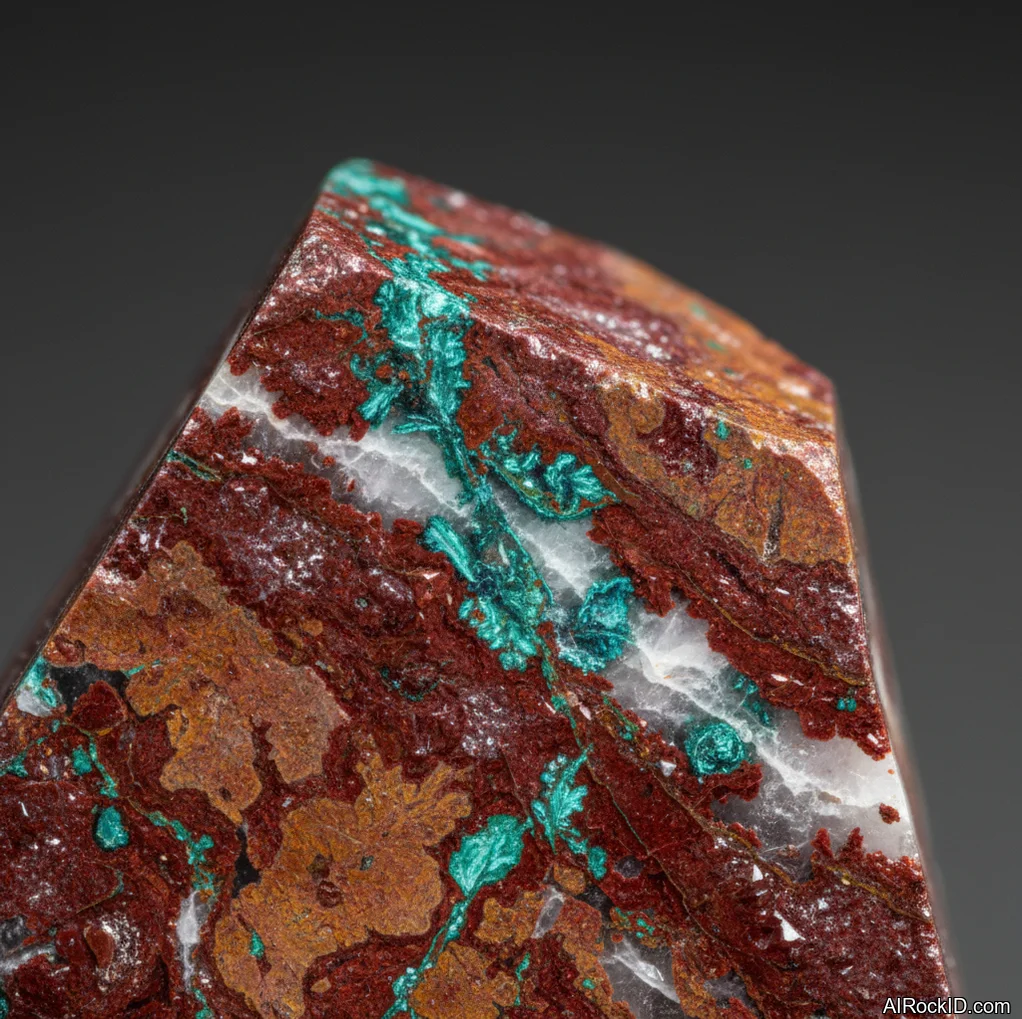
Quick answer: Sonora Sunrise is a copper-bearing lapidary material known for red cuprite set in blue-green chrysocolla, usually from Sonora, Mexico. Its identity is best checked by color zoning, matrix texture, relative softness, and whether the red and blue-green areas look naturally intergrown rather than dyed or assembled.
AI Rock ID can help compare a Sonora Sunrise photo against visually similar copper minerals, especially when red cuprite and blue-green chrysocolla are both visible. RockIdentifier.io provides visual identification support, but confirmation may still require hardness checks, magnification, or seller documentation for high-value pieces.
Good fit
- Collectors who like colorful copper minerals with strong natural contrast
- Lapidary buyers seeking cabochons, slabs, or display pieces with distinct red and blue-green zones
- Beginners who want a visually recognizable material but are willing to learn basic authenticity checks
- Specimen collectors interested in material associated with Sonora, Mexico
Not a good fit
- Anyone needing a hard, everyday-wear ring stone without protective settings
- Buyers who prefer single-mineral specimens with a simple chemical identity
- Collectors who want a water-safe or ultrasonic-cleaner-safe stone
- Anyone relying only on color without checking for dye, resin, or composite material
Most commonly confused with
- Chrysocolla: Chrysocolla may show similar blue-green color but lacks the diagnostic red cuprite zones typical of Sonora Sunrise.
- Azurite-Malachite: Azurite-malachite usually combines deep blue and green copper minerals rather than red cuprite with chrysocolla.
- Cuprite: Cuprite can be red to reddish brown, but standalone cuprite does not show the same blue-green chrysocolla host pattern.
- Dyed Howlite: Dyed howlite may imitate bright blue-green stone, but it usually has webby veining and no natural red cuprite patches.
Sonora Sunrise Lookalike Comparison
| Material | Typical Colors | Key Difference | Buyer Check |
|---|---|---|---|
| Sonora Sunrise | Red, blue-green, dark matrix | Red cuprite intergrown with chrysocolla | Look for natural color boundaries and consistent matrix |
| Chrysocolla | Blue-green to turquoise | Usually lacks red cuprite patches | Check whether red areas are present and mineralized |
| Azurite-Malachite | Deep blue and green | No typical red cuprite sunrise pattern | Compare hue: azurite is often stronger blue |
| Dyed Howlite | Artificial blue-green with gray veining | Dye may collect in cracks or pores | Inspect drill holes, edges, and scratches for dye concentration |
| Eilat Stone | Blue-green with mixed copper minerals | Different source and usually less red cuprite | Ask for locality and mineral composition details |
AI identification confidence
AI image identification is usually more reliable when the photo clearly shows both the red cuprite and blue-green chrysocolla areas in natural light. Confidence drops for polished beads, low-resolution images, heavily sealed surfaces, or pieces showing only one color zone.
When AI gets it wrong
- The specimen is photographed under overly warm or saturated lighting that exaggerates red and green colors.
- The piece is a dyed, stabilized, or composite material with colors that mimic copper minerals.
- Only a small cropped area is visible, hiding the matrix and natural boundary patterns.
- The item is a bead or cabochon with a high polish that obscures texture and mineral transitions.
Final recommendation
Choose Sonora Sunrise from sellers who disclose locality, treatment status, and whether the piece is natural, stabilized, or backed for lapidary use. For higher-priced material, prioritize clear photos of both faces, close-ups of color boundaries, and a return policy if the specimen does not match the description.
How to Check Sonora Sunrise Authenticity
Authentic Sonora Sunrise should show red cuprite and blue-green chrysocolla appearing naturally intergrown rather than painted, laminated, or sharply artificial. Under magnification, inspect color boundaries, pits, fractures, and edges for dye concentration or resin pooling. A seller should be able to state whether the piece is natural, stabilized, backed, or treated.
What to Ask Before Buying Sonora Sunrise
Ask whether the material is from Sonora, Mexico, and whether it has been stabilized, filled, dyed, or backed. Request photos taken in daylight or neutral lighting, including the front, back, edges, and any drilled areas. For cabochons and slabs, ask about thickness, cracks, polish quality, and whether soft chrysocolla-rich areas are secure.
Best Photo Conditions for Identification
Photograph Sonora Sunrise in indirect natural light on a neutral background to avoid color distortion. Include close-up images of the red and blue-green contact zones, the back of the specimen, and any chipped or unpolished areas. A scale reference such as a ruler or coin helps distinguish specimen pieces from small cabochons or beads.
What Is Sonora Sunrise?
Sonora Sunrise is a copper-rich lapidary rock, built out of red cuprite sitting in blue-green chrysocolla, and every so often you’ll spot black tenorite in there too.
Pick up a decent slab and the first thing that hits you is the heft. It feels weirdly heavy for how small it is. The polish on the chrysocolla goes slick and almost glassy under your thumb, but the cuprite reads different, like little red islands floating in a blue-green pool.
People glance at it and call it a “stone,” but it’s really a mix. And honestly, that mix is the whole deal. The nicest pieces have sharp contrast: true brick red (not that rusty brown) against blue that tips more turquoise than green. But you’ll also run into scrappier material where the colors smear together and turn kind of muddy, and that’s the stuff you see dumped in cheap buckets at shows.
Origin & History
Most dealers I’ve talked to trace the name “Sonora Sunrise” back to the lapidary world, tied to material coming out of Sonora, Mexico that got marketed for that sunrise color combo. I started seeing it all the time on dealer tables in the 1990s and 2000s, usually cut as cabs and those small polished freeforms you can feel warm up in your palm, not really as true “specimens.”
Thing is, the mineral components were described long before anybody slapped a trade name on it. Cuprite (Cu2O) has been known as a copper ore mineral for centuries. And chrysocolla has been used for ages too, a copper silicate gel-like material that shows up around old copper workings (that dusty blue-green stuff in the cracks). The trade name stuck because it’s way easier to remember than “cuprite in chrysocolla,” and honestly, it matches what your eye sees. Why fight it?
Where Is Sonora Sunrise Found?
Sonora Sunrise is sold as material from Sonora in northwestern Mexico, typically from copper-oxide zone workings and nearby lapidary rough sources.
Formation
Look at the colors for a second and you’re basically reading a weathering story. This stuff forms in the oxidized zones of copper deposits, right up near the surface where copper-bearing fluids can creep through fractures and tiny pore spaces. Oxygen does most of the work. And as the conditions shift, the copper minerals change into new forms.
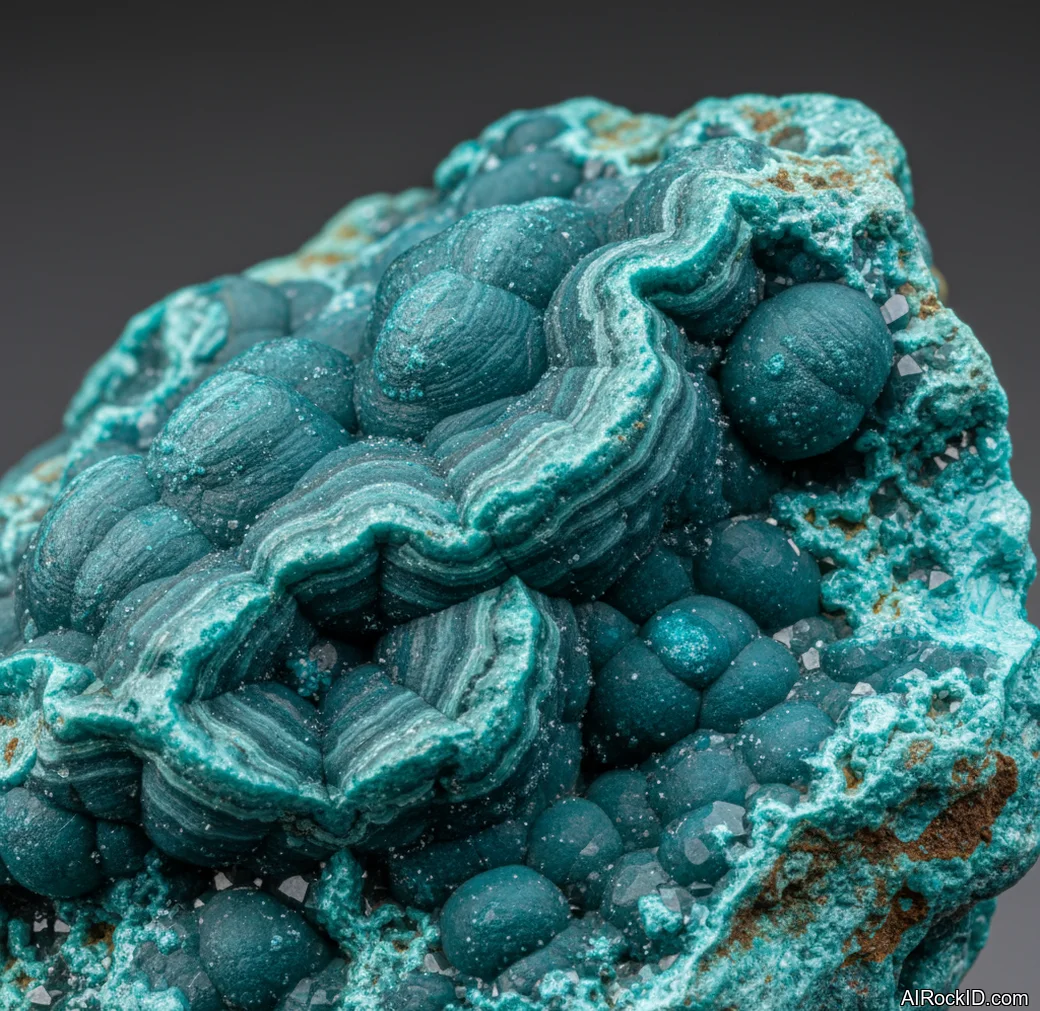
The red, more crystalline chunks are usually cuprite. The blue-green material, on the other hand, is often chrysocolla, and it tends to smear, fill gaps, and coat everything as a more massive matrix (almost like a thin paint layer in spots).
And those little black seams or peppery specks you sometimes catch when you tilt the rock in the light? That’s commonly tenorite (CuO) or other dark copper oxides. The overall pattern can come out brecciated, blotchy, or vein-like, depending on how the rock got cracked up in the first place and then glued back together by later copper-rich fluids.
How to Identify Sonora Sunrise
Color: Typical Sonora Sunrise shows brick-red to cherry-red cuprite against blue-green chrysocolla, often with scattered black tenorite streaks or dots. Colors are usually opaque and high-contrast when the material is good.
Luster: Polished pieces range from waxy to vitreous, depending on how silica-rich and well-cemented the chrysocolla is.
Pick up a piece and tilt it under a strong light. Real cuprite areas stay a solid red and don’t “flash” like glass or resin, while dyed composites often look too even and too saturated. The real test is the feel: good Sonora rough is cool to the touch and has that dense copper-mineral heft, not the lightweight warmth you get with plastic or resin blocks. And if you’ve got a loupe, check the borders between red and blue. Natural material usually has messy, irregular boundaries, not crisp cartoon outlines.
Common Look-Alikes
Sonora Sunrise is sometimes confused with these materials:
- Dyed chrysocolla or dyed howlite/magnesite sold as “Sonora Sunrise” (too-even turquoise with dye pooling in pits and along saw marks)
- “Cuprite in chrysocolla” look-alike mixes from other localities, including cuprite in quartz/calcite with chrysocolla stains (often sold under the same trade name)
- Malachite + cuprite composites or mixed copper-ore slabs (greener, bandy malachite can get mislabeled as the blue-green host)
- Eilat stone / “King Solomon stone” (multi-mineral copper ore with blues and greens, but it usually lacks those clean cherry-red cuprite islands)
- Stabilized or resin-impregnated chrysocolla with added red filler or crushed cuprite (plastic-looking gloss, red looks smeared instead of crisp grains)
- Dyed glass or cast resin “copper ore” cabochons (warm in the hand, bubbles, and the red/blue boundary looks too perfect)
Market Cautions & Treatments
When AI Can Get This Wrong
In photos, AI mixes Sonora Sunrise up with Eilat stone and generic “chrysocolla with cuprite” because all it sees is blue-green plus red spots. The real test is in-hand: it should sit heavy for a small cab, and a steel needle will bite the chrysocolla host easier than the cuprite islands. A loupe helps too, since real pieces show granular cuprite boundaries and occasional black tenorite specks instead of perfectly smooth color transitions.
Properties of Sonora Sunrise
Physical Properties
| Crystal System | Cubic |
| Hardness (Mohs) | 3.5-4 (Soft (2-4)) |
| Density | 3.6-4.0 g/cm3 |
| Luster | Waxy |
| Diaphaneity | Opaque |
| Fracture | Uneven |
| Streak | Reddish brown to greenish (varies by area) |
| Magnetism | Non-magnetic |
| Colors | brick red, cherry red, blue-green, turquoise, black |
Chemical Properties
| Classification | Oxides and silicates (mixture) |
| Formula | Cu2O + (Cu,Al)2H2Si2O5(OH)4·nH2O (mixture) |
| Elements | Cu, O, Si, H, Al |
| Common Impurities | Fe, Mn |
Optical Properties
| Refractive Index | 1.90-2.85 |
| Birefringence | None |
| Pleochroism | None |
| Optical Character | Isotropic |
Sonora Sunrise Health & Safety
Handling is usually fine. But the moment you start cutting, grinding, or sanding, you can kick up copper-bearing dust. I’ve seen that fine powder settle on the bench and cling to your fingertips (and it gets in the creases). So, keep it wet when you can, and use basic dust control. It really does matter.
Safety Tips
Use water while you’re shaping or polishing (it keeps the dust down and the grit from flying everywhere). And for lapidary work, wear a respirator that actually fits right, not one that leaks around your nose when you breathe in. Then wash your hands after you’ve handled rough stone or slurry, especially once that gray paste has dried on your fingers.
Sonora Sunrise Value & Price
Price Range
Rough/Tumbled: $10 - $80 per piece
Cut/Polished: $3 - $20 per carat
Prices climb fast when the red and blue are crisp and clean, there aren’t many fractures, and the polish doesn’t dig in and “orange peel” the softer spots. And yeah, big, solid hunks of stable rough cost more, because they hold together, unlike those thin, cracky slabs that practically beg to chip the second you touch an edge.
Durability
Moderate — Scratch resistance: Fair, Toughness: Fair
It can take a nice polish, but the mixed hardness means edges and thin points are the first things to bruise or chip.
How to Care for Sonora Sunrise
Use & Storage
Store it so it can’t knock into harder stones. I keep mine in a padded tray because the cuprite-heavy corners love to get tiny dings.
Cleaning
1) Rinse quickly in lukewarm water. 2) Use a drop of mild soap and your fingers or a very soft brush on polished surfaces. 3) Pat dry and let it air dry fully before putting it away.
Cleanse & Charge
Smoke cleansing and sound are both low-risk options for this material. If you use moonlight, keep it out of harsh sun since some chrysocolla-rich pieces can look a little duller after long window time.
Placement
Looks best where light rakes across the polish from the side, not straight down. A shelf spot at eye level shows off the red-blue boundary lines way better.
Caution
Skip ultrasonic cleaners, strong acids, or going at it with a stiff brush, especially if the surface is rough or pitted. That’s where stuff can catch and you’ll end up grinding the high spots down while the little pits just hold onto whatever you’re trying to remove. And if you’re doing any lapidary work, handle it the way you would copper-mineral material. Keep the dust under control. Seriously, you don’t want that fine powder floating around (it gets everywhere).
Works Well With
Sonora Sunrise Meaning & Healing Properties
Next to a lot of the “pretty blue stones” out there, Sonora Sunrise just feels… planted. It’s heavy. Dense. The kind of weight you notice right away when it drops into your palm. When I carry a palm stone of it, I don’t mess with it as much. I mostly just hold it like a worry stone, thumb sliding over the slick blue, then catching on those red patches.
In crystal-healing circles, people tie the blue-green chrysocolla side to calm communication, and the red cuprite side to drive and stamina. I keep that idea pretty down-to-earth. If a stone gets you to slow your breathing and actually pay attention for a minute, that’s useful. But it’s not medicine. And it’s not going to replace therapy, sleep, or real treatment. Come on.
But here’s the part people rarely say plainly: this stuff is a mix, so different pieces feel different because they literally are different. Some are mostly chrysocolla with just a couple red freckles. Some are cuprite-heavy and darker, almost moody-looking. So, if you’re picking one for personal work, don’t buy from a stock photo. Hold it if you can. The one that clicks is usually obvious in about ten seconds.
Common mistakes
- Assuming every red-and-blue-green stone is Sonora Sunrise without checking for cuprite and chrysocolla together.
- Confusing dyed howlite or other dyed porous stones with natural copper mineral material.
- Judging authenticity from color alone instead of inspecting edges, fractures, and drill holes.
- Buying polished beads without asking whether the material is natural, stabilized, or composite.
- Using harsh cleaning methods that can damage softer chrysocolla-rich areas.
- Overpaying for vague listings that do not disclose locality, treatment, or clear photos.
Identify Sonora Sunrise from a photo
Compare Sonora Sunrise traits, care tips, value clues, and common lookalikes with a clear photo.