Agni Manitite Pearl Of The Divine Fire
What Is Agni Manitite Pearl Of The Divine Fire?
Agni Manitite Pearl Of The Divine Fire is just a trade name for a dark, tektite-like natural glass. It’s usually amorphous, glossy, and pitted from rapid melting and cooling.
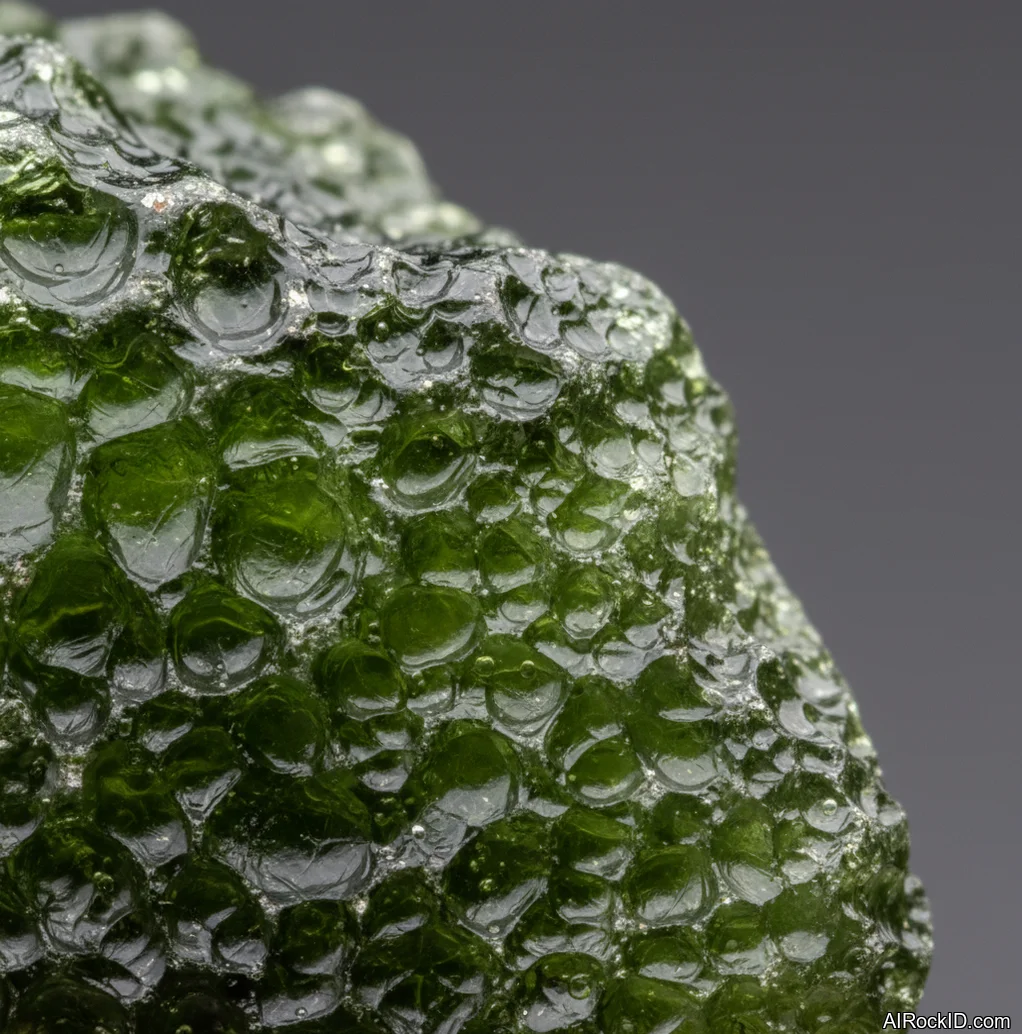
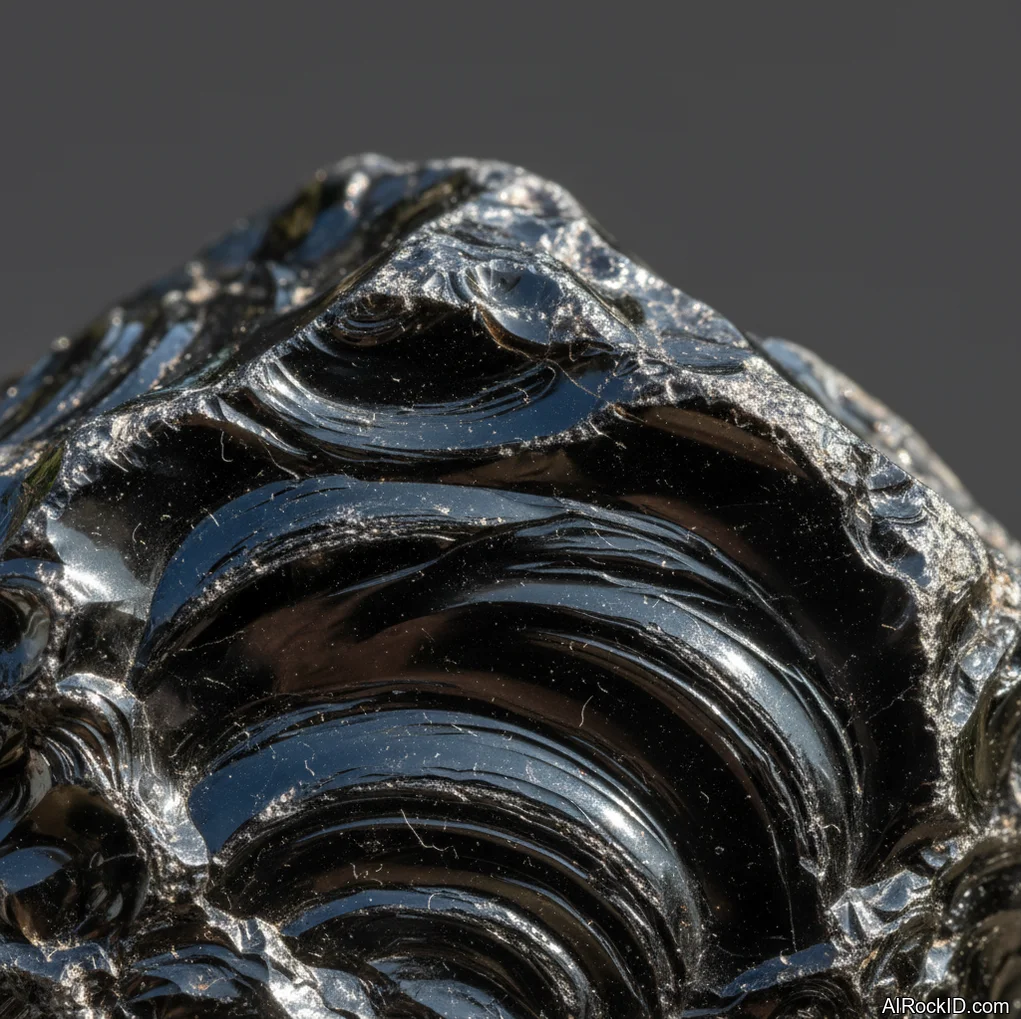
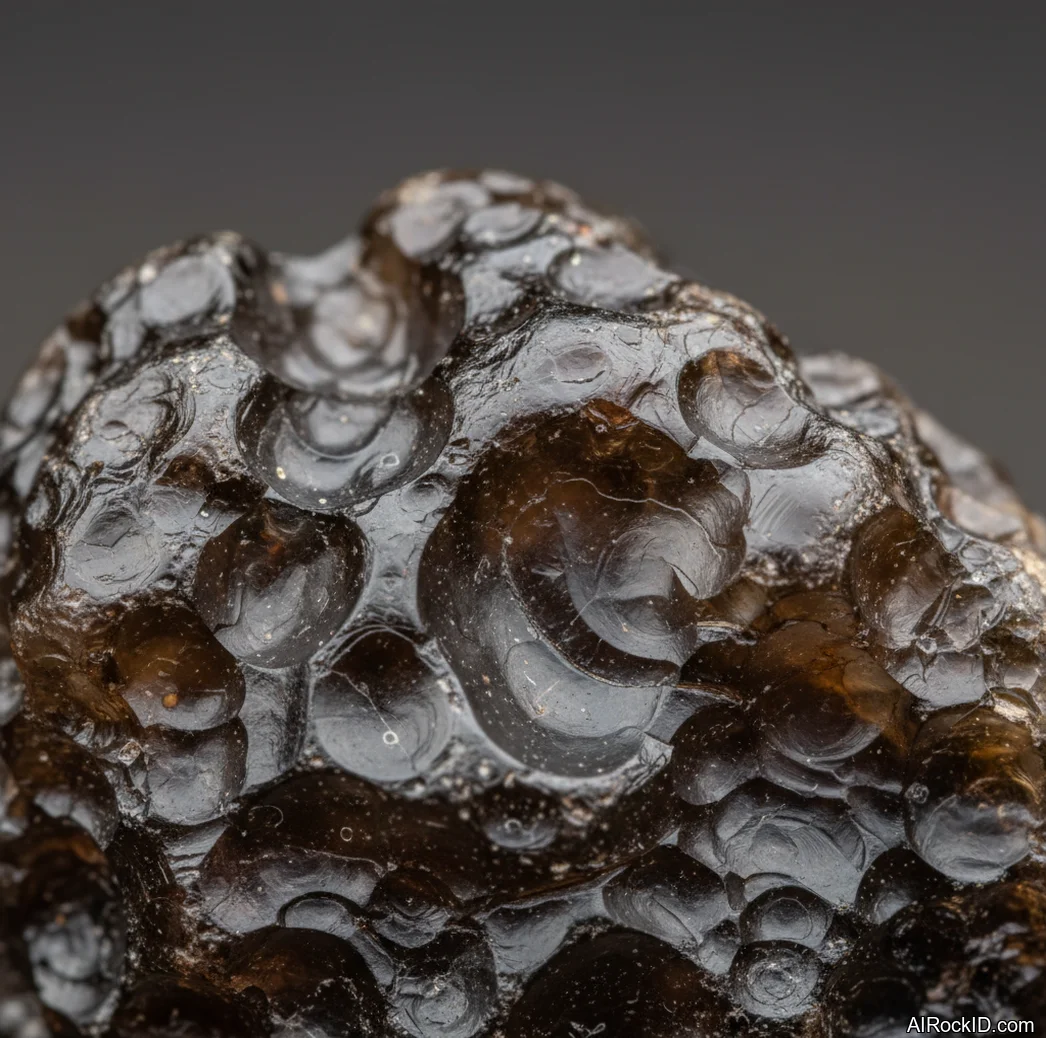
Pick up a real piece and two things hit you right away. It stays cool in your hand, and it feels weirdly light for something that looks that dark. Run a fingertip over the surface and you’ll feel those little dimples and ripples, like someone pressed a thumb into soft wax and it set before it could smooth out. Some pieces have tiny silvery sparkles caught inside (you only see them when you tilt it just right), but most read as smoky brown to near-black if you hold them up to a strong light.
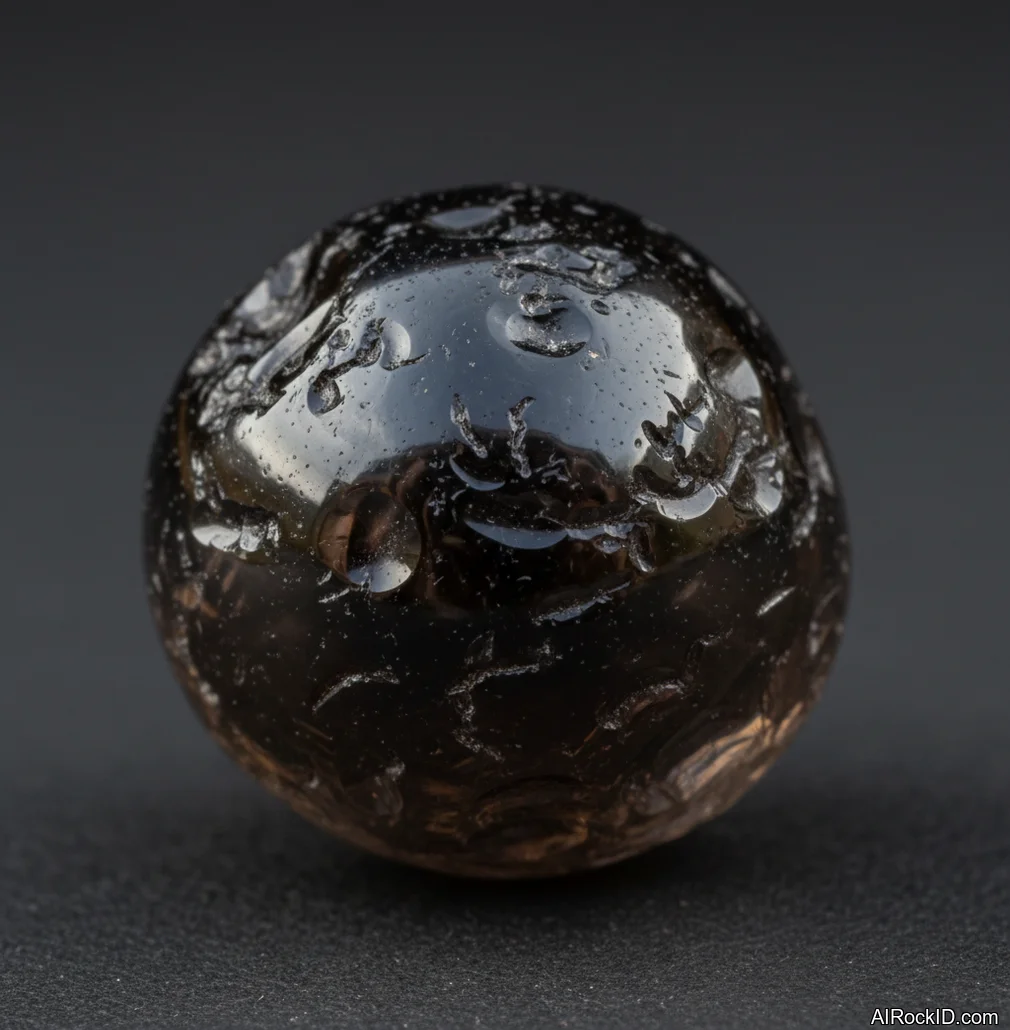
Most of what’s sold is tumbled into “pearl” shapes or small cab-style freeforms, the kind that sit nicely on your palm and have that slick, rounded edge. Raw chunks are out there, but finding clean ones is tougher. And yeah, the name’s a bit much, but the material is basically glass, so treat it like you’d treat a nice piece of obsidian.
Origin & History
Agni Manitite didn’t start life as some formal mineral species. It was a modern trade name first. “Agni” is the Sanskrit word for fire, and “mani” gets used to mean “jewel” or “pearl” in a bunch of South Asian settings, so the whole thing is basically sales-friendly shorthand for “fire jewel.”
In the collector scene, you start seeing it pop up around the late 20th into the early 21st century, mostly in the metaphysical crowd and at gem shows, usually pitched as a tektite or tektite-like glass from Indonesia. But here’s the catch: you won’t find “Agni Manitite” listed as an official IMA mineral. Dealers handle it the way they handle labels like “Indochinite” or “Philippinite,” meaning it’s about where it’s from and what it looks like, not a crystal system and a species.
Where Is Agni Manitite Pearl Of The Divine Fire Found?
Agni Manitite is sold as Indonesian material, commonly linked by dealers to the wider Southeast Asian tektite strewnfield region. Most pieces you’ll see at shows are traded through Indonesia even when the exact find spot is vague.
Formation
Look closely at the texture and it kind of tells the whole story. Natural glass like this forms when rock gets flash-melted, then quenched so fast it never has a chance to build a crystal lattice. So it stays amorphous. And that’s why the surface can come off looking melted, wrinkled, pitted, like it froze mid-splash.
With tektites, the accepted model is impact origin: a big meteorite hits, melts surface material, blasts it out, and the droplets cool while they’re still flying. Pretty simple on paper. But here’s the collector reality on the ground: “Agni Manitite” gets used really loosely. Some lots look dead-on tektite-like, others read more like volcanic glass once you’ve got one in your hand and you’re turning it under a light (that slightly greasy shine and the way the pits catch grit is hard to unsee).
Thing is, the real test is consistency. Tektite-type pieces often have that faint internal smokiness. And if you hit them with a bright flashlight, you’ll sometimes catch tiny bubble trails inside. That’s the tell.
How to Identify Agni Manitite Pearl Of The Divine Fire
Color: Usually dark brown to black in room light, but many pieces go translucent brown at thin edges or when you backlight them hard. Some have a faint olive-brown cast.
Luster: Glassy to resinous luster, like a well-polished obsidian pebble.
Pick up the piece and run a fingernail over the surface. Real natural glass often has tiny pits and a slightly grabby texture even when it’s polished. If it feels too slick and plasticky, be suspicious. If you scratch it with a steel nail, it should mark but not crumble, and the scratch will look like a dull line in glass. And if someone’s selling it as “crystal with points,” walk away. It shouldn’t have crystal faces.
Properties of Agni Manitite Pearl Of The Divine Fire
Physical Properties
| Crystal System | Amorphous |
| Hardness (Mohs) | 5.5-6 (Medium (4-6)) |
| Density | 2.35-2.55 |
| Luster | Vitreous |
| Diaphaneity | Translucent to opaque |
| Fracture | Conchoidal |
| Streak | white |
| Magnetism | Non-magnetic |
| Colors | black, dark brown, smoky brown, olive brown |
Chemical Properties
| Classification | Oxides (natural glass) |
| Formula | Variable (silica-rich natural glass; no fixed formula) |
| Elements | Si, O, Al, Fe, Ca, Mg, Na, K |
| Common Impurities | Fe, Ti, Mn |
Optical Properties
| Refractive Index | 1.48-1.52 |
| Birefringence | None |
| Pleochroism | None |
| Optical Character | Isotropic |
Agni Manitite Pearl Of The Divine Fire Health & Safety
It’s safe to handle in your hands, no problem. But once you start cutting or grinding it, you can kick up fine silica dust that hangs in the air and settles into that light, chalky film on your tools and fingers. So treat it the same way you’d treat obsidian for lapidary safety.
Safety Tips
If you’re shaping it, keep it wet with water, put on a proper respirator that’s actually rated for fine particulate (not just a flimsy dust mask), and deal with the slurry carefully instead of letting it dry out and sweeping it up.
Agni Manitite Pearl Of The Divine Fire Value & Price
Price Range
Rough/Tumbled: $10 - $120 per piece (small tumbled to larger display pieces)
Cut/Polished: $5 - $25 per carat (cabochons; quality varies a lot)
Price mostly comes down to size, what the surface feels and looks like in your hand, and whether it’s being sold raw or taken to a heavy polish. Big, clean pieces usually land higher. And if it’s got those little pits you can actually catch with a fingernail plus that nice translucency around the edges when you hold it up to a light, yeah, you’ll pay more.
Durability
Moderate — Scratch resistance: Fair, Toughness: Fair
It’s stable like most glass, but it can chip on edges and it doesn’t love being rattled around in a pocket with harder stones.
How to Care for Agni Manitite Pearl Of The Divine Fire
Use & Storage
Store it like you’d store obsidian or moldavite: separate pouch or a wrapped compartment so it doesn’t get edge chips. If it’s a high-gloss polish, keep it off rough quartz points.
Cleaning
1) Rinse with lukewarm water. 2) Use a drop of mild soap and your fingers or a soft cloth. 3) Pat dry and avoid abrasive towels that can haze the polish over time.
Cleanse & Charge
For a non-dramatic routine, smoke cleanse or sound is fine, and moonlight won’t hurt it. I skip salt bowls because gritty salt can leave micro-scratches on glossy glass.
Placement
I like it on a desk or shelf where you can backlight it once in a while and catch the brown translucence at the edges. Keep it away from spots where it can get knocked onto tile.
Caution
Skip ultrasonic cleaners and steam cleaners. And don’t trust the “heat safe” idea just because the name mentions fire. Glass can still crack if you hit it with a sudden temperature change.
Works Well With
Agni Manitite Pearl Of The Divine Fire Meaning & Healing Properties
Agni Manitite sounds like something out of a fantasy novel, but really it’s a pretty simple material with a big, dramatic label stuck on it. And yeah, it kinda is just that. But I totally get why people grab onto it anyway: in your hand it feels like a reset button, the same way good glass does, slick and cool without feeling dead. When I’m sorting a tray at a show, it’s one of those pieces I catch myself rubbing with my thumb on autopilot, like my brain’s testing the surface.
Metaphysically, most folks file it under “fire” stuff. Motivation. Courage. That kick to start the thing you’ve been dodging for weeks. I’ve watched people react in two totally different ways: they either swear they feel it right away, or they shrug and get nothing. That’s normal. If you’re using it for mindset work, treat it like a physical anchor (a reminder you can touch), not some magic fix. It isn’t medical care, and it’s not replacing therapy, sleep, hydration, or any of the boring basics that actually keep you upright.
But there’s a practical, grounded reason glassy stones can work well for focus, too. They give you instant feedback. Tilt it and the shine shifts. Hold it up to a lamp and the edges go brown and a little glowy, like a bottle catching light at the kitchen sink. That tiny sensory loop can be really handy for meditation or breath work. So, look, if you’re buying it for “energy,” do yourself a favor and buy it because you genuinely like how it looks, too. Otherwise it ends up in a drawer. And then what’s the point?
Identify Any Crystal Instantly
Snap a photo and get properties, value, care instructions, and healing meanings in seconds.