Cavansite
What Is Cavansite?
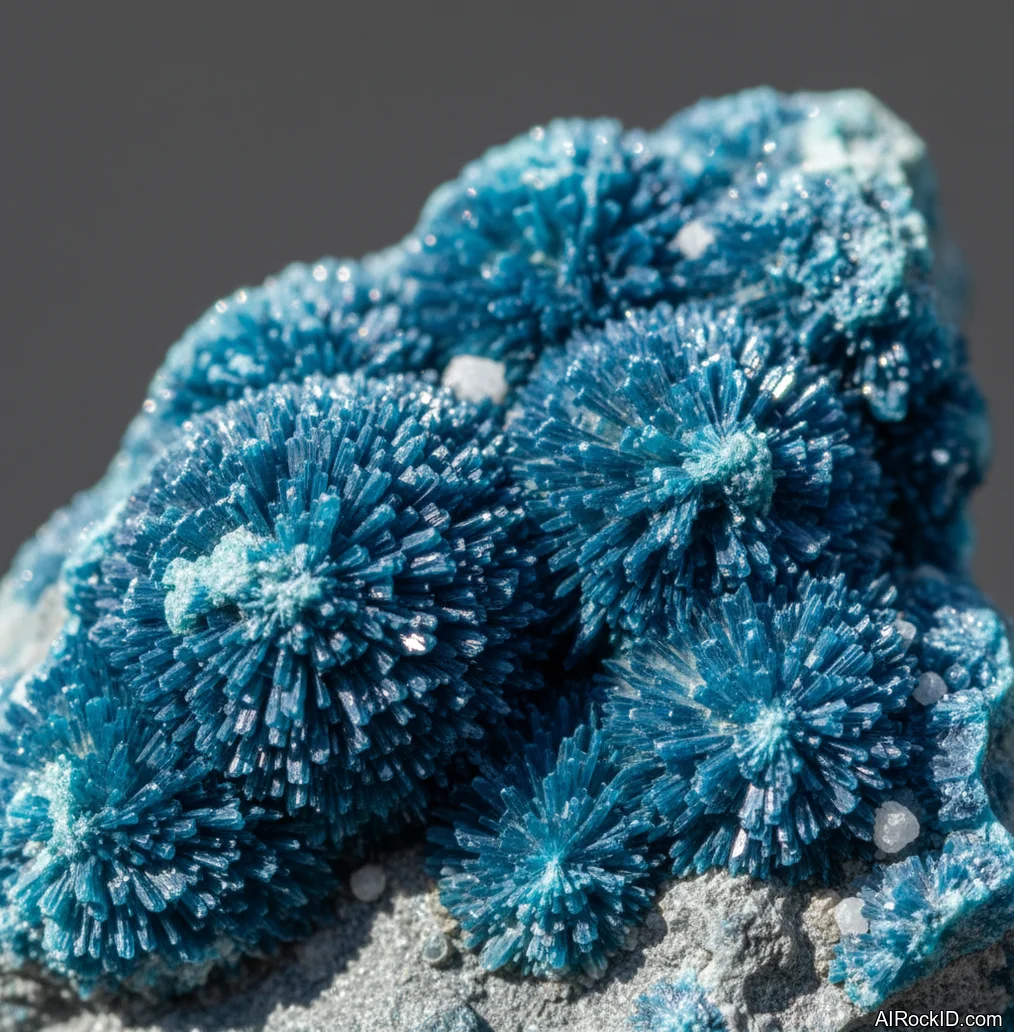
Cavansite’s one of those minerals you don’t run into often. It’s a rare calcium vanadium silicate, Ca(VO)Si4O10·4H2O, and it usually shows up as bright blue prismatic crystals sitting on a zeolite matrix.
Pick up a good specimen and, honestly, the first thing that hits you is how the blue looks like someone dabbed paint on the rock. But it isn’t paint. Tip it under a desk lamp and the crystal faces kick back tiny flashes, especially when they’re perched on white stilbite or heulandite. Most pieces are small, like thumbnail size. Doesn’t matter. The color’s so intense they don’t need to be big.
Most cavansite you’ll see for sale comes out of the Deccan Traps in India, and it usually shows up as tight sprays, little rosettes, or stubby prisms. But look, here’s the catch: it’s soft. You don’t want it bouncing around in a pocket next to quartz, and you really don’t want to scrub it like a dirty penny. I’ve handled enough of it to know the crystals can chip from one careless fingernail, especially if the tips are thin and brittle (and they often are).
Origin & History
Back in 1967, cavansite was first described in Oregon, USA, sitting in basalt cavities at the type locality near the town of Cave Junction. It didn’t get the official nod until it was analyzed, and then people started paying attention fast because that saturated blue just isn’t something you run across in the zeolite world.
The name’s basically built from its chemistry: CA for calcium, VAN for vanadium, SI for silicon. Kind of a mash-up. And yeah, it can sound like a brand name the first time you hear it, but once you’ve actually seen the real stuff in person, it stays in your head.
Where Is Cavansite Found?
Most collector specimens come from basalt-hosted zeolite pockets in western India. The type locality is in Oregon, and smaller occurrences are reported in a handful of other basalt terrains.
Formation
Out in the field, cavansite shows up as a cavity mineral. Picture gas bubbles and little open pockets in basalt that later turn into tiny chemistry labs. Warm fluids snake through those spaces, dump silica, calcium, vanadium, and water, and given enough time you end up with layers of zeolites, calcite, and then, every now and then, that blue surprise.
Look, if you study a typical Indian specimen up close, you can usually trace the sequence of what happened. Stilbite or heulandite tends to go down first as a pale base layer, then cavansite grows over it as sprays or short prisms, and sometimes there are later, clear apophyllite crystals sitting nearby (almost like they got dropped in last). This isn’t some deep-earth, high-pressure setup. It’s slower, low-temperature mineral gardening inside basalt.
How to Identify Cavansite
Color: The classic color is intense sky to electric blue, sometimes leaning slightly greenish-blue. Good pieces look saturated even in weak indoor light.
Luster: Vitreous to slightly pearly on crystal faces.
Pick up the specimen and use a hand lens. Real cavansite crystals are usually prismatic or in tight radiating sprays, not a smooth blue coating. If you scratch it with a steel needle, it can mark more easily than you’d expect for something that looks so crisp, which matches its Mohs 3–4. And if the blue looks like it soaked into the matrix with no crystal shape at all, be cautious, because dyed zeolites and painted souvenirs do exist.
Properties of Cavansite
Physical Properties
| Crystal System | Orthorhombic |
| Hardness (Mohs) | 3-4 (Soft (2-4)) |
| Density | 2.15-2.25 g/cm3 |
| Luster | Vitreous |
| Diaphaneity | Transparent to translucent |
| Fracture | Uneven |
| Streak | white to pale blue |
| Magnetism | Non-magnetic |
| Colors | blue, greenish blue, sky blue |
Chemical Properties
| Classification | Silicates |
| Formula | Ca(VO)Si4O10·4H2O |
| Elements | Ca, V, Si, O, H |
| Common Impurities | Al, Fe, Mg |
Optical Properties
| Refractive Index | 1.53-1.54 |
| Birefringence | 0.010 |
| Pleochroism | Weak |
| Optical Character | Biaxial |
Cavansite Health & Safety
It’s usually fine to pick up and handle as a specimen. The real worry is chipping or snapping the crystals (those little points can break off fast if you bump them), not any health problems.
Safety Tips
If you ever end up cutting or grinding matrix rock, put on a respirator and do it wet. Seriously. But honestly, most people never have to do any of that with cavansite.
Cavansite Value & Price
Price Range
Rough/Tumbled: $25 - $400 per specimen
Prices climb fast depending on crystal size, how deep the blue is, and whether the sprays are clean or have chips and dings. The ones that move quickest (and for more money) are the sharp cavansite sitting on bright white stilbite, with that little apophyllite sparkle that catches the light when you tilt it in your hand.
Durability
Fragile — Scratch resistance: Poor, Toughness: Poor
Cavansite is stable on the shelf but the crystals chip easily and can be damaged by rough cleaning or impact.
How to Care for Cavansite
Use & Storage
Store it in a specimen box with padding or a display case where it won’t get bumped. I keep my best cavansite pieces in perky boxes because the crystal tips love to snag and chip.
Cleaning
1) Use a soft air bulb or very soft brush to remove dust. 2) If needed, rinse briefly with clean water and let it air dry fully on a towel. 3) Skip ultrasonic and steam cleaners, and don’t scrub the blue crystals.
Cleanse & Charge
For non-physical practices, stick to smoke, sound, or leaving it in a clean, dry spot overnight. Avoid salt bowls, since grains can scratch and get stuck in the crystal sprays.
Placement
Give it stable footing on a shelf, not the edge of a desk where it can take a tumble. A small acrylic stand helps keep the face with the blue crystals from rubbing anything.
Caution
Don’t toss it around, crank down on it with tight wire-wrap, or wear it as jewelry unless it’s properly protected. Mohs 3–4 is soft, and it’ll get scuffed and gouged way faster than you’d expect. And skip harsh chemicals or long soaks, because that kind of treatment can loosen the fragile matrix minerals (the stuff that’ll start crumbling at the edges).
Works Well With
Cavansite Meaning & Healing Properties
People see cavansite and go straight to “wow” because that blue is basically shouting at you. But day to day, it’s not really a flashy flex stone for me. It’s a sit-and-stare mineral. When I’m back home sorting flats after a show, I’ll park a cavansite on the table just to rest my eyes for a second. The color grabs you fast. That’s the trick.
If you’re into the metaphysical side, cavansite usually gets tied to clear thinking, honest communication, plus that quick mental click you want when you’re learning something new. Look, I’m not calling that medicine. It’s personal stuff, tradition, whatever you want to call it. What I can say from actually handling the pieces is it kind of forces you to slow down, because you’ve got to baby it. You don’t let it clack against other stones. You don’t chuck it in a bag with the rest. The way you handle it shifts your mood a little all on its own (funny how that works, right?).
But there’s a practical limit people don’t expect. Cavansite really doesn’t like being worn or carried around, so if your whole routine depends on pocket stones, this one’s going to fight you. So keep it as a desk specimen, use it as a meditation focal point, or make it the one solid piece in a display where you can actually look at it. And thing is, if you’re the person who cleans everything in salt water, just choose a different stone. You’ll end up with scratched crystals and regret.
Identify Any Crystal Instantly
Snap a photo and get properties, value, care instructions, and healing meanings in seconds.