Fire Agate
What Is Fire Agate?
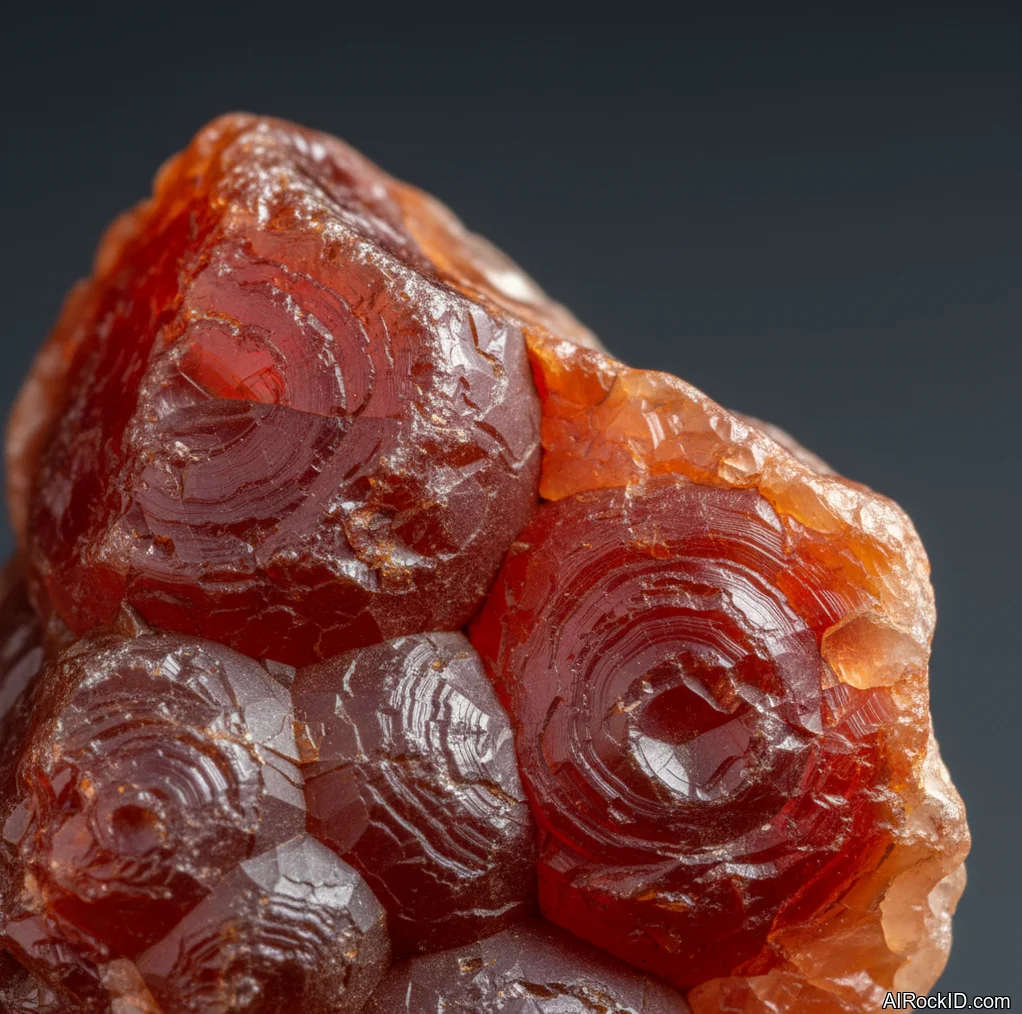
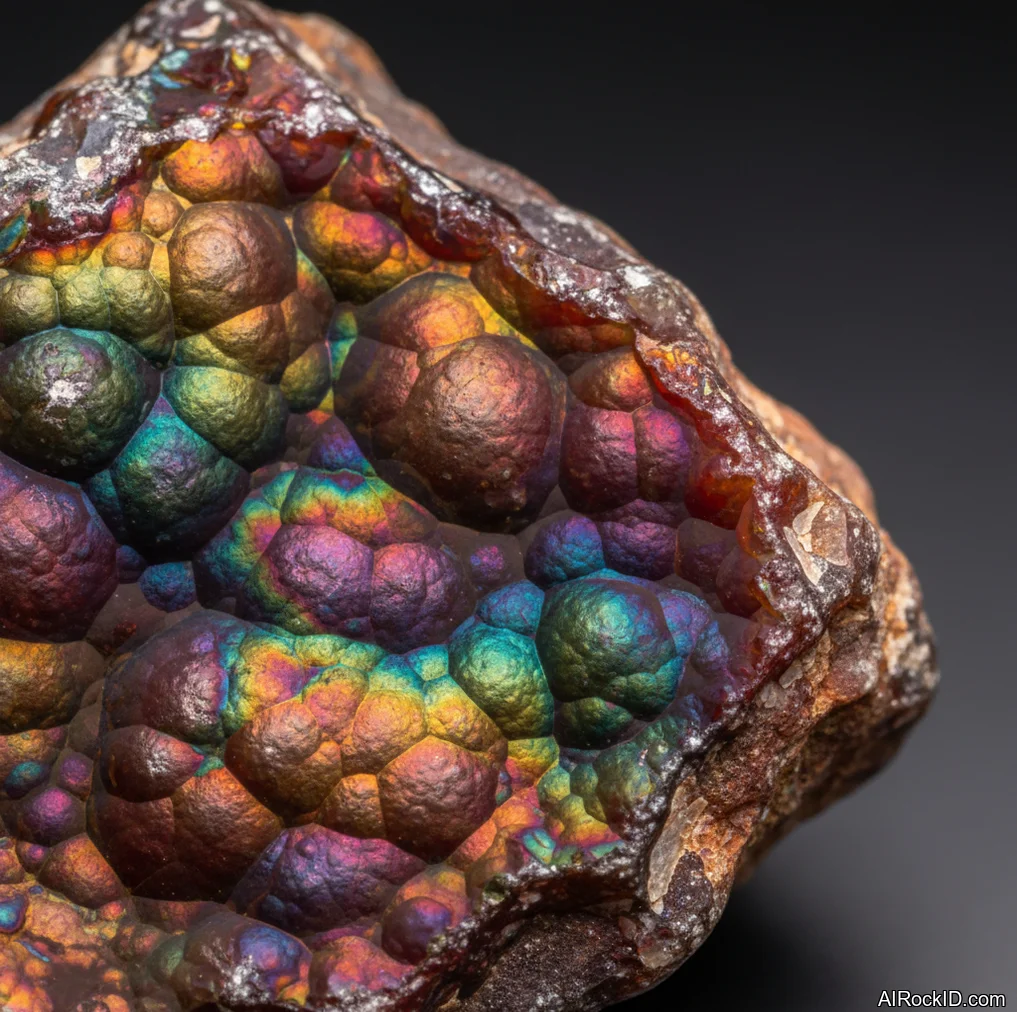
Fire agate is a type of chalcedony (microcrystalline quartz) with an iridescent play-of-color that comes from thin iron-oxide layers inside botryoidal agate.
Pick up a decent piece and the shape hits you first. It’s almost never a tidy little crystal. Most fire agate shows up as knobby, bubbly botryoidal lumps, like dried foam that got turned into stone, and the best color stays tucked away until you tilt it under a hard point light.
At first it can look plain, even kind of muddy brown. Then you rotate it a few degrees and this sheet of coppery red or green flicks on, then vanishes again. That on-and-off flash is basically the whole point with fire agate, so I always check pieces under a phone flashlight right there at the counter (you’d be surprised how many “good” ones go dead in soft light).
Origin & History
Fire agate didn’t get named because it came out of a volcano or anything like that. It’s called “fire” because the surface can flash that flame-looking iridescence when you tilt it under a light, the way it sort of pops and then disappears again.
The “agate” part is legit, though, since it’s chalcedony. But the actual color show comes from iron oxide layers, usually goethite or limonite, stacked in there and causing thin-film interference (thin enough that a slight change in angle changes everything).
As a trade name, you start seeing it in the Southwest gem scene in the 1900s, and material from Mexico and Arizona is what built the reputation. And you’ll still hear the old-timers at shows talk about certain parcels like “Deer Creek fire” or “Aguascalientes fire,” like it’s a flavor note. Thing is, the locality vibe really does matter.
Where Is Fire Agate Found?
Most classic fire agate comes from the desert Southwest, especially Arizona and northern to central Mexico. Smaller occurrences exist elsewhere, but the market is built on those two regions.
Formation
Picture cool, low-temp silica drifting through groundwater, sneaking into tiny cracks, lining open pockets, and leaving a slick coating on whatever it touches. Fire agate happens when silica gel or other silica-rich fluids drop chalcedony into cavities and fractures, usually in volcanic rocks like rhyolite or basalt.
The “fire” kicks in later, when iron-bearing fluids slip in and lay down insanely thin, stacked films of iron oxides between stages of chalcedony growth. Those films aren’t perfectly flat either. They get wrinkled and lumpy, so the color shows up in patches, swirls, and little window-like spots instead of one smooth sheet. And since the stuff grows botryoidal, that color layer can sit just under a bumpy skin you can feel with a fingernail (kind of like tiny grape-bumps). So cutters go slow and grind with a light touch, trying to land on the sweet spot without sanding the fire right off.
How to Identify Fire Agate
Color: Body color is usually brown to reddish-brown chalcedony with iridescent flashes of red, orange, gold, green, and sometimes blue. The play-of-color tends to look like metallic film rather than opal’s broad spectral patches.
Luster: Polished surfaces are vitreous to waxy, with a metallic-looking flash where the iridescence hits.
Look closely for a botryoidal texture on rough pieces, even if it’s been partly smoothed. The real test is rotation under a single strong light source, since the fire switches on at specific angles and then drops out fast. Cheap versions can be dyed agate or coated glass, and they often look too uniformly colorful from every angle and feel a little warm compared to quartz when you first touch them.
Properties of Fire Agate
Physical Properties
| Crystal System | Trigonal |
| Hardness (Mohs) | 6.5-7 (Hard (6-7.5)) |
| Density | 2.58-2.64 g/cm3 |
| Luster | Waxy |
| Diaphaneity | Translucent to opaque |
| Fracture | Conchoidal |
| Streak | White |
| Magnetism | Non-magnetic |
| Colors | brown, reddish-brown, orange, red, gold, green, blue |
Chemical Properties
| Classification | Silicates |
| Formula | SiO2 |
| Elements | Si, O |
| Common Impurities | Fe, Al, Mn |
Optical Properties
| Refractive Index | 1.530-1.540 |
| Birefringence | None |
| Pleochroism | None |
| Optical Character | Uniaxial |
Fire Agate Health & Safety
Fire agate is non-toxic, so it’s safe to handle. But it’s still a silica-based stone, and that matters if you’re cutting or grinding it. Don’t breathe in the dust. (That fine, powdery stuff that ends up on your fingers and settles on the bench.) Why risk your lungs?
Safety Tips
Use water and make sure there’s real airflow when you’re doing lapidary work, and put on a respirator that’s rated for fine particulates (the kind of dust that hangs in the air and gets in your throat if you don’t).
Fire Agate Value & Price
Price Range
Rough/Tumbled: $10 - $300 per piece
Cut/Polished: $5 - $80 per carat
Price can swing a lot depending on the viewing angle fire, how much of the stone actually shows color, and how neatly the cutter opened up the color layer. If you’ve ever tilted one under a lamp and watched it “turn on,” you get it. Big, clean “dragon skin” patterns where red and green show up together usually cost more than those small, spotty little windows.
Durability
Durable — Scratch resistance: Good, Toughness: Good
It’s stable quartz, so normal light and air won’t bother it, but the polished surface can pick up scratches if it rides loose with harder stones.
How to Care for Fire Agate
Use & Storage
Store it in a soft pouch or a compartmented box so the polish doesn’t get scuffed. And don’t toss it in with corundum or diamond jewelry.
Cleaning
1) Rinse with lukewarm water. 2) Use mild soap and a soft toothbrush to get into pits and botryoidal texture. 3) Rinse again and pat dry with a microfiber cloth.
Cleanse & Charge
For a simple reset, rinse and dry it, then leave it somewhere dark for a night so the surface doesn’t get dusty or sun-faded. If you use smoke or sound, keep it gentle and avoid heating the stone.
Placement
Pick a spot where you can hit it with a directional lamp, since the fire needs angle to show. On a shelf, a small puck light makes it look way better than diffuse room lighting.
Caution
Skip ultrasonic cleaners if the piece is full of little pits or has natural fractures, because that buzzing vibration can shove grit down into those hairline openings. And don’t reach for harsh acids or bleach.
Works Well With
Fire Agate Meaning & Healing Properties
In the metaphysical scene, fire agate tends to get talked about like a “keep your footing” stone, but with a little bite to it too. I get the appeal. When I’ve got a polished cab in my pocket, it looks steady and warm, like you’re staring at embers trapped under a crust, and it’s hard not to read that as grounding with some push behind it.
But it’s also kind of a fussy stone. The color doesn’t just show up on command. You have to meet it halfway with the right light and the right angle, and half the time you’re tilting it like you’re trying to catch glare off a phone screen. So I connect it more with focus and patience than with nonstop high energy. If you’re using it for meditation or as a touchstone, it does better as something you actually handle, roll around, and turn over in your fingers, not something you set on a shelf and forget about.
And none of this is medical. I’m not treating it like a cure for anything. I treat it like a reminder tool, plain and simple. Thing is, in a collection it’s one of those stones I’ll hand to someone who thinks all agate is “just brown,” and then I just watch their face change the second the fire finally catches.
Identify Any Crystal Instantly
Snap a photo and get properties, value, care instructions, and healing meanings in seconds.