Garnet In Staurolite
What Is Garnet In Staurolite?
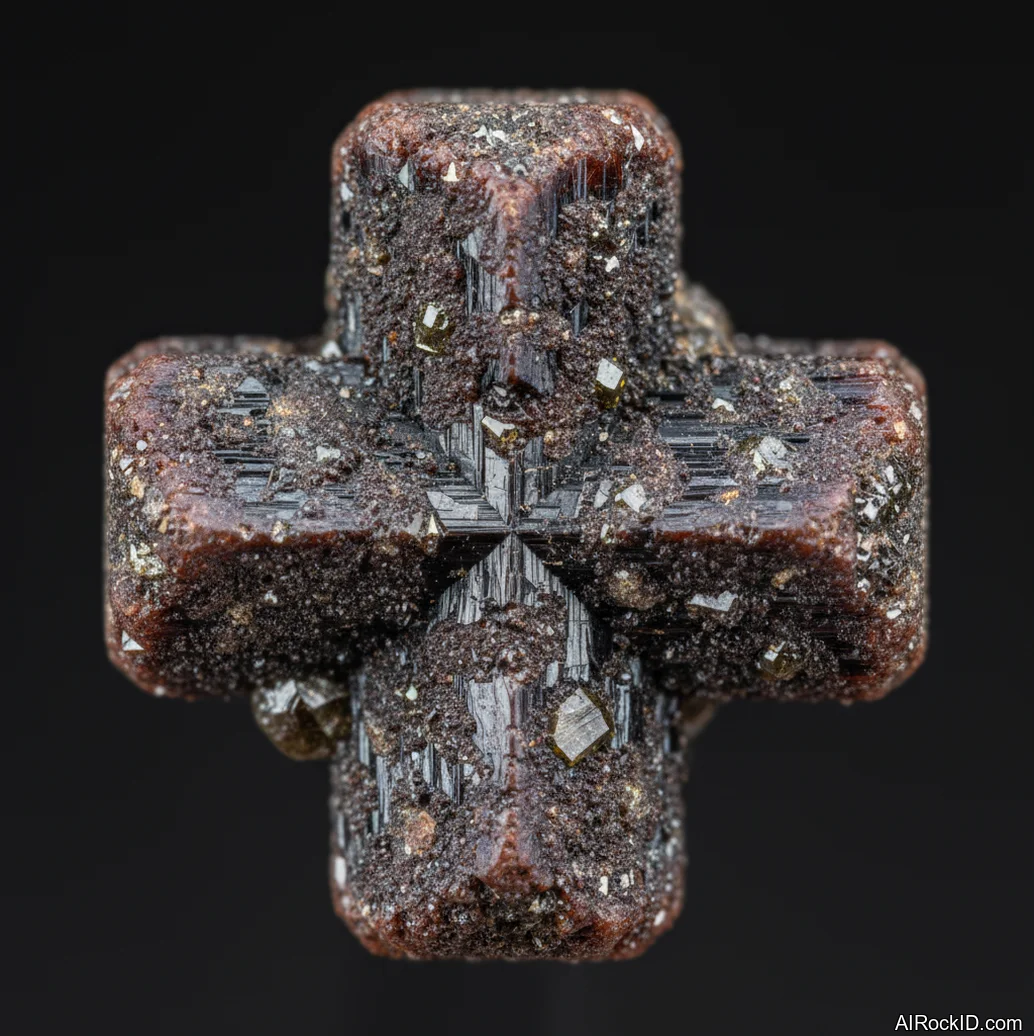
Garnet in staurolite is a natural metamorphic mineral pairing where almandine garnet crystals sit embedded in staurolite.
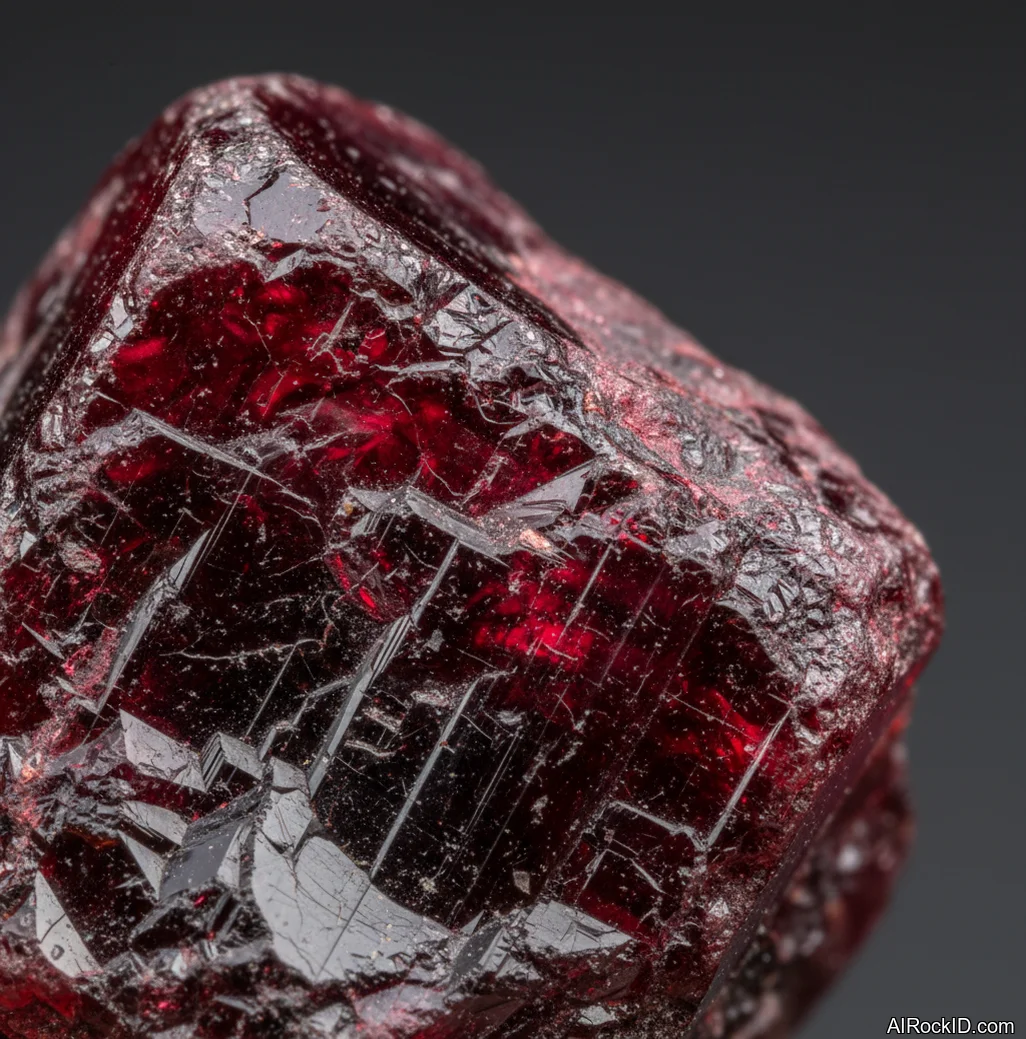
Grab a solid hand specimen and you feel it immediately. Staurolite has this gritty, dry drag to it, kind of like a tough ceramic that’s been left unglazed, and then the garnets show up as little hard bumps under your fingertips. Roll the piece under a lamp and they catch the light in a different way than the matrix does, almost like tiny mirrors compared to the duller host. Some chunks look kind of flat in a photo, but in person they wake up because the garnets throw a wine-red glint off small crystal faces (you’ll see it most when you tilt it just a few degrees).
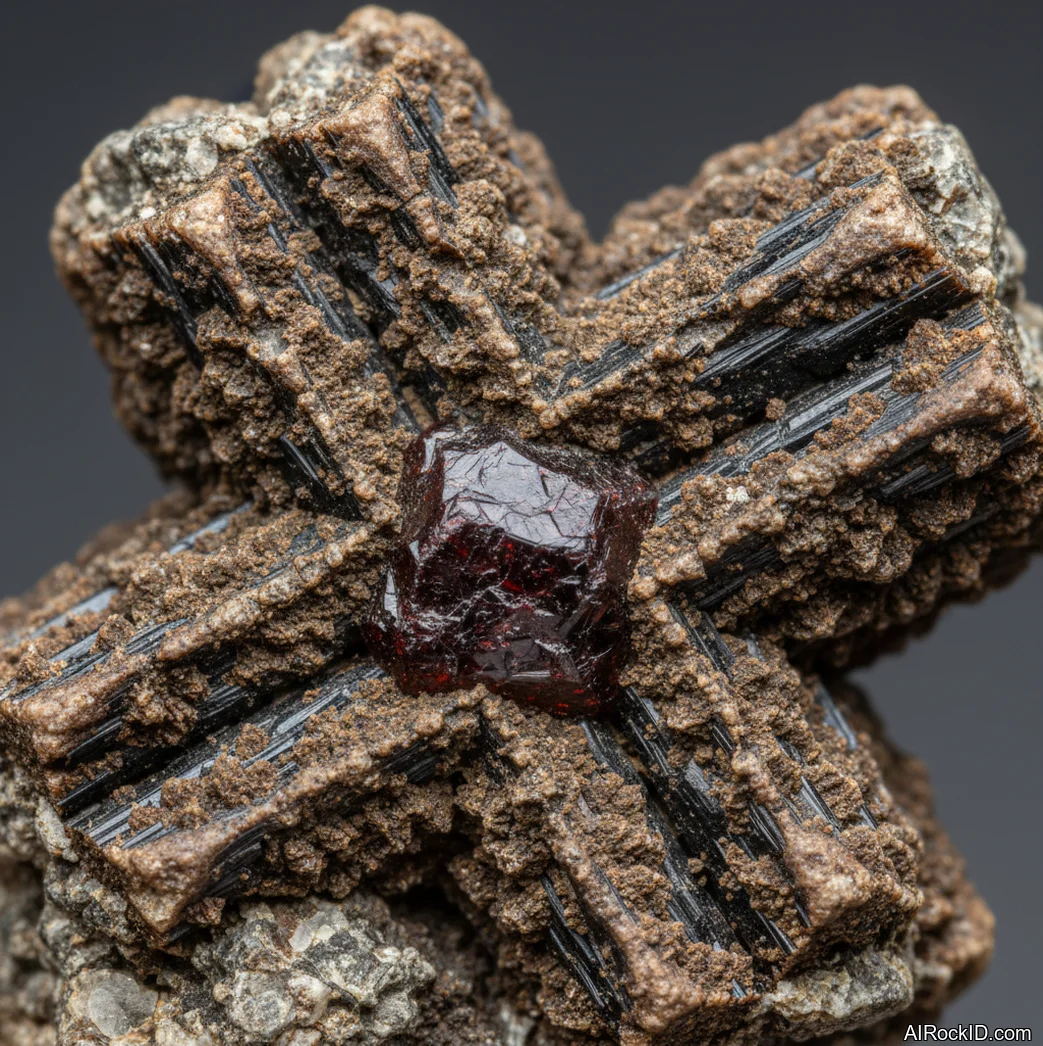
Most of what’s out there for sale is matrix material, not “gemmy” anything. But that’s not the point, honestly. The appeal is the contrast: rusty brown staurolite, then those darker red dodecahedrons peeking out like they’re trying to shove their way through the rock.
Origin & History
Staurolite got its formal write-up in 1792, thanks to Jean-Claude Delamétherie. The name’s straight out of Greek for “cross,” which makes sense the second you’ve held a good specimen: the crystals twin, hit each other at set angles, and you end up staring at these tiny cross shapes (like someone stuck two brown blades together).
Garnet, as a whole mineral group, has been known and used since antiquity. But “garnet in staurolite” isn’t some separate species hiding in the books. It’s really just collector and dealer talk, a handy label for pieces where you’ve got staurolite and you can also see garnet in the mix.
Look, if you dig through older collections, you’ll run into tags like “with garnets” or “garnetiferous staurolite schist.” Same thing, different handwriting (usually on those yellowed little paper labels). And the fun historical angle? In parts of Europe and the southeastern US, people carried staurolite crosses as charms. So the matrix pieces where the red garnet grains really pop against the darker rock, those were the ones that tended to get pocketed first. Who wouldn’t grab the flashiest one?
Where Is Garnet In Staurolite Found?
It shows up in medium- to high-grade metamorphic terrains, especially schists and gneisses. Dealers most often source similar-looking material from Brazil and the USA, with classic staurolite terrains also in parts of Europe and Russia.
Formation
Think mountain-building. Think pressure. And time that just won’t quit. Garnet and staurolite both grow during regional metamorphism, when clay-rich sediments get cooked into schist. As temperature and pressure climb, the minerals reorganize and new ones nucleate, so you can end up with staurolite crystals growing alongside (or later over) garnet in the same rock.
Look, if you’ve ever snapped one of these rocks and stared at the fresh break, you’ll see it right away. That “porphyroblast” look. Big, chunky crystals sitting in a much finer-grained matrix, sometimes with a slightly gritty feel where the mica-rich parts catch your fingertip. Garnets tend to form earlier across a range of metamorphic grades, but staurolite likes a pretty specific window in the middle grades. So where those conditions overlap, you get the combo, especially in staurolite schist that had enough iron and aluminum to feed both minerals. Why wouldn’t they both show up if the chemistry’s there?
How to Identify Garnet In Staurolite
Color: Staurolite is usually brown to dark brown, sometimes with a rusty or chocolate tone, while the garnet is typically deep red to reddish brown (often almandine). On fresh breaks, the garnet can look almost black until you catch a highlight.
Luster: Staurolite is dull to resinous, while garnet is vitreous on clean crystal faces.
Pick up the specimen and drag a fingernail across it. The staurolite feels slightly rough, but the garnet spots feel slicker and harder. If you scratch it with a steel nail, staurolite will resist pretty well, and the garnet should laugh it off, but don’t gouge up a display piece just to prove a point. The real test is a hand lens: garnet shows little geometric faces (often dodecahedral), while staurolite looks more blocky and granular with no glassy cleavage flash.
Properties of Garnet In Staurolite
Physical Properties
| Crystal System | Orthorhombic |
| Hardness (Mohs) | 7-7.5 (garnet) and 7-7.5 (staurolite) (Hard (6-7.5)) |
| Density | 3.65-4.30 g/cm3 |
| Luster | Resinous |
| Diaphaneity | Opaque |
| Fracture | Uneven |
| Streak | white to gray (staurolite); white (garnet) |
| Magnetism | Non-magnetic |
| Colors | brown, dark brown, rust, red, reddish brown, blackish red |
Chemical Properties
| Classification | Silicates |
| Formula | Staurolite: (Fe,Mg)2Al9Si4O23(OH); Garnet (almandine endmember): Fe3Al2(SiO4)3 |
| Elements | Fe, Mg, Al, Si, O, H |
| Common Impurities | Mn, Ti, Zn |
Optical Properties
| Refractive Index | Staurolite: 1.739-1.747; Almandine garnet: 1.760-1.830 |
| Birefringence | Staurolite: 0.008-0.010; Garnet: None |
| Pleochroism | Moderate |
| Optical Character | Biaxial |
Garnet In Staurolite Health & Safety
It’s fine to pick up and keep on a shelf, and a quick splash of water won’t do anything to it. But if you start sawing or grinding it, that’s when you’ve got to worry about the gritty rock dust getting in the air (and all over your hands).
Safety Tips
If you’re going to cut or shape it, put on a respirator. And use wet methods so the dust stays down (a little water goes a long way).
Garnet In Staurolite Value & Price
Price Range
Rough/Tumbled: $15 - $120 per specimen
Price mostly comes down to how easy it is to spot the garnets and how cleanly they’re formed, plus whether you’ve got actual staurolite crystals or proper cross twins instead of that plain brown schist that just looks muddy. Bigger chunks aren’t hard to find. But when the big ones have sharp, crisp garnet faces you can catch with your fingernail along the edges (that little clicky feel), they jump in price fast.
Durability
Durable — Scratch resistance: Excellent, Toughness: Good
It’s stable in normal home conditions, but edges can chip if the specimen has lots of thin schist layers or fractured garnets.
How to Care for Garnet In Staurolite
Use & Storage
Store it so the garnet-bearing faces don’t rub against harder minerals in a box. I wrap mine in a little paper towel because garnet will scratch a lot of stuff, and staurolite corners can chip.
Cleaning
1) Rinse under lukewarm water to remove grit. 2) Use a soft toothbrush with a drop of mild soap to scrub crevices. 3) Rinse well and air-dry completely before putting it back on a shelf.
Cleanse & Charge
If you do energy-style care, stick to smoke, sound, or moonlight. Avoid salt soaks since salt crystals love to lodge in the staurolite’s tiny pits.
Placement
A spot with side lighting works best so the garnet faces flash when you walk by. Keep it off a windowsill if you’ve got temperature swings, because micro-fractures in the matrix can open up over time.
Caution
Don’t put it in an ultrasonic cleaner if it’s fractured or schistose, and don’t let it clack against other specimens. Even at Mohs 7 plus, one sharp hit can knock a garnet right out or chip the matrix (it happens fast).
Works Well With
Garnet In Staurolite Meaning & Healing Properties
“Grounding” is the first word people throw at this combo, and honestly, I see it. Staurolite feels like a brick of earth. Garnet adds this slow, steady warmth. When I’m sorting flats after a show, I’ll keep a chunky piece right next to me because it stops my brain from pinging all over the place. It’s not some dainty little vibe. It has weight. You feel it in your palm.
If you like meditation tools, I’d file this under practical, not floaty. It works best with routines: journaling, planning, pulling yourself back in line after you’ve been drifting, that kind of thing. But look, here’s the catch. A lot of these pieces look like plain old ugly rocks until you learn how to see them, and if you’re expecting bright red “gem” energy, you might walk away disappointed (some garnets are just little dark bumps in the matrix, not a sparkly centerpiece).
And yeah, none of this is medical advice. I treat the metaphysical stuff as my own ritual layer on top of the geology. The geology doesn’t care either way: you’re holding two tough metamorphic minerals that formed under serious heat and pressure, then took a beating from erosion long enough to end up in your hand. Pretty wild, right?
Identify Any Crystal Instantly
Snap a photo and get properties, value, care instructions, and healing meanings in seconds.