Garnet In Wollastonite
What Is Garnet In Wollastonite?
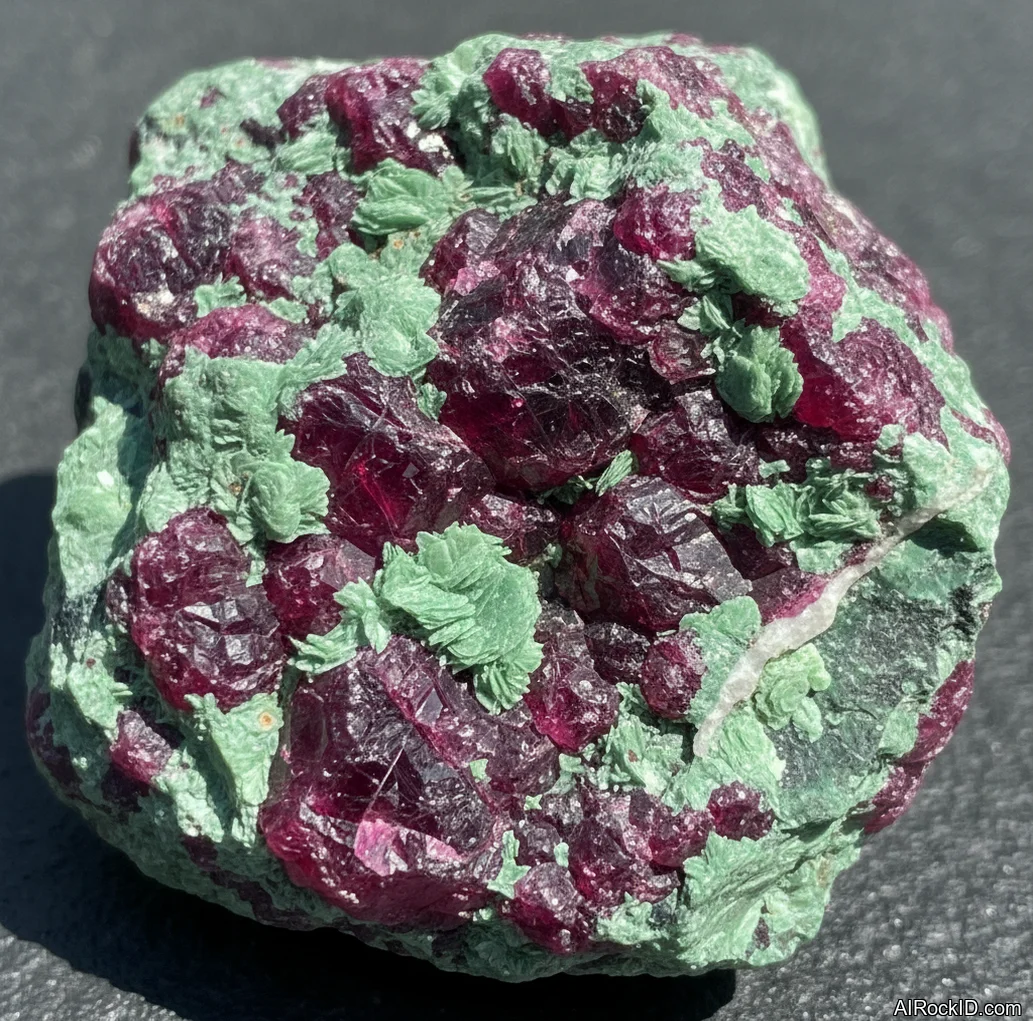
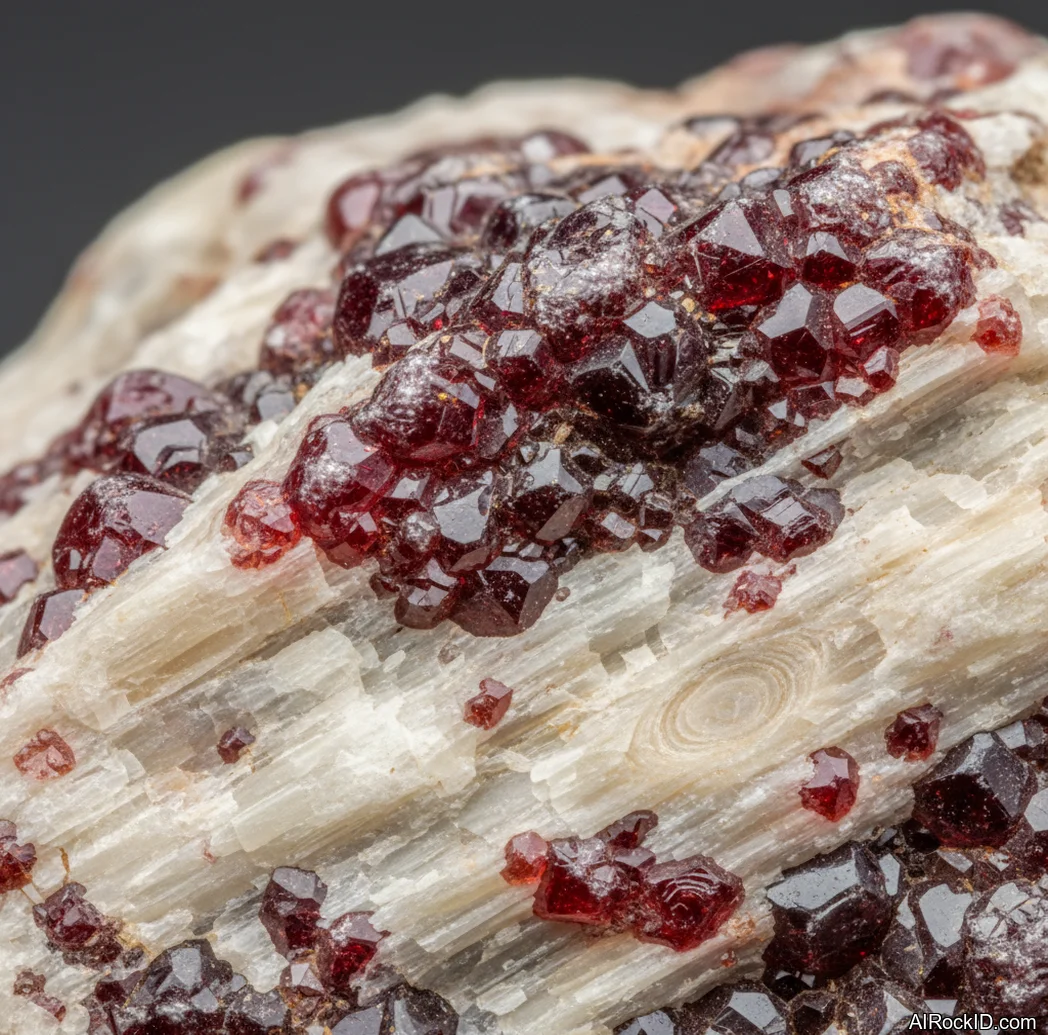
Garnet in wollastonite is a natural rock where red to brown garnet crystals sit locked into a white to gray wollastonite matrix.
Grab a chunk and the contrast hits you first. The garnets look like tiny button dots, sometimes like rounded dodecahedrons, sitting in this pale, almost sugary-looking background. And the feel gives it away fast: those garnet bumps are glassy-smooth under your fingertip, but the wollastonite around them feels drier, a little fibrous, kind of like very fine-grit sandpaper (especially along the lighter streaks).
People glance at it and call it “ruby in marble,” but that’s not what it is. Most of what’s sold as garnet in wollastonite is more of a lapidary mix than a collector crystal specimen, since the wollastonite in these pieces usually doesn’t show up as crisp, sharp blades. But when the garnets are nicely formed and spaced out, it still makes a killer display slab, or a palm stone you keep picking up without thinking.
Origin & History
Wollastonite got its official write-up in 1818, and it was named after the English chemist and mineralogist William Hyde Wollaston. “Garnet,” on the other hand, is an older group name, pulled from the Latin *granatum*, a nod to pomegranate seeds. And yeah, that comparison tracks because good red garnets sitting in pale rock really do look like little seeds scattered through it.
Thing is, “garnet in wollastonite” isn’t a formal species name. It’s more of a trade and collector label. Most dealers use it for calc-silicate skarn or metamorphosed limestone where garnet grew right alongside wollastonite during contact metamorphism. The first time I ran into it at a show, it was tossed in the same bins as “garnet in marble” and “ruby in zoisite,” so you should expect a bit of label slippage (it happens).
Where Is Garnet In Wollastonite Found?
It turns up in calc-silicate skarns and metamorphosed limestones worldwide, with market material commonly coming from Brazil, Russia, and parts of the western USA.
Formation
Look at the geology and it clicks pretty fast. Wollastonite (a calcium silicate) shows up when limestone or other calcium-rich rocks get cooked by heat and reactive fluids, usually right near an intrusive body. Get silica in there too and, yep, you’re in wollastonite territory.
Now, mix in aluminum plus a bit of iron and garnet can grow right alongside it. That’s why you’ll sometimes see garnet crystals sitting in a pale matrix that has that baked, contact-metamorphism look to it (kind of like it’s been toasted). But here’s the catch: that same material can grade from clean, white wollastonite with just a few garnets sprinkled in to darker, messier skarn with a bunch of other stuff mixed in. And if the seller cherry-picked, you’ll end up with the pretty end of that range.
How to Identify Garnet In Wollastonite
Color: Most pieces show brick-red to deep reddish-brown garnets in a white, off-white, or light gray wollastonite matrix. Some matrix looks slightly greenish-gray if other skarn minerals are present.
Luster: Garnet is typically vitreous, while wollastonite runs vitreous to silky on fibrous areas.
Pick up the stone and run your thumb across it. You can usually feel the garnet crystals as harder, smoother bumps against the chalkier or faintly fibrous wollastonite. If you scratch an inconspicuous spot with a steel nail, the wollastonite may mark or scratch, but the garnet won’t. The real test is a hand lens: garnet often shows rounded dodecahedral faces, while wollastonite looks like fine blades or a sugary mass rather than clean cleavage blocks.
Properties of Garnet In Wollastonite
Physical Properties
| Crystal System | Monoclinic |
| Hardness (Mohs) | 4.5–7.5 (Medium (4-6)) |
| Density | 2.85–3.65 g/cm3 |
| Luster | Vitreous |
| Diaphaneity | Opaque |
| Fracture | Uneven |
| Streak | white |
| Magnetism | Non-magnetic |
| Colors | white, gray, red, reddish-brown, brown |
Chemical Properties
| Classification | Silicates |
| Formula | CaSiO3 + X3Y2(SiO4)3 (garnet group; commonly Ca3Al2(SiO4)3 to Ca3Fe2(SiO4)3) |
| Elements | Ca, Si, O, Al, Fe |
| Common Impurities | Mn, Mg, Ti |
Optical Properties
| Refractive Index | 1.63–1.89 |
| Birefringence | 0.010–0.015 |
| Pleochroism | None |
| Optical Character | Biaxial |
Garnet In Wollastonite Health & Safety
It’s safe to handle and put on display, and typical specimens don’t come with any special toxicity worries. But it’s still a rock, so if you’re cutting it on a saw or sanding it down (and you can smell that gritty dust in the air), don’t breathe the dust in.
Safety Tips
If you’re going to shape this stuff, put on a respirator first. And keep a little water on it while you work so the dust doesn’t go flying everywhere. Then wash your hands when you’re done.
Garnet In Wollastonite Value & Price
Price Range
Rough/Tumbled: $10 - $120 per piece
Price swings based on a few really obvious things once you’ve actually had the material in your hands. How clean and white the wollastonite looks (some pieces are bright, almost chalky white, and others come off a bit gray), how red and well-formed the garnets are, and whether you’re buying a chunky display piece you can set on a shelf or just small tumbled material.
Durability
Moderate — Scratch resistance: Fair, Toughness: Fair
It’s generally stable, but the softer wollastonite matrix can scuff and undercut in jewelry-style wear even when the garnet itself is tough.
How to Care for Garnet In Wollastonite
Use & Storage
Store it so the softer matrix isn’t rubbing against harder stones. I keep mine in a tray with little dividers because the wollastonite can pick up scuffs fast.
Cleaning
1) Rinse briefly under lukewarm water. 2) Use a soft toothbrush with a drop of mild soap to clean around garnet bumps. 3) Rinse again and pat dry, then let it air-dry fully before putting it away.
Cleanse & Charge
If you do ritual-style cleansing, stick to smoke, sound, or a quick rinse and dry. Long salt soaks can be rough on porous matrix surfaces even when the minerals themselves are fine.
Placement
Look closely at your lighting. Side light brings out the garnet relief and makes the white matrix look less flat on a shelf.
Caution
Don’t assume the hardness is even across the whole thing. Garnet will take a nice polish, sure, but the wollastonite’s the weak link. It can undercut, the edges can chip, and if you carry it in your pocket it’ll start looking scuffed and worn fast (especially along the sharper corners).
Works Well With
Garnet In Wollastonite Meaning & Healing Properties
Compared to plain garnet, this mix gets described more like “energy with a brake pedal.” That’s the vibe people mean. You’ve got garnet, which a lot of folks link with drive and getting your body moving, and then there’s that pale calcium-silicate matrix that comes off calmer, steadier, more grounded.
Hold a polished palm stone and you’ll notice it right away: the surface isn’t uniform. Your thumb slides along smooth matrix, then catches on a garnet spot that’s a little firmer and subtly raised. I’ve seen people in a tense conversation rub those tiny bumps without even realizing they’re doing it, like a worry stone that actually gives your hand something to do. That’s the real-life use I see most. Not big promises.
But look, keep it honest. Any “healing” talk here is personal and traditional, not medical care. If you like stones as reminders, this one’s a solid pairing for staying steady while you push through a task (especially when you’re tempted to floor it and burn out).
Identify Any Crystal Instantly
Snap a photo and get properties, value, care instructions, and healing meanings in seconds.